





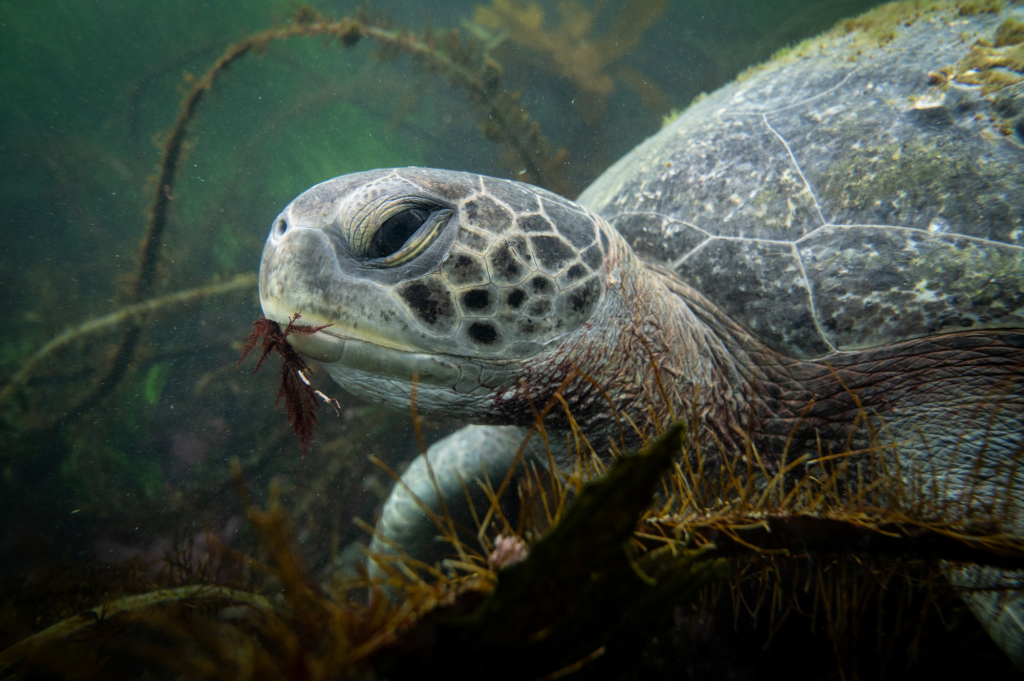
A friend told Tracy Tempest that there were green sea turtles in the bay.
“I looked for a long time, but couldn’t find them. When I found them, I just became fascinated with them,” says Tempest, a community scientist who works with local National Oceanic and Atmospheric Administration scientists to monitor the turtles. “It became important to me to, one, encourage boats to slow down and to protect the turtles and other species, like the migratory birds that are here in the water; and two, to share it with others because it’s a beautiful place to go out and kayak, and just be around nature.”
Read more BNSF announces $10,000 reward related to San Diego train derailment
These reptiles are in San Diego year-round, but summer is the best time of year to see them because of the warmer temperatures they prefer. They can grow up to 4 feet and weigh as much as 400 pounds, according to the U.S. Fish & Wildlife Service, and the Sea Turtle Conservancy notes that they’re the second-largest sea turtle, and they’re herbivores, munching on a diet of seagrass and eelgrass in temperate and tropical waters. Thanks to global conservation efforts, they’ve been reclassified by the International Union for Conservation of Nature and Natural Resources from “endangered” to “least concern” because of their increasing population. Locally, they’ve been spotted at the San Diego Bay National Wildlife Refuge’s South San Diego Bay unit and its Sweetwater Marsh unit.
Before Tempest began monitoring the sea turtles in 2020 — work that has been recognized with the Emerald Keeper of the Month and the Environmental Hero Award for Water in 2022 and 2025 — she says she retired from “all kinds of stuff,” to include careers as a tennis pro, teacher, real estate insurance, manager for the La Jolla Beach & Tennis Club, building houses as a supervisor for Habitat for Humanity, and volunteering at the Helen Woodward Animal Center and Cabrillo National Monument. On Saturday, she joins Anna Cahill, a lab technician with the Marine Turtle Ecology and Assessment Program at NOAA’s Southwest Fisheries Science Center in La Jolla, for “Sea Turtle Science Talk: The Green Turtles of San Diego’s South Bay & How to Be a Citizen Scientist” at 10 a.m. in the visitor center training room of the Tijuana River National Estuarine Research Reserve in Imperial Beach. Tempest took some time to talk about the green sea turtles, some of their history in San Diego, and their place in the ecosystem. (This interview has been edited for length and clarity.
You’re a community scientist who’s worked with local NOAA scientists to study these green sea turtles. First, what is a community scientist?
Basically, becoming a community scientist is just being willing to observe and share what you see with scientists who are able to collect that data and then use that data to help with their management system and conservation of a species. It could be a protected species like a turtle, or you could just be letting someone know you saw a certain kind of bird in your environment, and someone’s out there who’s interested in that.
How long have you been a community scientist and how were you introduced to this work?
I became a community scientist in 2015, but at that time I was just observing the turtles year-round, knowing the different times a year where they were, and then sharing it with neighbors. People would say, “I hear there are turtles out there,” and nobody believed it. Once I found them — after saying exactly the same thing, that I didn’t believe it, or no they’re not — I started going out with neighbors and sharing the information with them. About five years later, a neighbor contacted NOAA and told them they needed to know about me and my sightings. I guess that’s how I officially became a community scientist because I was then giving data to the scientists.
Originally, you use a QR code or a link, and there’s a questionnaire where anybody can cite any species of turtle from a sighting, primarily on the West Coast. You complete their questionnaire, and that becomes data for the scientists to know how often they’re seen here. My real connection came in 2020 when I became quote-unquote “invaluable” to them because NOAA was not permitted to be on the water due to COVID. So, I became their eyes on the water.
” ]
How would you describe San Diego’s green sea turtles? What role do they play in our local environment?
Basically, they’re very important to an ecosystem. First of all, they come from Mexico. They’re born in Mexico, about 1,600 miles from here. Then, they might come into our bay from about age 3 to 5 (years old). Down here in the South Bay, there is a just large amount of seagrass, or eel grass, which is their main diet because they’re herbivores, unlike many sea turtles. So, they’re here just getting fat, getting their energy, growing up until they’re probably about 20, and then they start migrating back to Mexico; maybe every couple of years for a male, and maybe every three years for females, so they can give birth on the same beach they were born on. Then, they come back and get fat and get energy again to make these long migrations.
Read more Pet of the week: Attention-loving kitty seeks adoption
A fascinating part is that they’re really great sentinels for the ecosystem and health of the bay. Instead of seeing emaciated and sad turtles, we see very healthy, fat turtles, so we know that this foraging area, and others in Southern California, are healthy ecosystems. They also have a unique digestive system, and when they eat the algae and the seagrass, it goes through their body very fast, so they’re able to poop it out fast, in hours or days. That enables the other animal species living in this environment to get access to food that would have taken them weeks to get from the eel grass. (According to the Coral Reef Alliance, a nonprofit that works to protect coral reefs, these turtles also excrete nutrient-rich waste because of their diets, which supplies nutrients to nearby coral reefs, aiding in the growth and development of these invertebrates.)
Lastly, they’re really good about eating the food here, and then using it to go south for their reproductive migration, mating, egg laying. They’re known as sort of the regulators and the engineers of an ecosystem, and they are good at it.
What is some of the history of these local turtles?
They’ve been around in the bay pretty much forever, but they were really studied and first seen by the (South Bay) power plant that used to be over in Chula Vista. They were seen from, say, 1960 to when it was decommissioned in 2010. At that time, there were believed to be about 60 turtles. Then, there was a major study by a lady named Marjorie Stinson, who was with San Diego State University, and she wrote a thesis that studied the turtles in the bay. (Marjorie “Margie” Stinson first studied the turtles in the 1970s as part of her graduate research, according to the Scripps Institution of Oceanography at UC San Diego.) Then, in about 1990 some of the NOAA scientists got involved with studying them, so they’ve been here, but they’re increasing; we’re up to probably 150 to 200 that forage in this area year-round.
What has that process been like to get their numbers up?
A lot of it has been protecting the nests in Mexico and helping with the threats. The threats to turtles can be the nets that fishermen use, so there’s helping the fishermen develop nets where the turtles don’t become bycatch, which means unintended capture. Or, hooks, or degradation of a nesting environment can also be threats. Now, since the numbers are increasing in our bay, the greater the chance vessel strikes them, or of a boat hitting them. So, but it’s protection and just working all ends of it—working with the fishermen, protecting the nests on the beach from people taking the eggs, or from dogs or raccoons getting them. Just protecting them, in general.
What can you tell us about the research you’ve been part of? What’s been the motivation for the research, and what have you learned as a result?
That’s pretty much a science question for the NOAA, but I’ll tell you as much as I can. There’s research going on all the time; for example, they’re looking at the number of females versus males, which is very important in terms of management and protecting this species, or any species. With climate change the way it is, it can affect the turtles substantially. When they lay their eggs, there’s no sex. They’re sex indeterminate, so depending on the temperature of the sand within the second-third of their incubation, whatever the temperature of that sand is determines the sex of all the eggs. (According to the National Ocean Service, the green sea turtles’ temperature-dependent sex determination dictates that if a turtle’s eggs incubate below 81.86 degrees Fahrenheit, the hatchlings will be male; if the temperature is above 88.8 degrees, the hatchlings will be female. If temperatures are between those numbers, there will be a mix of female and male babies. With rising temperatures due to climate change, this could lead to skewed and dangerous incubation conditions.) That’s one of the things they study because, obviously, if there are no males in the future, that’s a problem.
They also study how many turtles are living in the San Diego Bay, and that can be done based on capturing, and then a mathematical formula for whether they’re new, meaning they have never been tagged before, or they’re ones that have been recaptured. They can also look at drone footage counting how many turtles are seen in a drone sighting.
They also they put satellite transmitters on some turtles, and that enables scientists to know their migration routes within the bay, and possibly as far as to Mexico. That helps in terms of the management of the bay, of boat passage. They also put a CATS (Customized Animal Tracking Solutions) camera on a turtle periodically, and that can show the amount of eel grass the turtle’s eating. It’s also starting to reveal that turtles aren’t quite as solitary as everybody thought; they’re seeing some interactions, turtle-to-turtle. I think that’s a pretty good idea of what they do.
Where can people see these turtles?
The best place to see them is the Chula Vista Marina (and La Jolla Cove and the Safe Harbor Sunroad Resort & Marina, based on a blog post from San Diego Coastkeeper). They like the warmer water in the summer because there’s the abundance of the eelgrass. They tend to be in the middle of the bay, but you can see them anywhere. I’ve seen them from the Living Coast Discovery Center and the aquatic center over in Coronado. They can also be seen down by the Navy ships and down by Seaport Village, but not nearly the numbers you’re going to see in the South Bay in the refuge.
Read more After the fall: Fletcher announces he has moved from San Diego to parts unsaid