







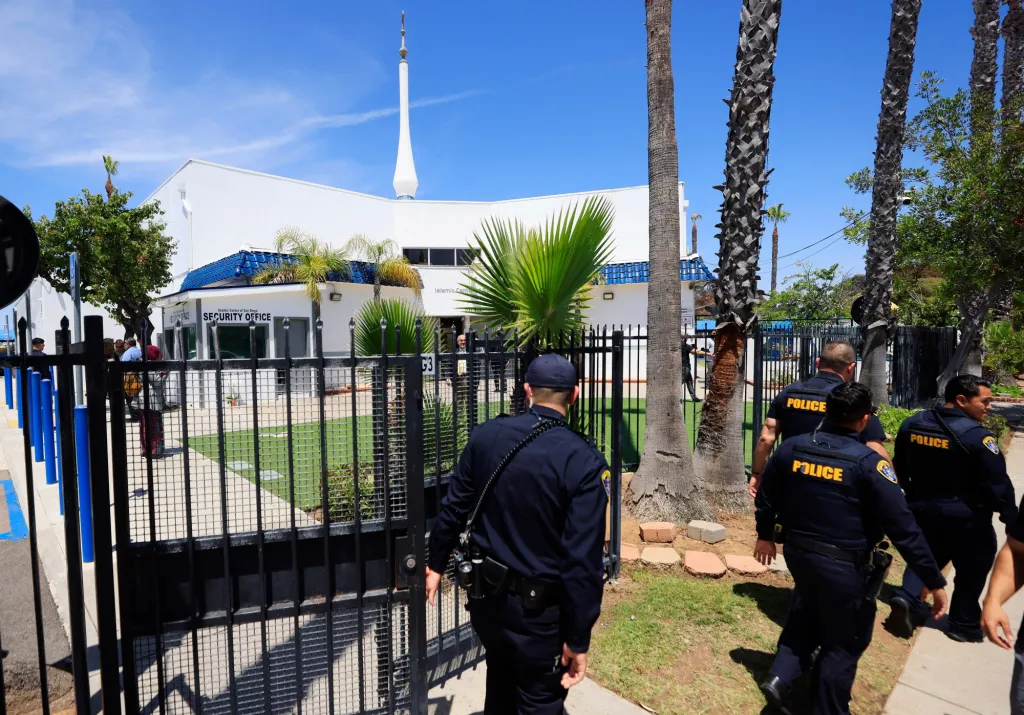
As San Diego police came to realize a runaway teen — possibly armed, suicidal and exposed to online hate speech — posed a potential public safety threat last month, the search for the teen and his friend quickly intensified.
Read more Mourners bury a 6-month-old Ebola victim, marking third orphanage death as Congo outbreak spreads
Within little more than an hour following that revelation, the teens killed three men at a Clairemont mosque before they were themselves found dead a few blocks away. But in those last still-hopeful minutes before 911 calls came in reporting the deadly attack, San Diego police activated two specialized units that are trained to quickly assess threats and investigate them.
They also turned to the San Diego Law Enforcement Coordination Center, a regional threat assessment center.
The coordination center, a mix of about 60 analysts and law enforcement investigators from various agencies, is a hub for gathering intelligence, analyzing it and disseminating information. It’s one of 80 Department of Homeland Security-designated “fusion centers” across the country, and one of six in California.
The No. 1 mission of the San Diego Law Enforcement Coordination Center is to prevent mass casualty incidents, said former sheriff’s Lt. Roy Frank, director of the local fusion center. It tracks potential threats, collecting and analyzing the information, which it can disseminate to federal, state and local law enforcement.
Despite the immediate effort to find the youths last month, authorities said they had limited information and were not able to stop the deadly attack. But they say their work has thwarted several others.
“There’s no question in my mind that we’ve stopped shootings,” Frank said.
Intelligence sharing
Such fusion centers were created in response to the terror attacks of Sept. 11, 2001, with the goal of sharing intelligence related to terrorism, instead of agencies working in silos. They are separate from Joint Terrorism Task Forces, run by the FBI in various regions, with similar goals of information analysis and sharing to prevent terrorist attacks.
The San Diego Law Enforcement Coordination Center is made up of local, state and federal law enforcement agencies, and is responsible for San Diego and Imperial counties. Its focus has grown beyond terrorism threats; Frank, the fusion center’s director, said it is an “all crimes, all risk” facility.
Partner agencies at the center include San Diego police and the Sheriff’s Office, California Highway Patrol, university police departments, the District Attorney’s Office and several federal bodies including the FBI, the Drug Enforcement Administration, Customs and Border Protection, Border Patrol and the National Guard. Frank said the local fusion center complies with California laws barring police from immigration-related work, and it does not assist with immigration investigations.
Fusion centers get funding from Homeland Security grants. Locally, those include one for urban sites considered high-threat and high-density, and one for drug trafficking corridors.
San Diego police Cmdr. Ryan Hallahan said San Diego police have long been attached to the fusion center, initially with a sergeant assigned to work there. That connection grew in 2020 when the department created an internal Threat Management Unit — which Hallahan oversees — and assigned some of its people to the fusion center, where they handle tips and leads, and investigate threats to life.
Hallahan, too, said he believes threats have been mitigated “because of the extra layers of enforcement or eyes that we put on this.” He said he believes several incidents have been thwarted.
Frank said that when he arrived at the fusion center in 2012, the group had 136 “suspicious activity reports” that year. Now, it handles about 2,400 reports annually.
School shooting concerns alone have prompted an average of 500 reports a year locally, although Frank said that dipped to about 400 last year. Several years ago, the District Attorney’s Office convened a committee of allied agencies — law enforcement, schools and more — to develop a countywide protocol to address school threats. As part of that work, the local fusion center established a procedure to track threats within the region.
Frank said “probably the most common” tip regarding a potential school threat comes when someone has posted something concerning on social media. “Some of them are unfounded,” Frank said. “Some of them aren’t.”
Sometimes, he said, it’s a kid who thinks their post is funny, not realizing the weight of it. Many times, the person is in crisis, and a Psychiatric Emergency Response Team is called in.
Frank said the center has a task force that tracks longer-term cases. And if there’s a big public event coming up in the region, say Comic-Con, the center has a unit that pokes around open-source sites looking for any mention of a potential threat.
The majority of the threats the center reviews are reported by the public. “That’s why it’s important for us to talk about parents, friends, associates,” Frank said. “A lot of times, folks are hesitant to actually report because they don’t want to get that person in trouble.
“My thought on it is different,” Frank said. “My thought is if you report, you may save a life, and you may even save the life of the person that you’re concerned about.”
Read more Horse-drawn carriage rides in New York on hold after teen tourist’s death
Some tips come from first responders in the field. “Our first responders — fire, paramedics — everybody gets similar training, so there’s little indicators (they) can keep an eye out for and be like, ‘Hey, that made the hair on my neck stand up,’” Hallahan said.
Say someone comes across a cache of guns. As police on the scene investigate, the fusion center gets a heads-up and starts its work.
What that work entails exactly is less clear. Officials declined to discuss specific cases or steps that investigators take.
That includes the mosque shooting.
At 9:42 a.m. on May 18, the mother of 17-year-old Cain Clark called 911 to report her son — a senior set to take final exams that day — had left their San Diego home three hours earlier with a person she did not know. Both were in camouflage, and a gun was missing. The call was classified as a runaway juvenile.
At 10:41 a.m., she called back to say she’d found a possible suicide note. And, on his computer, she found what police said were “threatening, hate-filled writings.”
The potential for violence prompted San Diego police to upgrade the priority of the call. They contacted authorities at a high school Clark had ties to; a school district police officer was on campus, they were told. Dispatch centers countywide were alerted. Officers headed to the Clark home to find out more.
At 11:06 a.m., San Diego police activated its internal Threat Management Unit and contacted the San Diego Law Enforcement Coordination Center. Investigators started working up a “suspicious activity report” for Clark and his companion, still only known by his first name. (He was later identified as 18-year-old Caleb Vazquez.)
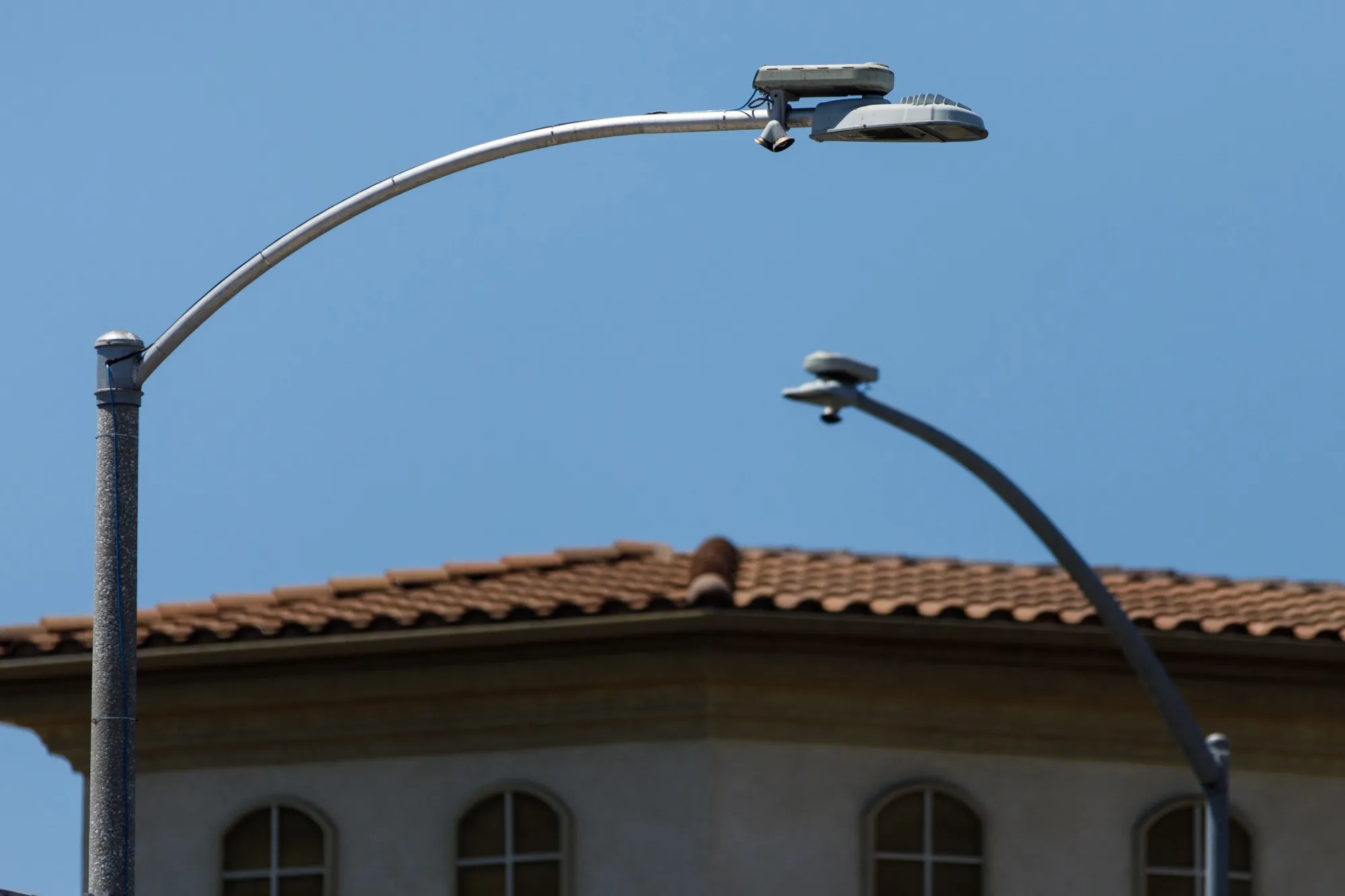
Patrol officers fanned out looking for the youths, and the Threat Management Unit requested the use of mounted license plate readers across the city to try to locate the vehicle. At 11:31 a.m., Clark’s vehicle was detected traveling in Mission Valley. Officers were sent to check on a mall store that Clark liked.
The attack at the Islamic Center of San Diego, the region’s largest mosque, happened nine minutes later.
The fusion center was called in only about a half-hour before the shooting started.
Civil liberties concerns
Fusion centers have critics. A 2022 report from the Brennan Center for Justice, a New York-based think tank, alleges the domestic intelligence model “has undermined Americans’ privacy, civil rights, and civil liberties.” It alleges materials leaked over the last 20 years have shown centers “tracking protestors and casting peaceful activities as potential threats.” It also alleges work is done in secret and that the data systems are “ripe for exploitation.”
Earlier this year, at the direction of a joint legislative committee, the California State Auditor said it would audit three fusion centers in California, with a focus on the centers’ compliance with rules governing them and their use of sensitive personal information. In a requesting an audit, state Sen. Sabrina Cervantes alleged the fusion network “operates in secret and under ambiguous lines of authority.” She alleged that the existence of the centers ”has stirred concerns about domestic intelligence gathering practices” and raised questions about federal involvement in local or state matters.
The San Diego site has not been selected for an audit, but Frank said the local center is transparent and will be available if selected.
Frank said staffers in his center “always pay attention to privacy, civil liberties, civil rights.”
“What we do would not shock the conscience of the public,” Frank said. “In fact, the public would want us to do what we’re doing.”
The San Diego center, like others across the country, trains designated liaisons from local agencies to serve as the point of contact for public safety matters. The liaison program also works with the FBI’s InfraGard to provide training to the private sector to protect critical infrastructure.
The center also works with a cross-section of potentially targeted sites — churches, mosques, synagogues, schools, reproductive health care providers and more — to assess their vulnerability to attacks.
There is interest in the training the center offers. The local fusion center’s website shows that a threat assessment class offered for schools earlier this month had a wait list. Classes on this month’s schedule include threat assessment training for first responders regarding domestic-based violent extremists and another training regarding preventing mass casualty attacks.
Read more Barack and Michelle Obama surprise first visitors to newly opened presidential center