



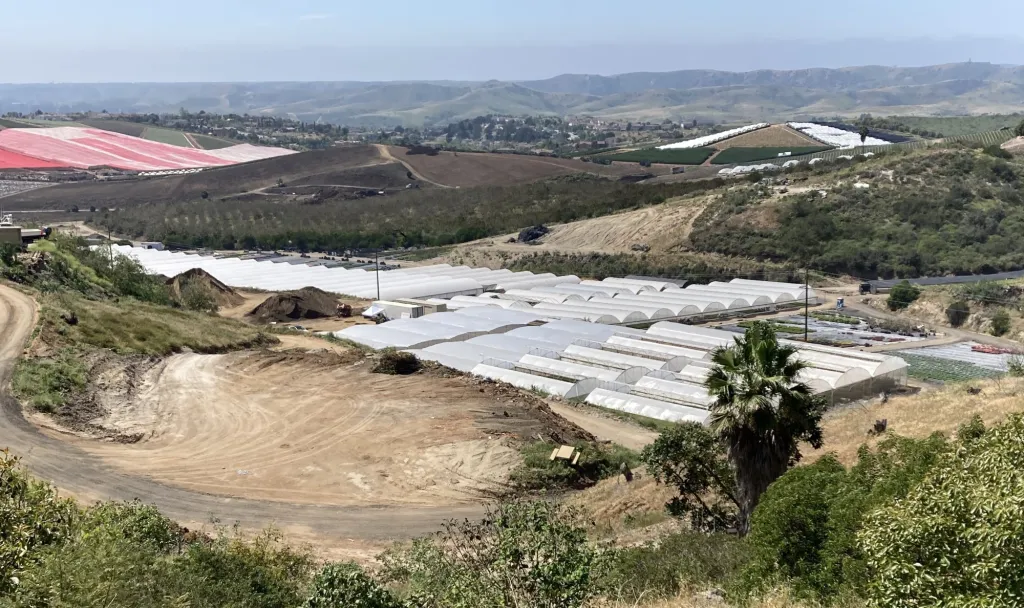
Plans to convert 25 “hoop houses” from hemp production to cannabis cultivation will be allowed to proceed for the South Morro Hills area of northeastern Oceanside.
Read more Police identify man who died after fight in Oceanside
Hoop houses are a type of greenhouse made by bending PVC or metal pipes into half circles and covering them with translucent plastic. These are 30 feet wide, 58 feet long and 17.5 feet tall, in groups of five, with temperature controls, filtered exhaust fans, and supplemental, solar-powered LED lights.
The Oceanside City Council voted unanimously May 20 to approve a conditional-use permit for South Morro Hills 47, LLC, to grow cannabis on a ranch in the 1300 block of Sleeping Indian Road. The company received a local license for cultivation through the city’s merit-based selection process on Sept. 1, 2019.
Duane DeLarco, chief operating officer of applicant South Morro Hills 47, thanked city planners along with South Morro Hills businesses and residents for supporting the application.
“We really appreciate the amount of time and work it takes to get a project to this point,” DeLarco said at the City Council meeting.
South Moro Hills remains primarily an agricultural area. Except for recent subdivisions such as North River Farms, most lots are 2.5 acres or larger. A few large growers such as Mellano and Company raise flowers, succulents and ornamentals on hundreds of acres.
South Morro Hills 47 has been growing commercial hemp for about two years on a little less than 2 acres leased from a ranch owned by Dustin Campbell and his family since 1994.
“The owners … have been downsizing their avocado and ornamental container business every year,” states a city staff report. “Currently, they are only farming 25 of the 142 acres … (and) drought, water cost increases, high property taxes, and imports of fruit and flowers and other external factors beyond their control have led them to seek a new tenant.”
Hemp is a variety of cannabis with a negligible level of the psychoactive compound THC. The plant’s fibers have been used for centuries to make industrial products such as fabric, rope, paper and food. The hoop houses allow indoor cultivation with controlled lighting, humidity and temperatures.
However, recent state legislation has made in more difficult to sell hemp in California. So the company is shifting to a slightly different product, DeLarco said, but the facilities will be essentially the same.
Read more New ferry service to connect Chula Vista waterfront with downtown San Diego
One speaker opposed the approval. Oceanside resident Rachel White said she was unaware of the application before the City Council meeting, and that it was “a bad idea.”
“You add opportunity and stupid, and you’re going to get crime,” White said.
Cannibus cultivation conforms with the agricultural zoning on the property. All operations will be conducted indoors, and the product will be sold only to licensed distributors.
The facility will have a double-layer security fence with no public access, 24-hour on-site, armed security personnel, and security cameras with a live feed to the city’s Police Department, according to a city report.
“Projects like this are part of Oceanside’s agricultural future,” states a letter to the city from long-time local farmer Neil Nagata, who lives near the site. “The South Morro Hills 47 project keeps the land in productive agricultural use while operating in compliance with environmental and city standards.”
The permit is at least the second for cannabis cultivation in Oceanside. A company called Zenleaf, LLC, received cultivation and nursery conditional-use permits from the city in 2021 for a site at 5712 North River Road. It operated briefly and then ceased production, according to city officials.
Oceanside has approved about 20 licenses for various types of cannabis businesses, from cultivation to off-site distribution, of which only a handful are active. Each license holder also needs a conditional-use permit from the city and a state cannabis license.
Oceanside initially legalized medical marijuana in 2018 and since then has gradually expanded its licensing program. In 2020, the City Council agreed to allow recreational cannabis businesses and approved the first delivery-only retail sales.
In August 2025, the city approved a process to issue its first four in-store retail cannabis licenses. So far, no retail shops have opened in the city.
Read more Estranged husband gets life in prison without parole for wife’s fatal stabbing in Spring Valley