





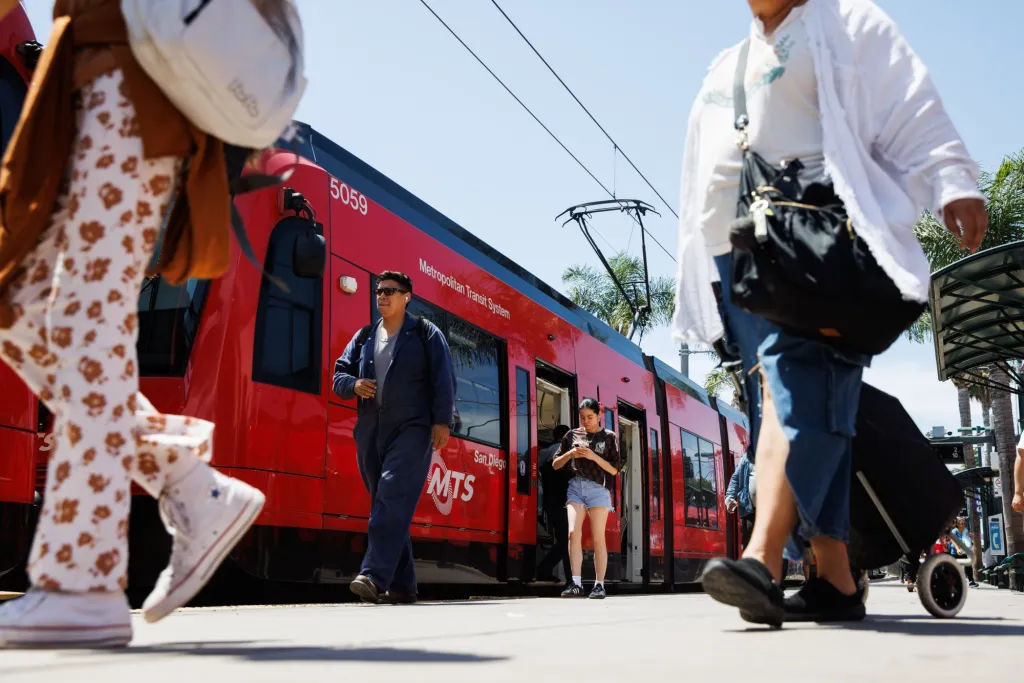
Local transit officials made a last-minute partial retreat Thursday on proposed fare hikes, approving a fare freeze for anyone enrolled in government assistance programs CalFresh, CalWORKs or Medi-Cal.
Read more Newsom commits $46M to Tijuana River sewage and pollution cleanup
The goal is protecting the region’s most vulnerable commuters from the financial impacts of a roughly 30% fare increase — but the retreat will worsen multimillion-dollar budget deficits the Metropolitan Transit System is facing.
The MTS board approved the freeze in an 8-4 vote one day before the fare hike is scheduled for approval Friday by the county’s regional planning agency, the San Diego Association of Governments.
While the fare increase would apply to buses and light rail operated by both MTS and the North County Transit District, the fare freeze only applies to MTS.
Supporters said the freeze would avoid burdening low-income people already struggling with rising costs, but critics stressed that MTS hasn’t analyzed the cost and there is no set date when the freeze would expire.
The freeze was proposed by San Diego Councilmember Sean Elo-Rivera, a member of the MTS board who has criticized officials for pursuing a fare increase before fully exploring other options such as deals for naming rights.
“We’re providing targeted support to people who are most vulnerable and depend on our system,” Elo-Rivera said. “It’s my best attempt to strike a balance.”
Marcus Bush, an MTS board member and council member in National City, said the fare freeze makes him feel better about the fare hike that he has consistently opposed.
“This is a really creative solution,” Bush said. “We have a better social safety net for our riders.”
El Cajon City Councilmember Steve Goble, another MTS board member, said the freeze comes with too many unanswered questions and could have unintended consequences.
“Is this where 50% of our riders qualify for these things and it’s a $4 million budget hit, or is it 10% of our riders and it’s a $500,000 budget hit?” Goble asked. “There’s not enough flesh there for me to understand the impact. If it’s a high number of existing riders, it guts fare revenue from the fare increase.”
The fare hikes are projected to increase annual MTS revenue by $14.2 million.
Sharon Cooney, the MTS chief executive, said the fare freeze is unlikely to apply to a large number of MTS users because Elo-Rivera exempted from it any transit users who already qualify for other discounts.
“A lot of people in this region who are under CalFresh, Medi-Cal and CalWORKS are probably already enjoying a reduced-fare program,” Cooney said.
But she conceded that her staff has not done any analysis because Elo-Rivera pitched the idea Thursday without consulting MTS staff beforehand.
“We just can’t tell you right now what we would project it to be,” Cooney said of the possible financial impact.
Two other opponents on the board, Carrie Downey of Coronado and Ronn Hall of Santee, said they were concerned about sending the wrong message to SANDAG by lobbying for a fare hike and then partially retreating at the last minute.
The fare freeze was approved in conjunction with a board decision not to include any new revenue from the fare hike in the MTS budget for the new fiscal year that the board is scheduled to approve next Thursday.
Cooney let the board choose whether to include that money because the fare hike is expected to get approval from SANDAG and take effect Oct. 1 — a quarter of the way through the new fiscal year, which begins July 1.
Downey said excluding the fare hike money could send the wrong message to SANDAG’s Transportation Committee, which has final say on the fare hike — not the full SANDAG board of directors.
“I’m not sure what they’re going to do,” Downey said. “I don’t think it’s a message this board wants to send.”
Lemon Grove City Councilmember Jennifer Mendoza, another MTS board member, disagreed.
“I don’t think it’s going to send the wrong message to SANDAG,” she said. “A fare freeze program allays a lot of the fears we have about raising fares for our most vulnerable riders in our low-income communities.”
Elo-Rivera opposed including fare hike money in the budget because it hasn’t been formally approved and because he wants MTS officials to continue looking for non-fare ways to boost revenue.
His proposal includes a third element beyond the fare freeze and leaves fare hike revenue out of the budget. It also requires MTS officials to present this winter a comprehensive strategy for non-fare revenue.
He suggested options could include more advertising on MTS apps or naming rights for the Green Line trolley, popular trolley stations such as 12th and Imperial and popular bus stations such as ones near hospitals.
Elo-Rivera and La Mesa City Councilmember Patricia Dillard, another MTS board member, also criticized surveys this spring by MTS that determined riders prefer fare hikes to service cuts.
“They basically have no choice,” said Dillard, stressing that most MTS riders are low-income. “If they don’t have the service, they probably won’t be able to keep their jobs.”
The fare hike would be the first in 17 years for monthly passes on local buses, the San Diego Trolley and the Sprinter. The cost of a pass would jump from $72 to $85 this fall and then to $95 in fall 2027 — up nearly 31%.
It would be the first increase in seven years for one-way fares, which would rise from $2.50 to $3 this fall and then to $3.25 in fall 2027. That’s a 30% hike, far steeper than the last increase in 2019 from $2.25 to $2.50.
Discounted fares for seniors, passengers with disabilities and people on Medicare would rise less sharply, from $1.25 to $1.50 for one-way fares and from $23 to $30 for monthly passes.
SANDAG’s Transportation Committee is scheduled to vote on the fare hike during a meeting scheduled to begin Friday at 1 p.m. at 1011 Union St.
Because the fare hike is an ordinance, the Transportation Committee is scheduled to approve it a second time on July 17.
Medi-Cal is subsidized health care for low-income people and people with disabilities, CalWORKs provides cash aid to needy families and CalFresh is California’s version of the federal Supplemental Nutrition Assistance Program, or SNAP, also known as food stamps.
Read more Body-worn camera footage shows San Diego police officer fire at driver