






State officials say they expect crews to break ground later this year on a long-awaited suicide barrier on the iconic San Diego-Coronado Bridge that would aim to prevent people from jumping off of it.
Read more Senate advances bill aimed at ending Iran war as Cassidy, after primary loss, flips to support
Designs are ready for the $145 million steel-mesh barrier, environmental analysis is complete, and two key approvals are expected next month.
In mid-June, the California Coastal Commission is slated to approved the project’s design. In late June, the California Transportation Commission is slated to finalize the financing plan.
A deterrent installed two years ago on San Francisco’s Golden Gate Bridge has sharply reduced suicides there. Caltrans officials say they are optimistic the proposed barrier in San Diego, which could be complete by late 2028, would have a similar effect.
Unlike the horizontal barrier installed under the deck of the Golden Gate, the local barrier would be vertical because the much taller San Diego-Coronado Bridge doesn’t have the ledges and side walkways needed to retrieve a person from a barrier.
The two bridges are believed to attract the most suicide attempts of any bridges in the nation.
Estimates by state officials and suicide-prevention groups put the number of suicides on the San Diego-Coronado Bridge at somewhere between 400 and 550 since it opened in 1969. Data from the San Diego County Medical Examiner shows 284 such deaths there since 1997.
The number of attempts and corresponding bridge closures is much higher, but a spokesperson said the agency doesn’t keep track of those incidents.
Anyone contemplating suicide or struggling with their mental health should call 9-8-8, the state’s crisis center consortium.
Caltrans officials say it’s important to reduce bridge closures, which require drivers to take a 23-mile detour through Imperial Beach and up the Silver Strand, because Coronado’s Naval Air Station North Island is crucial to national security.
A longtime advocate for the suicide barrier said Tuesday that he believes the vertical barrier will be superior to the Golden Gate’s horizontal barrier.
The Golden Gate barrier can catch those who attempt suicide, but they still must be rescued and could possibly crawl out, said Wayne Strickland, a longtime Coronado resident who helped create the website stopcoronadobridgesuicides.com.
The local project will require frequent nighttime lane closures for installation of the barrier, which will rise roughly 8 feet above the bridge’s concrete side walls.
At least one of the bridge’s five lanes will remain open in each direction at all times during the roughly two years of construction, according to Caltrans.
The project will include 20 new security cameras and under-the-bridge catwalks for maintenance. The catwalks are needed because the new barrier will reduce access to the bridge for maintenance and repair crews.
The six cameras now installed on the bridge don’t provide complete coverage and don’t allow police or other officials to comprehensively analyze an incident.
Strickland said he’s excited Caltrans is finally ready to move forward with the barrier.
“It’s going to be a wonderful thing that will save lives,” he said.
In addition to national security concerns, Strickland said life in Coronado gets badly disrupted when the bridge closes for an extended period because of a suicide attempt.
“People need to get back and forth over that bridge,” he said.
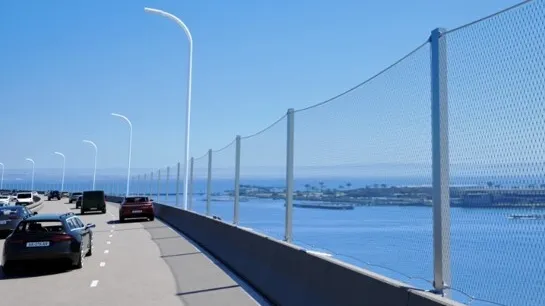
The barrier as planned would consist of a series of stationary panels made of brushed steel-wire mesh with roughly 1-inch openings designed to prevent people from climbing over the existing concrete bridge barriers.
The new barrier panels would be installed on top of the existing concrete barriers with anchored metal plates spaced about 20 feet apart. Steel mesh was chosen so officials can see through the barrier.
The panels would be installed along both the northbound and southbound sides of the Bridge, extending about 2 miles from the toll plaza on the Coronado side of the bridge to the Interstate 5 onramps on the San Diego side.
Installation would occur on the northbound side of the bridge for roughly one year, followed by roughly one year of installation on the southbound side.
Tension cables would frame the netting on all four sides, not just at the top and bottom. At the top of the netting, the tension cables would be topped with wire spikes spaced every 4 inches.
At each of the four end points, a small panel about 2 to 3 feet wide would be mounted perpendicular to the netting to prevent access.
Funding for the project comes from the 2021 federal Infrastructure Investment and Jobs Act and a variety of state sources.
The process of cobbling financing together was relatively difficult because suicide barriers don’t qualify for traditional state road funding under the Highway Safety Improvement Program.
The suicide deterrent is scheduled to be presented to the Coastal Commission at the commission’s three-day San Diego meeting from June 10 through 12 at the Wyndham Bayside on Harbor Drive. It will be the first time the project has been presented to the commission.
The state Transportation Commission is scheduled to discuss the funding plan at its meeting on June 25 and June 26 in Folsom.
Read more Where Trump falters with Republicans — and where he holds steady, according to a new poll