


Imani Camara grew up on Tumblr, hopping on the blogging platform in the sixth grade where she saw and learned a lot about photography, interior design, installations, and all kinds of art from creators all over the world. That led her to a love of museums in her late teens, constantly going to museums in Los Angeles, and finding any contemporary art museum in even the smaller towns she would visit while on vacation.
Read more New African savanna elephant welcomed at San Diego Zoo Safari Park
“I was always just a visitor, an appreciator, until my late 20s. That’s when I started to actually get involved because it seemed more accessible to me. The more that I saw more Black people just pursuing careers in the arts, it kind of was like, ‘OK, this is doable,’ you know?,” she says. “When you live in a place and you start to see people in your community, specifically in the Black community, it is something that is super inspirational, even if it’s not intended to be. Even if they’re just doing their thing, you’re like, ‘Oh, OK, this is something that I can do, as well,’ so I was mostly inspired when I moved to San Diego by other Black artists that were pursuing careers in the arts.”
After moving to San Diego at the end of 2024, she started hitting up as many arts and cultural events as she could find, meeting and connecting with other local Black creatives. She began to notice that they would all be sprinkled through some of these events, but how great would it be to have events where they filled the room? So, she got to work. She started working at the Museum of Contemporary Art San Diego as an event sales associate in 2025, where she contributed to programming and outreach efforts with the Black community, and collaborated on a museum event looking into the collecting and conversations of Black art and culture. She also founded Black Women SD in 2025, organizing social and cultural gatherings to connect Black women in San Diego. Most recently, she’s curating “Onyx: A Black Artist Exhibition” opening June 19 and continuing through Aug. 2 at Brokers Gallery in San Diego, featuring the works of 22 local Black artists.
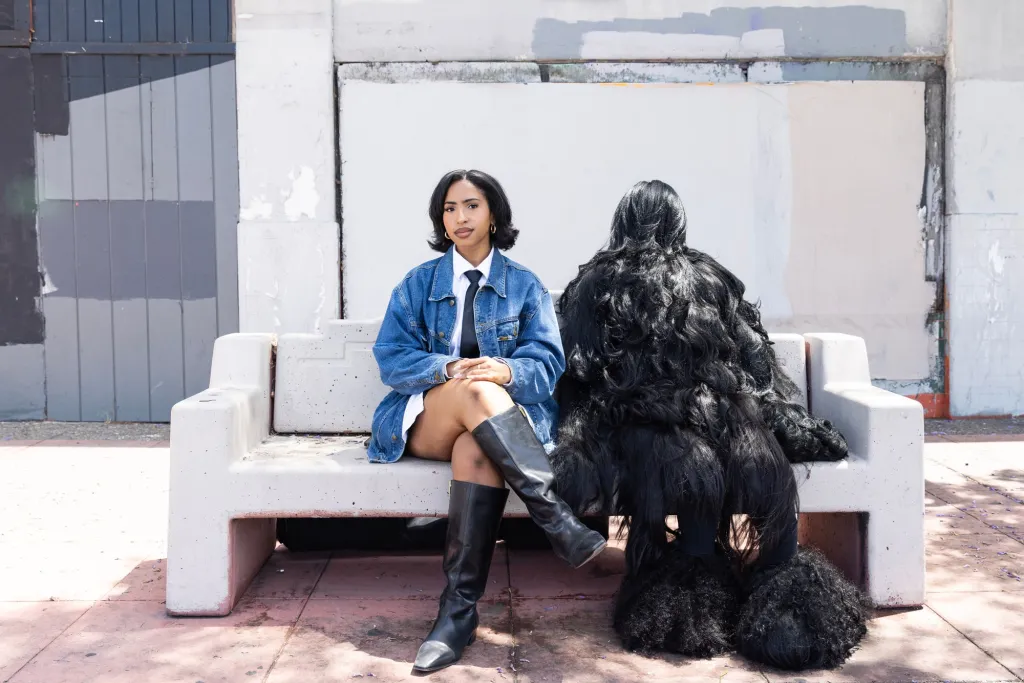
Camara, 29, is also a photographer and community organizer living in North Park, and is creating a sculpture for the “Onyx” exhibition this month. She took some time to talk about being able to connect with other Black creatives and support each other’s work and aspirations.
“Onyx” opens on Juneteenth; was opening on this date deliberate?
No, it actually wasn’t. I was planning on doing a Black artist exhibition, regardless of Juneteenth. My main focus is Black people; I kind of want that to be the basis of my community work, just focusing on the Black community. Everything that I do is for the Black community, so I thought it would be really fitting to do the opening reception on Juneteenth because I feel like that would add to the festivities of the weekend. I know San Diego has a lot of Juneteenth events, and it just added another arts and culture event to that fold. I wanted to provide another way to celebrate Black culture in a meaningful way.
Why “Onyx”? Why did you want to focus on a show for Black artists?
Onyx is a black stone, so it was based off of that. Then, when I looked up the spiritual properties of onyx, it is grounding, self-protection, focus, wards off negative energy; that’s pretty meaningful, as an artist. You have to be focused, you have to have self-determination, you can’t let people define you. Also, there are a lot of layers in onyx. Sometimes there are layers of other stones, and I think a lot of Black artists in San Diego have a lot of layers. They’re not just artists, they sometimes have to have their day job, sometimes they’re DJs, sometimes they’re curators and artists; they have all of these different identities. Even within Blackness, I think there are a lot of layered identities. Not everyone is just African American. In this exhibition, there are Afro-Latinos, there are two Indigenous and Black artists, there’s a Haitian artist. Even other queer Black artists in this exhibition, their identity is layered, complex.
These are accomplished, really great, successful artists. They’re not struggling, trying to get in the door; these are people with residencies and studios, and who are making a living off of art, so I also wanted to highlight that because I do think that some of these people don’t know each other. I think we can expand the narrative and get more communities of artists to work together on different projects, so that was kind of behind the name for “Onyx”— mining layered identities, and also the spiritual properties of onyx and it being a black stone, I think that was really cool.
What I love about North Park…
I do like being close to all of these event locations. I’m really close to Part Time Lover, I’m really close to Park & Rec. If you want interesting nightlife, I would rather be close to the culture, so I do love the options for nightlife living in North Park, as well as just the general culture. It’s very art forward. And, it’s very walkable and safe, it’s central to everything.
In curating this exhibition, what kinds of conversations or interactions were you having with the artists? What were you looking for in terms of how the finished exhibition would look and feel?
I did want a certain level of quality because these are distinguished artists, so I wanted to give them a little bit of an elevated experience, but I also wanted it to be true and didn’t want it to be so uppity and elevated to where that it was disconnected from other Black people. Sometimes, in the art world, it becomes a display for White people of ‘Come and look at our pain. Come and be taught something about Black people,’ and I really didn’t want that to be the narrative. I wanted the artists to be able to just display their best work. I asked for things that were personal to them within their Black artistic identity because it is their story to tell. Sometimes, when they’re added to these other programs, they are used for diversity: ‘OK, now we have a Black artist, we’re diverse now.’ They’re not really able to tell the story they want to tell because they’re being used as an addition as a Black artist, not because of their work. I’m glad that they’re trusting me with their work, and with bringing something together.
Can you tell us about some of the creators and the work we’ll see?
There are 22 artists and this exhibition is very colorful. We have a mix of fine art photography, oil paintings, some sculpture, works made out of wood. We have a sculptor (and multimedia artist), Christopher Lloyd Tucker, and he does all of his work out of wood. There’s some collage from Cairo Mayeson he does in clippings, so he has a four-foot by two-foot collage, all made from magazine clippings. There are people who’ve put in months of work on these paintings and have never even been able to put them up in a gallery setting, so people can see different variations of Black art in San Diego.
How would you describe your art, currently?
My art right now is based off of personal narrative. My piece for “Onyx” is actually a sculpture made out of the wigs that I was wearing throughout the last two years. It’s a sculpture that’s based on consumption and Black women in hair, the conversation around how much we spend on hair and what it becomes after it’s no longer on our head, which is trash. Trying to make something useful and open up a conversation about that, so I would say my art is really based on using what you have. That’s what my life is based off of, really just making things useful, using these spaces, trying to take advantage of opportunities that I get because I don’t have a background in the arts, but I do see people utilizing their resources and making them meaningful. That’s basically what my art and my life is based off of.
You’re also the founder and organizer of Black Women SD, and you recently became the San Diego coordinator of Black Girls in Art Spaces, an organization with local chapters throughout the U.S., providing programming for Black women who work in and around the arts. Can you talk a bit about the utility of each of these organizations, and some of the ways you’ve witnessed connection and community grow as a result?
Through Black Women SD, I was meeting these Black women artists, and just Black women in general. From there, there were different instances of them collaborating on events, them getting hired for certain things, me being able to hire them for certain things, and there was this exchange. People are getting connected and they’re like, “Where are you? Where’s your residency at? How have you been treated there? What’s it like? How many Black people are there?” Or, “Who’s buying Black art? Who are some of the collectors you talk to? Where are some of the places you go?” I want those conversations to happen. Those conversations lead to opportunities, so the utility of these spaces is this in-person conversation creates actual, tangible, real-life change and we need more of those spaces for Black people. That’s not nightlife; it creates real opportunity and real economic circulation. That’s what I feel like the utility of Black Women SD, of me working at the museum, of “Onyx” and Black Girls in Art Spaces is-these are real, in-person conversations that create real, in-person opportunities.
Where do you like to go to see and experience art locally?
I like to go to Barrio Logan. One, I think that they have a lot of cool art exhibitions always going on. There’s art everywhere and there are smaller artists who have studios over there. They have The Woo, which I think is a really cool space. I definitely like Bread & Salt, as well. Now that I know about The Mental Bar and the San Diego Black Arts & Culture District, they have smaller exhibitions going on. Also, Maxx Moses, his studio also has a lot of art there. But, mainly, Barrio Logan is where I like to view art the most.
Who are some local Black artists you think people should pay attention to? What is it about their work that you find compelling?
I definitely think you should pay attention to Amel Janae. She does craft, she does oil paintings, and she also does some print work on different materials, but her focus is on the body and the imperfections of the body. She also has done numerous shows and she does these displays of brown skin that are kind of zoomed in, like an introspection of skin for women, which I think is really inspiring because it looks so beautiful—stretch marks, scars, and different imperfections of the skin that she highlights and makes really beautiful. I think when you see them, it’s very similar to your own body as Black women, and you’re going to be able to see it in that light.
Another artist is Bilal Bikile. He owns an art gallery in Barrio Logan, born and raised in San Diego. He started Deixis Gallery, which is a gallery space, a writing workshop space, and a conversation space where he hosts writing workshops and salons on different topics, and brings together people from different walks of life to have conversations on topics that are going on in the world. He also allows other artists to do different exhibitions in his space. He was one of the inspirations for “Onyx,” as well, and he definitely taught me a lot and introduced me to some Black artists because his focus is on Black artists.
I think another artist that you should definitely pay attention to probably would be Jazzmine Marie. She’s a fine art photographer in the exhibition and she does amazing work. She does fine art photography, drone photography, some travel photography.
What is the best advice you’ve ever received?
Less is more. Just trying to keep things simple and then scaling as you grow. It’s not to think small, but it’s just to start somewhere.
Please describe your ideal San Diego weekend.
It would start on a Thursday night. Thursday night events are like a weekend kickoff for San Diego, I think. So, jazz night on Thursday, and then on Friday I do like to go out to dance, so it would be Bluefoot Bar and Lounge. Then, San Diego has beautiful parks, so going to get a breakfast burrito and then going to Golden Hill Park. It’s a really nice park that the planes fly over. I do love to thrift, so local Goodwills, like on Home Avenue. Because of all the stuff that I do, I like to go to people’s events. I really like the Wine Garden Sessions at Carruth (Cellars) at Liberty Station; I think those are really nice.
To suggest a notable San Diegan for the One-on-One series, contact Lisa Deaderick at [email protected].
Read more Refilling starts for newly painted Reflecting Pool in Washington, in photos