





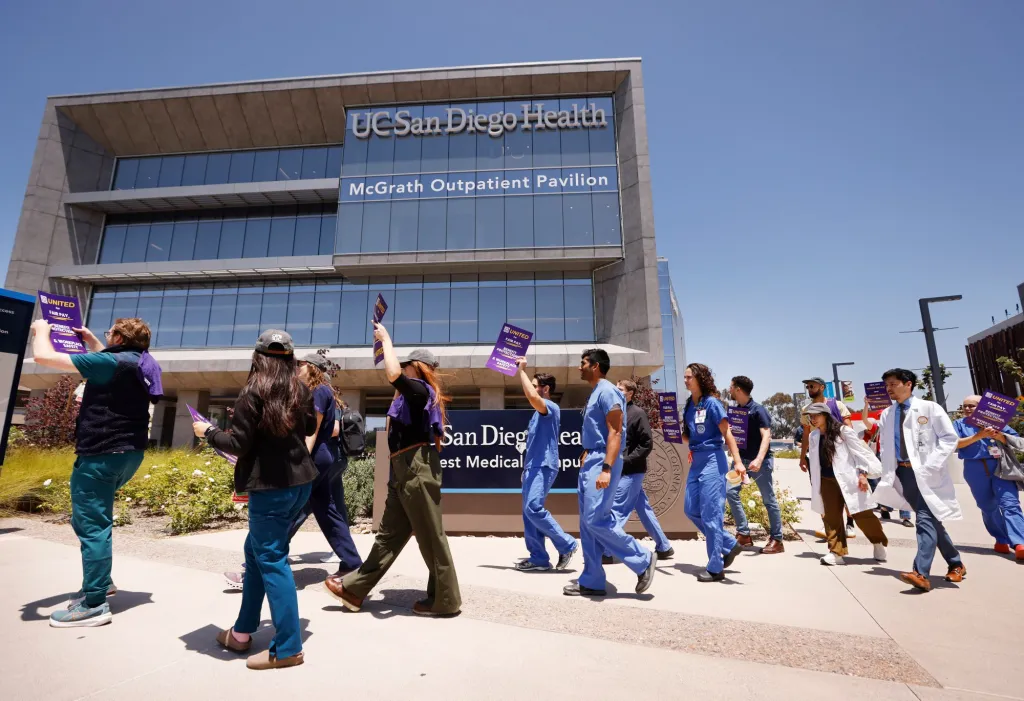
UC San Diego resident physicians demonstrated at UC San Diego Medical Center on Wednesday, accusing their employer of resisting their calls for better wages and benefits as part of a statewide “unity break” labor action that is bringing labor pressure to bear at all University of California medical campuses.
Read more Iran’s Kharg Island is key to its oil exports. Targeting it carries major risks
The event was not a strike. Doctors in hands-on training programs attended on their own time.
Dr. Colin Boehnlein, a third-year medical resident just three weeks away from finishing the UCSD Family Medicine Program, is a bargaining unit member of the Committee of Interns and Residents (CIR), an affiliate of the Service Employees International Union.
The union represents medical interns and residents, medical doctors completing their supervised practice requirements after earning their medical doctorates, across the UC system and in 15 states, covering “more than 40,000 interns, residents and fellows” according to its website.
Boehnlein said that all CIR union contracts at UC facilities expired last July, and a one-year temporary extension will expire on July 1.
Workers, he said, are asking for wage increases and for compensation to be equalized across all UC medical campuses. Currently, he said, workers have different wages at each location. Those completing their residencies, he said, have seen their ability to make ends meet during the residency periods erode as inflation has increased costs for a group of professionals who often must borrow heavily before they can begin earning full professional salaries.
“It is very expensive to live in California, especially in the major metro areas where the majority of the UC sites are,” Boehnlein said. “Many of our members have hundreds of thousands in student loans, which you still have to make payments on when you’re in residency or fellowship.”
The starting wage, Boehnlein said, is about $91,000 for a first-year resident, often called an intern, increasing about $3,000 per month. He deferred to union communications personnel for more details on what kind of wage increase the union is asking for. That question had not been answered as of Wednesday afternoon.
Read more Melania Trump unveils a spinoff of Trump Accounts for foster kids
Increases in health insurance premiums and increased costs around valued benefits, such as fertility treatment and child care, items that are front-and-center for those in their late 20s and early 30s, have also been sticking points that led to Wednesday’s small demonstration. Surgeons, for example, commonly have seven-year residency and fellowship requirements after completing medical school.
“We believe our residents and fellows should be able to start a family and make the fertility decisions that they need to,” Boehnlein said.
Other negotiating points, he added, are particular to the specific demands of medical residencies, especially the requirements to work shifts of 24 or more hours. Ride-sharing services are a good example.
“Our residents have to drive home after being awake for 24 hours, 28 hours, 36 hours, which is unsafe,” Boehnlein said. “It’s not just unsafe for our members, but it’s obviously unsafe for pedestrians and other drivers on the street.”
Heather Hansen, senior director, labor communications, external relations, for the University of California Office of the President, said in an email Wednesday that the university “does not agree with the union’s characterization of the negotiations.”
“UC remains committed to reaching an agreement that supports residents across the system,” Hansen said. “Notably, this includes reaching a one-year wage agreement with the union last summer that guaranteed these valued employees a 5% wage increase in 2025.
“These talks are complex because they involve consolidating eight local contracts into a single agreement across multiple UC locations. Medical residents are essential to UC’s mission, and we value their contributions.”
Read more States face more budget pressures amid rising costs, slow growth
CIR represents about 6,500 physicians across the UC system.