







A county watchdog panel is praising San Diego for its ambitious plan to build a comprehensive bicycling network, but the panel also criticizes gaps in the city’s unfinished network and a lack of bike lanes in low-income areas.
Read more Democrats say money from Trump’s tax bill is paying for White House ballroom project
In a new 33-page report, the county grand jury recommends San Diego make it easier for bike commuters to use bike lockers and to bring their bikes on local buses.
The report urges the city to encourage more bicycle commuting by public school students and criticizes the city for having only one street sweeper capable of cleaning the city’s 59 miles of protected cycle tracks.
The county’s regional planning agency, the San Diego Association of Governments, is also criticized for its regional cycling maps. The report says the maps have errors and lack important detail.
The report comes with San Diego continuing to pursue a comprehensive cycling network despite negative feedback from many neighborhoods and merchant groups frustrated by removal of parking spots and vehicle lanes.
Mayor Todd Gloria recently proposed eliminating a city engineering team focused on creating bike lanes, but the City Council made a last-minute decision to restore money for the team in the budget for the new fiscal year that starts July 1.
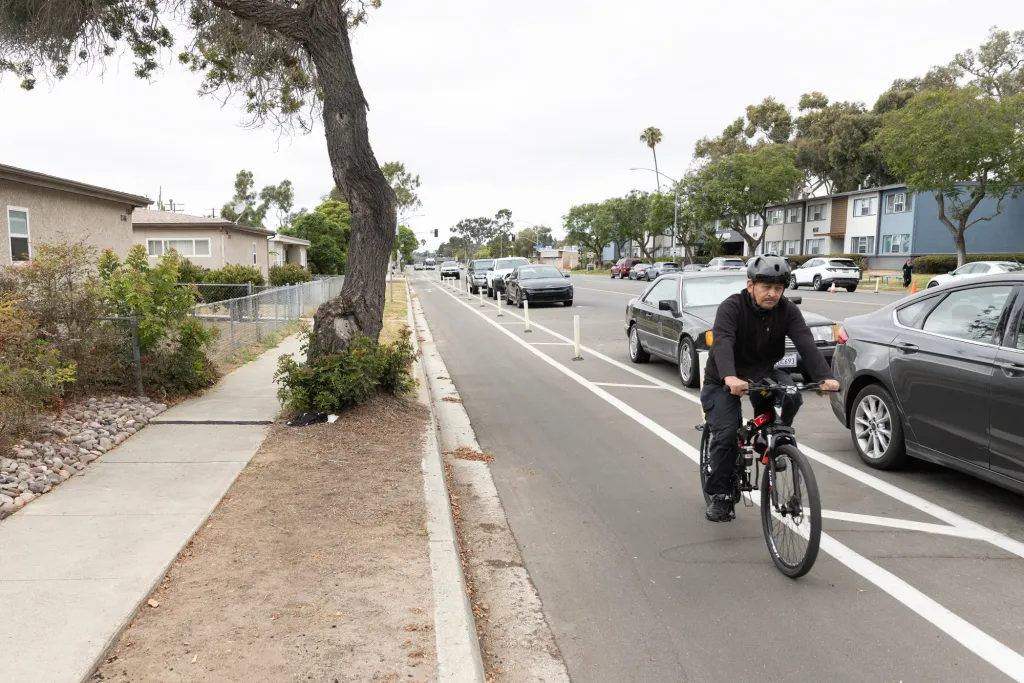
High-profile projects have opened recently on Pershing Drive and Clairemont Drive. The report praises the Clairemont Drive cycle track as a model because there are no gaps and it connects to the neighborhood trolley station.
“It is the kind of bike infrastructure that every San Diego community deserves,” the report says.
The report also gives the city general praise for trying to build a network and setting a goal in its 2022 climate action plan of cycling accounting for 10% of commutes in the city’s urban neighborhoods.
“On balance, the Grand Jury finds that the City is advancing bicycle infrastructure in a meaningful way,” the report says.
But the report complains of many gaps in the network and many situations where bike lanes end without adequate warning to cyclists.
It notes that the city has 1,900 miles of bike lanes compared to 6,600 miles of lanes for vehicles.
And it stresses that only 260 of those 1,900 miles are either grade-separated bike paths or cycle tracks – which run parallel to roads with cars but are separated by barriers like bollards or raised curbs.
Read more See the photos of the Obama Presidential Center dedication ceremony
The other lanes include 1,224 miles of painted bike lanes on pavement where cars can travel and 395 miles of sharrows – lanes with paint designating them as shared spaces for bikes and cars.
The report says fear is the No. 1 reason people don’t consider cycling as a viable way to travel, contending that more protected and separated lanes are needed to reduce such fear.
The report criticizes the city for being slow to address glaring gaps in its cycling network.
One of the report’s recommendations is for the city to “prioritize building continuous bike infrastructure now, particularly on routes with gaps, instead of waiting years for larger infrastructure projects to move forward.”
It also recommends the city work with the Metropolitan Transit System to increase the size of bike racks on buses, which now have space for two bikes, and to install racks that don’t require bikes to be lifted several feet in the air by commuters.
The report says bike lockers at MTS facilities should be accessible with a smartphone app, criticizing the current system that requires people to mail in a payment before they can start using a locker.
The report notes that the city has only one street sweeper capable of cleaning its cycle tracks, suggesting that buying a second sweeper should be a priority.
The report also says many low-income neighborhoods are ripe for more cycling infrastructure based on their potential to help complete a citywide network and equity concerns. It cites in particular corridors east of 28th Street, Martin Luther King Jr. Way, Imperial Avenue and Ocean View Boulevard.
The lack of school children commuting by bike is a key concern raised by the report, which estimated that 10% to 14% of traffic on local streets is parents dropping off and picking up children at school.
Based on a survey the grand jury conducted, only one in 20 schools in the San Diego Unified School District have an active “safe routes to school” program that encourages students to bike to campus.
The report praised the city for making efforts to enforce its bike lanes. The city issued 2,740 citations between December 2024 and December 2025 for blocking bike lanes or leaving hazards within a bike lane.
Read more Senator urges FAA to reject any pressure from Trump to approve triumphal arch over aviation safety
The city and other agencies mentioned in the report have 90 days to respond.