







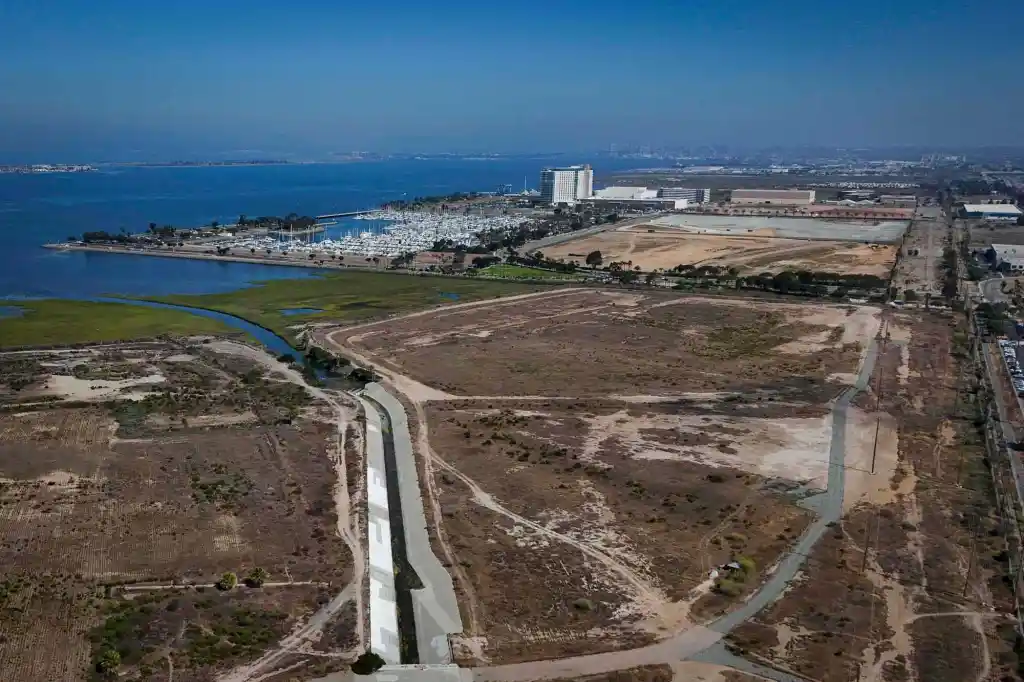
The developer proposing a tennis-anchored sports complex on the Chula Vista Bayfront is asking for more time to advance the mega project, despite not yet solidifying a commitment from a mystery elite athlete organization.
Read more Watchdog panel says San Diego’s admirable effort to create bike network is falling short in key ways
Tuesday, the Board of Port Commissioners for the San Diego Unified Port District will consider authorizing a new, two-year exclusive negotiating agreement, or ENA, with Pangaea Development, LLC for the development of a 124-acre site at 990 Bay Blvd, as recommended by agency staff. The requested ENA also allows for two 180-day administrative extensions.
If approved, port staff will draft a contract to replace the short-term agreement that is set to expire in less than two weeks, giving the developer an extended window of time to not only hit unmet milestones but also accomplish the tasks required to ready the project for future approval.
“It takes time to do a legacy project. It’s not an overnight thing. … I want to do it right,” said Gerald Divaris, who is the sole owner of Pangaea Development, LLC and the chairman of Virginia Beach-based commercial real estate firm Divaris Group of Companies. “Most ENAs (with the port) have been two years or more, so all we’re asking for is what has been typically done, instead of working on a basis that can’t allow us to really program the thing properly.”
The Pangaea project centers around a large tennis facility with a stadium court seating up to 18,000 people and 34 surrounding courts of varying size, surfaces and purpose.
The development team, which includes Divaris subsidiary The McGarey Group and local design firm Tucker Sadler Architects Inc., has for two years dangled the prospect of securing a star tennis player to be the face of the complex, but has so far not disclosed the identity of the athlete, citing a need for confidentiality.
The complex, as proposed, is complemented by a water polo academy, four hotels, a meandering retail village, three ocean-oriented office buildings and a public trail circling the expansive site.
The project has an initial estimated cost of $2.2 billion, Divaris told the Union-Tribune.
The developer’s request for a two-year negotiation period, which is routine for large developments on port tidelands, was envisioned when the local government agency entered into an initial, six-month contract at the beginning of the year.
ENAs are generally employed for large or complex projects. They formalize the working relationship between the port and prospective tenants, and they take a property off the market as the parties work toward a lease agreement or development deal.
The atypically short term granted to Pangaea was explicitly crafted to allow sufficient time for the developer to procure a non-binding, public letter of intent with the unnamed tennis pro.
A letter of intent, or LOI, is an industry-recognized, commercial real estate document that typically identifies preliminary deal terms. The Pangaea team has not provided an LOI from the athlete group. Instead, earlier this month, the development team submitted a confidential letter from representatives affiliated with the elite professional athlete who expressed their interest in the project, according to a staff report prepared for Tuesday’s board meeting.
Staff considers the interest letter evidence of meaningful progress toward satisfying the ENA milestone, Port of San Diego Vice President Anthony Gordon said in an emailed statement.
The short-term ENA established five other milestones, requiring the developer to produce a market demand study, submit a preliminary project description and land-use plan, enter into a project labor agreement with relevant unions, develop a local hire plan and implement a public outreach plan. To date, Pangaea has signed a contract with the San Diego County Building and Construction Trades Council.
“The milestones in the ENA were intended to measure progress, not simply create a checklist. While not every item has been fully completed, we are very encouraged by the formal expression of interest from the athlete and the signed labor agreement. We believe the developer has demonstrated that they are serious,” Gordon said. “Ultimately, the question before the board is whether sufficient progress has been made to justify continued evaluation of the proposal.”
The concept of a massive, tennis-anchored sports complex on the Chula Vista Bayfront dates to February 2024, when the Pangaea development team submitted its original unsolicited proposal for what’s known as the Otay District. The district, south of the Gaylord Pacific Resort and Convention Center, is an expansive, undeveloped area that was the former home of the South Bay Power Plant.
Read more Democrats say money from Trump’s tax bill is paying for White House ballroom project
The group’s sports and entertainment complex was further defined in a detailed, 51-page document submitted to the port in February 2025. The current iteration of Pangaea includes 1.4 million square feet of space for sports and wellness uses, 300,000 square feet of space for retail stores, 722,970 square feet for hotel use, 464,250 square feet of office space, and 64.9 acres of land reserved as open space.
The proposal identifies a number of planned entertainment options, like an IMAX theater by Paragon Entertainment and an upscale mini-golf venue co-owned by Tiger Woods called PopStroke. The initial ENA also notes that a multi-purpose stadium with up to 80,000 seats is also being contemplated for a future phase of development.
Pangaea Development, LLC is 100% owned by Divaris, the Divaris Group chairman.
Founded in 1974, Divaris Group of Companies is a commercial real estate brokerage and services firm that manages or leases more than 37 million square feet of office, retail and industrial space across the U.S., according to information provided to the port.
The firm’s experience includes The Town Center of Virginia Beach, a large mixed-use development that spans 17 city blocks and features residences, hotels, office buildings, retail and a performing arts theater. The urban city center started in 2000 as a public-private partnership between the city of Virginia Beach and Town Center Associates, a partnership between Armada Hoffler and Divaris Partners. Divaris is credited as the visionary behind the project, and his firm continues to oversee management and leasing for all of the office and retail buildings. Divaris remains a direct partner in the project’s Westin Hotel and also owns three properties at the Town Center, the developer said.
The McGarey Group and Tucker Sadler Architects Inc. helped create the Pangaea proposal, but do not currently have ownership stakes in the development entity. Provident Resources Group, which specializes in public-private partnerships, is expected to assist with financing.
The Pangaea proposal was treated as confidential until July 2025, when the Board of Port Commissioners agreed to waive its policy for a competitive solicitation process and granted the group an exclusive, six-month negotiating period.
The contract, which took six months to negotiate, was executed on Jan. 1 and will expire on July 1 without the identified milestones completed. The group wasn’t able to make more progress on the milestones because the project hinges around the tennis component, Divaris said.
The real estate executive is optimistic, however, that Pangaea will secure the letter of intent from the athlete group in six to eight months.
“We’ve spent six months actively working with these people, talking to them. The port folks have actually met the people, so they know it’s not a figment of our imagination,” Divaris said. “I would like to get (the letter of intent) done as soon as possible, because everything is held up until we get that done. We are motivated, incentivized, and it’s going to be eating away on our two years. There’s a lot of work to be done following completion of that.”
Port Commissioner Ann Moore, who is chair of the agency’s seven-member board and represents the city of Chula Vista, characterized Pangaea as a rare opportunity worth exploring.
“From my perspective, I feel like if we get a real, top-level tennis facility for Chula Vista, it would be a tremendous opportunity for the region, particularly for the South Bay,” Moore told the Union-Tribune. “Opportunities like this, they don’t come along every day, especially if you have the backing of an elite professional athlete. That doesn’t come through the usual, normal process.”
Moore said she has met with representatives of the athlete organization and is encouraged by their reputation and earnestness in the project. She also said the agency has nothing to lose in granting Pangaea more time, given that the site in question would require years of planning work before the agency would be ready to solicit bids for redevelopment.
And the cloud of secrecy surrounding the identity of the professional athlete is just an unfortunate-but-necessary reality of dealing with a third party, she said.
“I understand that everybody wants to know who this elite athlete is. I would love to tell everybody,” Moore said. “But for their business purposes, they feel that they can’t do that right now. But they definitely understand that it will need to become known at some point. And the sooner the better.”
Read more See the photos of the Obama Presidential Center dedication ceremony