





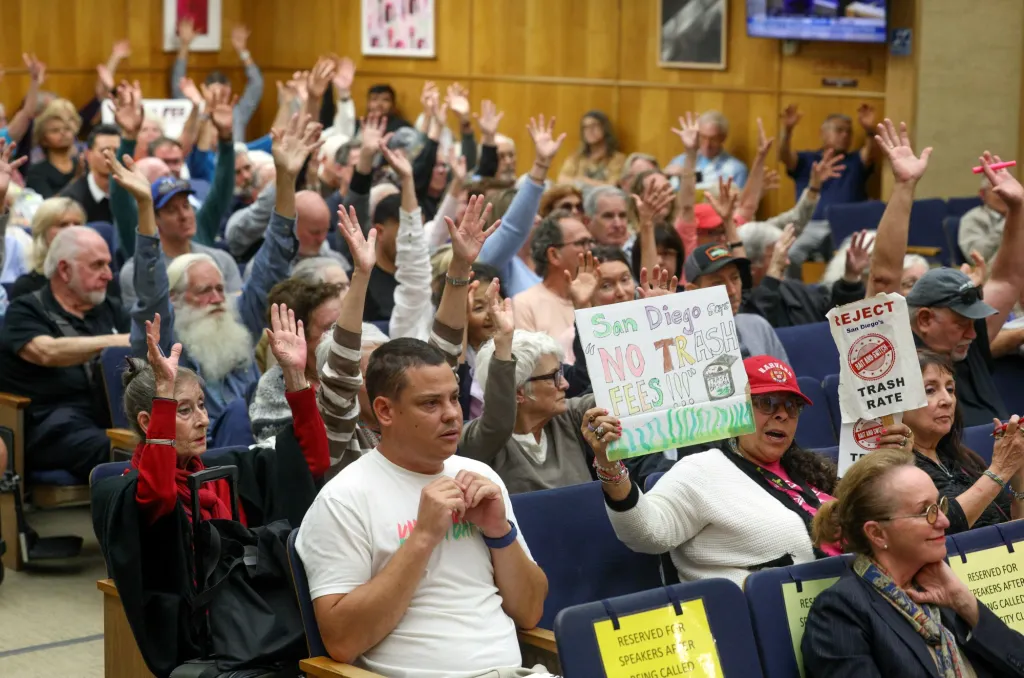
San Diego officials violated state law when they set the trash fee for residential homes approved by voters, adding millions of dollars to the cost of solid-waste collection services that should be refunded, lawyers for property owners argued in court Tuesday.
Read more 85-year-old French widow caught in Trump’s immigration crackdown describes her detention
In his opening statement for the trial that seeks to lower the monthly trash fee, attorney Michael Aguirre told the Superior Court judge that the city wrongly piled on costs to single-family homeowners and that the charge should not have been added to property tax rolls.
“The costs went from $73 million in one year to $147 million in one year,” said Aguirre, who is the former elected San Diego city attorney. “The money was used pretty much for anything, for payment.”
Attorneys for San Diego waived their opening statement on Tuesday.
But in court papers they sharply dispute the allegations, insisting that city officials were diligent in determining how much to charge homeowners for the service and how to roll out the fee most fairly.
Homeowners last year filed the legal challenge to the city’s decision to charge up to $53 per month for residential trash collection services. The final fee was set by the City Council last June at just under $44 per month, although it is scheduled to rise over coming years.
The trial began one day after the San Diego City Council rejected a settlement plan that would have rolled back charges to between $23 and $29 each month – the same amount voters were told the service was likely to cost ahead of the 2022 vote.
Council members refused to approve the settlement plan following a closed-session discussion on Monday, which led to the trial beginning Tuesday.
Before the start of the trial, Judge Euketa Oliver granted motions filed by city lawyers seeking to shield Mayor Todd Gloria, Council President Joe La Cava and Councilmember Sean Elo-Rivera from testifying.
The decision means the three elected officials will not be called to testify under oath.
The trial also opened as the Lincoln Club of San Diego business group continues to push a ballot measure that would repeal the trash fee for two years – a move that, if approved, could deprive the city of millions of dollars in revenue.
The trash fee was added to property tax rolls last fall and thousands of homeowners already have paid the fee as a portion of their annual property tax payments.
The annual assessment was approved in November 2022 by voters who agreed to overturn what was known for more than a century as the People’s Ordinance, a city law that guaranteed single-family homeowners would not be charged for weekly trash service.
Plaintiffs claim San Diego officials inflated the assessment to raise more revenue and help balance the city budget, which is facing a significant shortfall. They also accused officials of commingling money collected from fees, which by state law must relate directly to the cost of service.
Read more Musk, Cook and other prominent US executives invited to join Trump on trip to China
Among other missteps, Aguirre said the city misstated the number of homes that would be charged the trash fee – initially saying as many as 300,000 households would be assessed, but later settling on about 222,000 properties.
The difference is significant because the costs are now being divided between a significantly smaller pool of property tax payers.
Plaintiffs also claimed the cost-of-service study San Diego relied on to set rates did not include an independent review of existing collection costs. They also said the city gave homeowners the largest, most expensive containers when many preferred smaller cans.
Homeowners also criticized the city for adding the new trash fees to property tax rolls rather than setting up a billing program like the water and sewer departments.
“This is tapping into people’s homes,” Aguirre told the court in his opening statement. “If they are unable to pay, they are terrified they will be foreclosed on or a lien will be placed on their house.”
Aguirre also claimed the city systematically inflated the trash fees after November 2024, when San Diego voters rejected a sales-tax measure that would have eliminated a structural budget deficit by generating some $400 million a year in new revenue.
“You will see video evidence of council members saying, ‘We need the money because we have a structural deficit and we have to raise as much money as we can,’” he said. “It was commingled and it was diverted to wherever it was needed.
“It was used for purposes other than the costs of service,” Aguirre said.
In a statement late Monday, after the City Council rejected the proposed legal settlement, Gloria said the deal would have blown a hole of up to $150 million in the city budget that is now being developed.
City officials already are confronting a deficit of more than $120 million and the mayor’s initial 2026-27 budget included notable cuts in library services, park maintenance and support for the arts.
“This (deal) would mean radical cuts to city services, including layoffs of firefighters and police officers and permanent closures of libraries and recreation centers,” the mayor’s statement said. “The special interests who are working overtime to advance this bad idea are motivated by politics, not protecting taxpayers.”
The trial, formally known as Mary Brown et al vs. Joe La Cava et al, will continue Wednesday and is expected to last through six court days. The case is not being heard by a jury. Instead, the judge will issue a decision after the evidence is presented.
Read more West Virginia voters navigate new law requiring photo IDs at polling places in primary election