

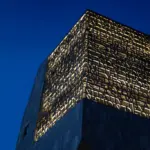



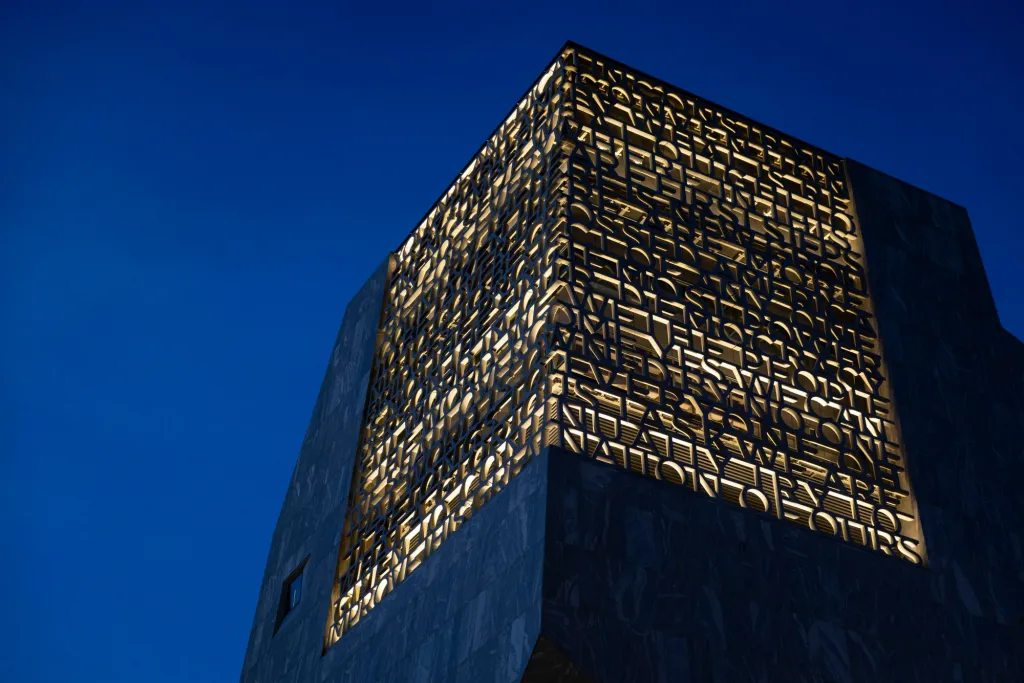
The Obama Presidential Center, which opens to the public on Friday, on Juneteenth, hugs the north end of Jackson Park, runs alongside a lagoon, rises 225 feet at its highest, and rolls backward down Stony Island Avenue, settling into 58,000 square feet of brilliantly green sloping lawn.
Read more B-52 bomber crashes after takeoff at US military base in Southern California
Michelle Obama wants you to sled here in the winter. Nearby are picnic tables and a sprawling fruit and vegetable garden and cast-iron barbecue pits for grilling — Barack Obama would like you to use those in the summer. Need a book? There’s a new branch of the Chicago Public Library, one of the center’s four buildings. Want to exercise? There’s 60,000 square feet of athletic facilities, rooted around an NBA-regulation court, the Obama Foundation’s rising-sun at its hub.
Everything about the Obama Presidential Center feels inviting, packed with meaning, deliberate, more than you expect of what is ostensibly an $850 million community center.
Or rather, a museum with a remarkable, warmhearted community center attached. Initially, it can be hard to explain exactly how this place should be described. But on your first or second visit, do not expect to dip in and dip out. This is an all-day place.
ObamaLand.
That is not meant glibly, but literally: The Obama Presidential Center is a world unto itself, a self-contained universe, a self-described space where “hope has a home,” where every cynical thought you bring in is met with a history lesson and call to action, where the former president is like the Mickey Mouse, steadfast optimist. And then you leave, struck by how different the world feels outside its grounds. It contains multitudes.
It contains — oh, where to begin — a 75-foot long mural by Aliza Nisenbaum telling the story of a library from morning to dusk (with yes, a nod to Walt Whitman); a four-story-high video wall; beehive boxes on the roof; an homage to the Thorne miniatures at the Art Institute; a new film about the Obamas by mixed-media theater company Manual Cinema; 3.7 acres of new parkland; an enormous playground; a restaurant serving Obama Burgers ($15.50); a cafe offering chilled water infused with fresh-cut fruit; a replica Oval Office; a pair of Muhammad Ali’s boxing gloves; a new sculpture by Maya Lin; one of the last sculptures by Chicago artist Richard Hunt; and views of Chicago that would rival anything downtown.
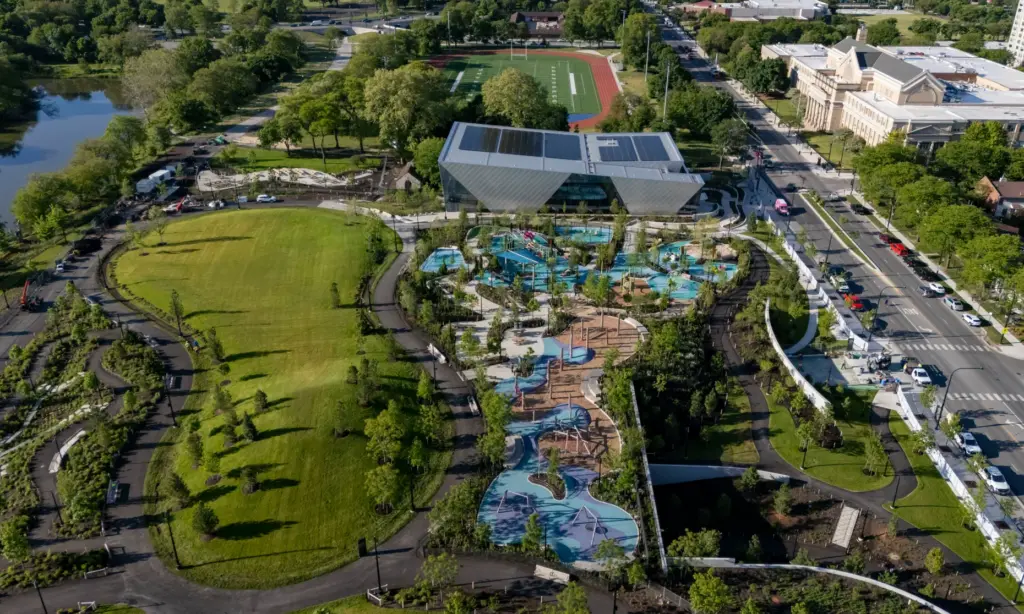 The great lawn and playground on the campus of the Obama Presidential Center, June 3, 2026, in Chicago’s Jackson Park. (Brian Cassella/Chicago Tribune)
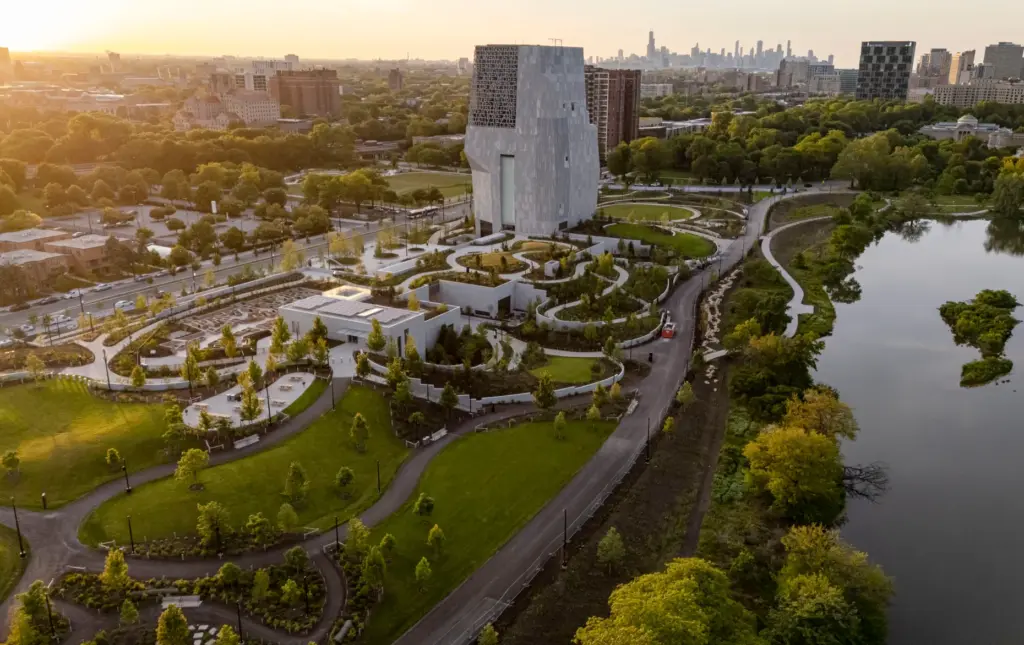 The Obama Presidential Center on June 3, 2026, ahead of its opening in Chicago’s Jackson Park. (Brian Cassella/Chicago Tribune)
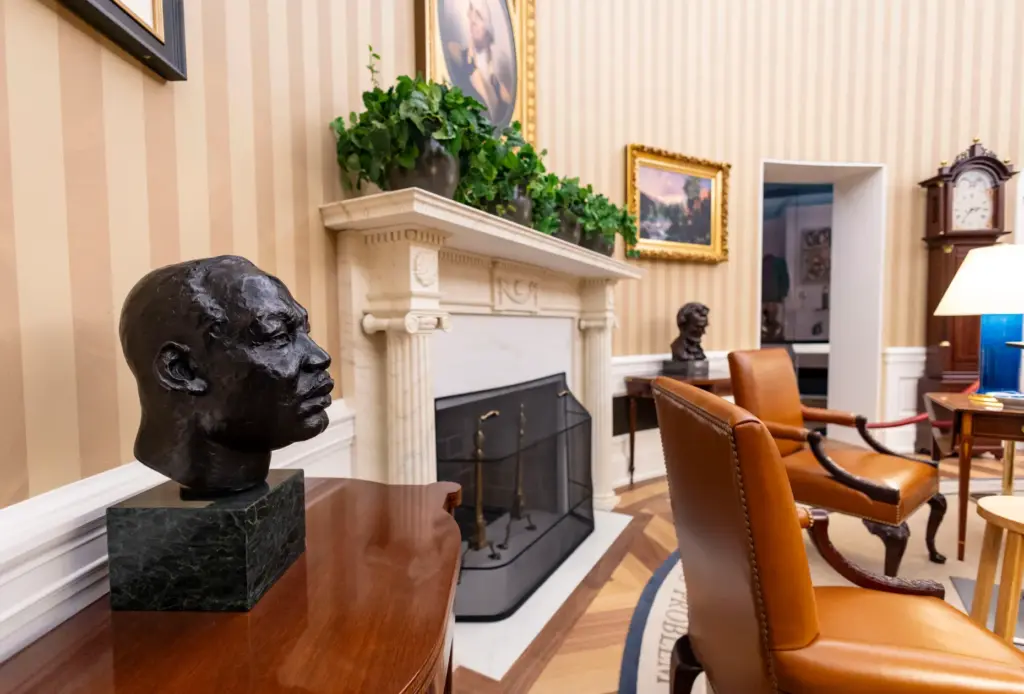 A bust of the Rev. Martin Luther King Jr. displayed in a replica of the Oval Office at the Obama Presidential Center on June 8, 2026, in Chicago’s Jackson Park. (Brian Cassella/Chicago Tribune)
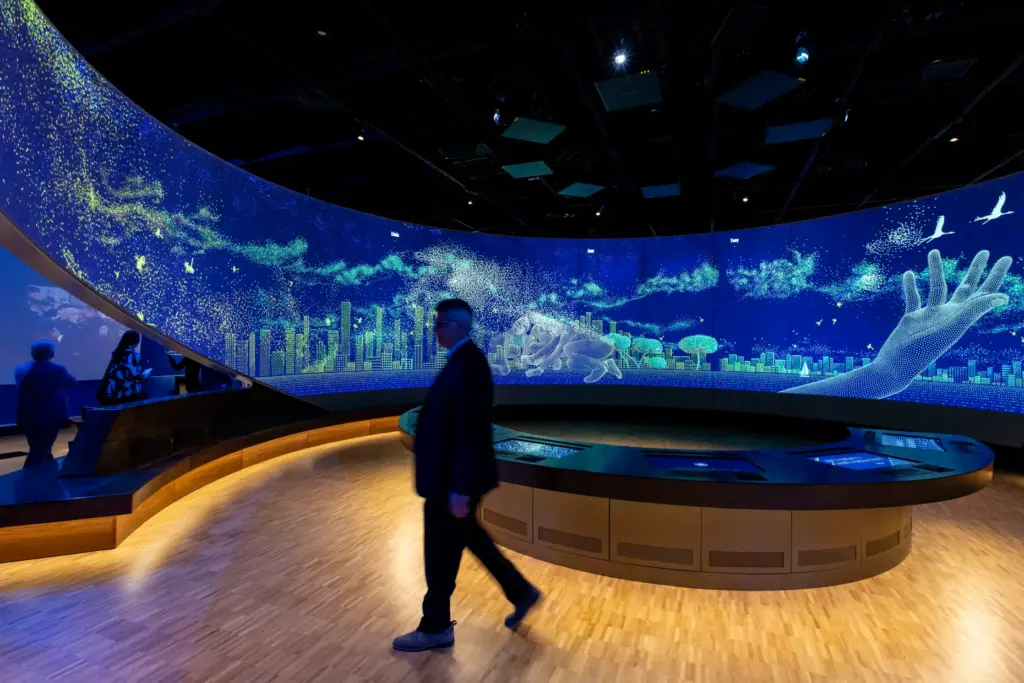 Exhibits on participating in democracy are displayed in the museum at the Obama Presidential Center, June 8, 2026, in Chicago’s Jackson Park. (Brian Cassella/Chicago Tribune)
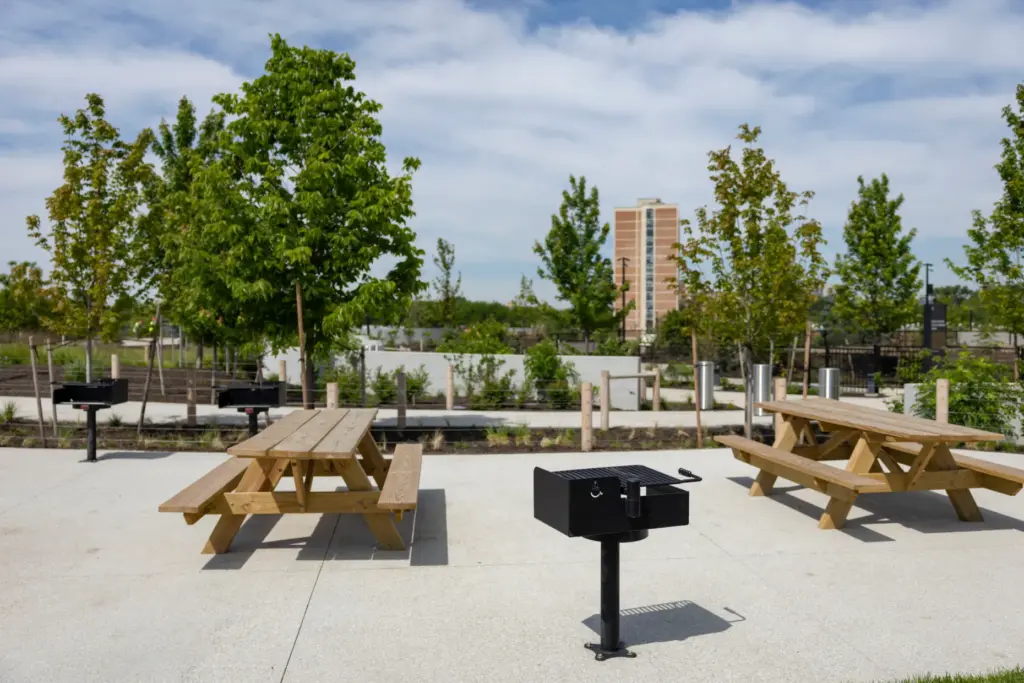 Barbecue grills and tables are available for the public on a rooftop as the Obama Presidential Center, June 3, 2026, in Chicago’s Jackson Park. (Brian Cassella/Chicago Tribune)
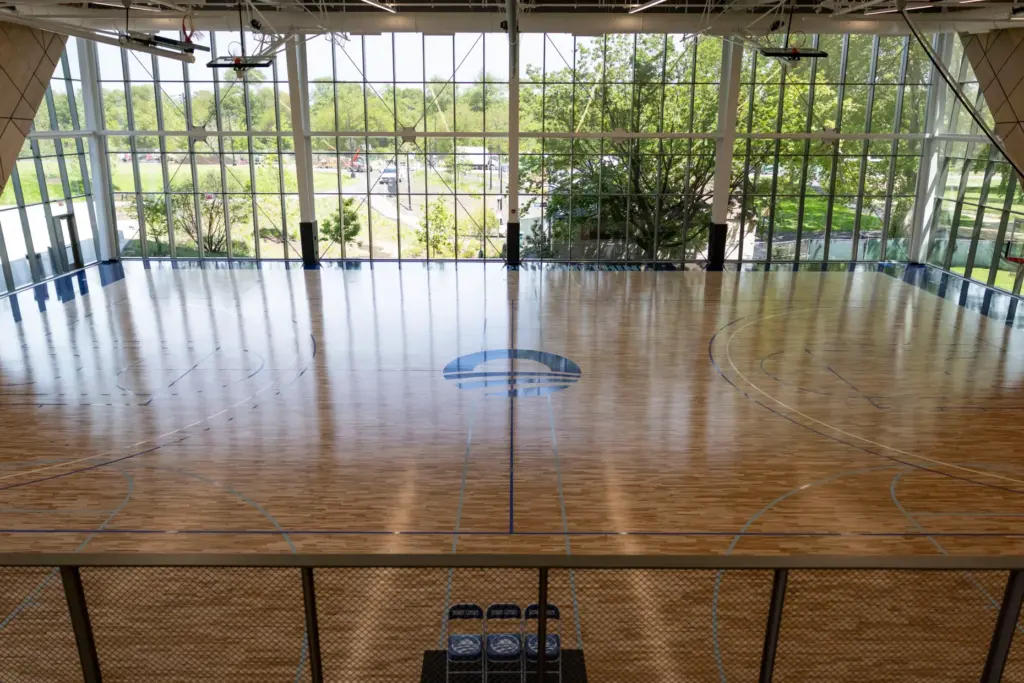 The Home Court at the Obama Presidential Center, June 3, 2026, in Chicago’s Jackson Park. (Brian Cassella/Chicago Tribune)
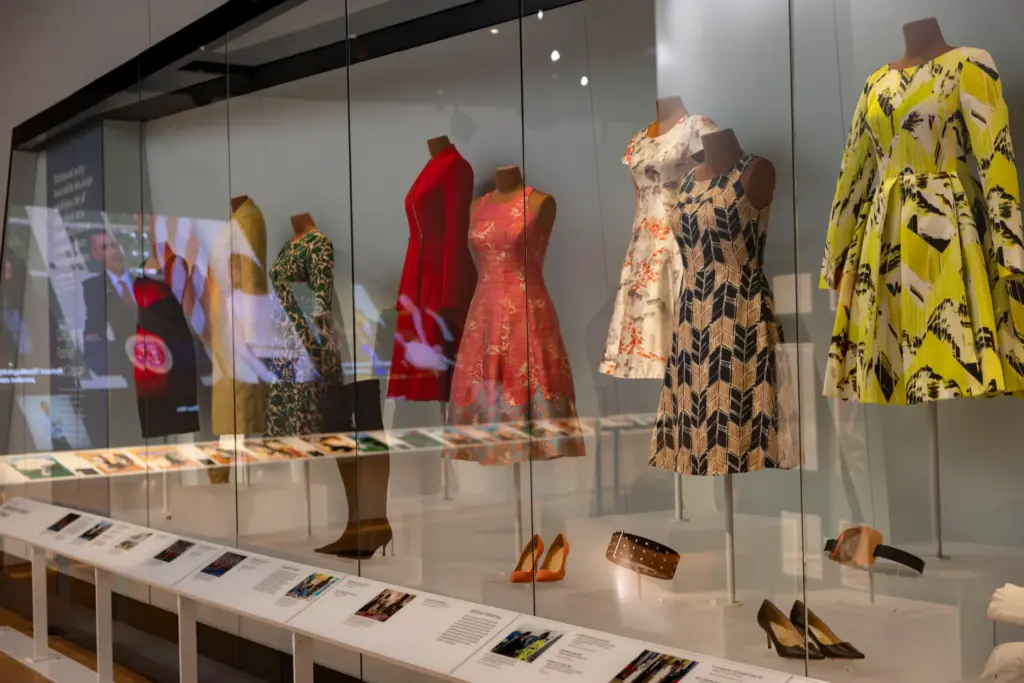 Some of first lady Michelle Obama’s dresses are displayed in the museum at the Obama Presidential Center, June 8, 2026, in Chicago’s Jackson Park. (Brian Cassella/Chicago Tribune)
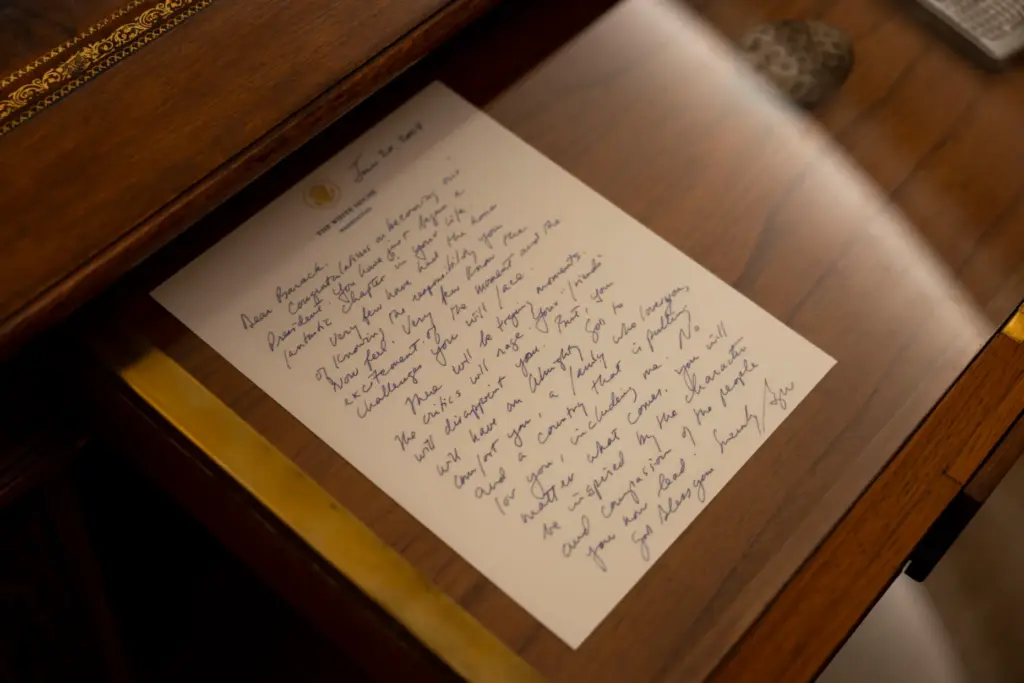 A letter from President George W. Bush to President Barack Obama is displayed in the desk drawer inside a replica of the Oval Office as the Obama Presidential Center prepares for opening, June 3, 2026, in Chicago’s Jackson Park. (Brian Cassella/Chicago Tribune)
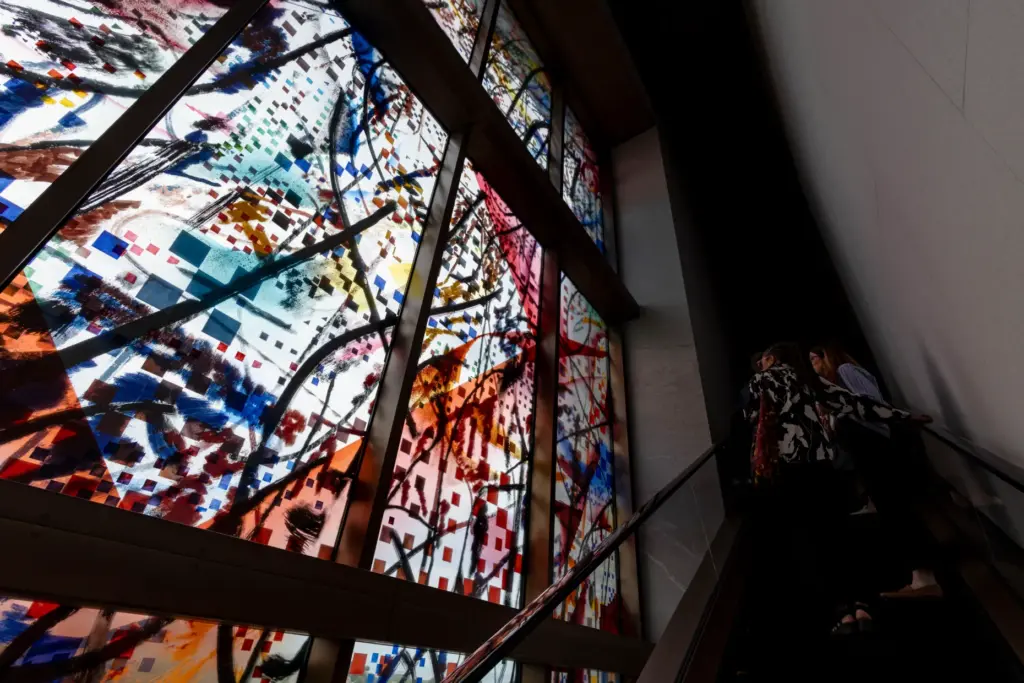 Julie Mehretu’s “Uprising of the Sun” on the north windows by the escalators in the museum at the Obama Presidential Center, June 8, 2026, in Chicago’s Jackson Park. (Brian Cassella/Chicago Tribune)
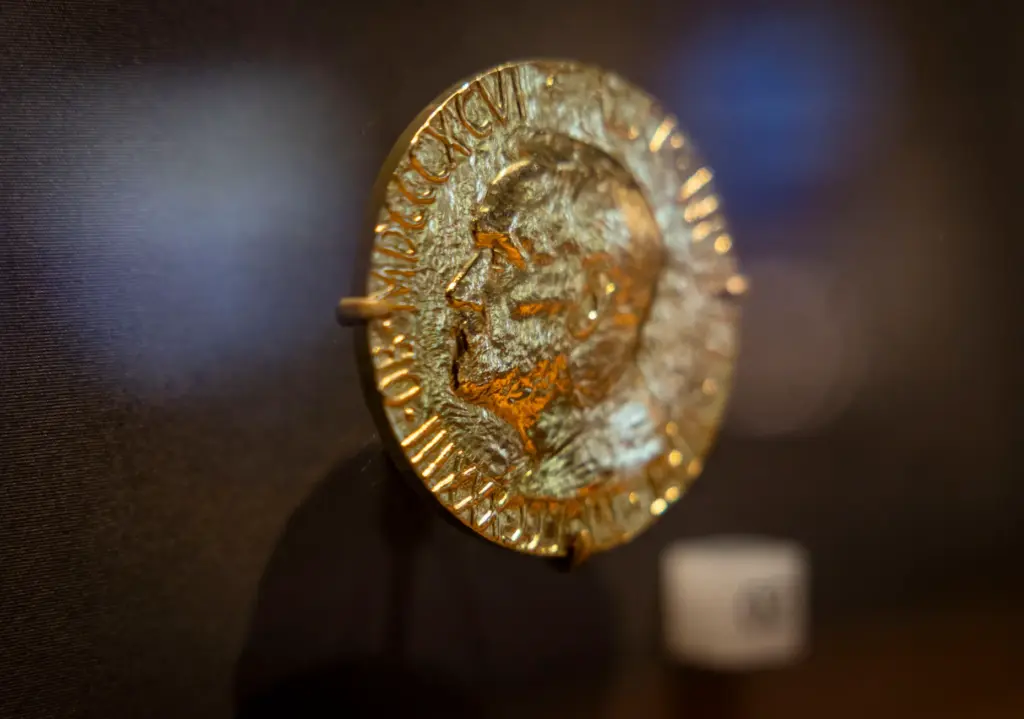 President Barack Obama’s Nobel Peace Prize is displayed at the Obama Presidential Center, June 8, 2026, in Chicago. (Brian Cassella/Chicago Tribune)
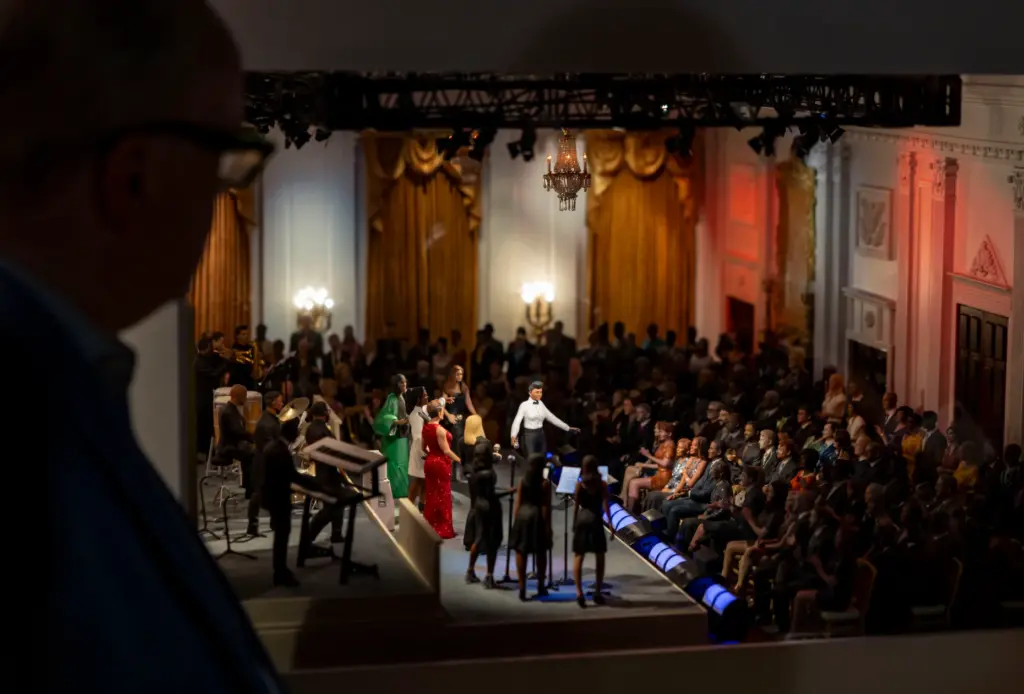 A miniature model of Janelle Monet performing in the East Room of the White House is displayed at the Obama Presidential Center, June 8, 2026, in Chicago’s Jackson Park. (Brian Cassella/Chicago Tribune)
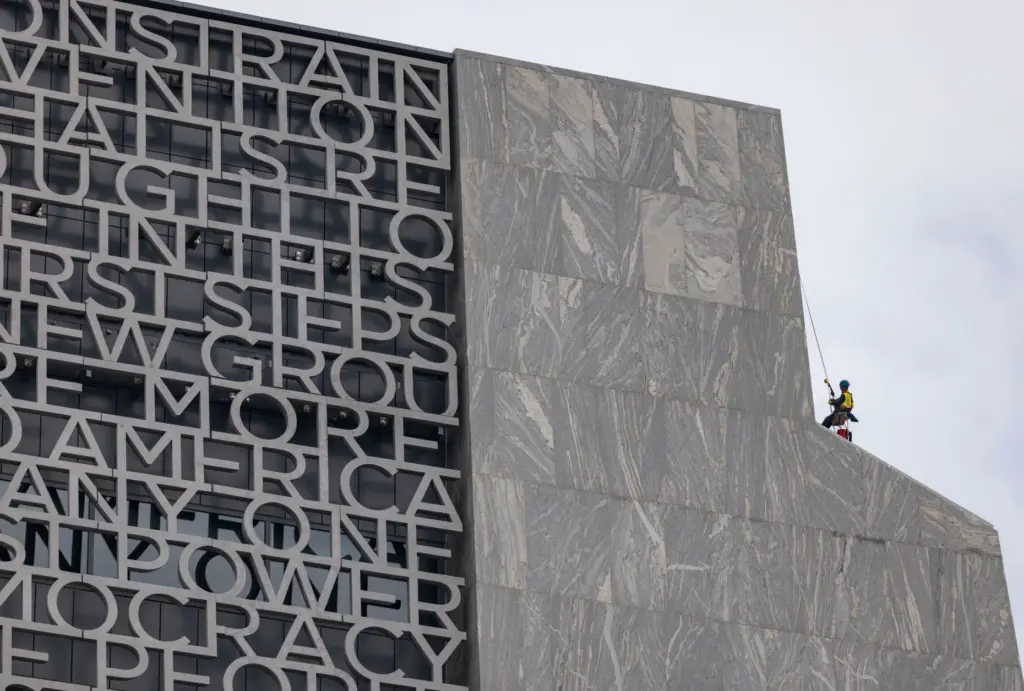 A worker climbs outside the building as preparations continue at the Obama Presidential Center, June 8, 2026, in Chicago’s Jackson Park. (Brian Cassella/Chicago Tribune)
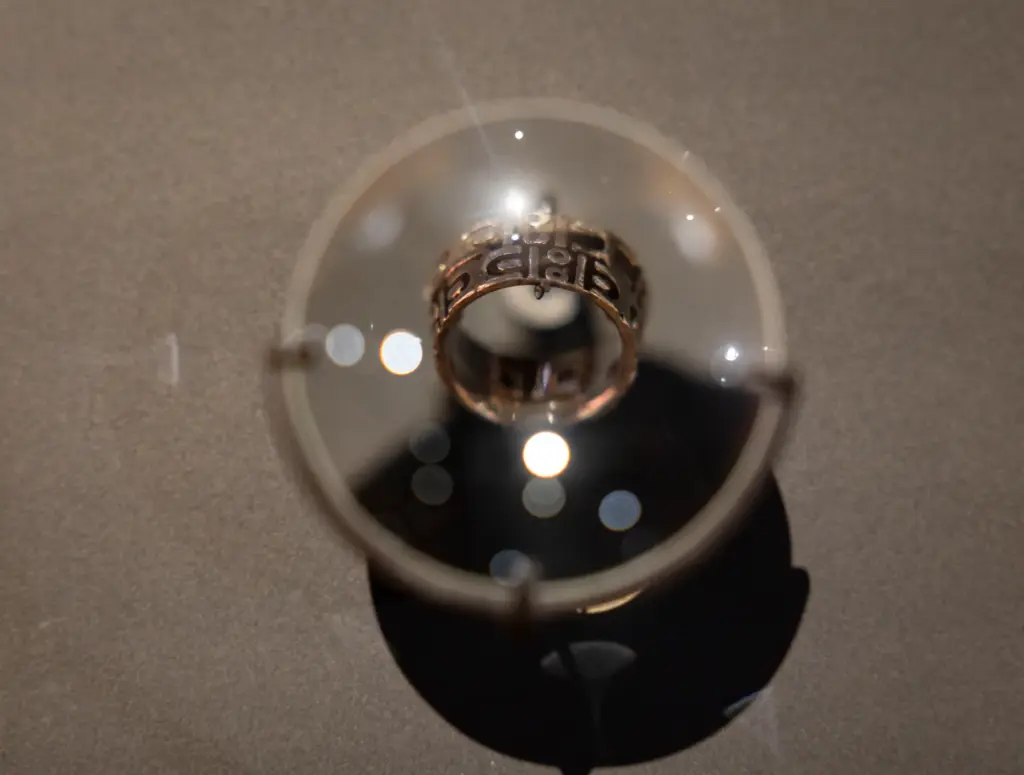 A wedding ring belonging to Jim Obergefell, a plaintiff in the landmark 2015 Supreme Court case Obergefell v. Hodges that allowed marriage equality, is displayed at the Obama Presidential Center, June 8, 2026, in Chicago’s Jackson Park. (Brian Cassella/Chicago Tribune)
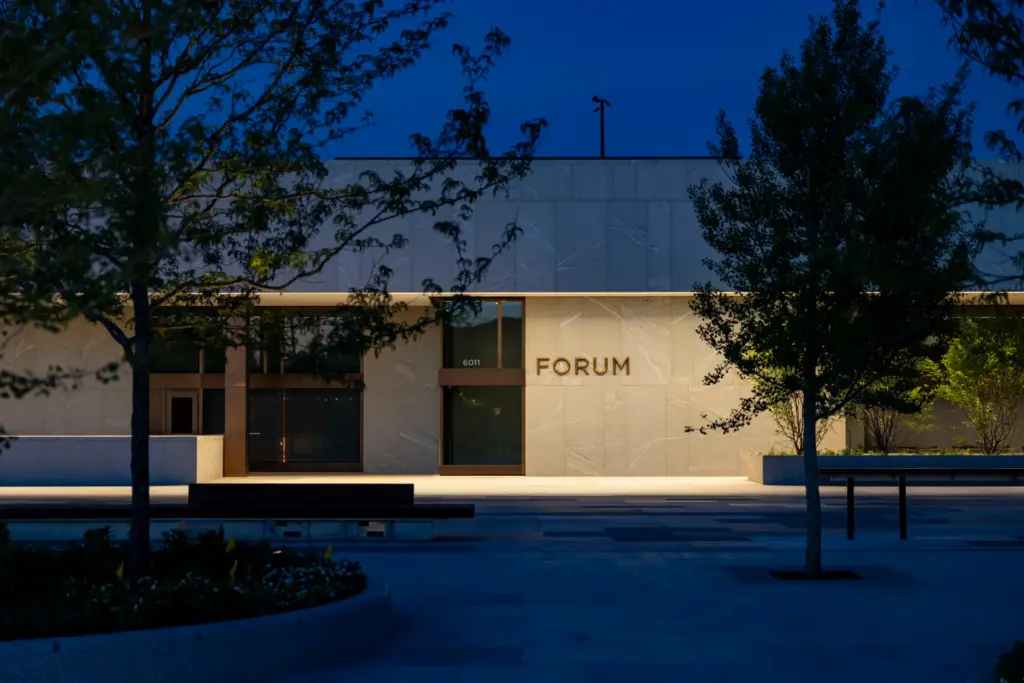 The Forum building on June 3, 2026, as the Obama Presidential Center prepares for opening in Chicago’s Jackson Park. (Brian Cassella/Chicago Tribune)
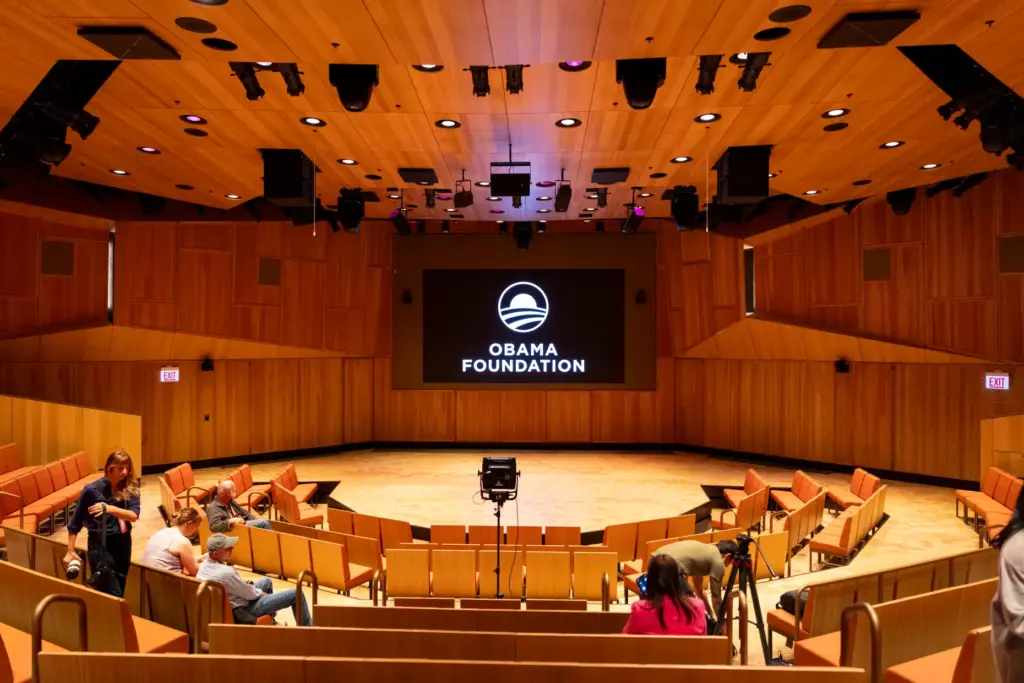 The Elie Wiesel Auditorium in the Forum at the Obama Presidential Center, June 3, 2026, in Chicago’s Jackson Park. (Brian Cassella/Chicago Tribune)
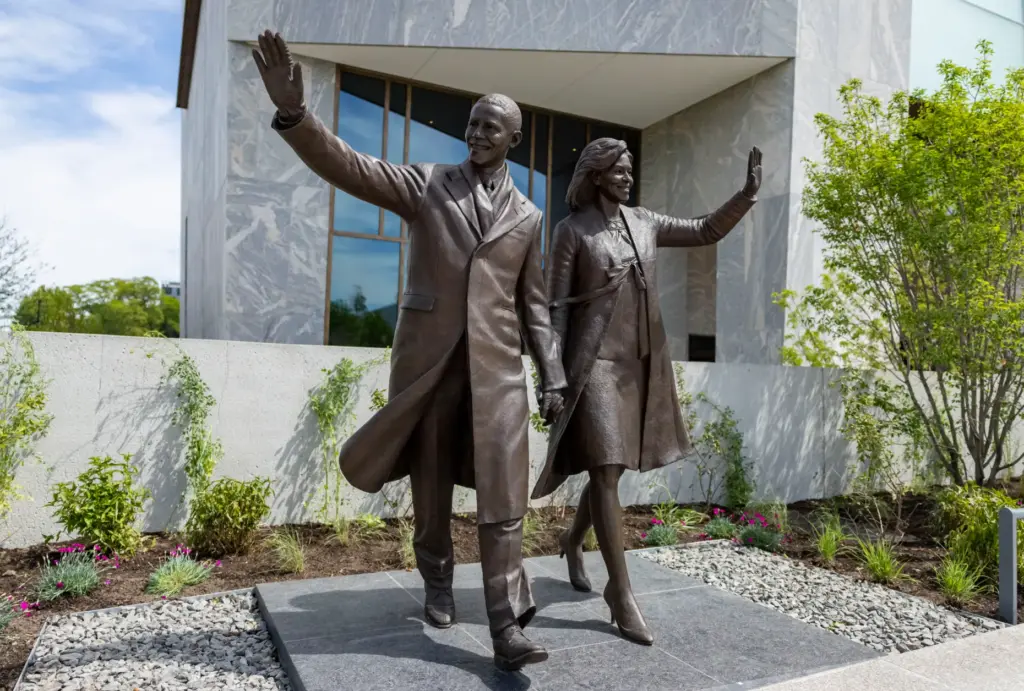 A statue of President Barack Obama and first lady Michelle Obama from the 2009 inauguration greets visitors June 3, 2026, at the Obama Presidential Center in Chicago’s Jackson Park. (Brian Cassella/Chicago Tribune)
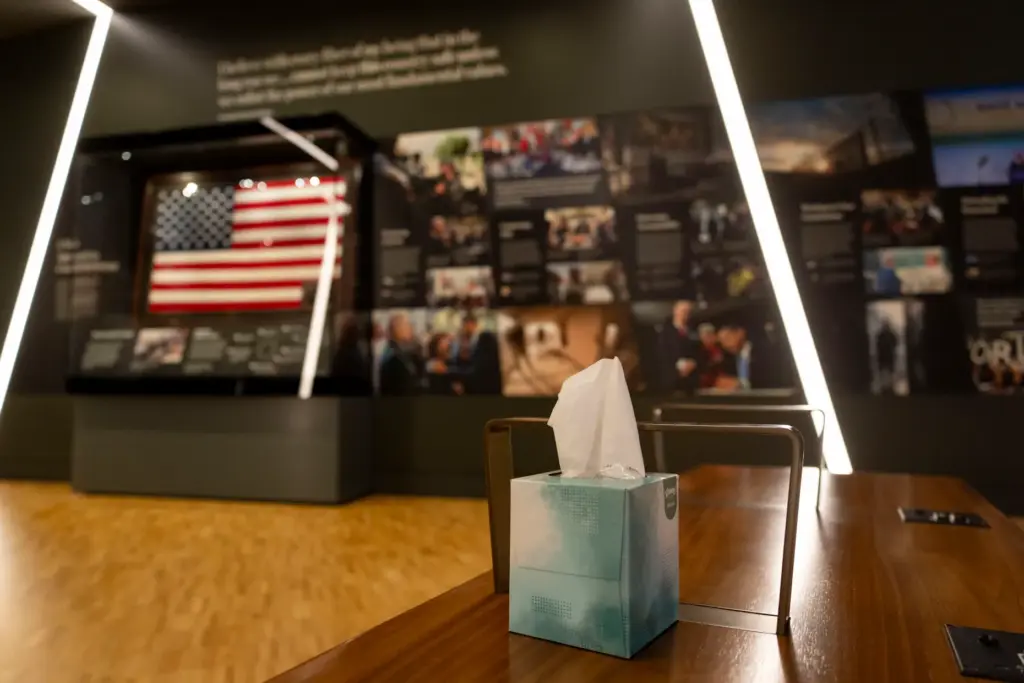 Tissues are available in an exhibit gallery at the Obama Presidential Center, June 8, 2026, in Chicago’s Jackson Park. (Brian Cassella/Chicago Tribune)
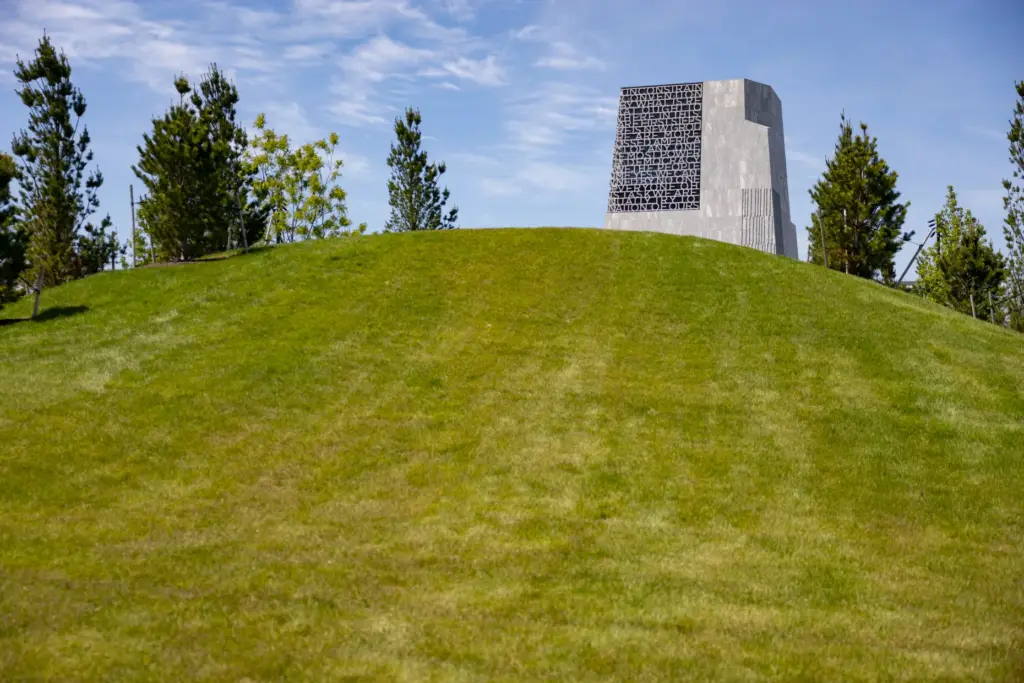 Green hills surround the Obama Presidential Center as the campus prepares for opening, June 3, 2026, in Chicago’s Jackson Park. (Brian Cassella/Chicago Tribune)
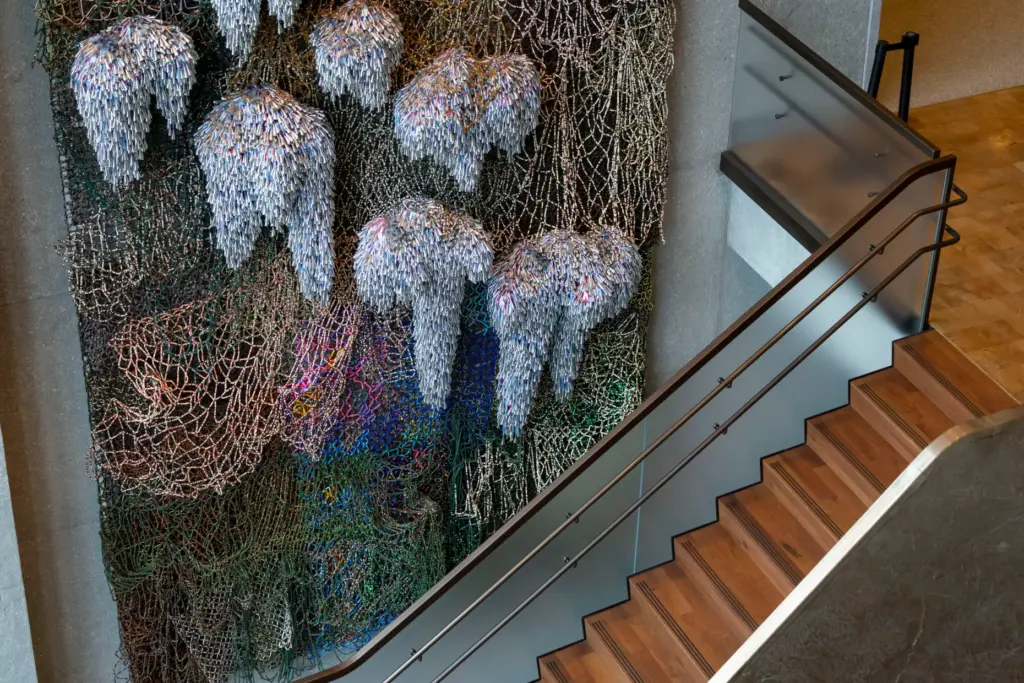 Nick Cave and Marie Watt’s artwork “This Land, Shared Sky” next to a staircase in the lobby at the Obama Presidential Center, June 8, 2026, in Chicago’s Jackson Park. (Brian Cassella/Chicago Tribune)
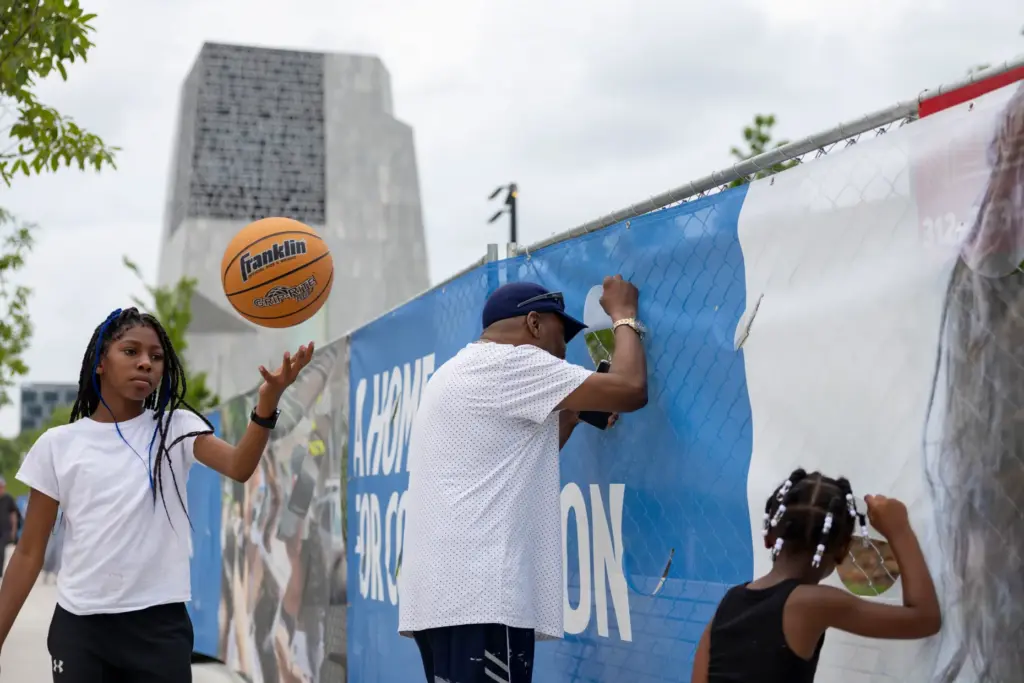 Alfred Coleman brings his granddaughters Peyton, 12, and Alyah, 4, to peek through the fence at the Obama Presidential Center, June 8, 2026, in Chicago’s Jackson Park. (Brian Cassella/Chicago Tribune)
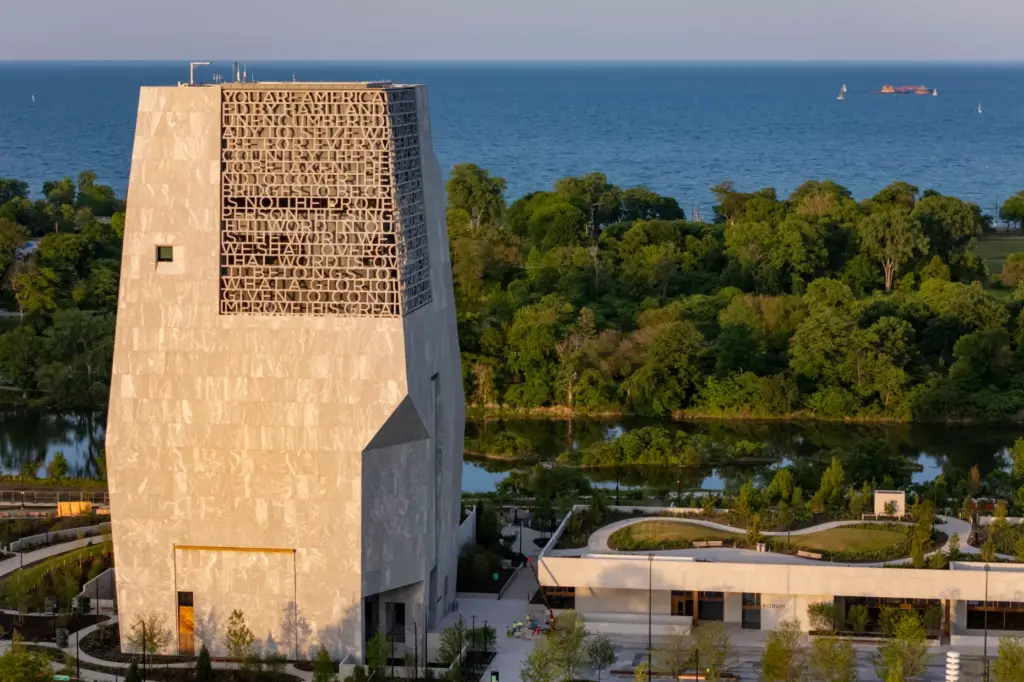 The Obama Presidential Center on June 3, 2026, before its opening in Chicago’s Jackson Park. (Brian Cassella/Chicago Tribune)
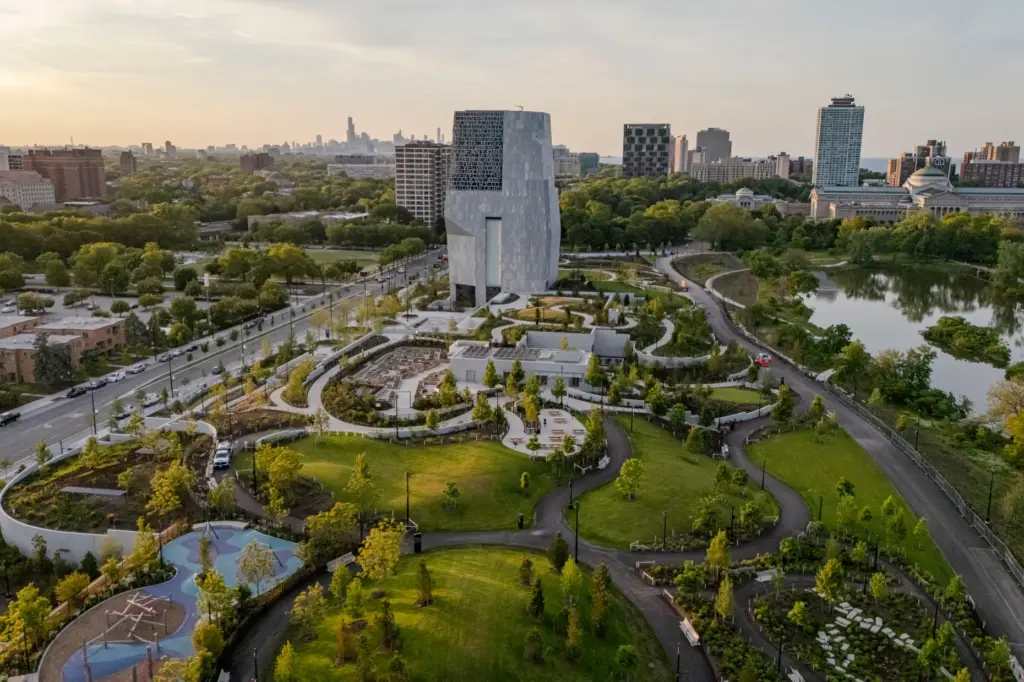 The Obama Presidential Center on June 3, 2026, ahead of its opening in Chicago’s Jackson Park. (Brian Cassella/Chicago Tribune)
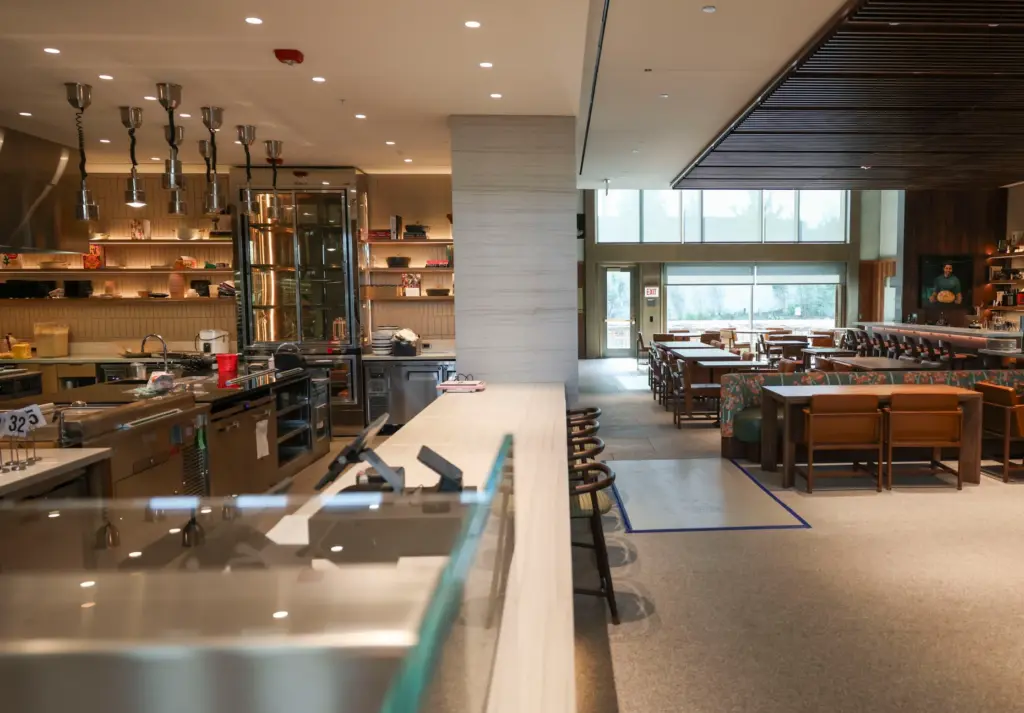 Tafari’s Kitchen restaurant, named for the late White House chef Tafari Campbell, is prepared for opening June 3, 2026, at the the Obama Presidential Center in Chicago’s Jackson Park. (Brian Cassella/Chicago Tribune)
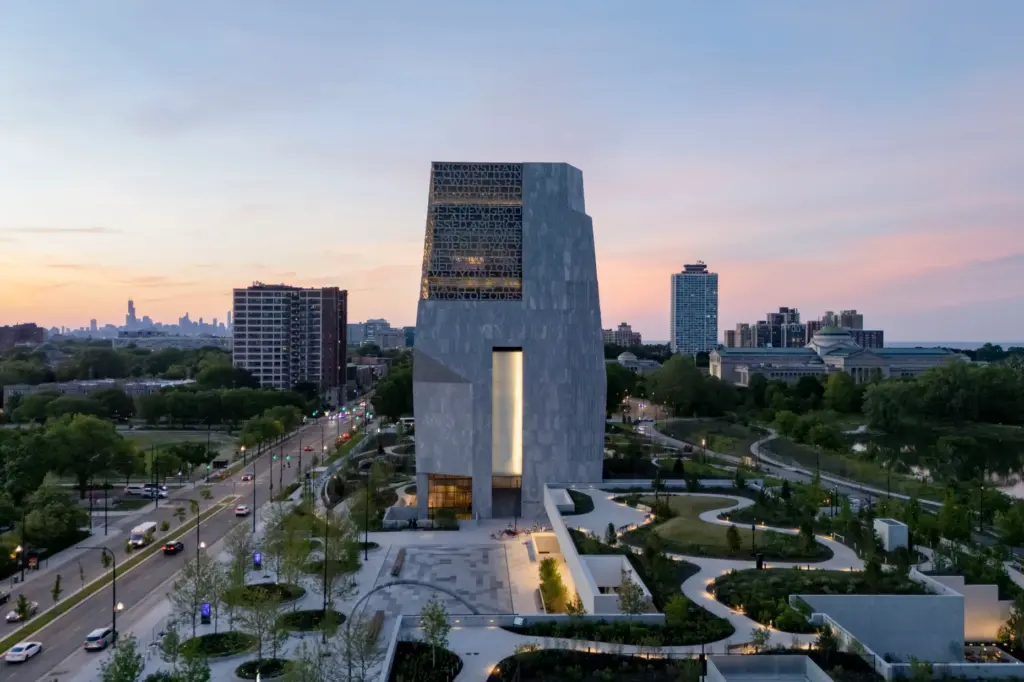 The Obama Presidential Center on June 3, 2026, ahead of its opening in Chicago’s Jackson Park. The almost 20-acre campus includes free park and garden spaces. (Brian Cassella/Chicago Tribune)
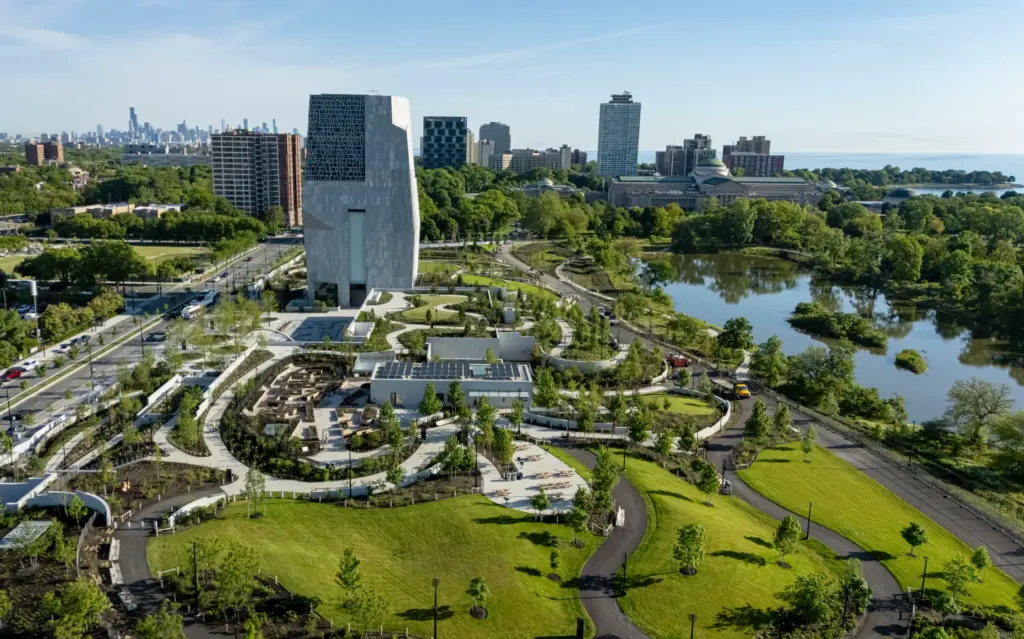 The Obama Presidential Center on June 3, 2026, as it prepares for opening in Chicago’s Jackson Park. The almost 20-acre campus includes free park and garden spaces. (Brian Cassella/Chicago Tribune)
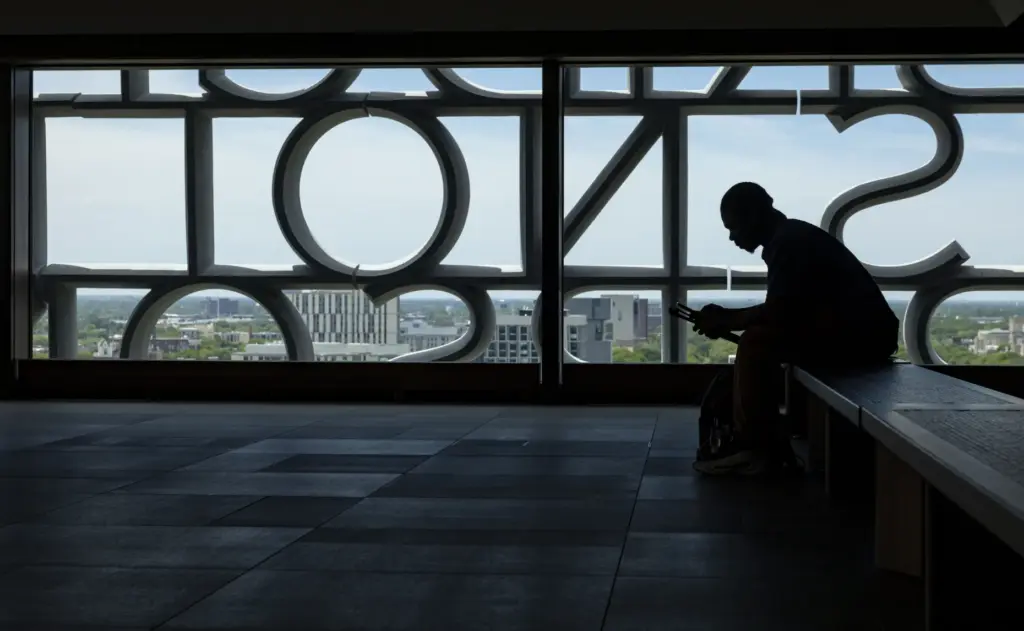 A visitor sits in the Sky Room as the Obama Presidential Center prepares for opening, June 3, 2026, in Chicago’s Jackson Park. (Brian Cassella/Chicago Tribune)
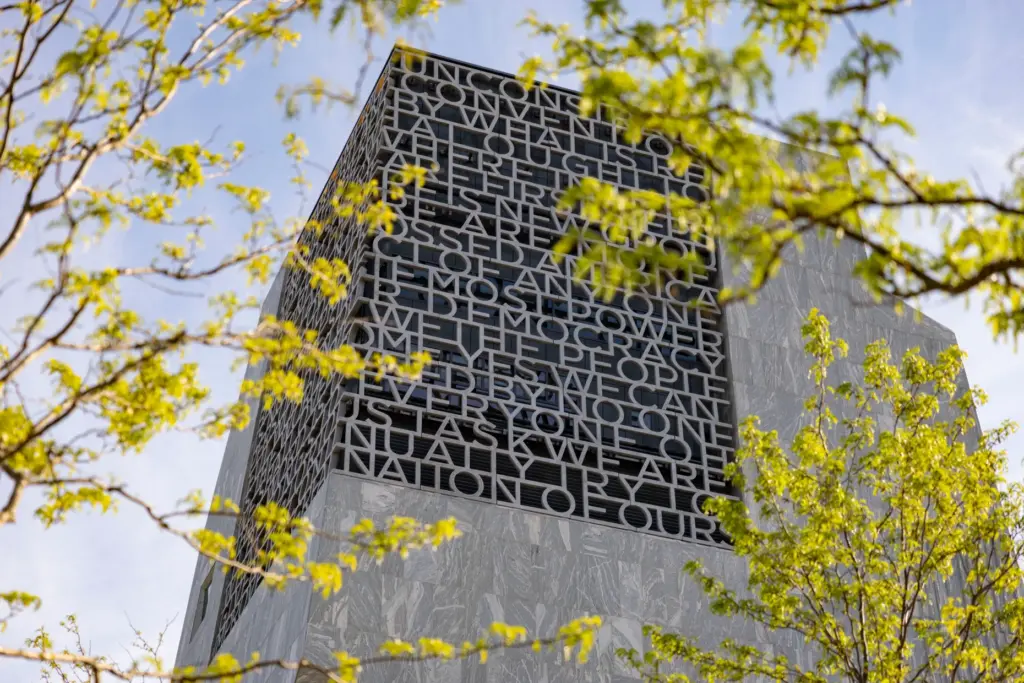 The Obama Presidential Center prepares for opening, June 3, 2026, in Chicago’s Jackson Park. (Brian Cassella/Chicago Tribune)
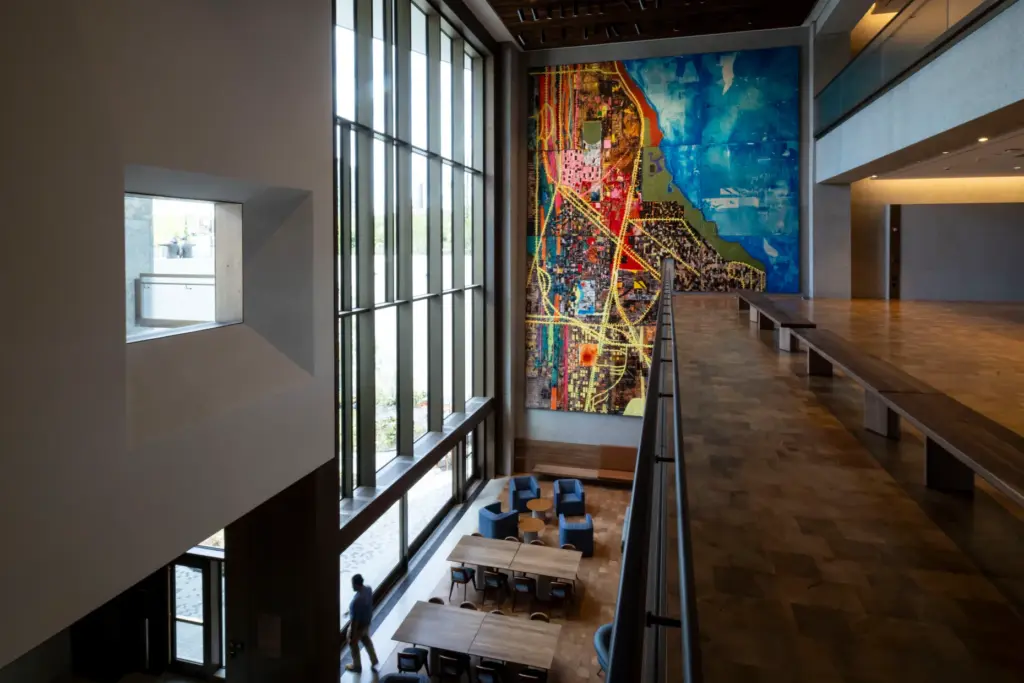 Artwork by Mark Bradford fills a wall between the garden and entry levels of the museum at the Obama Presidential Center prepares for opening on June 3, 2026, in Chicago’s Jackson Park. (Brian Cassella/Chicago Tribune)
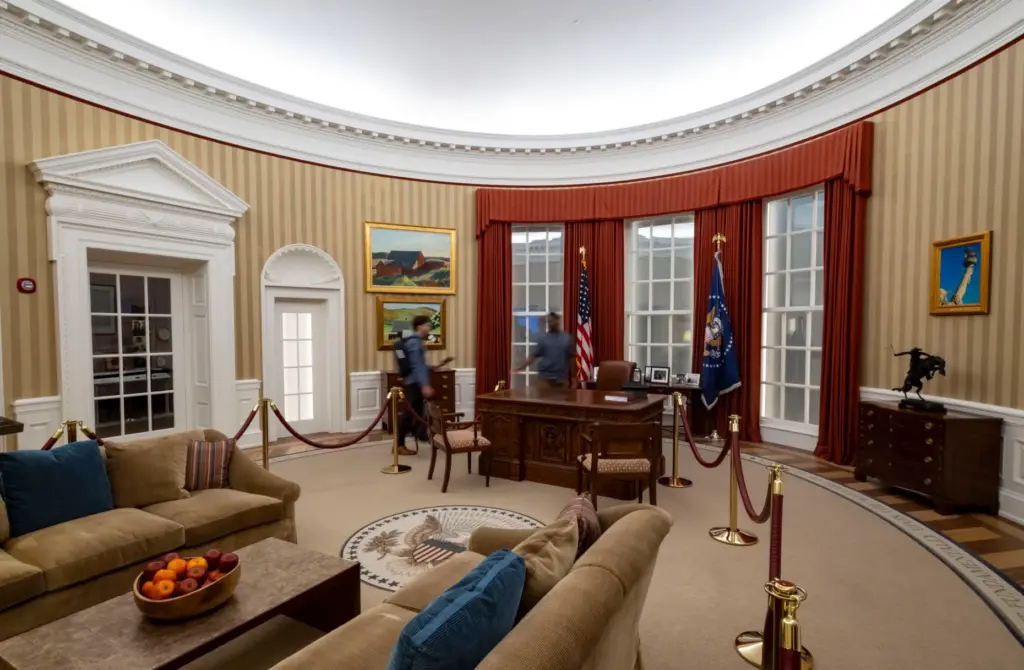 A replica of the Oval Office is on display as the Obama Presidential Center prepares for opening, June 3, 2026, in Chicago’s Jackson Park. (Brian Cassella/Chicago Tribune)
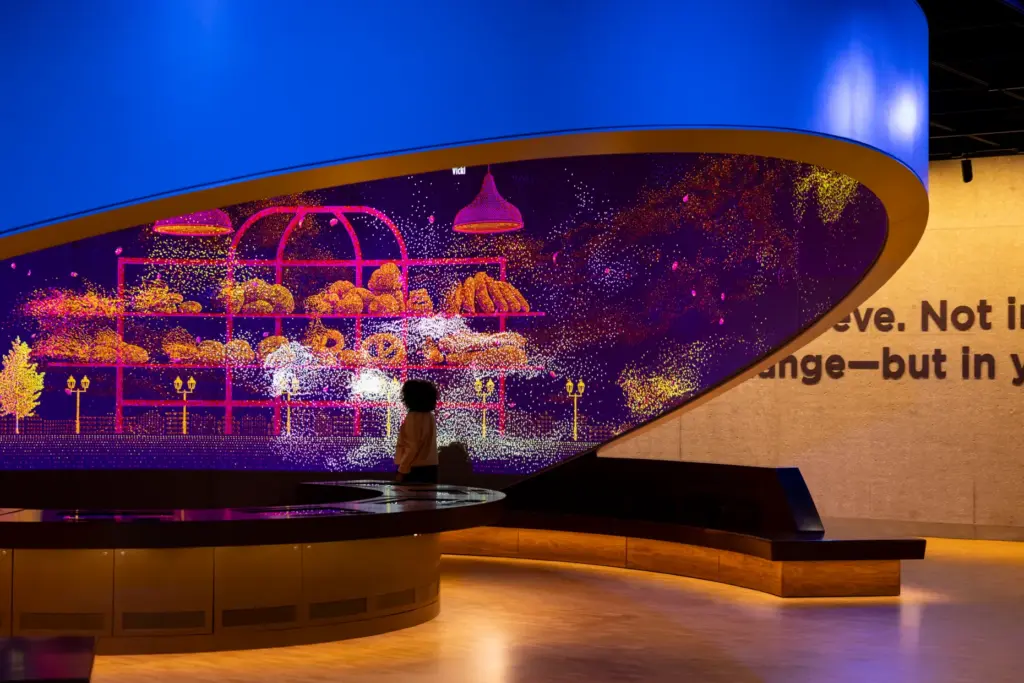 Exhibits encourage political participation as the Obama Presidential Center prepares for opening, June 3, 2026, in Chicago’s Jackson Park. (Brian Cassella/Chicago Tribune)
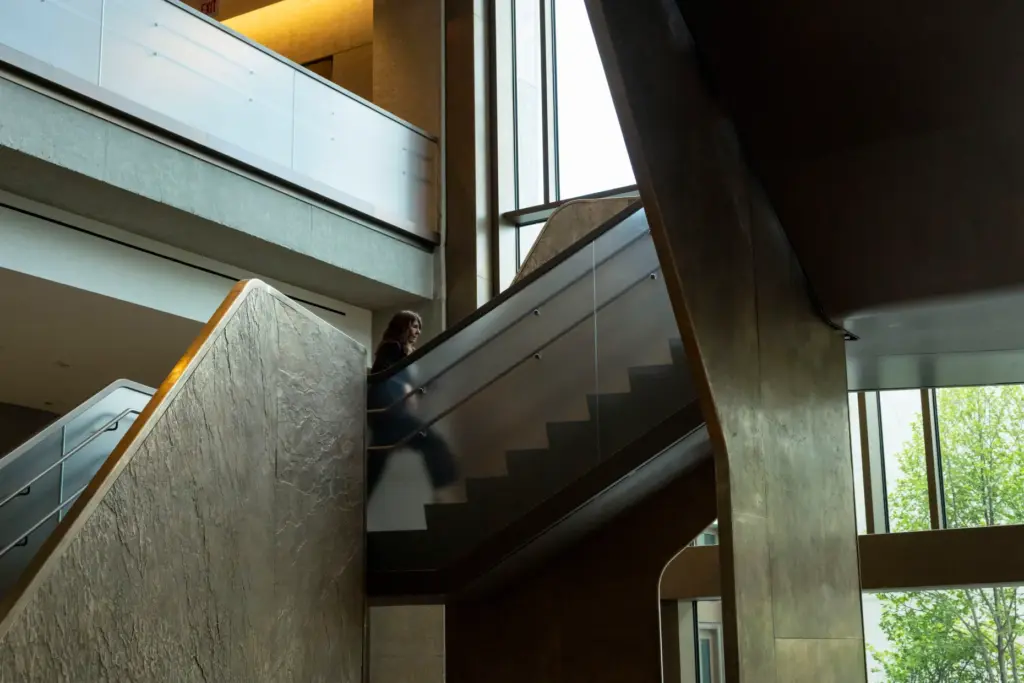 A stairway links the main floor with the garden level as the Obama Presidential Center prepares for opening, June 3, 2026, in Chicago’s Jackson Park. (Brian Cassella/Chicago Tribune)
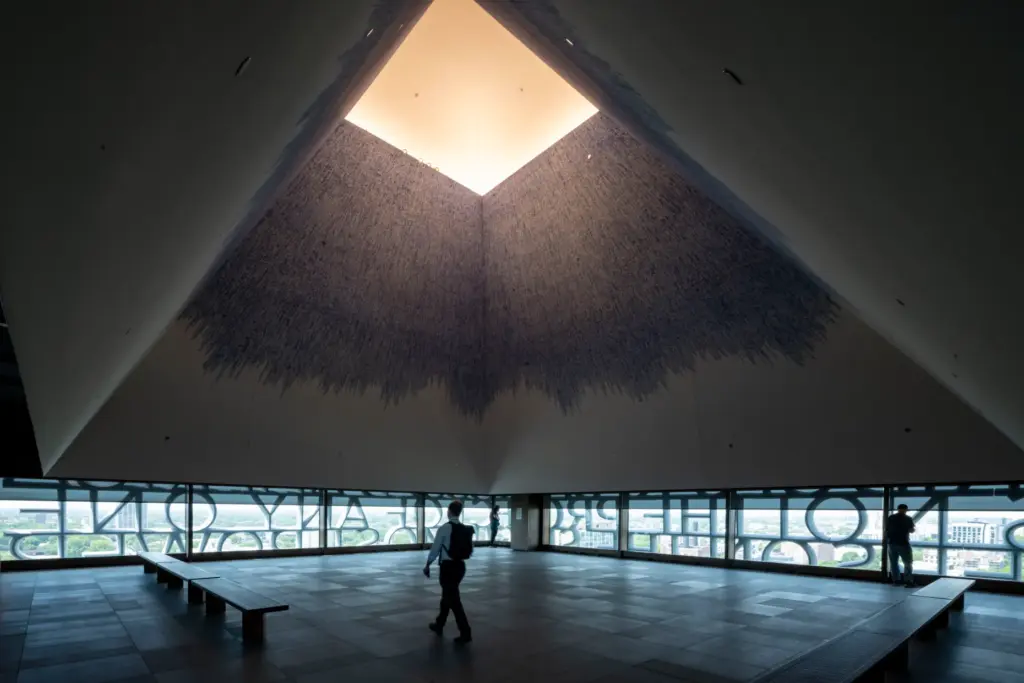 Visitors tour the Sky Room as the Obama Presidential Center prepares for opening, June 3, 2026, in Chicago’s Jackson Park. (Brian Cassella/Chicago Tribune)
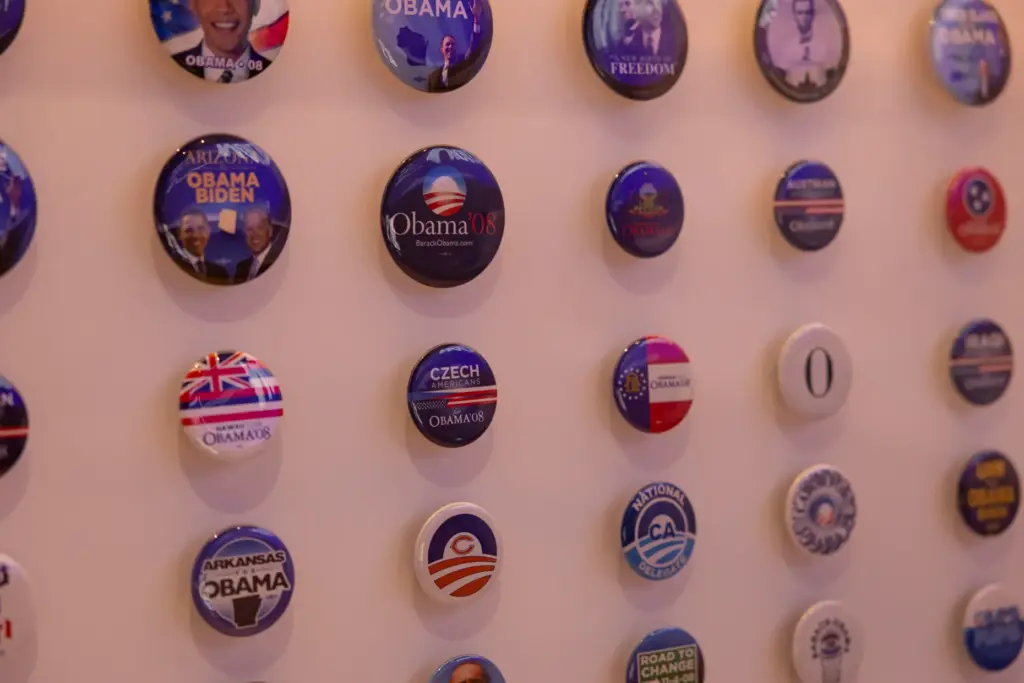 Campaign buttons from 2008 are displayed as the Obama Presidential Center prepares for opening, June 3, 2026, in Chicago’s Jackson Park. (Brian Cassella/Chicago Tribune)
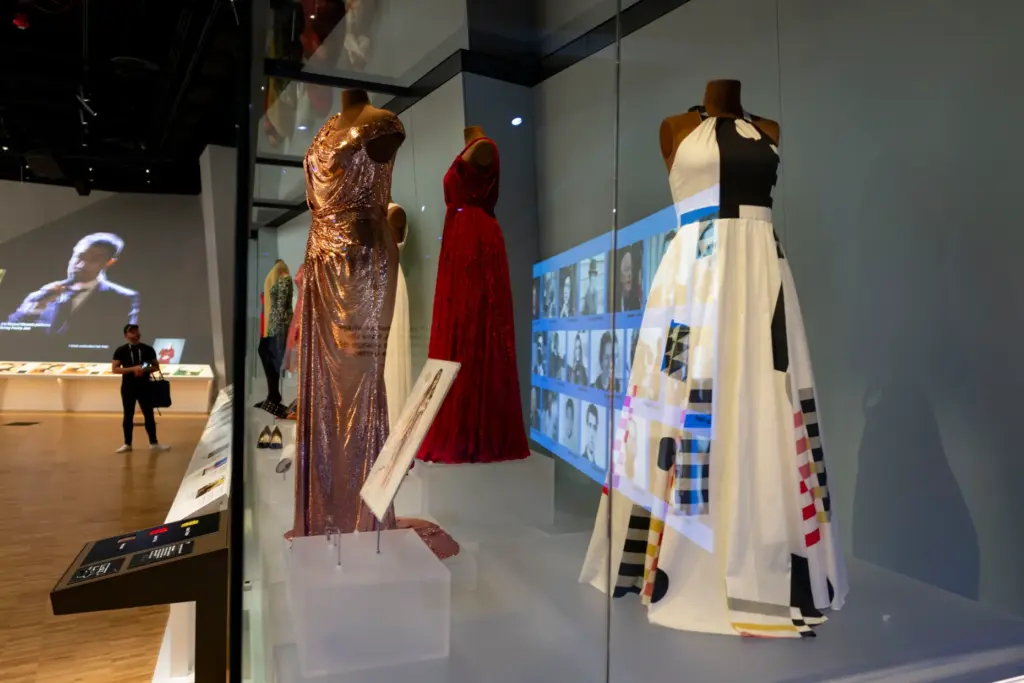 Some of Michelle Obama’s dresses are displayed as the Obama Presidential Center prepares for opening, June 3, 2026, in Chicago’s Jackson Park. (Brian Cassella/Chicago Tribune)
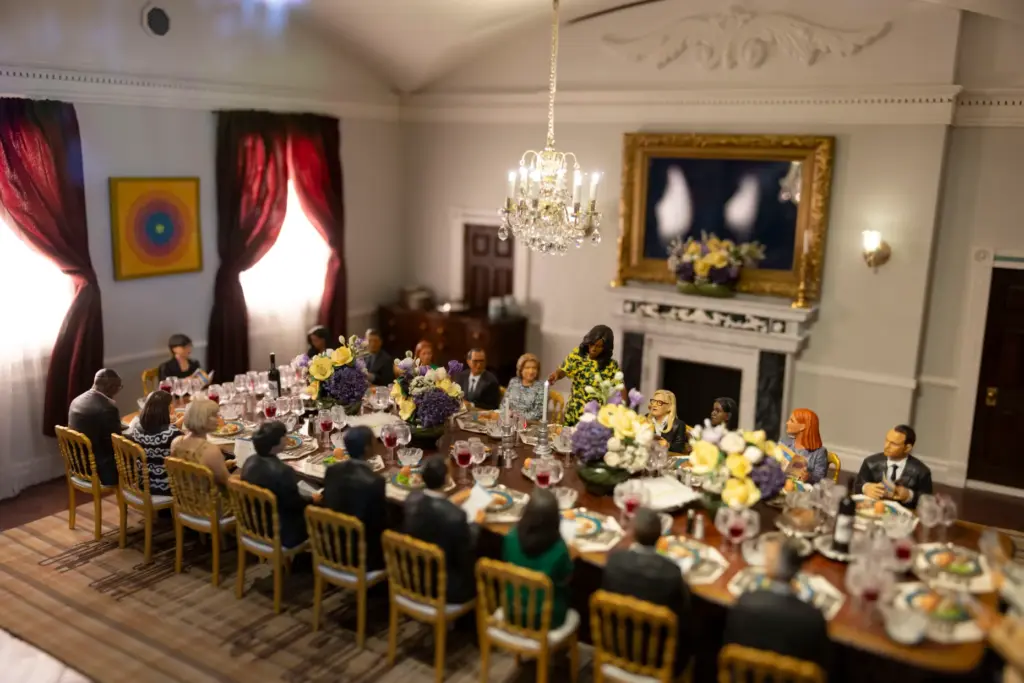 Miniatures depict a Passover Seder in the White House from 2016 as the Obama Presidential Center prepares for opening, June 3, 2026, in Chicago’s Jackson Park. (Brian Cassella/Chicago Tribune)
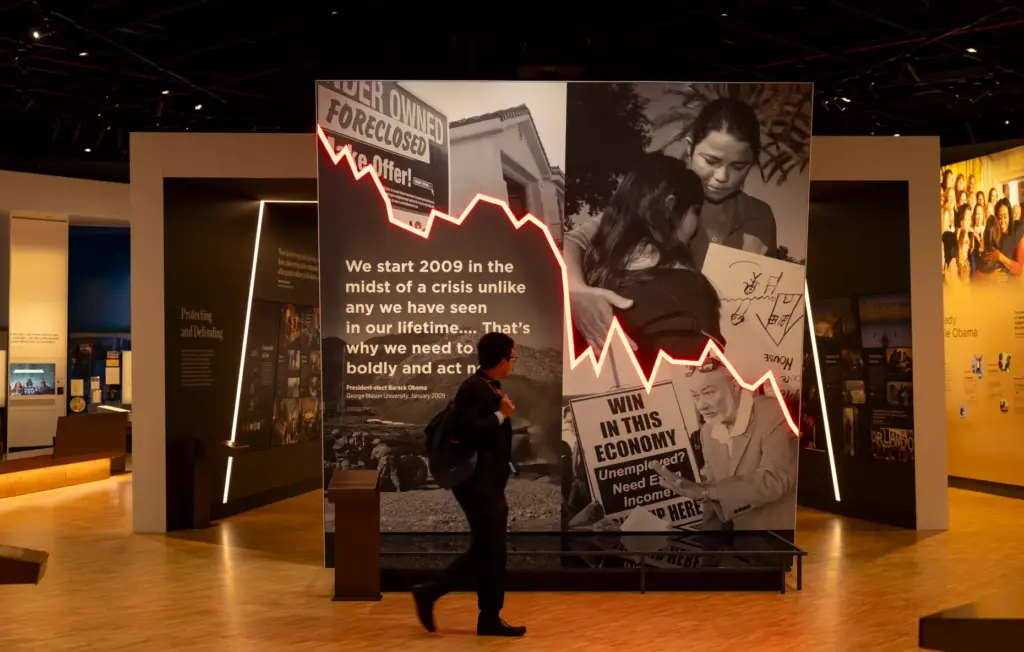 Exhibits are displayed as the Obama Presidential Center prepares for opening, June 3, 2026, in Chicago’s Jackson Park. (Brian Cassella/Chicago Tribune)
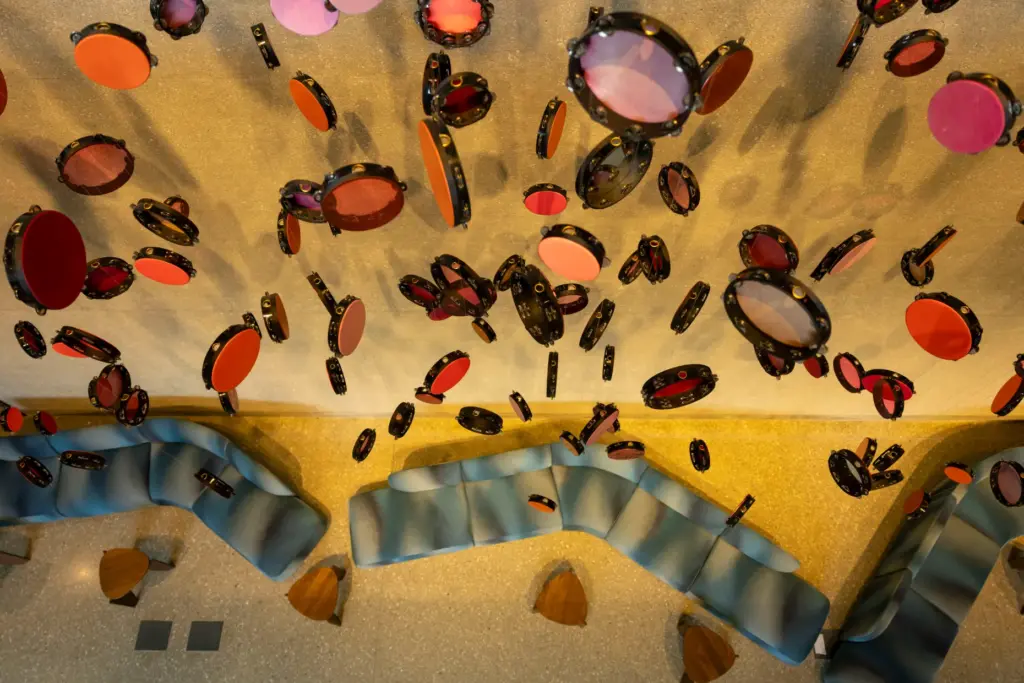 Artwork fills the entry level as the Obama Presidential Center prepares for opening, June 3, 2026, in Chicago’s Jackson Park. (Brian Cassella/Chicago Tribune)
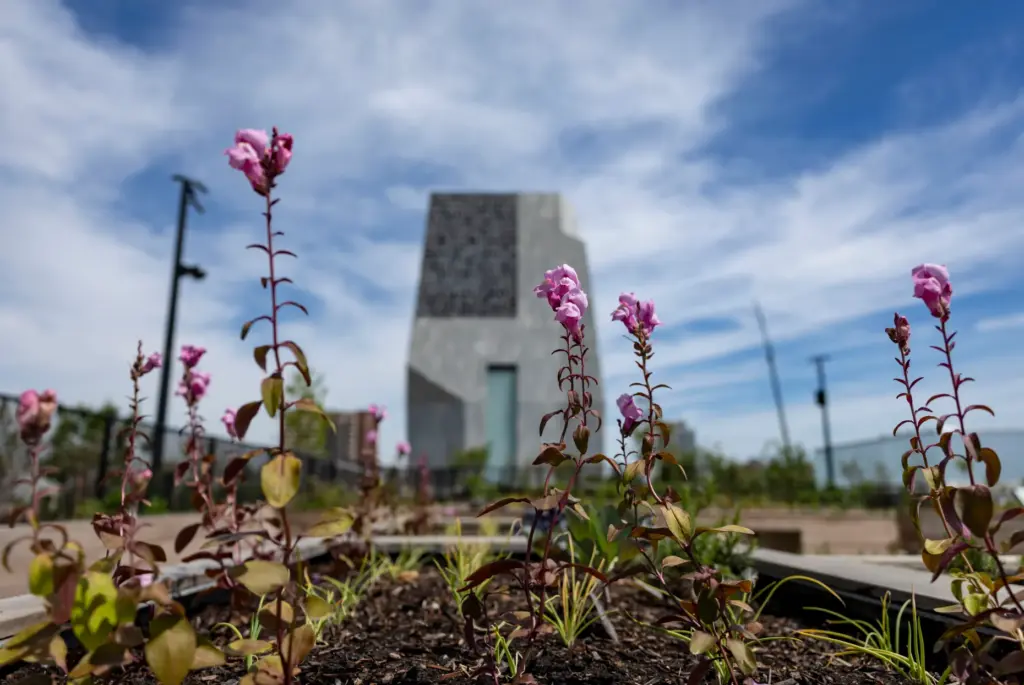 Plants grow in the Eleanor Roosevelt Fruit and Vegetable Garden as the Obama Presidential Center prepares for opening, June 3, 2026, in Chicago’s Jackson Park. (Brian Cassella/Chicago Tribune)
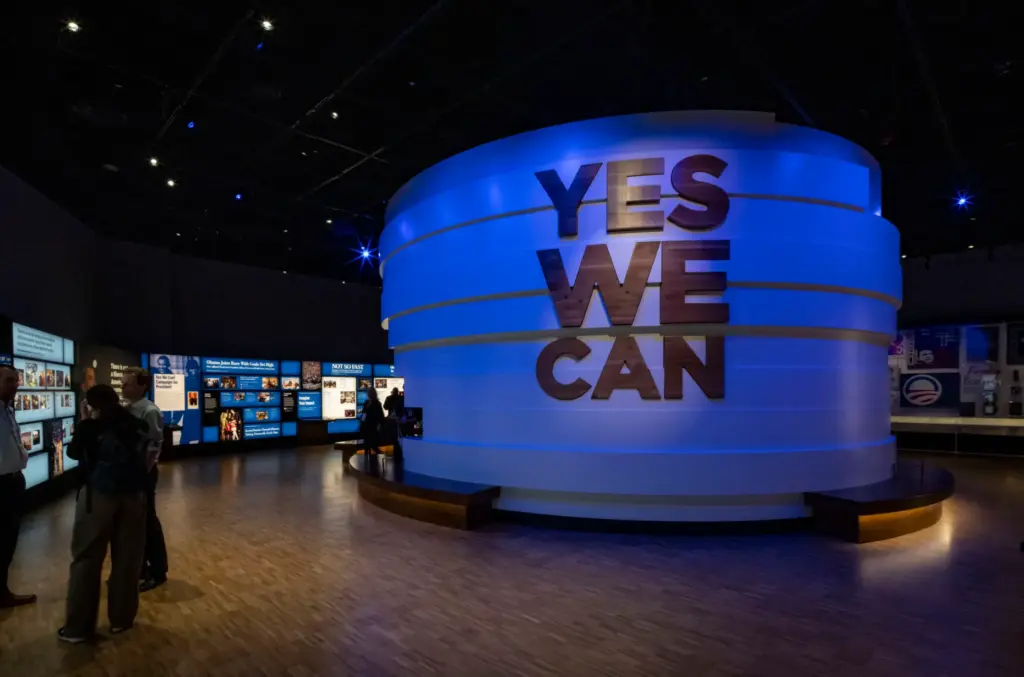 Exhibits from the 2008 campaign are displayed as the Obama Presidential Center prepares for opening, June 3, 2026, in Chicago’s Jackson Park. (Brian Cassella/Chicago Tribune)
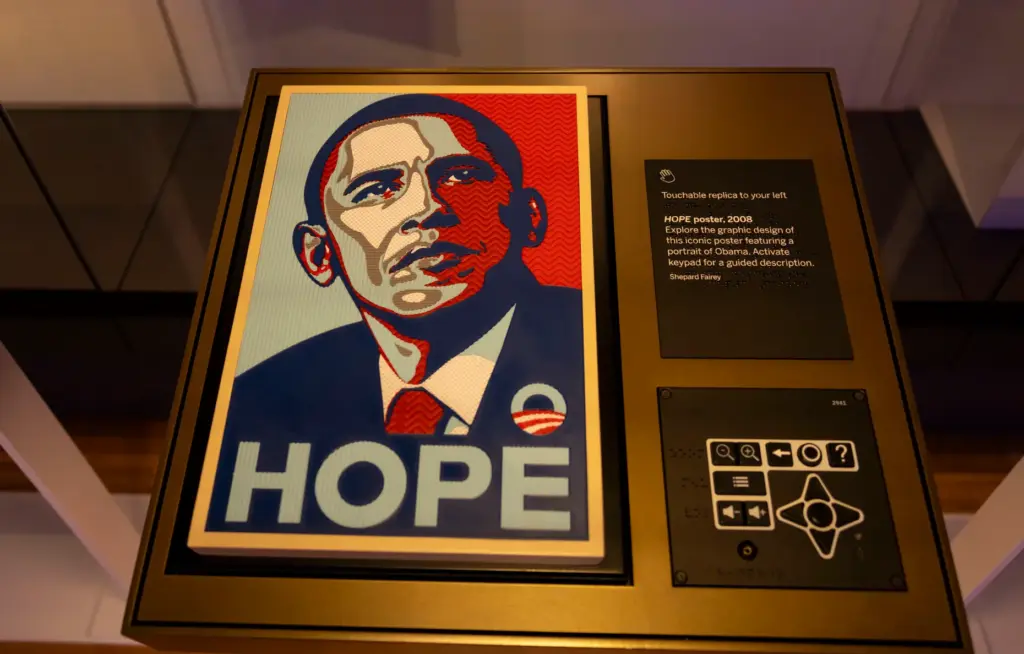 A sensory exhibit invites visitors to touch a reproduction of the Shephard Fairey campaign poster as the Obama Presidential Center prepares for opening, June 3, 2026, in Chicago’s Jackson Park. (Brian Cassella/Chicago Tribune)
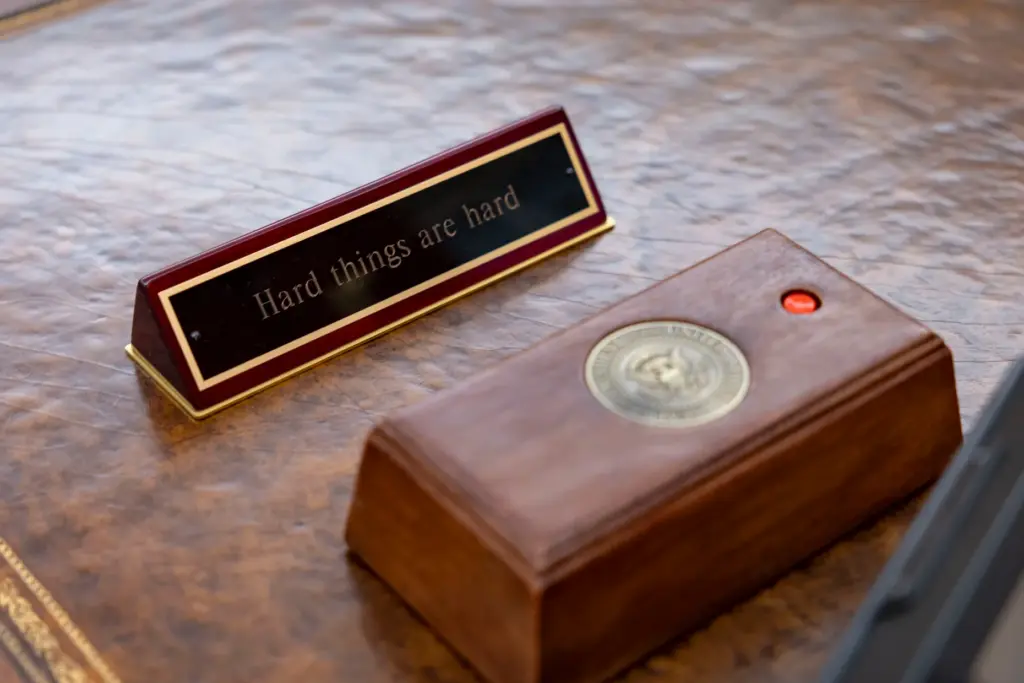 A sign is visible on a replica of the Resolute Desk in the Oval Office as the Obama Presidential Center prepares for opening, June 3, 2026, in Chicago’s Jackson Park. (Brian Cassella/Chicago Tribune)
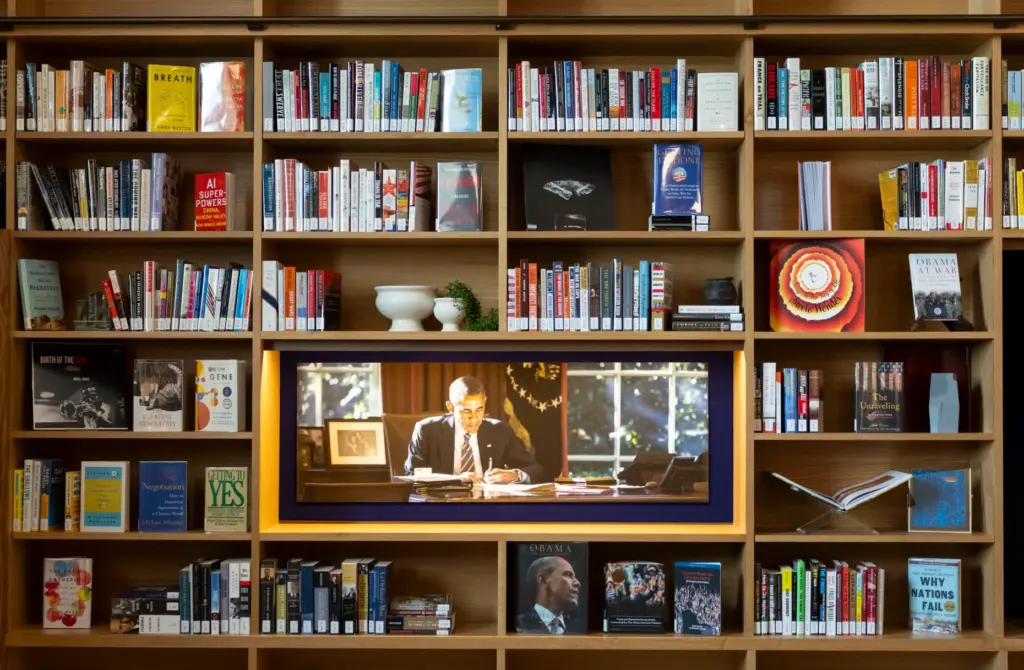 The President’s Reading Room is prepared June 3, 2026, inside a branch of the Chicago Public Library to open at the Obama Presidential Center campus. (Brian Cassella/Chicago Tribune)
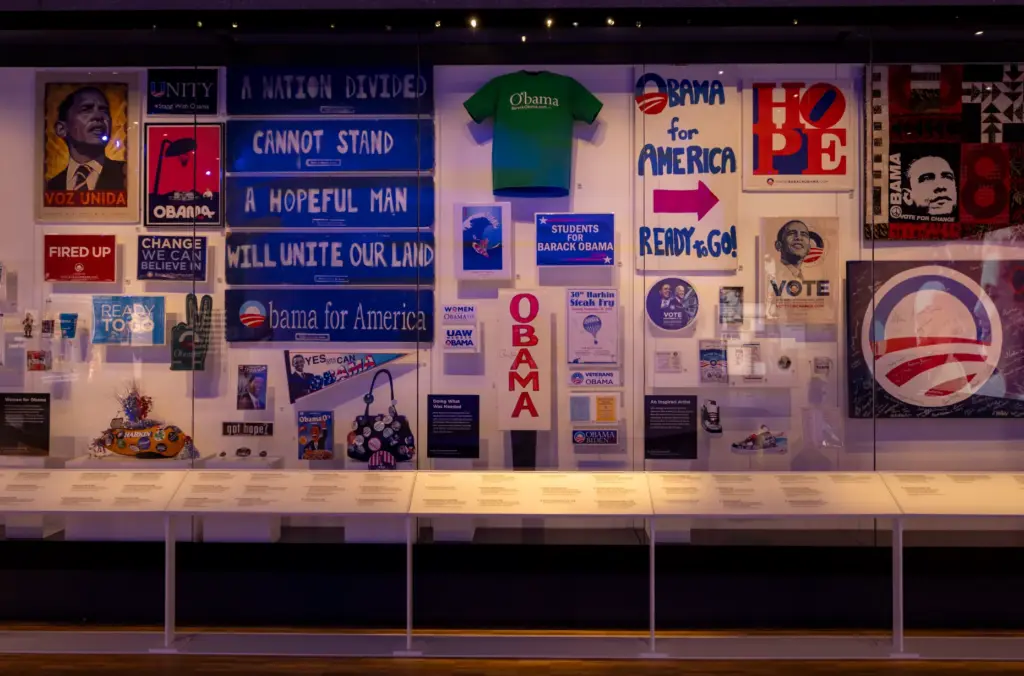 Exhibits in the museum feature the 2008 campaign as the Obama Presidential Center prepares for opening, June 3, 2026, in Chicago’s Jackson Park. (Brian Cassella/Chicago Tribune)
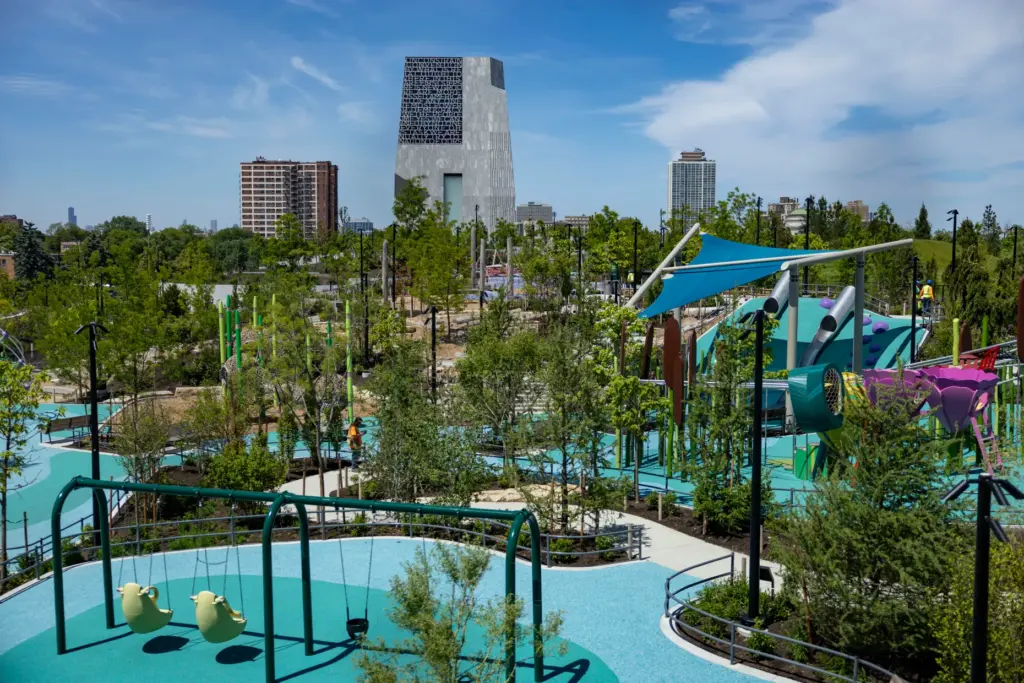 A view from the Home Court shows the playground and the campus of the Obama Presidential Center as it prepares for opening, June 3, 2026, in Chicago’s Jackson Park. (Brian Cassella/Chicago Tribune)
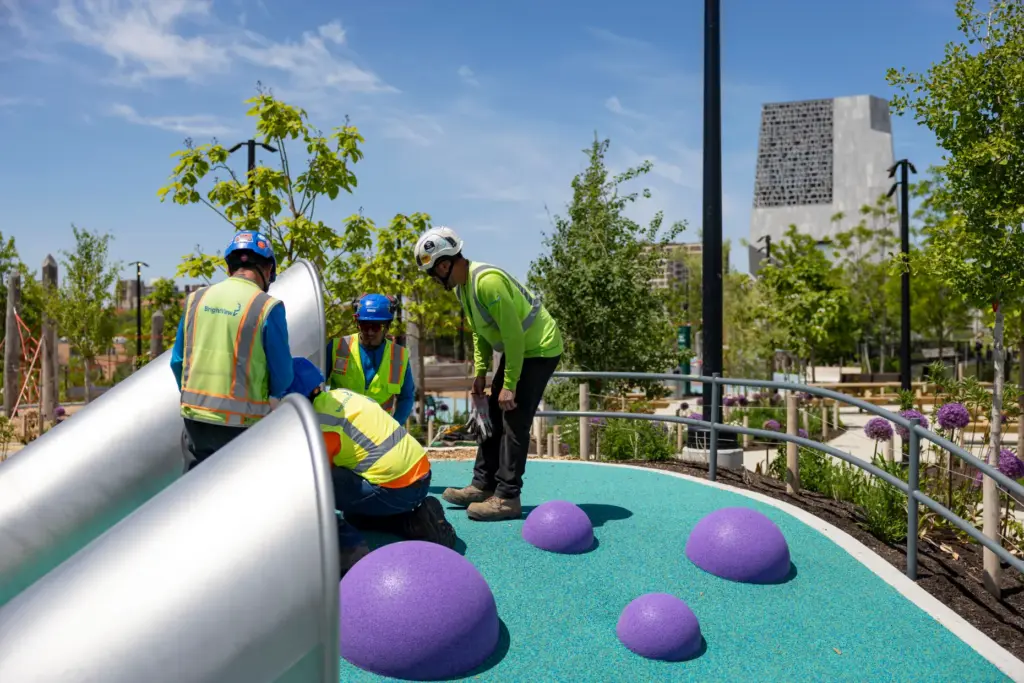 Workers prepare a slide on the playground as the Obama Presidential Center prepares for opening, June 3, 2026, in Chicago’s Jackson Park. (Brian Cassella/Chicago Tribune)
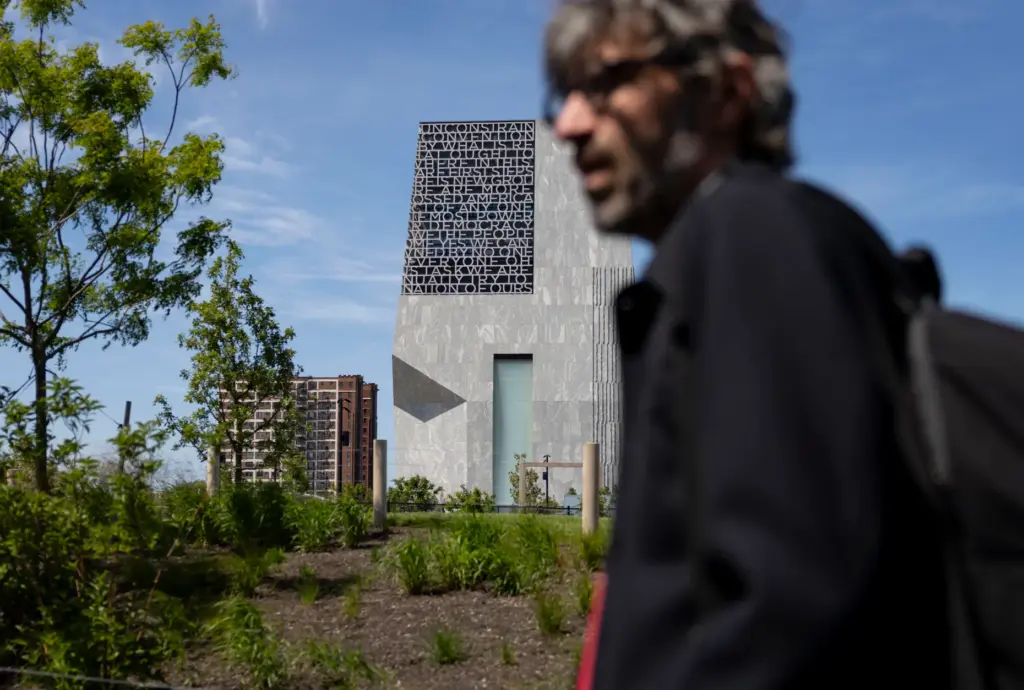 The Obama Presidential Center prepares for opening, June 3, 2026, in Chicago’s Jackson Park. (Brian Cassella/Chicago Tribune)
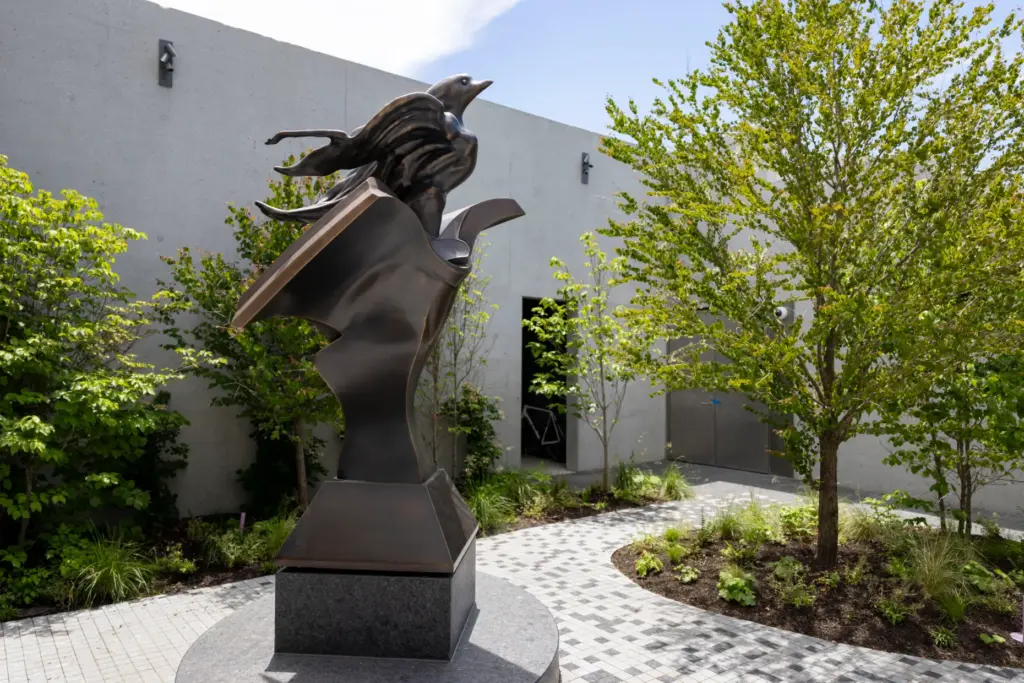 A statue by Richard Hunt sits in a courtyard outside a branch of the Chicago Public Library on the Obama Presidential Center campus, June 3, 2026, in Chicago’s Jackson Park. (Brian Cassella/Chicago Tribune)
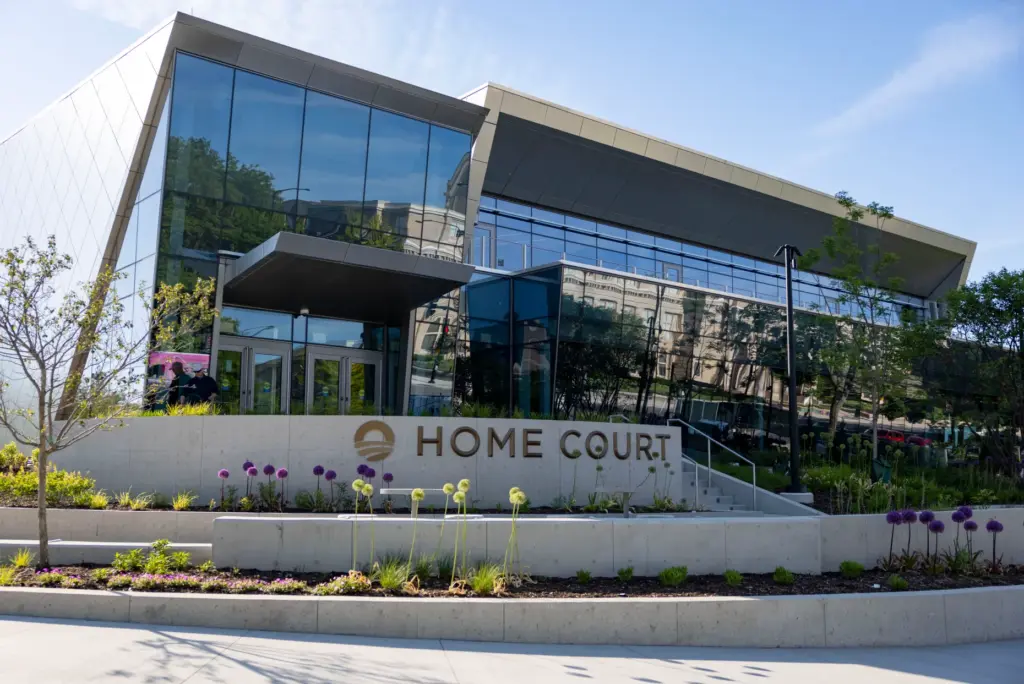 The Home Court at the Obama Presidential Center prepares for opening, June 3, 2026, in Chicago’s Jackson Park. (Brian Cassella/Chicago Tribune)
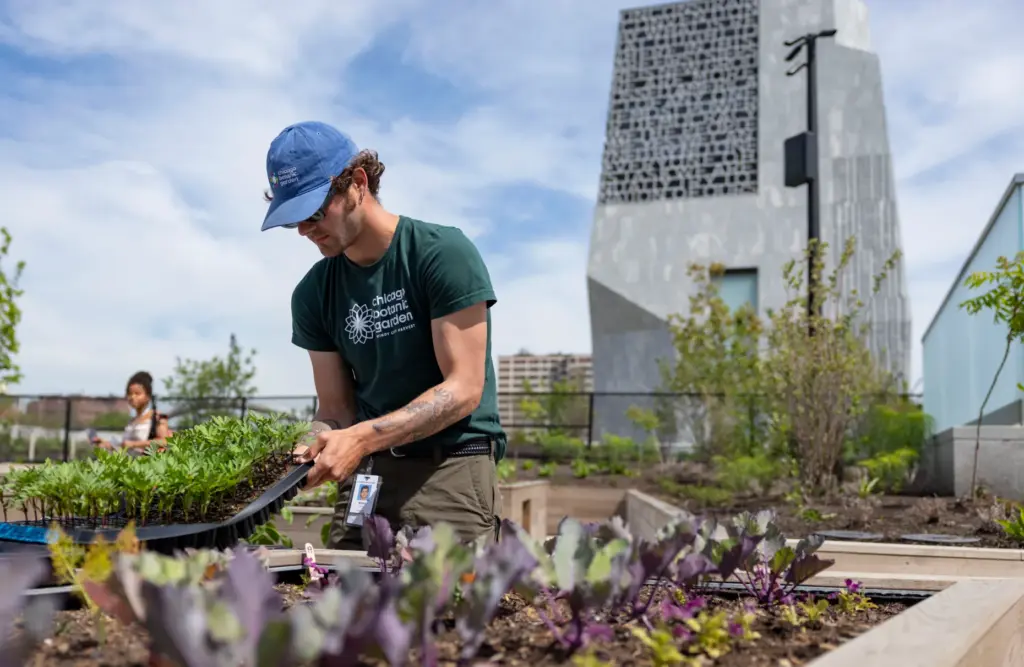 Aidan Jacobs works in the Eleanor Roosevelt Fruit and Vegetable Garden as the Obama Presidential Center prepares for opening, June 3, 2026, in Chicago’s Jackson Park. (Brian Cassella/Chicago Tribune)
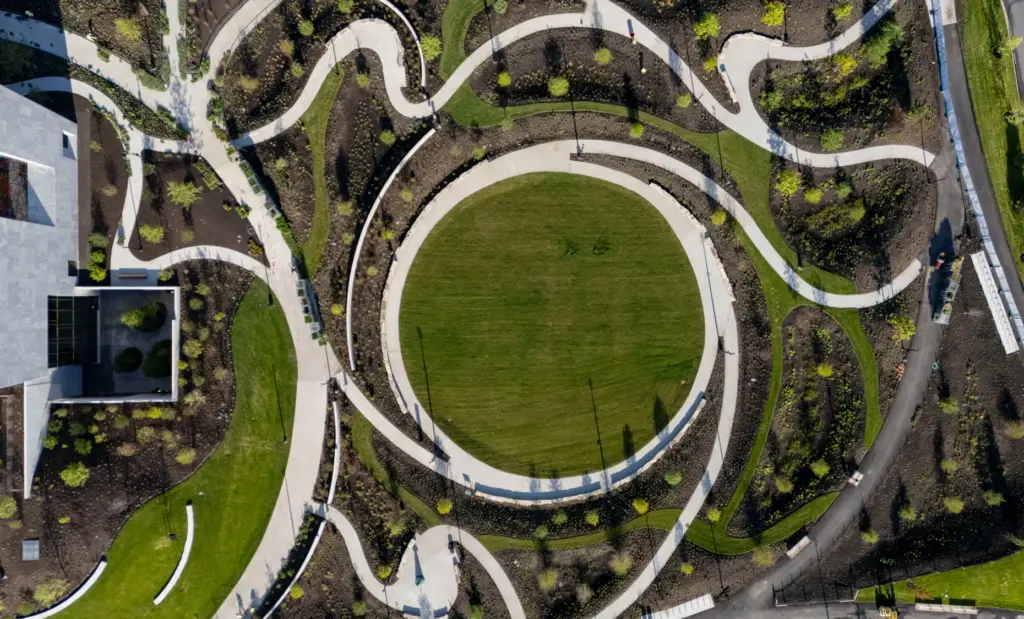 The Women’s Garden at the north end of the Obama Presidential Center prepares for opening, June 3, 2026, in Chicago’s Jackson Park. (Brian Cassella/Chicago Tribune)
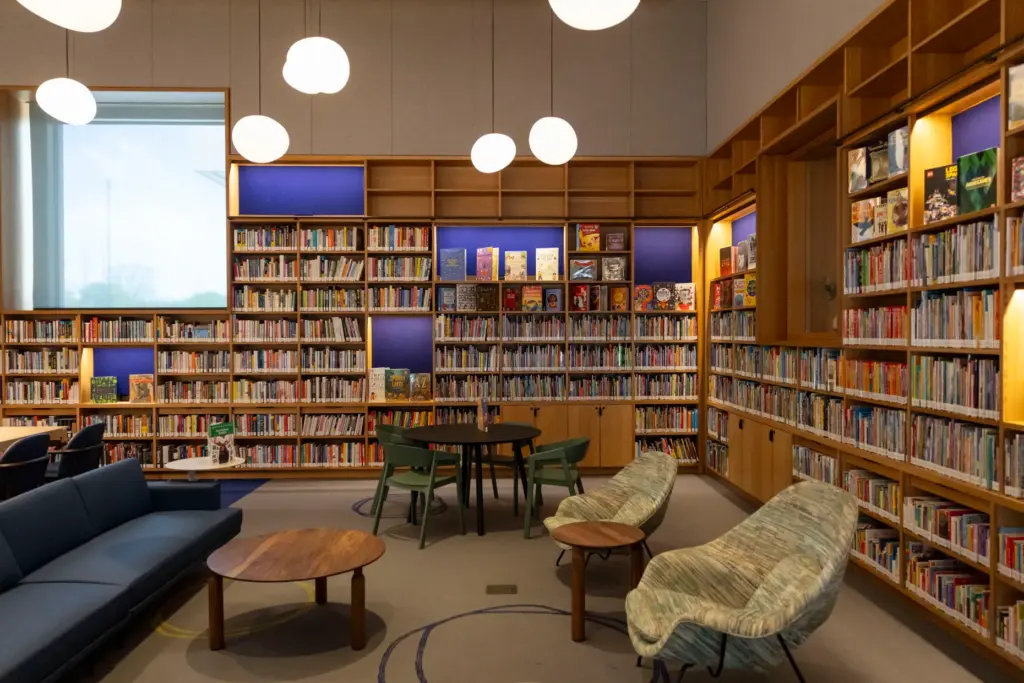 A branch of the Chicago Public Library prepares to open at the Obama Presidential Center campus, June 3, 2026, in Chicago’s Jackson Park. (Brian Cassella/Chicago Tribune)
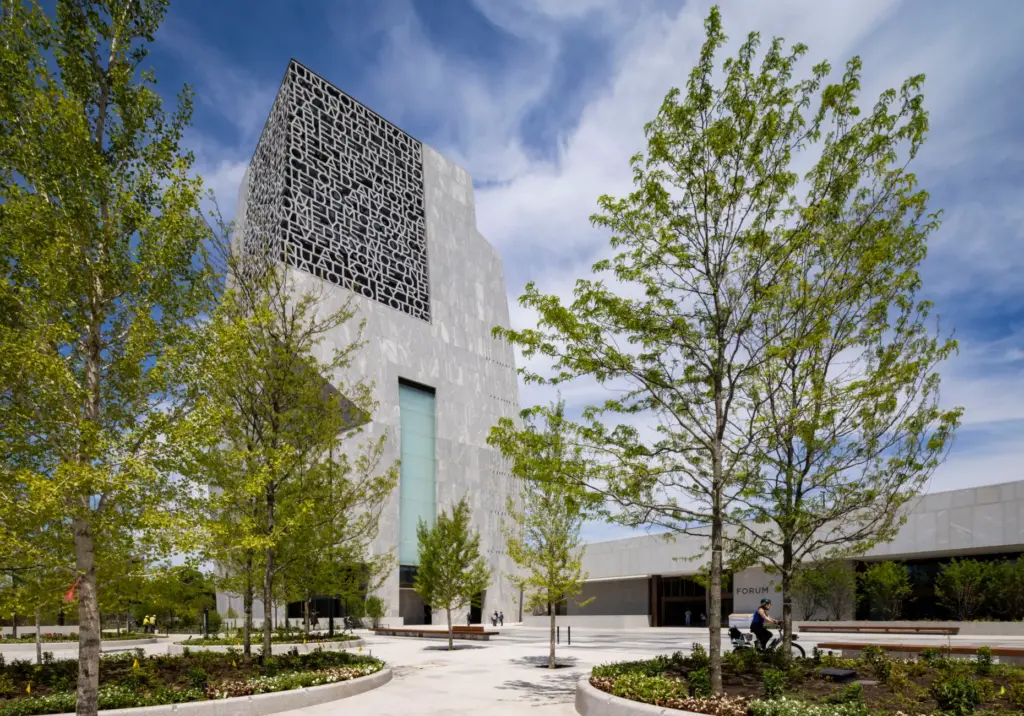 The Obama Presidential Center prepares for opening, June 3, 2026, in Chicago’s Jackson Park. (Brian Cassella/Chicago Tribune)
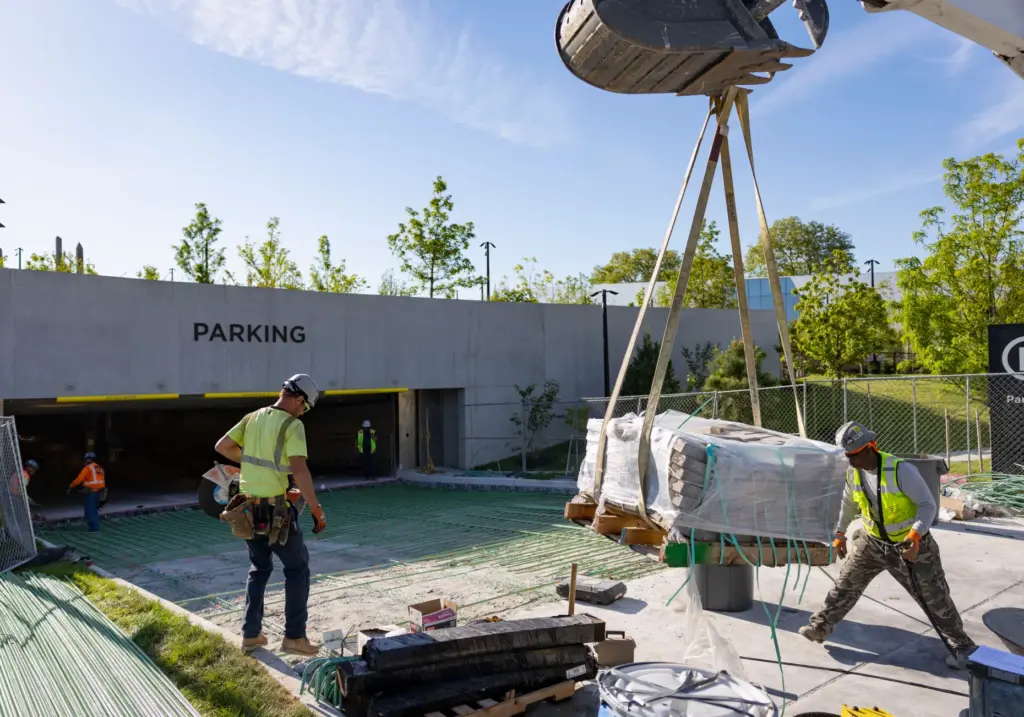 Workers finish the parking garage entrance as the Obama Presidential Center prepares for opening, June 3, 2026, in Chicago’s Jackson Park. (Brian Cassella/Chicago Tribune)
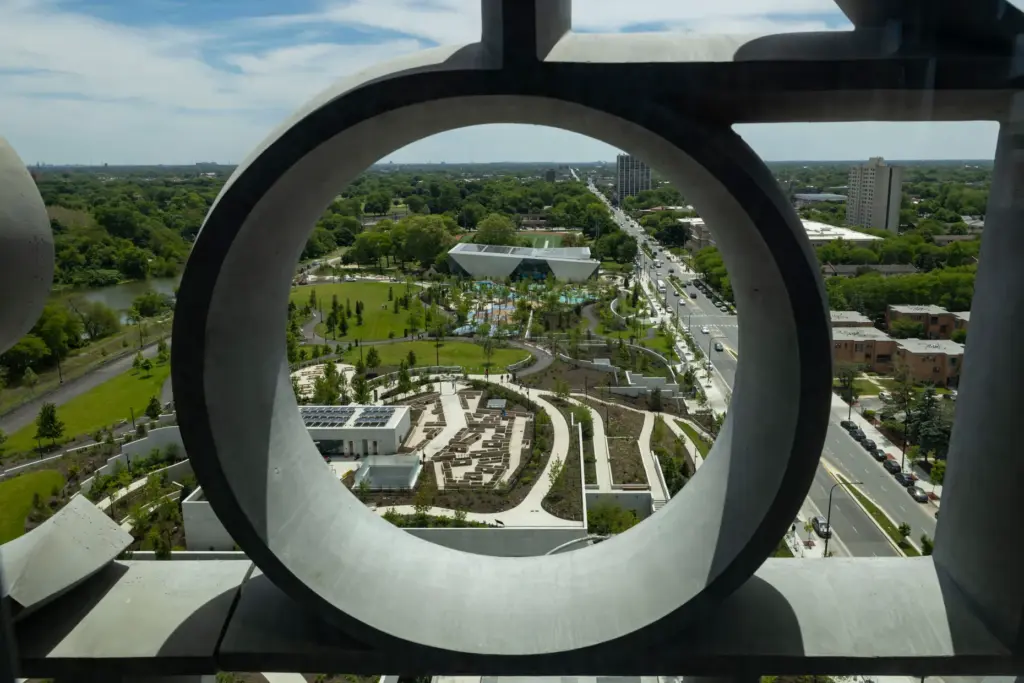 A view of the campus from the Sky Room on June 3, 2026, as the Obama Presidential Center prepares for opening, in Chicago’s Jackson Park. (Brian Cassella/Chicago Tribune)
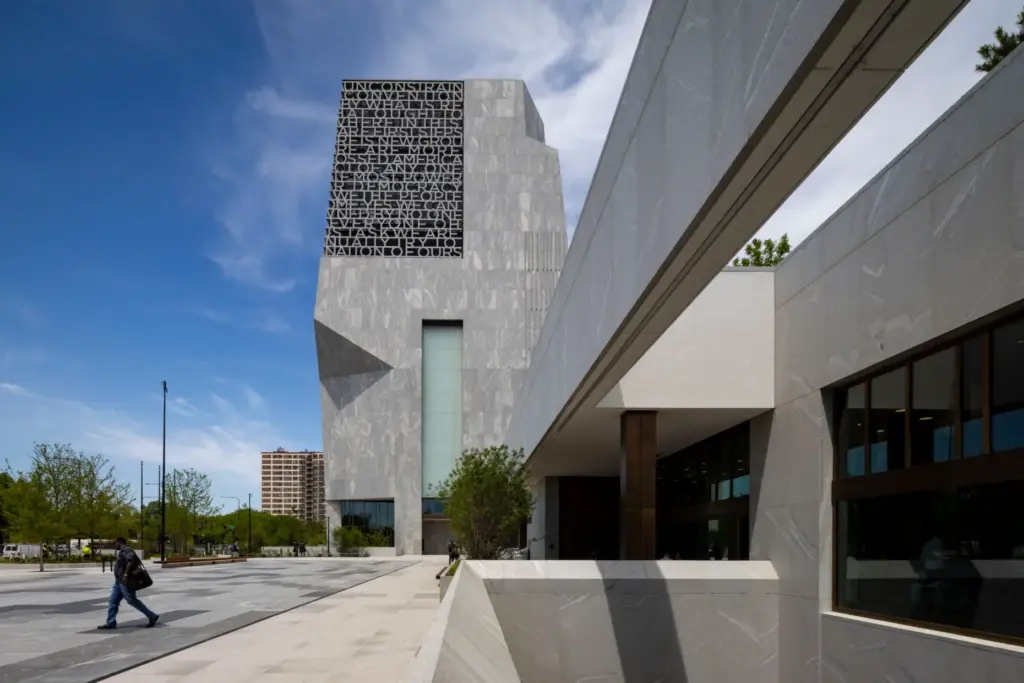 The Obama Presidential Center prepares for opening, June 3, 2026, in Chicago’s Jackson Park. (Brian Cassella/Chicago Tribune)
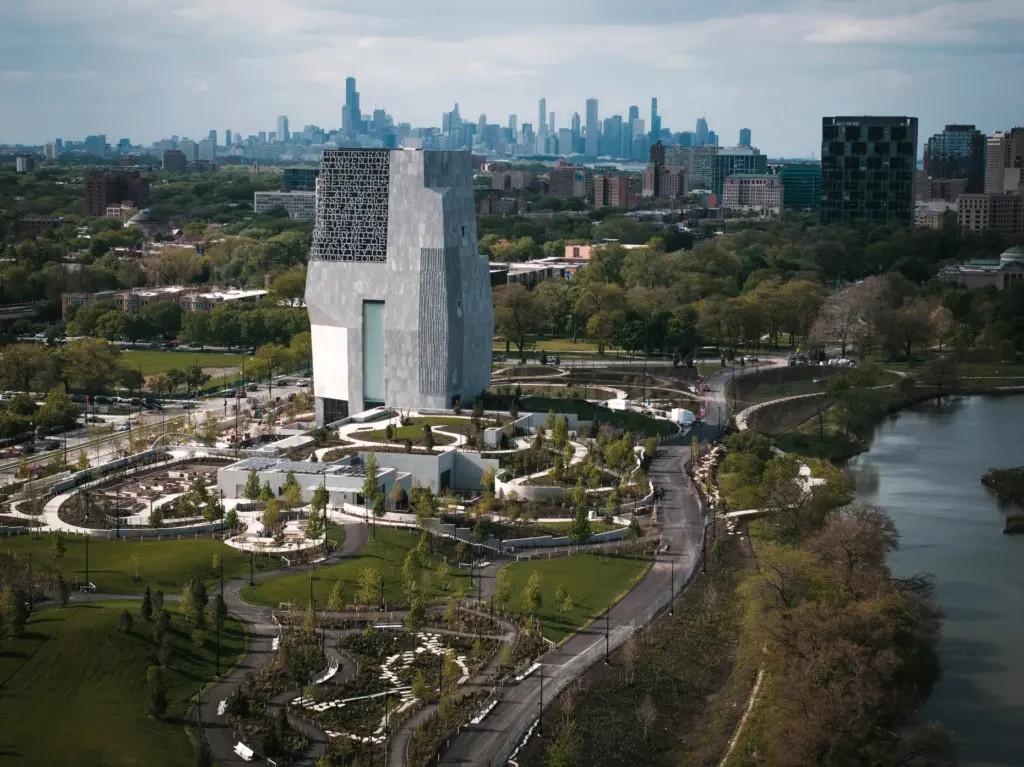 The Obama Presidential Center on May 6, 2026. (E. Jason Wambsgans/Chicago Tribune)
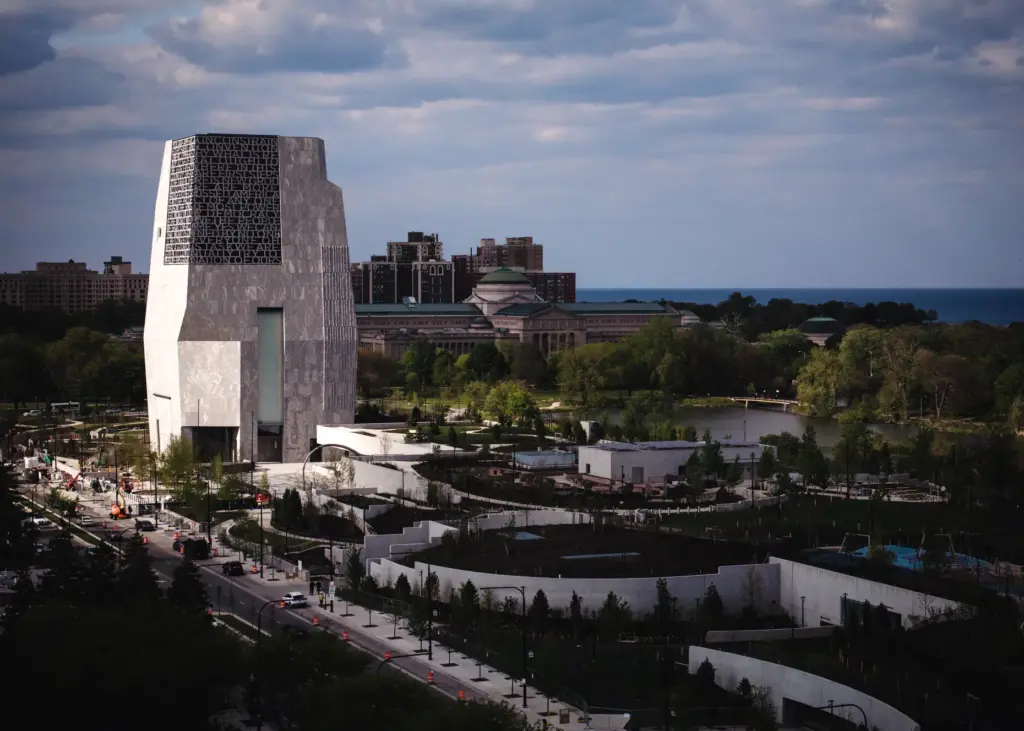 The Obama Presidential Center in Jackson Park, May 6, 2026. (E. Jason Wambsgans/Chicago Tribune)
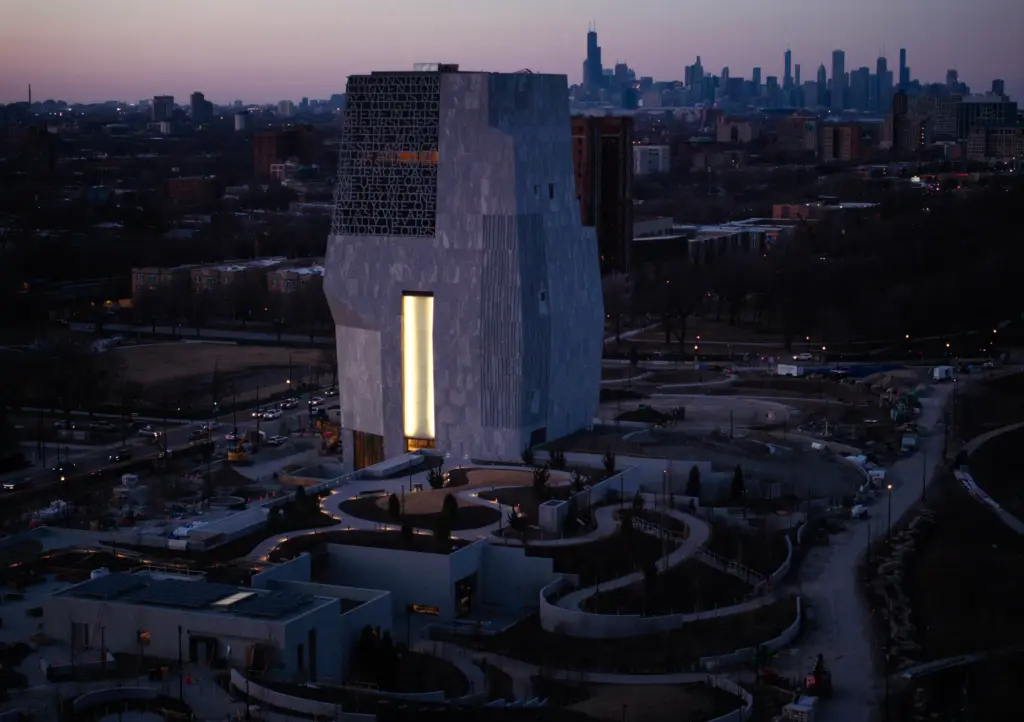 The Obama Presidential Center on Feb. 25, 2026. (E. Jason Wambsgans/Chicago Tribune)
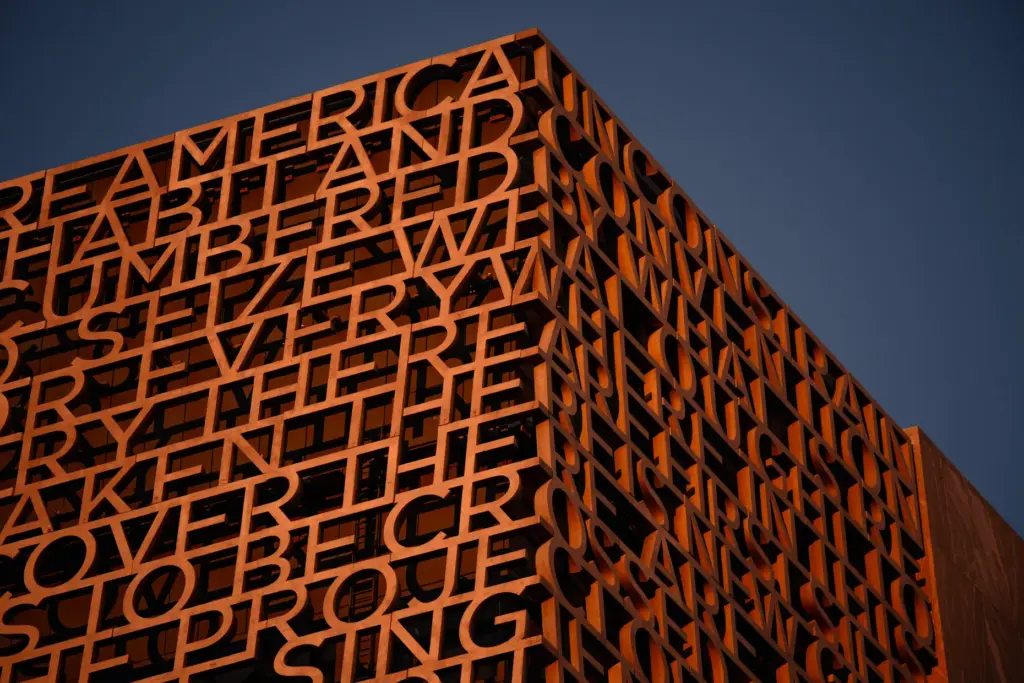 The quote from President Barack Obama’s commemoration of the 50th anniversary of the marches from Selma to Montgomery on the exterior of the Obama Presidential Center Museum building, Feb. 25, 2026. (E. Jason Wambsgans/Chicago Tribune)
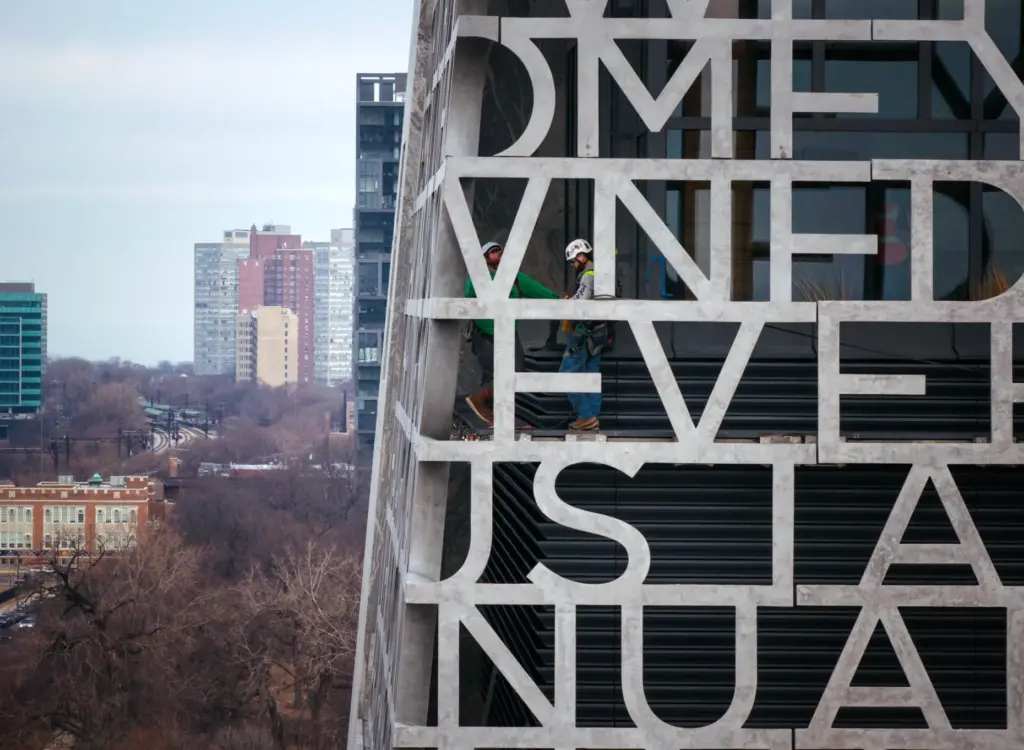 Workers finish installing words from from President Barack Obama’s speech marking the 50th anniversary of the Selma to Montgomery march, on the exterior of the Obama Presidential Center Museum building on Feb. 17, 2026, (E. Jason Wambsgans/Chicago Tribune)
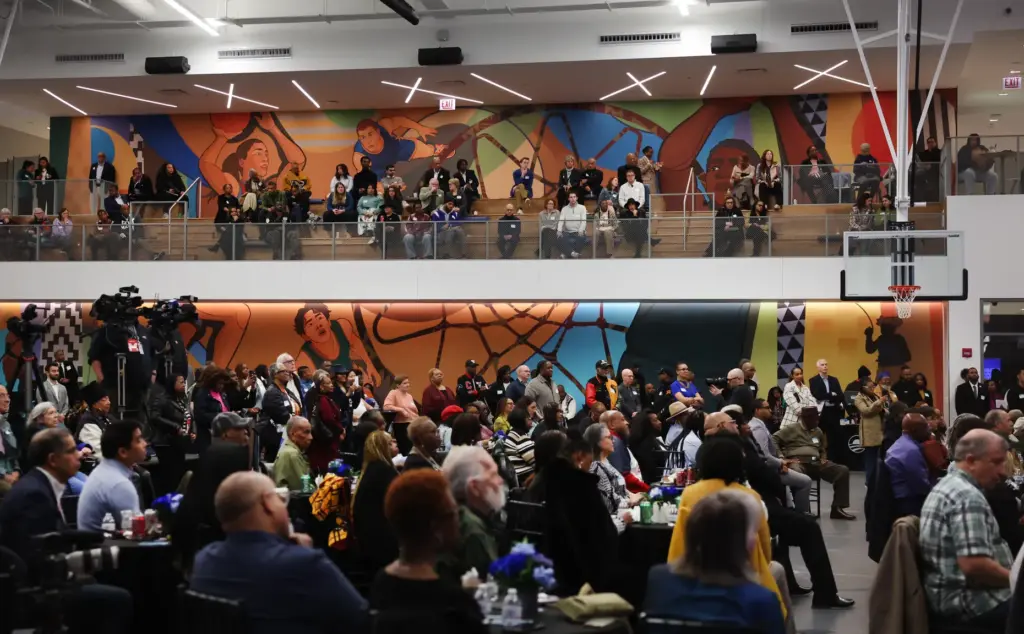 People attend a program inside Home Court at the Obama Presidential Center in Chicago, March 7, 2026. (Chris Sweda/Chicago Tribune)
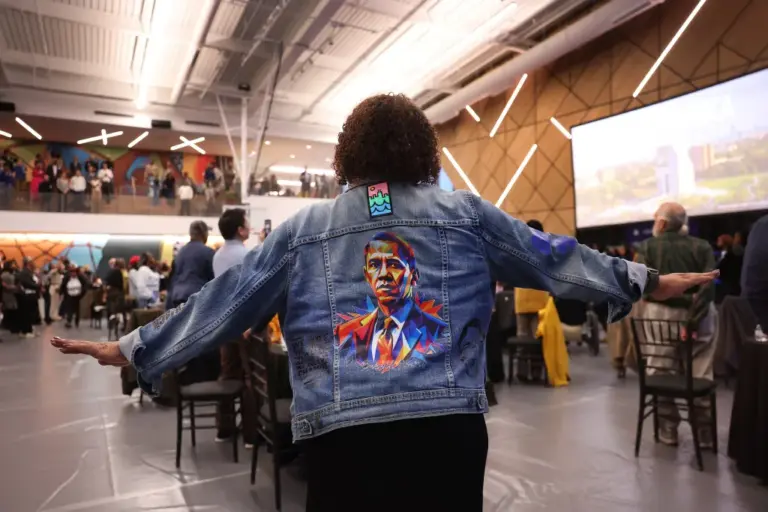 A woman wears a jean jacket adorned with an image of former President Barack Obama inside Home Court at the Obama Presidential Center in Chicago, March 7, 2026. (Chris Sweda/Chicago Tribune)
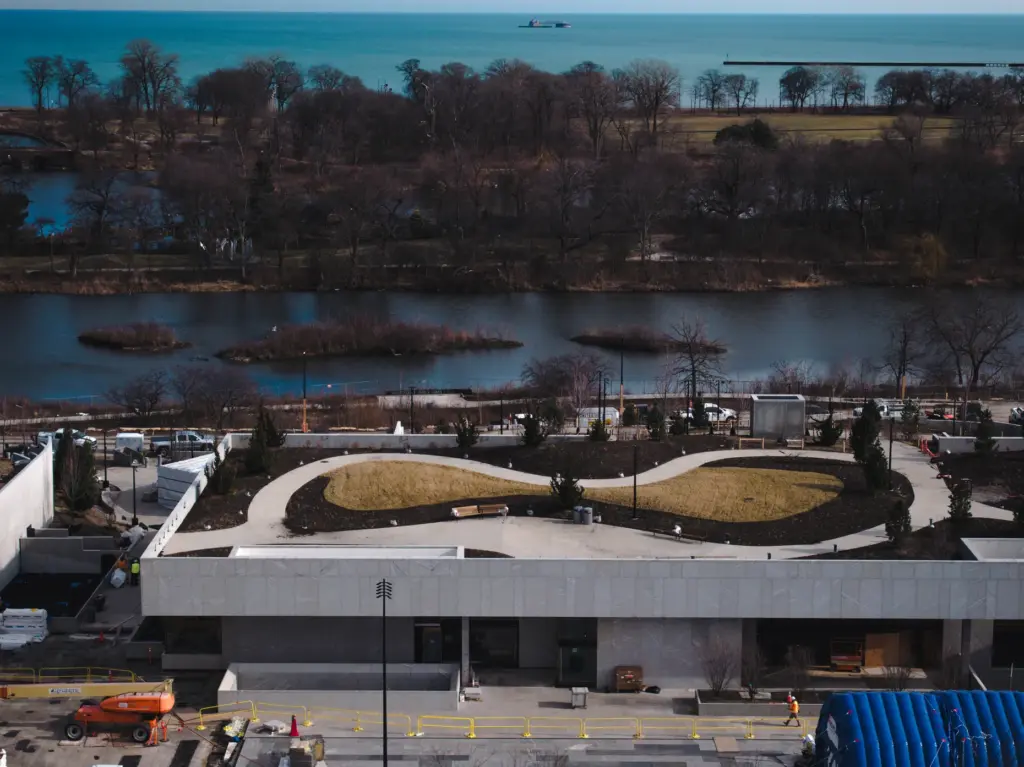 Work continues on the Obama Presidential Center on Jan. 13 2026, in Chicago. (E. Jason Wambsgans/Chicago Tribune)
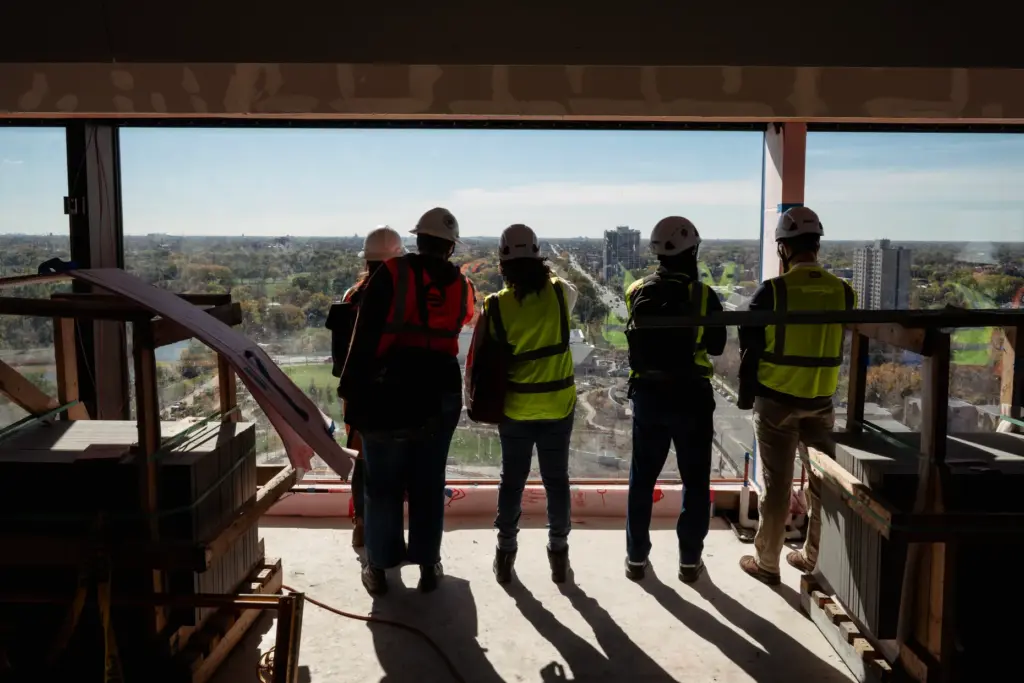 View from the top floor of the Obama Presidential Library and Museum building on Oct. 24, 2025. (E. Jason Wambsgans/Chicago Tribune)
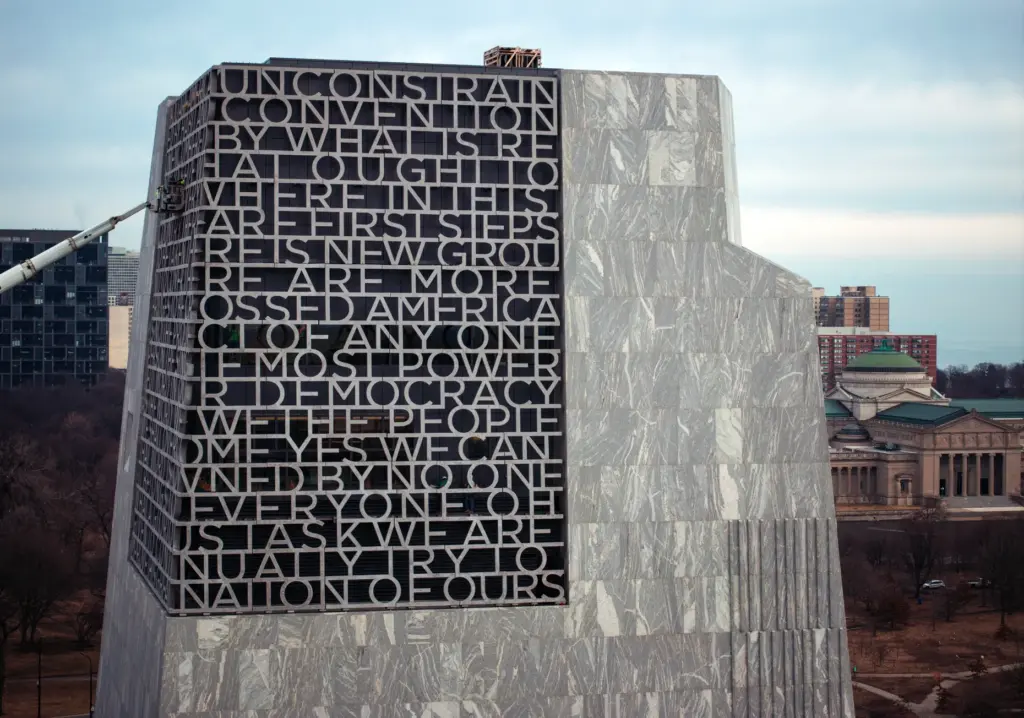 Workers finish installing words from from President Obama’s speech marking the 50th anniversary of the Selma to Montgomery march, on the exterior of the Obama Presidential Center Museum building, Feb. 17, 2026, (E. Jason Wambsgans/Chicago Tribune)
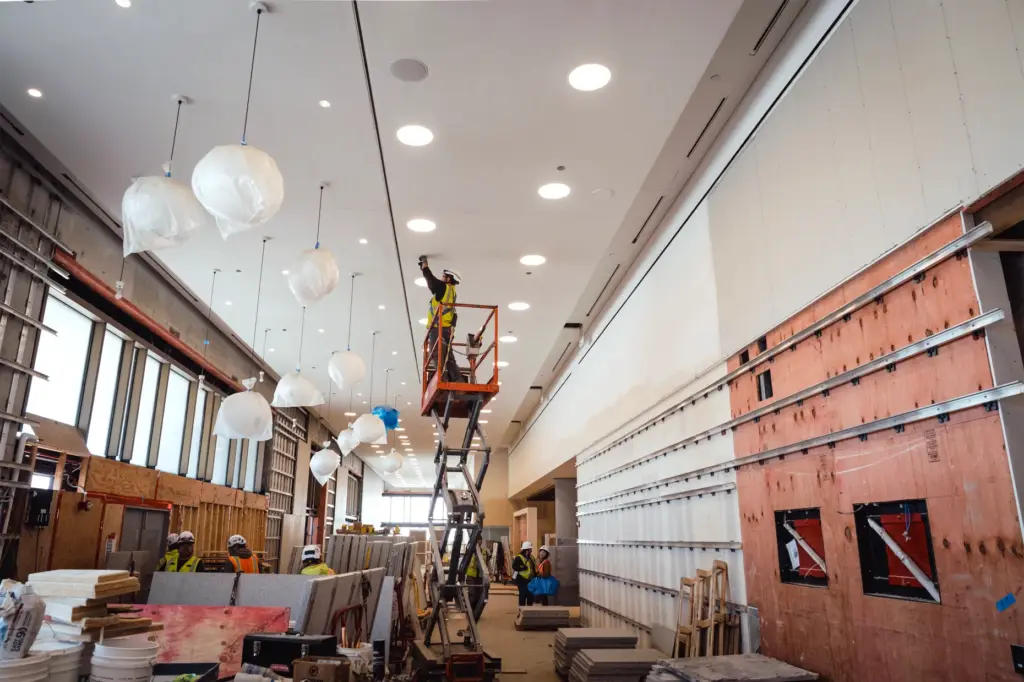 Work on the Hadiya Pendleton Atrium of the Forum Building on the Obama Presidential Center campus on Oct. 24, 2025. (E. Jason Wambsgans/Chicago Tribune)
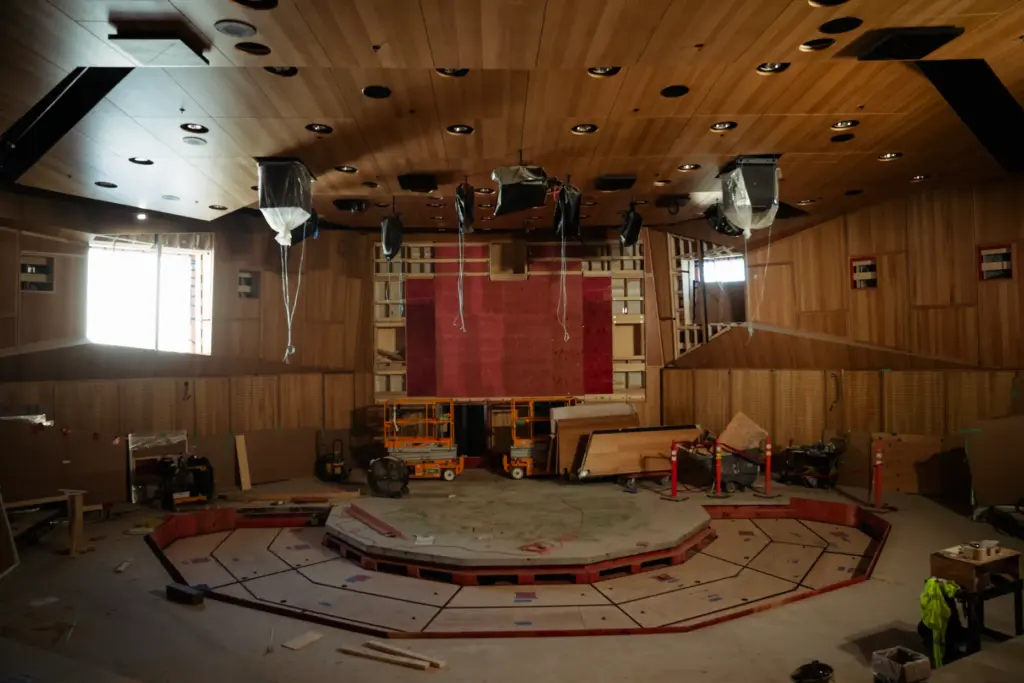 Construction on the Elie Wiesel Auditorium on the Obama Presidential Center campus on Oct. 24, 2025. (E. Jason Wambsgans/Chicago Tribune)
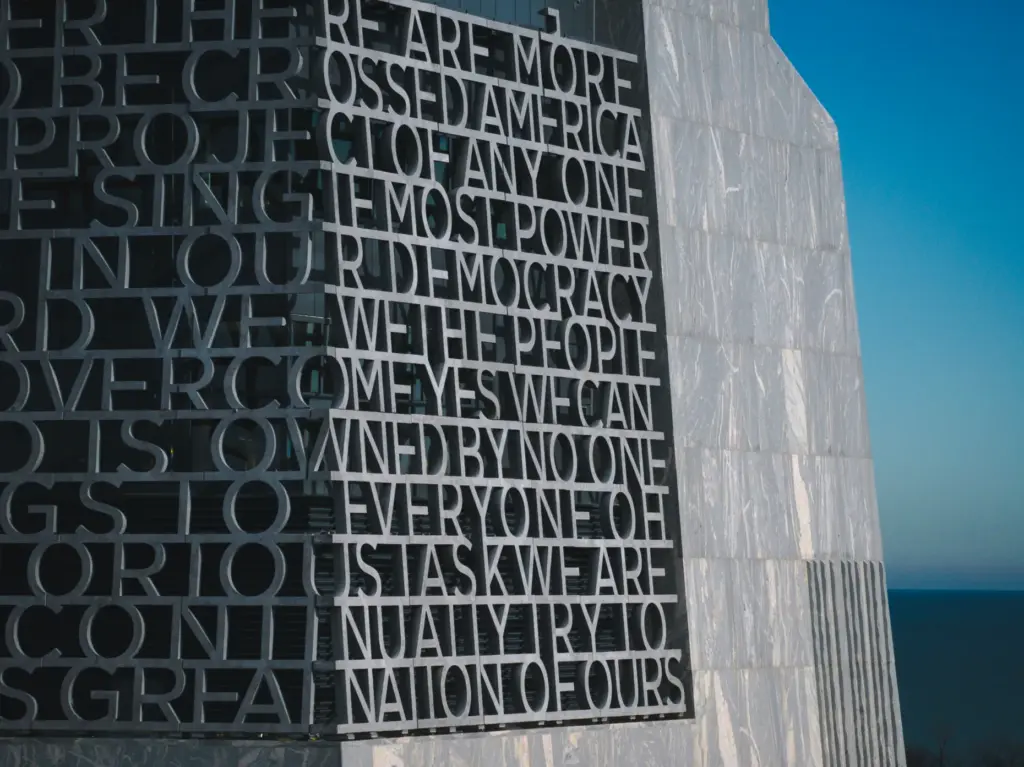 Words from from President Obama’s speech marking the 50th anniversary of the Selma to Montgomery march are being installed as work continues on the Obama Presidential Center Museum, Jan. 13 2026. (E. Jason Wambsgans/Chicago Tribune)
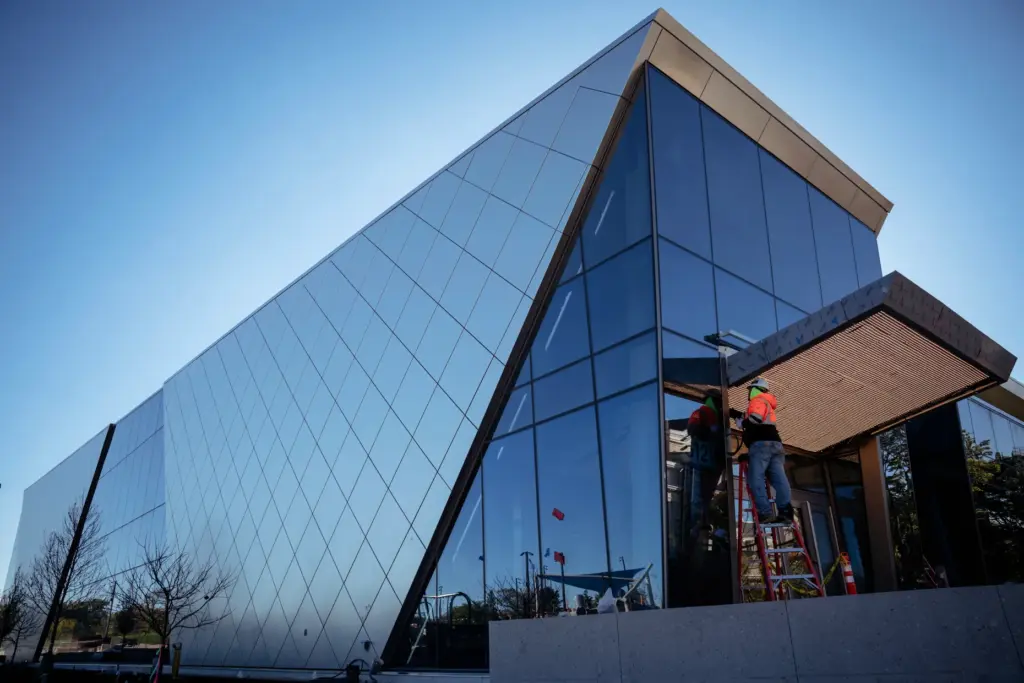 Construction on Home Court, the 45,000 square foot multipurpose space on the Obama Presidential Center campus, Oct. 24, 2025. (E. Jason Wambsgans/Chicago Tribune)
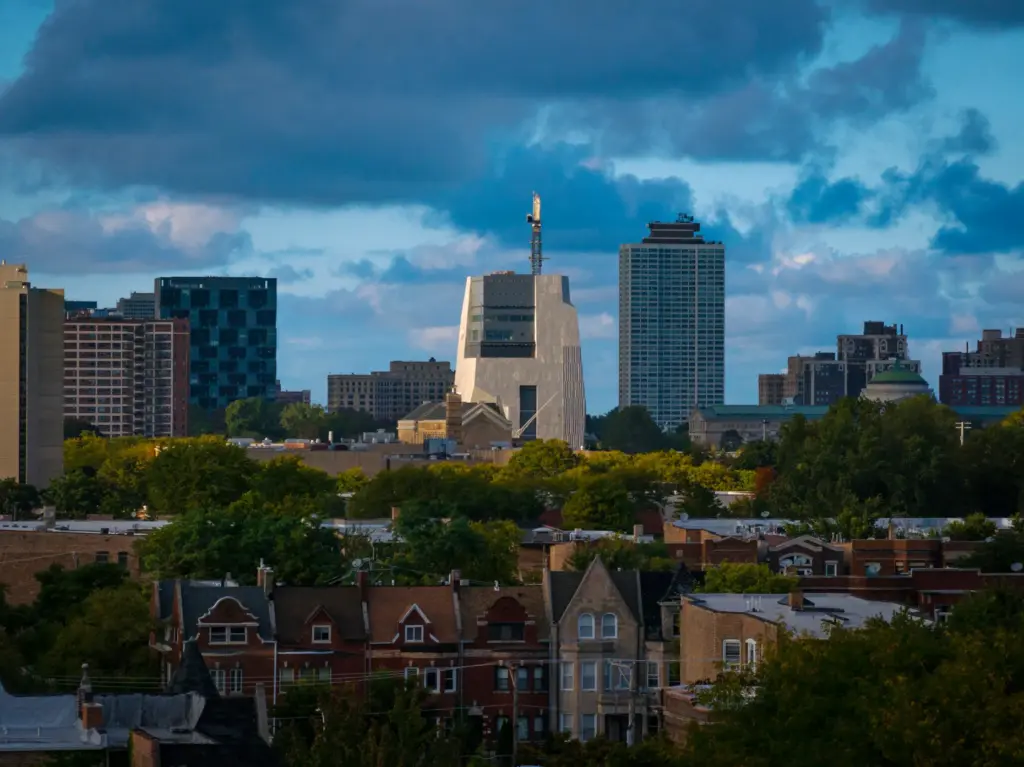 The Obama Presidential Center under construction and the nearby Woodlawn neighborhood on Sept. 24, 2025. (E. Jason Wambsgans/Chicago Tribune)
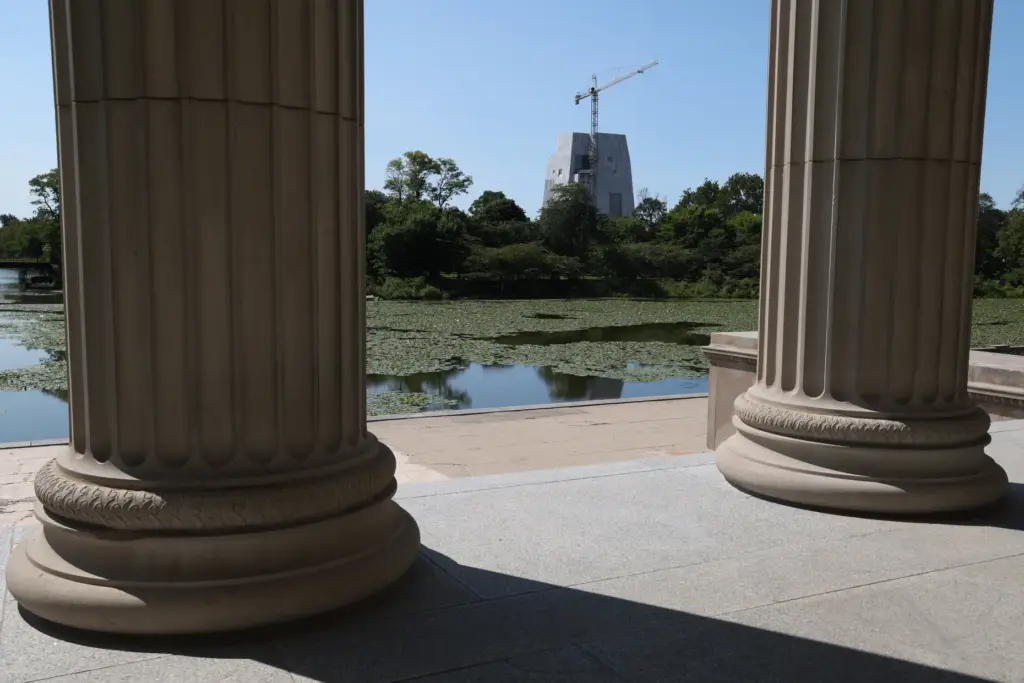 A view from the steps of the Griffin Museum of Science and Industry shows the ongoing construction at the Obama Presidential Center, Sept. 8, 2025. (Antonio Perez/Chicago Tribune)
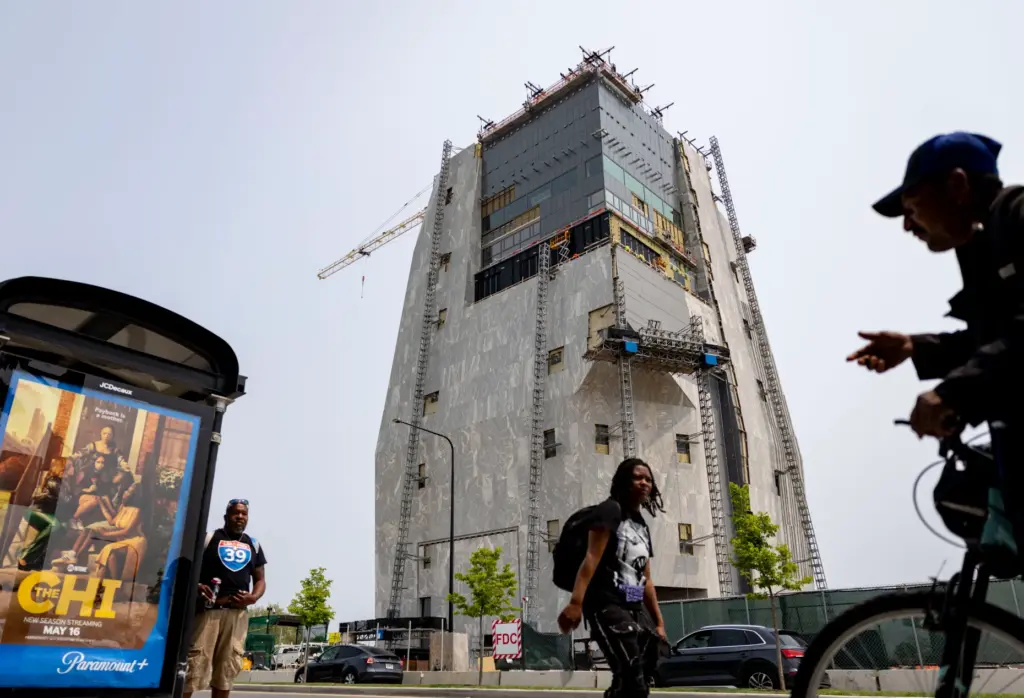 Construction continues on the Obama Presidential Center on June 2, 2025, in Jackson Park. (Brian Cassella/Chicago Tribune)
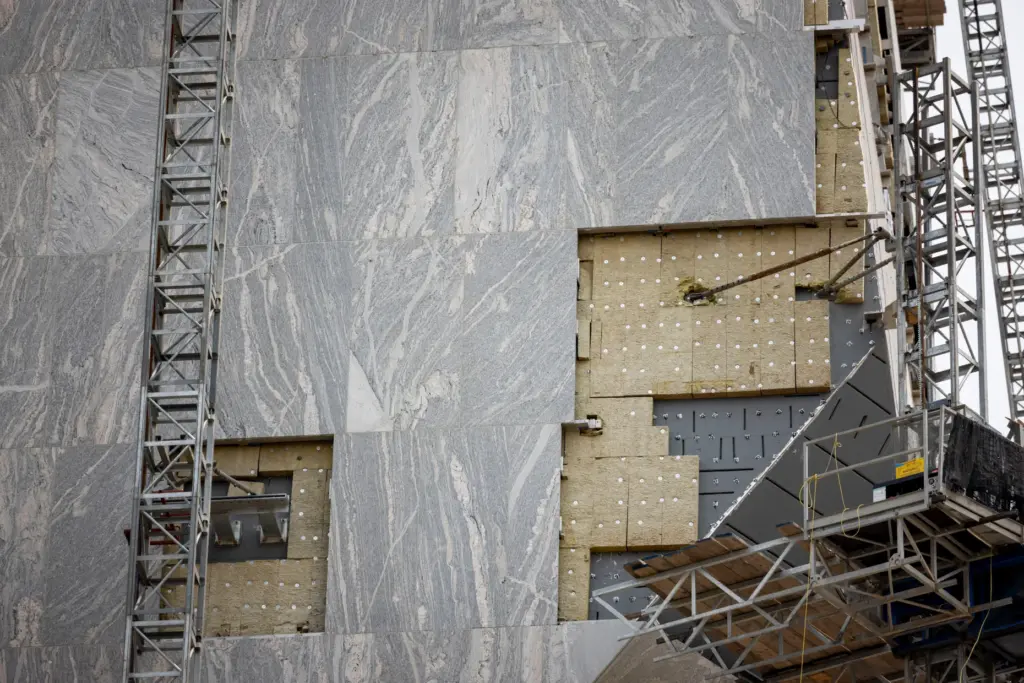 Granite panels are installed as construction continues on the tower at the Obama Presidential Center, June 2, 2025, in Jackson Park. (Brian Cassella/Chicago Tribune)
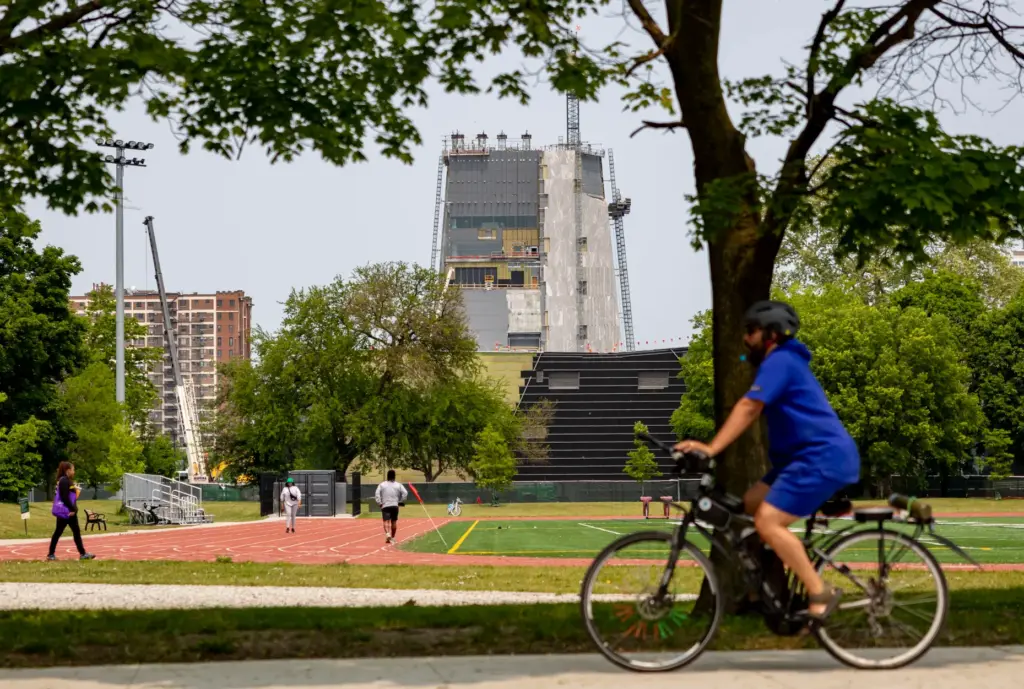 The tower rises behind athletic fields in Jackson Park as construction continues on the Obama Presidential Center, June 2, 2025. (Brian Cassella/Chicago Tribune)
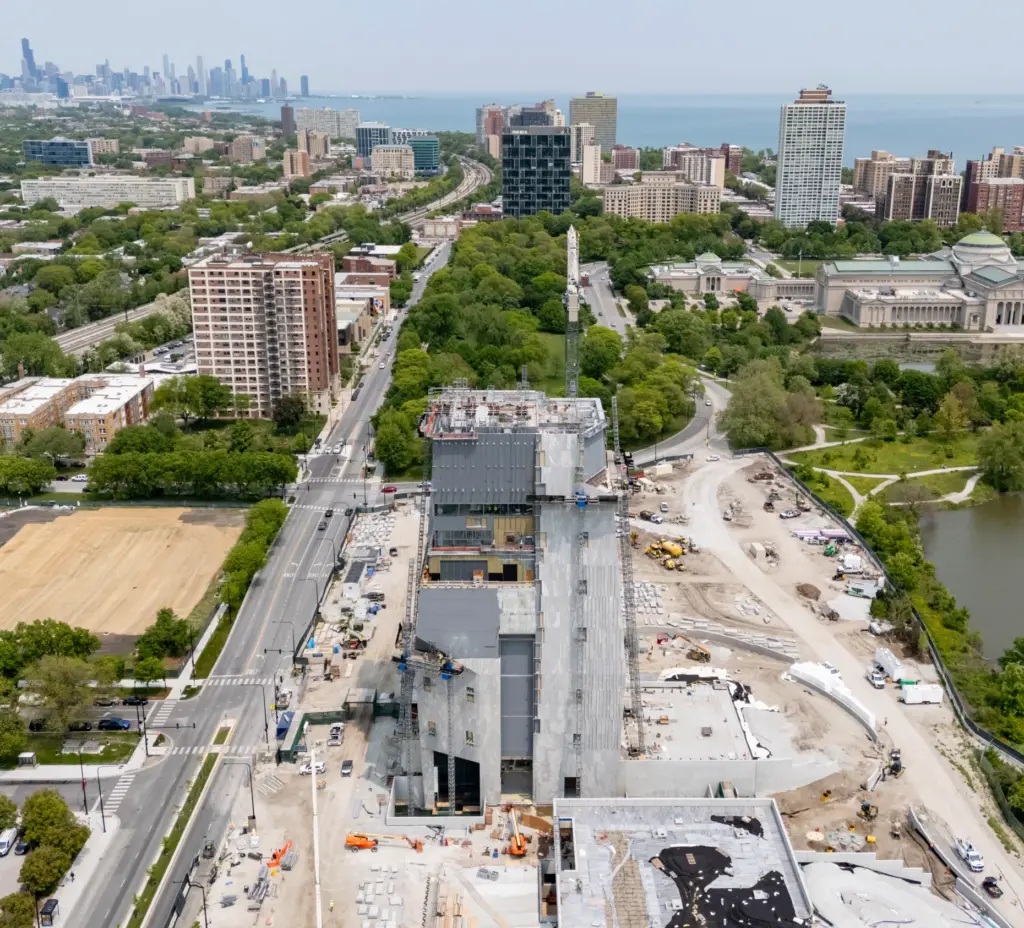 Construction continues on the Obama Presidential Center, June 2, 2025, in Jackson Park. (Brian Cassella/Chicago Tribune)
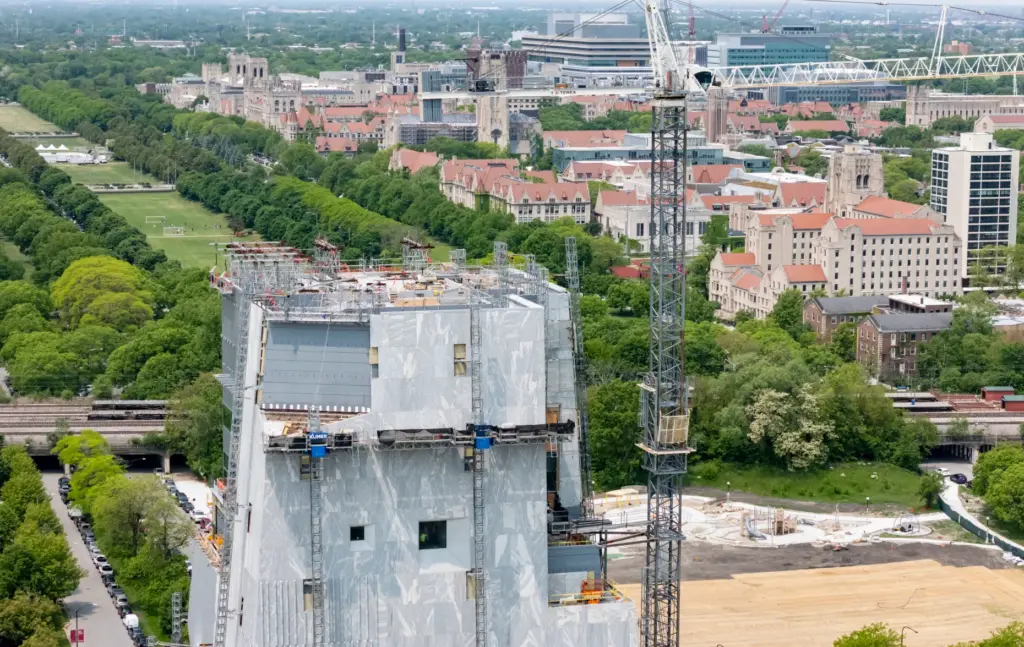 Construction continues on the Obama Presidential Center near the University of Chicago campus and the Midway Plaisance, June 2, 2025. (Brian Cassella/Chicago Tribune)
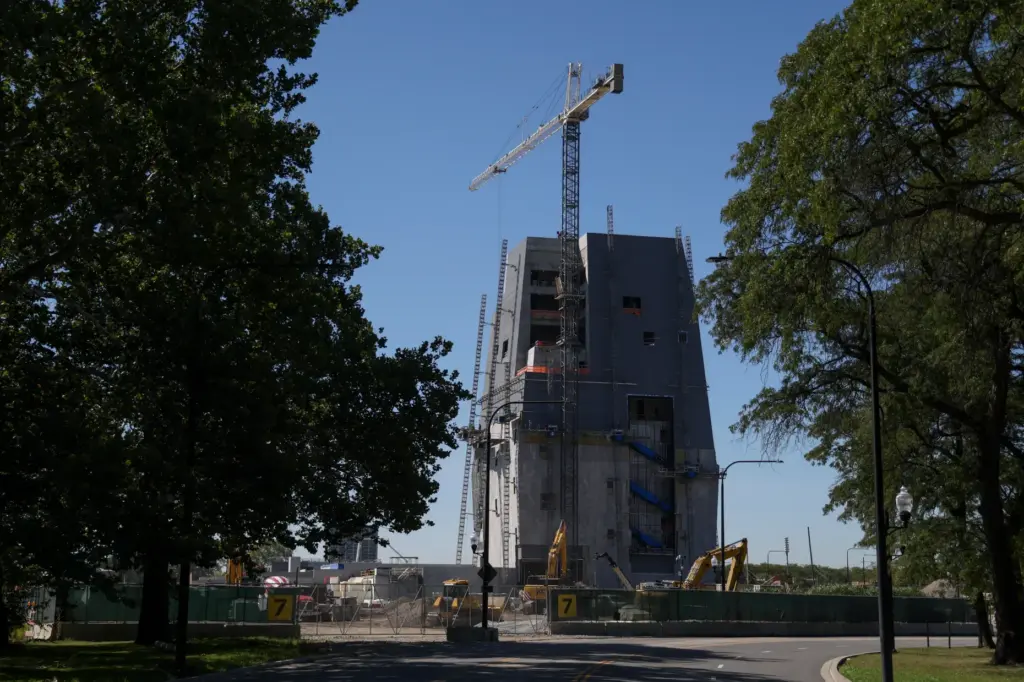 The Obama Presidential Center rises in Woodlawn on Sept. 4, 2024. (Eileen T. Meslar/Chicago Tribune)
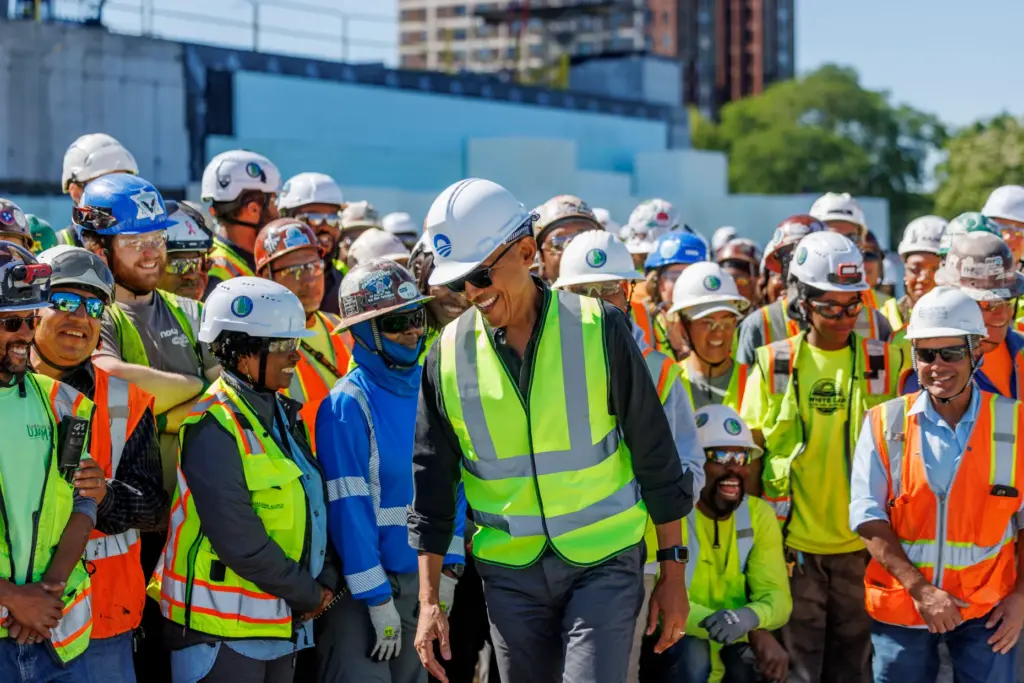 Former President Barack Obama talks with workers while visiting the site of the Obama Presidential Center to sign a metal beam as the concrete infrastructure of the museum building reaches its full height on June 10, 2024, in Chicago. (Armando L. Sanchez/Chicago Tribune)
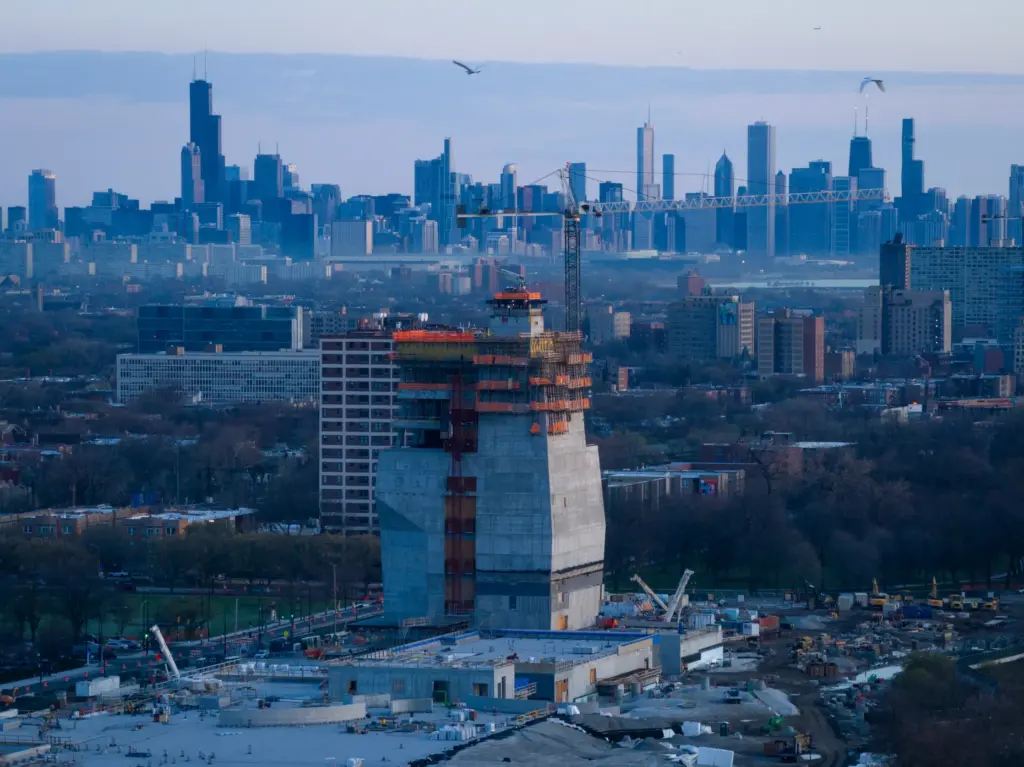 Construction on the Obama Presidential Center in Jackson Park on April 10, 2024. (E. Jason Wambsgans/Chicago Tribune)
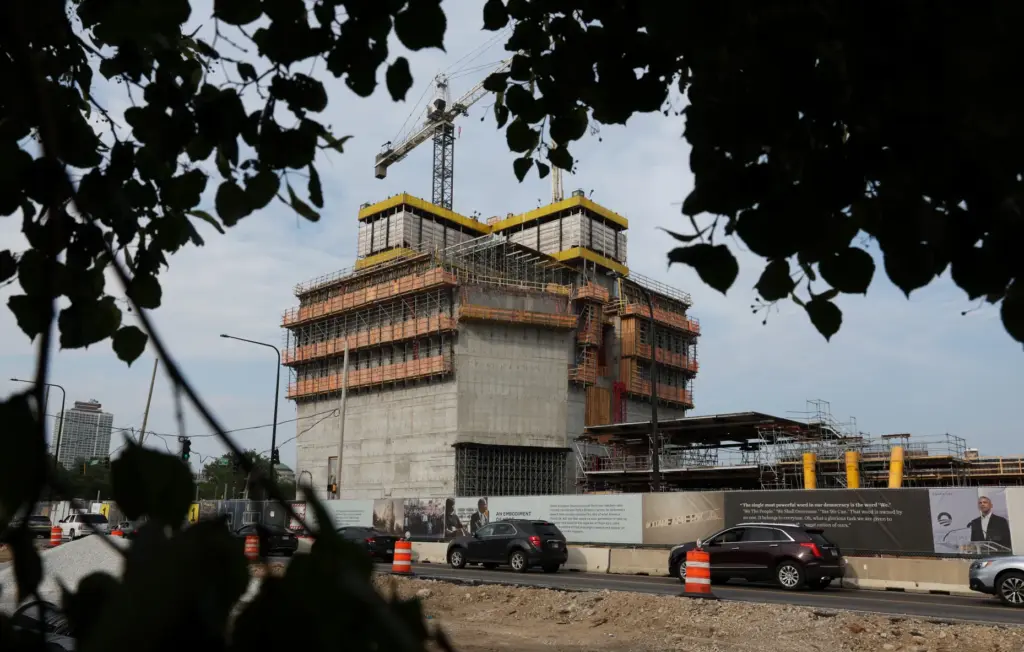 Vehicle traffic moves past construction of the Obama Presidential Center in the 6000 block of South Stony Island Avenue, Aug. 8, 2023, in Chicago. (John J. Kim/Chicago Tribune)
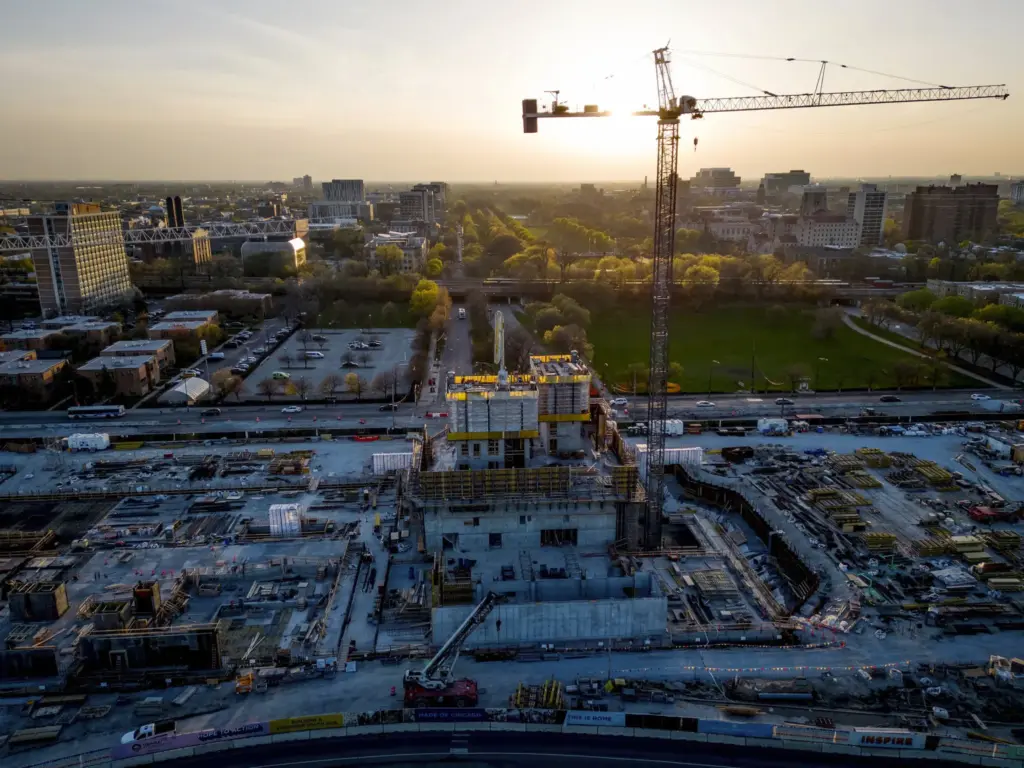 The Obama Presidential Center emerges in Jackson Park, April 18, 2023. (E. Jason Wambsgans / Chicago Tribune)
Standing in front of a film about a single day in the life of the presidency — June 26, 2015, both the day same-sex marriage was legalized and the day Obama gave a eulogy at Mother Emanuel AME Church in South Carolina, singing “Amazing Grace” — a woman beside me, crying, reached into her handbag and pulled out tissues.
You’re going to need tissue stations in this place, I said to Louise Bernard, the director of the museum, who responded, without hesitation: “We already have tissue stations.”
Every presidential center in this country, historians point out, can’t help but reflect the meaning and character of the men they honor. The showmanship of the Reagan years is in the 100 acres of the Ronald Reagan Presidential Library and Museum in California, with its Air Force One and actual Irish pub, imported and reassembled on-site. The ego of Lyndon Johnson is in the floor plan of the LBJ Presidential Library in Texas — initially eight floors until the president insisted its basement and subbasement be included, since 10 floors sounds better. (There’s a reason Robert Caro, Johnson’s biographer, referred to presidential libraries as “America’s pyramids.”)
In that sense, the Obama Presidential Center is no different.
It’s smart, cool, sincere, good with rhetoric, wants to be everything to everyone, yet paradoxically, somewhat humble, even subtle. As you enter the museum, for instance, you’re not greeted by the slick design of the Shepard Fairey “Hope” campaign poster but a battered collage by artist Jack Pierson spelling “HOPE” in rusted lettering.
“It’s important those letters look beaten up and mismatched,” said Christine Mehring, a University of Chicago art professor who lives in the neighborhood. “Each letter seems to stand for a community in this country — that’s a powerful thing right from the get-go. I mean, this is not a library about Obama! It seems foremost about celebrating American experiences. Bombastic a presence as it is, there’s a weird modesty to the whole thing.”
John Bridgeland, the former director of the White House Domestic Policy Council for George W. Bush, now director of More Perfect, a D.C.-based alliance of presidential museums and centers, said: “Having been through so many of these buildings, from old traditional ones to the modern, I entered thinking, of course, it would be about Obama, and I guess I left thinking it was about us, the agency that everyday Americans have to make a difference — that’s what makes it distinct. I’ve never seen a presidential center so engaging of the community and empowering of individuals. I found it quite inspiring.”
Indeed, it’s so full of resonance that if you’re a “Star Wars” fan of a certain age, it’s hard not to see its towering centerpiece as a doppelgänger of the Rebel base in the original 1977 movie, the seat of the rebellion, a new hope. The Obama Presidential Center is so full of such echoes and trills that it’s easy to forget what the Obama Presidential Center is not.
It’s not a presidential library.
♦♦
But before we get to that, you will notice when you go how easy it is to go. There is no entry point, Bernard noted. “We wanted to ensure a porous quality between the street and the campus. The intent is a direct connection to the community.” Other than four floors of the museum — which require a ticket — and administrative offices, the rest of the campus is accessible to anyone who walks in. (It is a public park, after all.) Nobody says it, but the silent message is that democracy doesn’t require a single entry point, either.
Chances are, though, you’ll walk through the expansive John Lewis Courtyard — named for the civil rights leader, “courtesy of Jeff Bezos,” who gave $100 million — at the center of campus. Soon you’ll notice every square foot seems to pay homage to “change makers,” ideals — there’s a Rachel Carson Courtyard, a Bill Russell Room, a Nanci Pelosi Garden Pavilion, an “Our Story Atrium” courtesy of Oprah Winfrey, a “Hope and Change Lobby.”
The Obama Presidential Center expects 600,000 visitors a year to the museum, and a million to this larger campus. I heard a visitor ask a staffer where they should begin. He replied, “I’m a superfan of finding your own way.” A natural starting point, Instagram-ready, is the bronze statue of Barack and Michelle Obama, sculptured from photos of the 2009 inauguration, arms extended, as if welcoming you.
Sit in the courtyard for a moment.
Before you is the Forum, an all-purpose space designed by Tod Williams Billie Tsien Architects of New York; it’s low and sleek, and if it feels familiar, they also made the Logan Center for the Arts on the nearby University of Chicago campus. Gray concrete courtyard melds into blocks of Kitledge granite mined from New Hampshire.
Inside, the Forum smells like a new car right now. It’s also the most ordinary space on campus, an example of how the center crams something in everywhere. A recording studio for podcasters and musicians (with reservations); the offices of the Obama Foundation on the basement level; a 299-seat Elie Wiesel Auditorium (sound-tested using members of the Lyric Opera) with the creamiest of peach leather cushions. Rugs were chosen by Michael Smith, the Obama White House interior designer. Stand in one spot in the restaurant, you can take in a private dining room named for Alice Walker, a painting by Hugo McCloud that recalls Barack Obama’s Hawaiian childhood, and a portrait by Kate Capshaw (Steven Spielberg’s wife) of the Obamas’ late chef Tafari Campbell, for whom the restaurant is named.
The Forum is also a good place to realize how much of the art — there were 28 new commissions, by 30 contemporary artists, many of them brand names, such as Lorna Simpson, Jenny Holzer and Evanston-raised Rashid Johnson — blend in quietly with the campus, the majority of the works accessible without a ticket to the museum.
“Art follows you everywhere there,” said Kate Sierzputowski, director of Expo Chicago. “It’s so embedded, it makes this incredible case for great art as a part of everyday life.”
- The Elie Wiesel Auditorium in the Forum at the Obama Presidential Center, June 3, 2026, in Chicago’s Jackson Park. (Brian Cassella/Chicago Tribune)
- The Forum building on June 3, 2026, as the Obama Presidential Center prepares for opening in Chicago’s Jackson Park. (Brian Cassella/Chicago Tribune)
In the Forum’s main lobby, easily overlooked, a 175-foot aluminum frieze by Chicago artist Theaster Gates, using photos of city life from the Johnson Publishing archives. One floor down, the largest commission yet by Tyanna Buie, who was raised around Chicago; she nods to the Bud Billiken Parade, using silk screens. Buie, who teaches at Rhode Island School of Design, said, “It’s funny how I find myself surrounded there by artists I’ve been obsessed with — people I taught for 20 years.”
Chicago-based Nick Cave, whose joint installation with Indigenous artist Marie Watt — a long net of beads, jangles, jingles — cascades down a museum wall, said he thought of maps, migration, land, Woody Guthrie’s ribbon highway. “I thought hard about how a piece can look at one with architecture — to me, it’s just another window to outside.”
Mehring said that, on the whole, the art alone represents the most significant contribution to public art in Chicago in decades. James Rondeau, director of the Art Institute, said it’s “art at the highest level.” Asked if he was kind of jealous, he paused a second and said: “Yes, 100% — equal parts admiration and envy.”
None of this is typical of any presidential center, mind you.
Virginia Shore, who oversaw the art and was curator for the State Department’s Office of Art in Embassies, said commissioned work was always “a key part of the planning,” a continuation of how the Obamas routinely displayed contemporary art, from Robert Rauschenberg and Mark Rothko to Alma Thomas, whose “Resurrection” was the first work by a Black woman shown in the White House.
“We would look at spaces first, come up with concepts, think how an artist might align,” Shore said.
They sought work that reflected values and issues the center focused on, questions of migration and resilience, the messiness of American life, the history of the South Side. Video installations, paintings, collage, photography. One of the artists, Lindsay Adams, graduated from the School of the Art Institute only last year. When Michelle Obama asked for a gallery for guest curators, 5,000 square feet of exhibition space was added on.
Indeed, as sincere as the Obama Presidential Center comes off, that ethos and messaging — “Working for the Common Good,” “Yes We Can” — is so woven throughout that it can seem at times almost indistinguishable from a chillier corporate branding.
The gift shop is what you expect. Obama coffee cups, magnets and books on the South Side. Except it also extends its language of empowerment — “Community,” “Empathy,” “Bring Change Home” — across merchandise shelves in almost satirically tone-deaf fashion. Is bringing home an Obama Presidential Center gym bag the same as bringing home change?
♦♦
After the Forum, head for the library, which is pocket-size, adorable, off the main courtyard. There are meeting rooms here, a “maker space,” another recording studio, oceanic-blue upholstered chairs beneath orb-shaped lighting. The Presidential Reading Room is anchored with a rustic wooden study table surrounded by books — many local, Eve Ewing, Daley bios — selected by the Obamas.
Here, eventually, will be a dedicated computer for accessing digitized Obama administration papers, with assistance from a librarian skilled in government records.
But again, this is a Chicago Public Library branch, not a presidential library. If it were, there would be government archivists on staff, and there are no archivists at the center. Unlike the previous 13 presidential libraries, administration records are not stored here. The records are in College Park, Maryland, at a site maintained by the National Archives.
It’s no minor point.
To understand why is to understand the Obama Presidential Center and presidential libraries.
Read more Gov. Gavin Newsom says Trump’s DOJ is investigating him and his wife
Valerie Jarrett, CEO of the Obama Foundation, said that since the Obama administration operated primarily through email, it made sense for a digital archive on-site, not a physical one. “Change takes time to get used to. I promise in retrospect people will look back and think, ‘Paper?’ Why force people to come here to see papers?”
The foundation will pay $5 million toward digitizing efforts at the National Archives, which will loan the museum papers and artifacts for display. Bernard said the future of presidential libraries “is moving to our model.” She noted that less than 10% of the Obama administration’s records were on paper. Still, according to the National Archives, that’s 21 million papers.
This decision was made a decade ago, and a decade on, it hasn’t aged well with historians, archivists or even other presidential centers.
Jonathan Alter, one of Obama’s biographers, a Chicago native, recalled interviewing Obama in the Oval Office in 2009 and asking if he had thought about a library: “I asked if it would be in Chicago. He said maybe it wouldn’t even be a physical library. He said he didn’t want to spend his time after his presidency passing the tin cup, raising money for a library.”
Now that it’s here, Alter thinks it’ll be great for Chicago. He loves what he’s seen, “but I object to no real library. Having spent significant time at presidential libraries, FDR, Carter, researching books, it makes a difference for scholars to get their hands on the original documents.”
The first presidential library was the FDR Presidential Library and Museum in Hyde Park, New York, which opened in 1941. Roosevelt wanted his papers in one place. (Herbert Hoover, his predecessor, didn’t see his own library open, in West Branch, Iowa, until 1962.) Before FDR, presidents donated their records to universities or the Library of Congress.
In 1955, the Presidential Libraries Act formalized a procedure: A private-public partnership in which each new administration creates a private foundation to raise money for a library, then gifts it to the National Archives, which runs it in perpetuity. By 1978, in the wake of the Watergate scandal, the Presidential Records Act was created, establishing that all presidential records would go to the National Archives.
“Before that, presidential records were getting lost or stolen or even eaten by rats,” said Benjamin Hufbauer, a historian of presidential libraries. “And the thing was, they were sold to the public initially as libraries, places for historians to get access to real history.”
Steadily, ego and money entered.
Presidential libraries, in general, are staffed by the nonpartisan National Archives, with museum exhibits maintained largely by presidential foundations. But as early as FDR, critics accused presidential libraries of becoming partisan temples, clubhouses for cronies. For a couple of decades, presidential libraries actually were nonpartisan, said Anthony Clark, a former legislative director with the U.S. House of Representatives who worked on oversight of the National Archives, then wrote “The Last Campaign: How Presidents Rewrite History, Run for Posterity & Enshrine Their Legacies.”
After LBJ, he said, presidential centers got “monumental,” costs rose even as the number of archivists shrank. The closer he studied presidential libraries, “the more I saw so much wrong.”
In 1990, the Richard Nixon Presidential Library and Museum decided to go private, opting out of the system — only to be so often accused of whitewashing Nixon, it requested 17 years later to join the National Archives system. “Supporters of an administration can find it difficult to embrace a balanced view of a legacy,” said historian Timothy Naftali, who became director of the Nixon library in 2007, “but even the best make mistakes.”
At $850 million, the Obama Presidential Center is also the most expensive presidential center by a mile — the second most expensive being George W. Bush’s, estimated to have cost $327 million.
That number, though, likely contributed to why there is no presidential library in the Obama Presidential Center. In 1986, eager to shift the burden away from taxpayers, Congress mandated that new presidential libraries raise an endowment equal to 20% of the cost, for future maintenance. In 2003, that went to 40%, and in 2008, to 60% — Obama became the first president required to raise an additional 60%.
Yet, said Alan Price, director of the John F. Kennedy Library and Museum in Boston (and Obama’s assistant director of management for the Peace Corps), while it may work for the Obama Presidential Center to not be a part of the National Archives system, “it still sets a precedent that‘s in many ways troubling — if there is a privatization of the official narrative (of an administration), you could see so many pressures, from a president, from a family, to just do a hagiography.” (He said the Kennedy family has never meddled in how JFK’s story was told, “as far as I know.”)
Christina Shutt, executive director of the Abraham Lincoln Presidential Library and Museum in Springfield — which is not a part of the National Archives — said there are pros and cons to not being in the official system. “In the current political climate, we have more flexibility in how to tell stories,” she said. “The downside is funding. Still, I also think there is something valuable to the tangibleness of real archives, a handwritten note, the little sailboats JFK would doodle on his own memos.”
Two historians I spoke with came up with the same metaphor for the Obama Presidential Center: They worried a purely digital presidential archive would be something akin to that final image of “Raiders of the Lost Ark,” a gargantuan warehouse too large to ever find anything in.
Colleen Shogan, former National Archivist until being fired by President Donald Trump in 2025, now a senior adviser at More Perfect, isn’t especially reassuring. After the Obama Foundation decided against a traditional library, she moved Obama administration records out of Hoffman Estates to Maryland. She said anyone who needs paper records can go to College Park.
Yet, confusingly, the National Archives maintains an online “Barack Obama Presidential Library,” separate from the OPC. “The challenge,” she said, “is that right now the National Archives doesn’t have a great way of sharing (online) records in a way that makes them easily accessible by everyone.
“They need a better interface. But the problem is not the Obama Foundation’s, it’s on the National Archives.”
♦♦
As you leave the library, head to the roof.
Here, perhaps more than any archive, could be the future of the Obama Presidential Center. To the north, you see paths leading toward a circular garden facing the Griffin Museum of Science and Industry, and to the south, paths winding down to a great lawn, the playground and Home Court, the athletic center, designed by Chicago’s Moody Nolan, the largest Black-owned architecture firm in the country. (If the grounds feel familiar, its landscape architect, Michael Van Valkenburgh, also designed Maggie Daley Park.)
In the middle of the grounds, on top of the Forum, a test kitchen and garden, with snap dragon, Chicago hardy fig, strawberries — it’ll grow here, then be donated to food pantries (with assistance from the Chicago Botanic Garden, which shaped the space).
Its 19.3-acre campus is actually small for a presidential center, the smallest since Nixon’s 9.
It’s also the future because long after the gushing fades and everyone’s seen the museum, a community stays, a community initially unsure of how this place might gentrify its neighborhood, the impact on its Frederick Law Olmsted park, and how it fits age-old fears of bigfooting by the University of Chicago, which campaigned for the center.
You can imagine these grounds active year-round.
You can imagine them quiet and empty.
“A lot of the design features are feedback from the community,” Jarrett said, who added the foundation wants to avoid people coming and going, never venturing into the South Side. Norman Teague, the artist who designed the sloping solid walnut benches throughout the museum, said: “Growing up on the South Side, we were handed leftovers of the city, we made things happen on our own, so it’s nice to have something community-minded. It’s a rarity to see something so well done for communities of color.”
♦♦
Go to the museum last, but save time for it.
This is the most traditional part of the Obama Presidential Center, and paradoxically, the most radical. That focus on community, contemporary and historical, carries inside. The first thing you see is the president’s personal copy of the Declaration of Independence — alongside a petition by the Cherokee Nation to slow expansion. The display is labeled: “Founding Contradictions.”
The museum, in other words, doesn’t start with Obama’s origin, but with people and artifacts that influenced a nation — “the building blocks of American democracy and social movements that made his 2008 election possible,” Bernard explained. Emancipation, suffrage, labor unions, Ida B. Wells, the New Deal.
Soon, you wander into the thumping of “London Calling” and Bob Marley, a smooth transition to an exhibit on Gen X culture and politics that shaped the Obamas. The president said he never wanted a “mausoleum.” What he got was a small compromise. There are showier artifacts: His Nobel Prize; a handwritten to-do list from his second term; a grade school history project; a painting by Fraser Robinson, Michelle Obama’s father; an old briefcase with “Barack” on the side in gold leaf; the first lady’s dresses (including two off-the-rack outfits from Target). There’s a history of his Chicago community-organizing years and generous attention to Harold Washington, and an immersive video installation that drops you into the Situation Room. It’s largely a museum of historic context, leading to issues that defined him, such as health care and immigration.
At the risk of sounding dull, it’s sometimes a lot of reading and graphs — at times, I wondered if this is what an Al Gore presidential library might have looked like — and like all presidential centers, you get oodles of spin.
But to be fair, it comes with a side dish of ambiguity, numerous plaques titled “The Work That Remained,” placed at the request of Obama himself, Bernard said. “For instance, late in the process, we realized we hadn’t duly addressed gun violence. The president was constantly frustrated by his inability to make a difference, and he asked for more, and so we worked out a larger space for it.”
What’s even more striking, though, is how, woven throughout, on all floors, your attention is pulled away from Obama to the stories of ordinary people, activists and interactive displays that quiz you on how you might contribute to our ever-elusive Common Good. There is a whole room devoted to the challenges of living in a democracy, with a pointed plea to use your power and withstand “extreme division and authoritarian leaders.” Sit at the desk in the Oval Office, and right before you is a nameplate reading:
“Hard things are hard.”
Open a drawer and there is a replica of a kind letter to Obama from George W. Bush.
Is this the Most Idealistic Place on Earth?
Or are the hard things just hard?
Argue on the way out. But first, one floor above the Oval Office returns you to community, protest, activism, stirring speeches asking how you plan to take home some lessons, voiced by Obama, warning that you will be frustrated. The floor above that is the sky room. From here, Chicago looks greener. I stood beside a visitor from New York, her eyes swimming in tears. I asked her if she was OK, and she smiled: “You know, this whole museum, I’m thinking: What country is he talking about here? It’s like I’d forgot.”
Read more Utah canyon BASE jump kills 2, including extreme athlete who performed with Madonna