



A hazy portrait of the two teens behind Monday’s deadly rampage at San Diego’s largest mosque has emerged from snippets of personal grievances tucked within a hate-filled manifesto they purportedly wrote and court documents seeking to confiscate guns from one boy’s home a year before the attack.
Read more San Diego police release timeline of events from day of mosque shooting
Caleb Vazquez, 18, was on the autism spectrum, according to his family, and he wrote of being bullied. There were concerns of “suspicious behavior idolizing Nazis and mass shooters,” enough to get the attention of Chula Vista police, court records show.
Cain Lee Clark, 17, wrestled at a Clairemont high school while attending online school, according to school records. He empathized with short men who tried but failed to find a girlfriend, according to the manifesto.
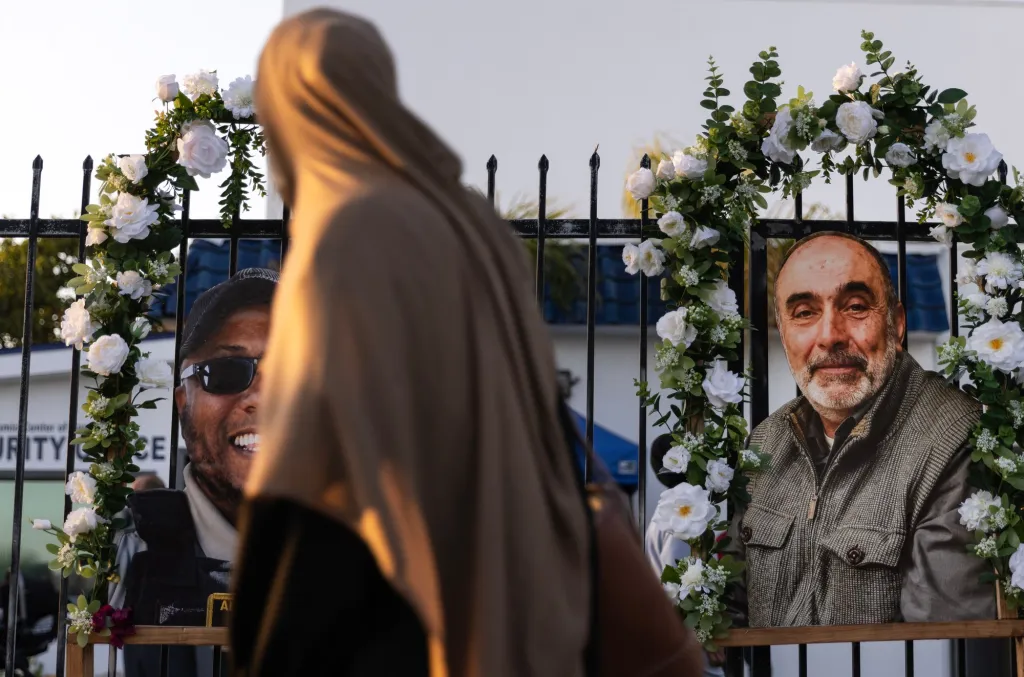
And police said they both became radicalized by hate online, where the teens met virtually and then, at some point, in person, before killing three men outside the Islamic Center of San Diego Monday. The teens are believed to have killed themselves shortly after the attack in a vehicle nearby. It appears the pair livestreamed the attack and their deaths, and the videos circulated widely online.
The FBI said it recovered a manifesto. An extremism expert the Union-Tribune spoke with said she believes a manifesto also widely circulating online, which the Union-Tribune has reviewed, was written by the two teens.
The manifesto cites White supremacist and neo-Nazi ideology, repeats tropes and rails against a cross-section of groups — religious, ethnic, women and LGBTQ+ communities. It calls for violence and praises mass shooters, and there are repeated references to a young man who opened fire at Chabad of Poway in 2019, killing one congregant and wounding three.
Well more than a year before the shooting, Vazquez drew the attention of Chula Vista police, who cited his “suspicious behavior idolizing Nazis and mass shooters” in seeking an emergency court order to seize guns belonging to his father, Marco Vazquez.
It is not clear what prompted Chula Vista police to step in. However, a written declaration from his father references an “incident.” In the request to take the guns, police also wrote that the teen had been placed on an involuntary mental health hold at some point, although it’s not clear when.
Days before police sought the order, the father and his wife voluntarily stored 26 weapons — pistols, rifles and shotguns — with a licensed gun dealer.
“I am well aware of the seriousness of the allegations made against my son,” Marco Vazquez said in a written declaration in the court file, adding those allegations are what prompted him to store the weapons outside the home. He said the guns would not return “until my wife, my son’s therapist and I believe it is safe to do so.” He said they also secured all sharp knives in the home.
The teen had started therapy, the father wrote, and he and his wife had “significantly increased” their supervision of him. Since “the incident,” he said, they were monitoring his online presence. “We observe all of his online activities, who he talked to, what he talks about and who he is friends with.”
In mid-February, the family and police agreed to dismiss the matter in court. The emergency order to take the guns was dissolved.
Asked about the emergency protective order, Chula Vista police referred questions to the FBI and San Diego police. The two agencies are investigating the mosque shootings.
Authorities have not said who owned the weapons the teenagers used in the attack. San Diego police said Clark, the other teen, had taken guns from his home when he went missing the morning of the shooting.
Vazquez attended preschool through fifth grade at Washington Elementary School in Little Italy in the San Diego Unified School District, a district spokesperson said. After Vazquez left Washington in June 2018, there is no record of him enrolling at another city school campus, the spokesperson said. Court documents indicate he was enrolled in school and had a job, but the filings do not say where.
Vazquez’s parents purchased the townhouse in eastern Chula Vista in 2008, according to public property records.
On Thursday, the Vazquez family issued a statement mourning the victims and condemning their son’s actions as those of “an immensely lost, troubled, and misguided soul.”
“Our son was on the autism spectrum, and it is painfully clear to us now that he struggled not only with accepting parts of his own identity but also grew to resent them,” the statement reads.
“We believe this, combined with exposure to hateful rhetoric, extremist content, and propaganda spread across parts of the internet, social media, and other online platforms, contributed to his descent into radicalized ideologies and violent beliefs,” the statement reads.
Read more Ham on Wry: Time well spent with family in Montana
“Although measures were taken to help him through his mental instability, it ultimately was not enough,” the family said, adding that they repeatedly encouraged him to seek help and that he voluntarily spent time in multiple rehabilitation centers.
Clairemont student
Less is known about the other suspected shooter. Clark was a high school senior at iHigh Virtual Academy, which is San Diego Unified’s online-only school. A district spokesperson said the teen had been an iHigh student since 2021, when he was in eighth grade, and was on track to graduate.
He spent his freshman, sophomore and junior years on the wrestling team at Madison High — his neighborhood school, the standard site for extracurricular activities for students of the virtual school.
He did not attend Madison as a student, although a traditional yearbook portrait of him appears in the yearbooks from his freshman, sophomore and junior years. The yearbook from his junior year also features a picture of him after winning a wrestling match, as well as team photos. He does not seem to appear in the yearbook from this year, his senior year.
Before moving to the online school in eighth grade, Clark attended middle school at San Diego Creative and Performing Arts School, a public magnet school with a focus on visual and performing arts. However, the pandemic led all San Diego Unified schools to move classes online from the end of his sixth-grade year through most of his seventh-grade year.
He practiced Jiu-Jitsu as a younger child, according to his father’s Facebook profile.
Clark’s parents purchased the home in northern Clairemont in 2004, according to property records.
Clark’s father is a DJ as well as the author of a five-part comic series in which the protagonist, a misunderstood boy, is faced with killing newfound friends to break a curse, according to the father’s Facebook account and online book reviews. His mother at one time ran a medi-spa in Clairemont, according to Facebook and other public business records.
Clark’s parents have not responded to requests for comment.
Tucked into the many pages of hateful rants and ideology in the manifesto the teens apparently co-authored are threads of personal grievances.
The part purportedly written by Vazquez mentions years of ridicule and rejection — one of the few full sentences of his written in all caps.
“You all thought it was hilarious to treat me like I was subhuman, to make fun of and tease me for every little thing. No matter how hard I’d try, I could never fix myself there was always something to make fun of me for, and I hate you all for it,” the document reads.
The writer laments that while it’s OK for girls to be short or shy, he is treated as “subhuman” or seen as “weird and awkward.” He also alluded to being autistic or neurodivergent, and said he had “mental issues which I am sure will come out eventually.”
Part of the section that purports to be by Clark discusses men growing depressed after trying but failing to find relationships with women, particularly “a short guy.”
“I can say this with confidence because I experienced the same thing,” the manifesto reads.
Two hours before the teens arrived at the Islamic Center on Monday, Clark’s mother had called authorities and reported that her son had run away with a friend he’d met online, and both were dressed in camouflage. One gun was missing. An hour later, she called back, reporting finding a possible suicide note and hate-filled, threatening writings, police said.
As police — sensing a greater public threat — searched for the pair, calls came in reporting shootings at the mosque.
Staff writers Karen Kucher, Phillip Molnar and Noelle Harff contributed to this report.
Read more San Francisco immigration court shuts down after purge of judges, leaving asylum cases in chaos