





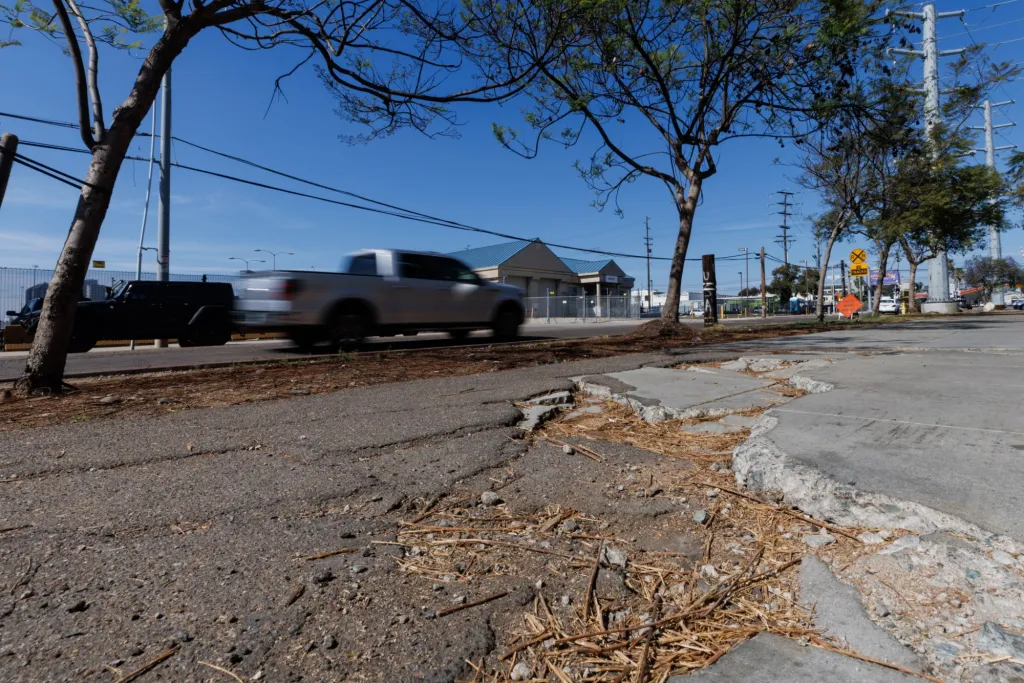
San Diego’s budget crisis is forcing city officials to end a popular fee-waiver program that spurred millions in voluntary sidewalk repairs that property owners probably wouldn’t have tackled otherwise.
Read more A federal judge strikes down Trump administration immigration policy affecting 39 countries
The nearly three-year-old pilot program shrank the city’s sidewalk repair backlog and eliminated some dangerous sidewalk situations, but officials say lack of money prevents them from making the program permanent.
June 30 is the last chance to participate in the program for more than 4,800 property owners who have received eligibility letters since fall 2023. Anyone who applies by then will be accepted despite scarce funding, officials said.
City officials say the program, called Safe Sidewalks, was a success that will likely be revived when funds are available. They say it helped many property owners realize they are responsible for repairing damaged sidewalks near their property.
The carrot-and-stick program notifies property owners they could be liable for injuries caused by damaged sidewalks near their property if they don’t quickly tackle costly repairs — but there’s a twist.
The program waives a $2,200 city permit fee, and it allows property owners to avoid a bureaucratic approval process by self-certifying their repairs with before-and-after photos they mail to the city.
More than 10% of property owners who got eligibility letters — formally called notices of responsibility — have had their repair plan approved. Of those 550 repairs, more than 340 have been completed.
City officials estimate the program has saved property owners more than $1 million in fees and spurred more than $3 million in repairs. When all the repairs are completed, the total is likely to climb from $3 million to more than $5 million.
“This program fueled neighborhood repairs that likely never would have occurred otherwise while helping to reduce city liability for sidewalk infrastructure,” Naomi Chavez, the city’s acting transportation director, wrote in a recent memo to the City Council.
But Chavez told the council it would cost about $450,000 to hire three full-time workers needed to keep the program running after June 30.
No new employees were hired for the pilot program, which used existing clerical staff to send the eligibility letters and an existing engineer to review and approve repair plans.
While $450,000 is a small fraction of the city’s $2.2 billion operating budget, San Diego faces a $146 million deficit, and leaders have vowed to focus on core services like public safety — not pilot programs for things like sidewalk repair.
But Chavez said the program was so successful that it will likely be back someday.
Read more ICE will no longer report deaths of detainees who have recently been released from custody
“The Transportation Department is proud of the model that was established and we stand ready to reinstate this program or similar efforts when resources are made available,” she said in her May 28 memo.
City officials say the fee waivers essentially cost the city nothing because the program was creating new projects that wouldn’t have happened, not reducing fee revenue from projects that would have happened anyway.
When the program ends, sidewalk repair permitting will revert back from the Transportation Department to the Development Services Department, which will charge permits fees to recover the department’s costs.
Eligibility letters were sent to property owners based on where they live and that area’s ranks in a system the city calls the “pedestrian priority model.” The city sent letters to properties in 32 of the 56 areas in the model, but didn’t get to the final 24 areas.
After June 30, officials say they will continue to send letters — but at a much slower pace. Before the pilot program, the city hadn’t sent letters for years because response rates had been so low without the fee waiver.
Because sidewalks can seem to some property owners like just as much a public responsibility as roads, storm drains and other parts of the public right of way, many are unaware that state law has a special designation for sidewalks that makes owners of adjacent property responsible for repairs.
San Diego’s policy says the city is responsible when the damage is caused by parkway trees, grade subsidence, city-performed utility cuts and heat expansion.
That leaves property owners responsible when the damage is caused by private trees and tree roots, deteriorating concrete and cracking, weather conditions or normal wear and tear.
The city has a backlog of more than 8,000 needed sidewalk repairs. Officials say that number would be higher without the pilot program.
In the capital improvement budget for the new fiscal year that begins July 1, city officials propose to boost annual spending on sidewalk repairs to $12 million — nearly double the $7 million in the budget for the ongoing fiscal year.
City officials say that’s still not enough. They estimate $17 million per year is needed to wipe out the backlog in 14 years. Otherwise, they say it will keep growing.
The proposed budget also includes $300,000 for sidewalk repairs in low-income neighborhoods, where residents might be less able to fund repairs near their property. That funding level has remained constant since fiscal year 2024, covering 132 repair projects.
Read more Trump’s back-and-forth on troops in Europe potentially cost millions, US officials say