


In a large, dimly lit room on the first floor of the Chula Vista Police Department’s downtown headquarters, Sgt. Evan Linney and drone pilot Rusty Johnson sit before a wall of monitors displaying maps, data feeds and live news broadcasts.
Read more Outdoors: These little stinkers arrive nightly at Secret Spring
Linney listens as a 911 call comes through. Within seconds, the map on the screen updates in real time, a marker pinpointing the caller’s location. On another monitor, a dashboard that resembles the menu screen of a flight simulator flickers to life — only this is no simulation. A drone lifts off from the roof of police headquarters and climbs 200 to 300 feet into the clear blue sky above the city.
“Back in 2018, when we started our drone program, we were the first agency in the country to utilize drones as first responders,” said Linney, the drone unit’s supervising sergeant, crediting the program with faster response times, better de-escalation and improved safety for officers and civilians alike.
Eight years on, Chula Vista operates one of the most sophisticated drone programs in American law enforcement — and, with 46 aircraft on its books, one of the largest inventories of any agency in San Diego County, according to annual reports required by state law.
Assembly Bill 481 mandates police agencies develop detailed use policies for military-grade equipment and submit annual reports covering inventory, usage, purchases and public complaints. Local governing bodies must annually review those reports and vote on whether departments are in compliance. The council in April voted unanimously to approve the department’s report.
Manny Salazar, the Police Department’s public information officer and former drone team member, said the 46-drone figure is misleading. Roughly seven are purpose-built Drone as First Responder (DFR) aircraft, about 10 are tactical drones officers can check out for field use, and the remainder are older units no longer in operation, but required to be reported under state law.
“It’s kind of like if you had an old iPhone that you still have under your possession, you don’t use it, but you still have it in your drawer,” Salazar said. “The full number is inflated and we don’t use all that many drones. But we keep all of our old drones until we find a way to sell them or get rid of them properly.”
With an annual operating cost of $1.5 million for maintenance and personnel, the department’s inventory of Unmanned Aircraft Systems (UAS) cost over $500,000 for all 46 drones listed in the military equipment report, though Linney said many of the older models were donated to the department by various companies during the program’s infancy. The program is largely funded by Measure A, a half-cent sales tax measure funding public safety staffing and services passed by Chula Vista voters in June 2018, generating an estimated $17 million annually.
For context, the San Diego Police Department — serving a population roughly four times larger — reported 43 drones at a higher total cost of around $900,000. Sgt. Nicholas Link, in charge of SDPD’s Unmanned Aircraft System Unit, said the active fleet is far smaller. Like Chula Vista, he said, older and retired models remain on the books under state reporting requirements, with only about 16 drones accounting for more than 90% of operational use.
Unlike Chula Vista, San Diego does not yet operate a Drone as First Responder program, though Link said the department is actively assessing one.
“I’ve been trying to promote this unit and its technological benefits, and lifesaving and de-escalating capabilities for years now,” Link said. “Chula Vista did a great job, but DFR is challenging to implement for a lot of other reasons.”
The San Diego County Sheriff’s Office reported 71 drones in its most recent inventory — the largest count of any agency in the county — but a department spokesperson said many of those platforms are obsolete or out of service due to maintenance or airworthiness issues, with only approximately 30 aircraft in operation.
Chula Vista Acting Police Chief Dan Peak said drones have helped the department keep pace with a rapidly growing city, even as he said they remain the most understaffed department in the region by officers per capita.
“It’s a challenge, but we’ve been able to keep up with our community policing and being able to get to our calls for service just with the enhancement of technology,” Peak said. “Drones don’t have to stop at traffic lights or stop signs. They get to the call way faster than a human being does. And once that drone gets there, it’s on scene, it’s able to relay footage back to our officers.”
Salazar said a pilot monitors the radio and can dispatch a drone before a call is even assigned to a patrol officer, with live video feeding directly to officers’ mobile computers and phones. He said the program has brought the department closer than ever to meeting high-priority response time thresholds.
“In the last 20 years, we’ve had a hard time meeting those thresholds,” Salazar said. “But now with the drone we’ve come very, very close.”
Read more Sharp sees strategic advantage in new deal with Tri-City Medical Center
Concerns over transparency and privacy have followed drone programs nationally. In Chula Vista, there was a high-profile lawsuit between the city and the publisher of La Prensa San Diego, Arturo Castañares, who sought access to Chula Vista police drone images under the California Public Records Act. After roughly four years of litigation, Chula Vista was ordered by the court to hand over the drone footage and pay for Castañares’ legal fees.
Addressing privacy concerns, Salazar said all flights are uploaded to a public dashboard showing telemetry, destination and incident number, and that camera protocols bar operators from pointing the camera downward except when directly over a call location — preventing inadvertent recording of private property.
“We only use them for high-priority calls,” he said.
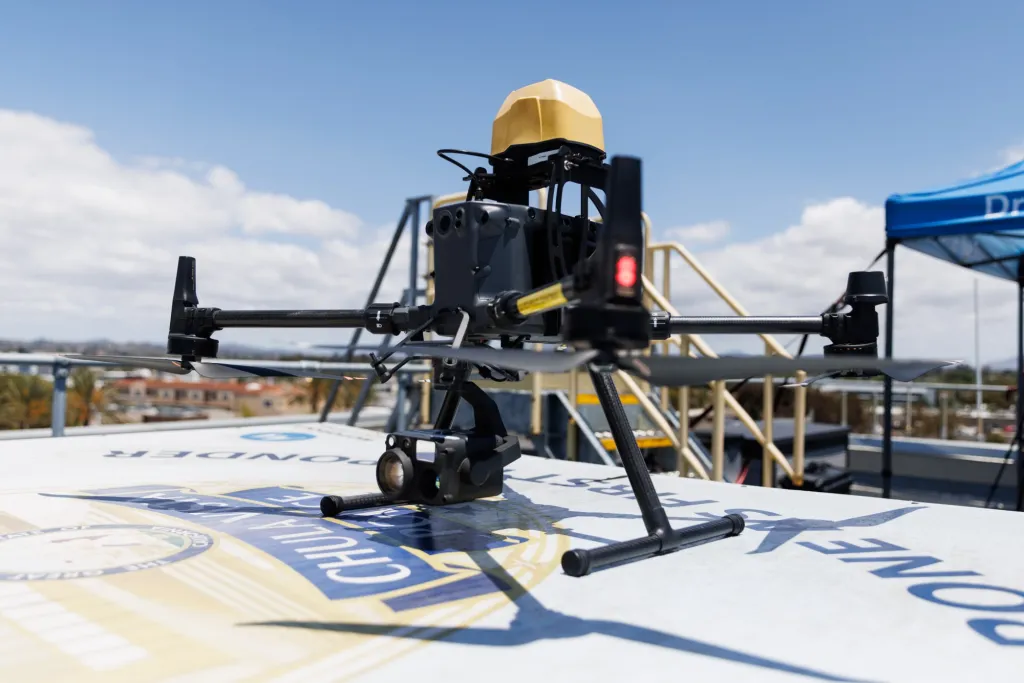
The main DFR aircraft — the DJI M300s and M350s — are roughly 3 feet by 3 feet, carry two large batteries, a camera gimbal, LiDAR, thermal imaging, and a parachute.
The department also operates Brinc Lemur S units for indoor tactical situations and the autonomous DJI Box 3 with Matrice 4TD — a drone-in-a-box platform that is programmed to launch, navigate and return to base entirely on its own.
The operating team is made up of a lieutenant, a sergeant and two full-time officer pilots, all licensed by the Federal Aviation Administration and required to attend monthly training. The weekday pilot flies Monday through Thursday, 9 a.m. to 7 p.m., while a second pilot covers weekends from 7 a.m. to midnight to accommodate higher call volumes.
To become a licensed drone pilot within the department, officers must apply, interview, and pass an FAA exam — requiring knowledge of nautical and weather chart reading. Candidates then attend a weeklong school at the Regional Training Center in Riverside before completing monthly four-hour training sessions and 40 hours of mandated annual DFR flight time.
“We don’t compromise safety,” Salazar said. “We want to make sure that we’re on top of the laws and make sure that everybody’s trained properly.”
National City Police Chief Alex Hernandez said the broader law enforcement community is taking notice of drone programs like Chula Vista’s. He said agencies across the region are exploring similar technology to get eyes on a scene before officers arrive, though budget constraints and FAA airspace restrictions — particularly in dense urban areas near flight paths or military corridors — remain significant barriers to adoption.
National City’s drone fleet consists of three aircraft — two DJI Phantom 4 Pros and one DJI Mavic Pro, all acquired in 2018 — plus a Fotokite Sigma tethered drone capable of up to 24 hours of autonomous flight. Hernandez described drones as useful for situational awareness at command posts, but stopped short of committing to a larger fleet.
“Am I going to chase after the drones? Probably not,” he said. “The price point’s a little on the high side.”
Hernandez did note one tactical use his SWAT team has already embraced: sending a small drone inside a building to clear it before officers enter.
“If we hear something inside, sound like a gunshot, and we don’t know if somebody’s still in there, we’ll send a small one to fly around inside to kind of clear it out before we send our team in, just to be on the safe side,” Hernandez said.
Peak said the role drones play in improving officer safety and response times cannot be overstated, especially in regards to their utility as a de-escalation tool.
“Drones have really de-escalated situations over the years, and have prevented many shootings, for instance, from potentially happening,” Peak said. “It’s all due to the fact that if we’re getting 911 calls of a person with a weapon, and the drone gets there first, it’s able to see if it’s a real gun, a real weapon, for example. Then from there we can act accordingly. Having that technology in place really brings down the potential for a tragedy.”
But Peak said the technology is not a full-stop substitute for officers. “At the end of the day, you still need a real police officer to show up on scene for those emergency calls.”
Read more Santee increasing fire safety measures along San Diego River corridor