





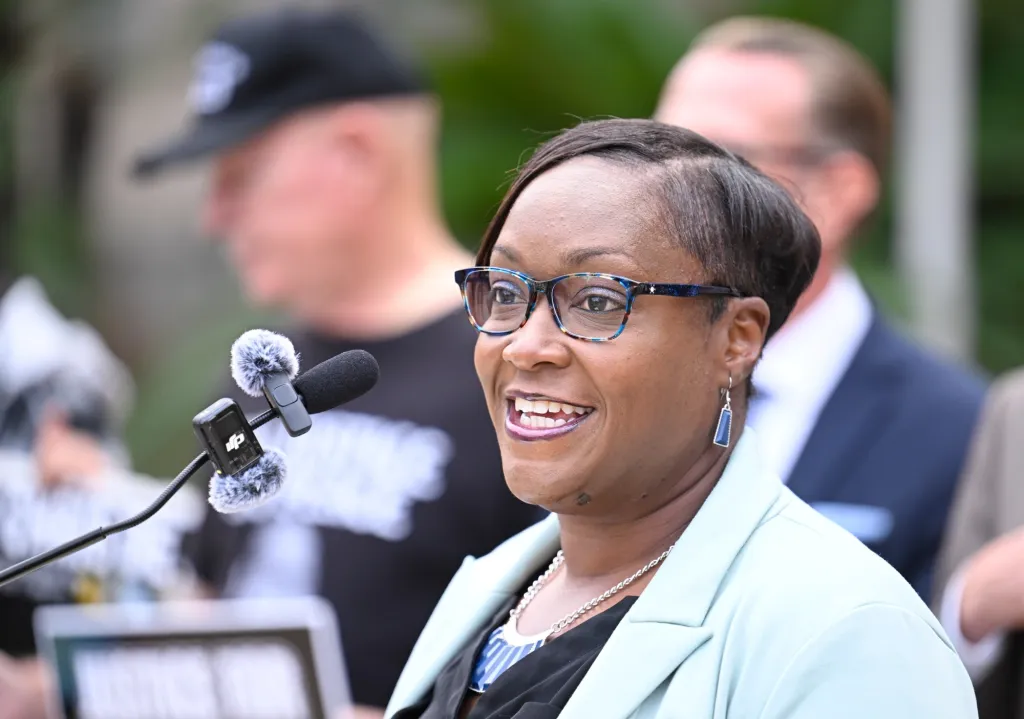
LaShae Sharp-Collins, a Democrat and incumbent Assembly member, is running for re-election in the 79th District representing La Mesa, El Cajon, Lemon Grove and southeastern San Diego neighborhoods.
Read more Q&A: Meet Andrew Lawson, candidate for California State Assembly District 79
The San Diego native is seeking her second term in the Assembly.
The San Diego Union-Tribune emailed a series of questions to Sharp-Collins and other candidates to help inform voters about their positions, priorities and plans if elected.
Sharp-Collins said she did not use any AI tools in responding to the Union-Tribune’s questions.
1) Why are you running, and what makes you the best candidate? (150 words max)
I was drafted to run by families and leaders in my district. I was born and raised in the district, where I’m currently caring for my parents and raising my son. I graduated from Lincoln School and San Diego State University, where I later worked as an adjunct professor. I served on the board of Planned Parenthood and as the community engagement specialist for the San Diego County Office of Education. I also served as district director to then-Assemblymember — now Secretary of State — Shirley Weber.
I am deeply connected to the values of this district because I live them every day. I have spent my first two years delivering for the 79th district with over $60 million in budget funds and numerous bills, including regulating predatory tow fees and improving law enforcement oversight. I am the best candidate because I have delivered and will continue to do so. I remain steadfast in my commitment to ensure that as long as I am elected, my district has a seat at the table.
2) What are the top 3 issues facing this district? (150 words max)
The needs of my district easily map over those of the rest of the state. I am working to address the rising cost of living by fighting for affordability and equity. I am also working with my colleagues to increase housing supply to help get people out of homelessness and ensure working families can build generational wealth through homeownership. Finally, I serve on the public safety committee, where I fight to make sure our constituents feel safe where they live while also balancing the over-policing of our communities.
3) What are the first 3 things you would do in office if elected? (150 words max)
N/A
4) What should California do to solve its shortage of affordable housing and curb homelessness? Which existing efforts do you believe are working, and which aren’t? (150 words max)
I am fighting this issue on multiple fronts. I voted last year to advance long-overdue CEQA reforms to make sure we can build housing sooner. I serve on the Assembly Select Committee on Housing Affordability, where I help advance these conversations. I support the housing bond working its way through the Assembly to provide local jurisdictions with more resources to build housing as well. I also want to continue building a continuum of housing for the unhoused — from emergency housing to permanent — to help people move successfully through state support into situations where they are thriving.
5) This district and its neighbors are vulnerable to climate change impacts like wildfires, rising seas and extreme heat, and to the health effects of climate-warming emissions. What should California do to improve climate resilience and reduce emissions and fire risk? (150 words max)
Since I was elected, I have been a voice for the district regarding climate change. In every conversation about Los Angeles wildfires, I have advocated for a disaster relief structure that accommodates all needs, including the floods my district experienced in 2024. Climate change is real, and we must address these issues head on with smart, equity-rooted policies that account for all possibilities, such as wildfires, floods, soil erosion or extreme heat.
We need an equitable division of resources while ensuring a responsive insurance market. We also need investments in the types of home-hardening seen in rural districts but sometimes missed in districts like mine.
6) Laws enshrined in California’s Constitution that protect residents from tax increases have also painted local governments into a corner as they seek to fund basic services and have led to chronic underfunding of schools. What would you do about this? For instance, would you support changes to Proposition 13 to remove its protections for commercial properties? (150 words)
Any discussion of Proposition 13 requires all stakeholders to be involved and time to come to a solution that benefits all parties, including local governments that want more property taxes but don’t want to see businesses leave the state. We must ensure residents are protected from rising costs so that we can ensure homeownership is within reach for those who wish to own a home.
7) In light of those constraints, along with federal funding cuts, how should California balance its budget and fund basic services? Where would you seek new revenues or savings? (150 words)
Read more Q&A: Meet Tim Arnous, candidate for California’s 50th Congressional District
California’s budget priorities must focus on critical services, including full Proposition 98 funding for public schools and funding for community colleges and the CSU and UC systems. That is why I support the research bond for the UC system, the proposed housing bond for the November ballot. In addition, I have introduced three bills and a budget request to support social safety-net programs.
8) Speaking of spending, Californians consistently rank the cost of living as a big concern. Recent jumps in the costs of fuel, food and other goods — combined with federal cuts to safety-net programs, new limits on certain federal loans and more — are further squeezing residents who were already struggling. What relief would you seek to offer, and how? (150 words max)
In my first year, I introduced two bills to support and backfill cuts to CalFresh and CalWORKs. This year I am the chair of the Select Committee on CalFresh Enrollment and Nutrition. I championed a budget request, supported by both houses of the Legislature, to provide counties with the necessary resources to address the HR 1 cuts. I also have a bill to undo the restriction for income-eligible individuals who work over 100 hours from receiving CalWORKs support. Affordability is a key issue in my district, and I was proud to eliminate unfair towing fees last year. I will continue to fight for an affordable and equitable California where we all can thrive.
9) President Trump has made cracking down on immigration a cornerstone of his administration, ordering widespread arrests and detentions of immigrants nationwide and directing military resources to a new military zone along the U.S.-Mexico border. What impact have these actions had on this district? What are your goals on immigrants, immigration and the border, and how would you pursue them in the Legislature? What is your message to constituents who are immigrants? (150 words max)
I stand with our immigrant community and my constituents. Immigrants are the story of America, and my district is proof of how great we can be when we embrace diversity and inclusion. My social media pages are a resource for those in need of assistance. I continue to advocate for and support funding to aid immigrants in need. I have supported and will continue to support bills that stop local law enforcement from participating in federal policies aimed at targeting our immigrant communities.
10) Health care costs for many Californians are rising — some because of new federal eligibility requirements, some because of Gov. Gavin Newsom’s moves to limit Medi-Cal coverage for some immigrants. How would you rein in costs? Would you vote to reverse the governor’s cuts to immigrant health care coverage? (100 words max)
The rising cost of healthcare is troubling. I voted for legislation this year that would create a new way to help the California understand the cost of all the new healthcare mandates with respect to the cost burden on consumers. I routinely meet with hospitals in San Diego County, and I am well aware of the financial pressures they face. Last year and again this year, I supported emergency funds to keep hospitals, particularly in rural areas of the state, open and available to provide care. I am working hand in hand with them to ensure they are able to keep their doors open, while also addressing the pressing needs of both patients and employees.
11) Among the many ballot measures being pursued by lawmakers and citizens for the November ballot are a handful that have drawn much attention and money. Should each of the below measures qualify for the November ballot, would you personally vote for measures that would do the following? (50 words max per measure)
— make ride-hail companies like Uber and Lyft liable for sexual assaults committed in cars?
As a general matter, companies are liable for the behavior of their employees while on the clock. I am working with ride-share companies to help them stay operational and establish a system where riders feel safe and protected.
— require voters to provide a government-issued ID each time they vote?
No, I do not support this measure. It is a modern-day form of voter suppression, similar to Jim Crow-era poll taxes and literacy tests. With minimal evidence of voter fraud at best, and with documentation of Black, Brown and socially disadvantaged communities being disenfranchised, I cannot support this measure.
— levy a one-time 5% wealth tax on people with over $1 billion in assets?
I do support this measure. At a time when the wealthiest are gaining while California is forced to make hard choices to provide for our most vulnerable, I do think that a one-time tax makes sense.
— pass $10 billion in bonds to fund affordable housing development?
I support this measure. My vote last year to relax some CEQA regulations does not make sense if we cannot also put money towards the issue. I support this measure, and should my district agree, I look forward to money flowing into San Diego to address homelessness, student housing and homeownership.
Read more Q&A: Meet Mara Elliott, candidate for California State Senate District 40