








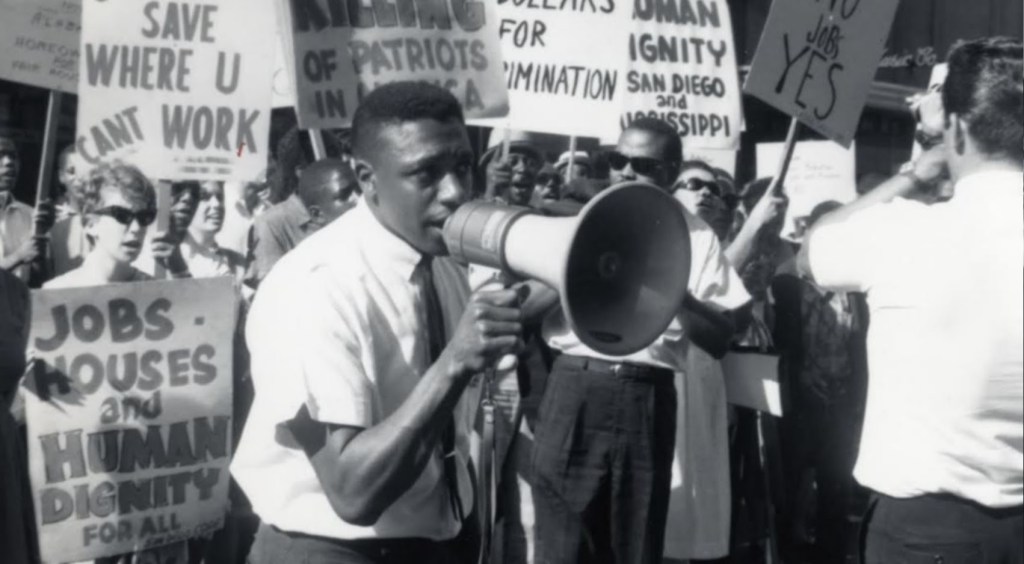
Harold K. Brown, the upbeat educator and activist who tirelessly fought the discrimination Black people faced in securing jobs and housing in San Diego County during the height of the civil rights era in the 1960s, has died.
Read more San Diego would further roll back efforts to keep city clean, orderly in mayor’s proposed budget
Brown passed away from natural causes on May 6 — on his 92nd birthday — while receiving care at Sharp Grossmont Hospital in La Mesa, according to Bernard Johnson, a long-time friend.
Brown became San Diego State University’s first Black administrator and founded its Afro-American Studies program. He was also an SDSU benefactor for decades, including the years in which the Army veteran promoted economic empowerment programs for Black people while working as a banker.
“Hal Brown was an extraordinary man whose life reflected both purpose and courage — from excelling in academics and athletics to serving his country and finding his voice in the Civil Rights movement,” SDSU President Adela de la Torre said in a statement.
“His lifelong commitment to this university and to advancing opportunity for others stands as a powerful example of what it means to lead with purpose.”
Brown was born May 6, 1934, in York, Penn., a small city on the north side of the Mason-Dixon Line, which became known as the cultural and political boundary between the northern and southern U.S. during the Missouri Compromise debates of 1820.
Historians say he was the youngest of seven children and attended a segregated elementary school, where he experienced his first brush with racism when factory workers verbally abused and spat on him.
“(Brown) also recalls how he and his friends would many times have to fight their way to school past gangs of white children,” according to an SDSU biography. “Hence, the Black-White confrontation in his life had begun.”
In 1953, he enrolled at San Diego State College, before it became a university, and founded the school’s first Black fraternity, Kappa Alpha Psi. He had to set aside his studies two years later when he was drafted into the Army. Brown returned to campus in 1955 and became a starter on the basketball team while majoring in speech and physical education.
Read more Republican senators say they need more detail on $1B White House security request
He also joined the Wesley Foundation, a Methodist campus ministry that encouraged students to explore race relations. This led Brown to become a civil rights activist, notably by founding and helping run a local chapter of the Congress of Racial Equality in 1961.
CORE, as it was known, was emerging as one of the most important civil rights groups in the country, organizing sit-ins and demonstrations. The group also helped produce the Freedom Rides, which tested the non-enforcement of U.S. Supreme Court rulings that declared segregated public buses unconstitutional.
Brown, a junior high school teacher at the time, worked at the local level across San Diego County, leading efforts to desegregate housing and jobs in communities such as El Cajon and La Mesa. His opposition included such major institutions as Bank of America, San Diego Gas & Electric, the San Diego Zoo, and Montgomery Ward. He was arrested many times for his activism. But Brown never lost hope, forever expressing the need to be a positive force.
“The experience of growing up in segregated schools and back alleys really left a mark on me,” Brown told a writer for an SDSU publication in 2022. “Being called the ‘N-word’ and being looked at as inferior has a negative effect on Black people, and we never really talked about race relations in San Diego when I was a student.”
His push for justice extended beyond the U.S. In the mid-1960s, he became deputy director of the Peace Corps operation in Lesotho, Africa, where he challenged the racially toxic apartheid form of government, finding time along the way to also serve as a teacher and a banker.
Another key moment came in 1971 when Brown — known to most people as Hal — became the first Black person to serve as an administrator at SDSU, one of California’s oldest schools. A year later, he created and led the Afro-American Studies program, which is today regarded as one of the best of its kind in the U.S.
Brown spent 26 years at SDSU, retiring in 1997, but only to a degree. He did not formally leave his position as director of the Center for Community Economic Development at the university until 2004.
Read more Q&A: Meet Josh Newman, candidate for California state superintendent of public instruction