


Almost everyone agrees the interchange between Interstate 5 and state Route 78 can be a tight squeeze, and the California Department of Transportation is again asking people to consider some solutions.
Read more Chula Vista mayor’s campaign acknowledges violating city contribution ordinance
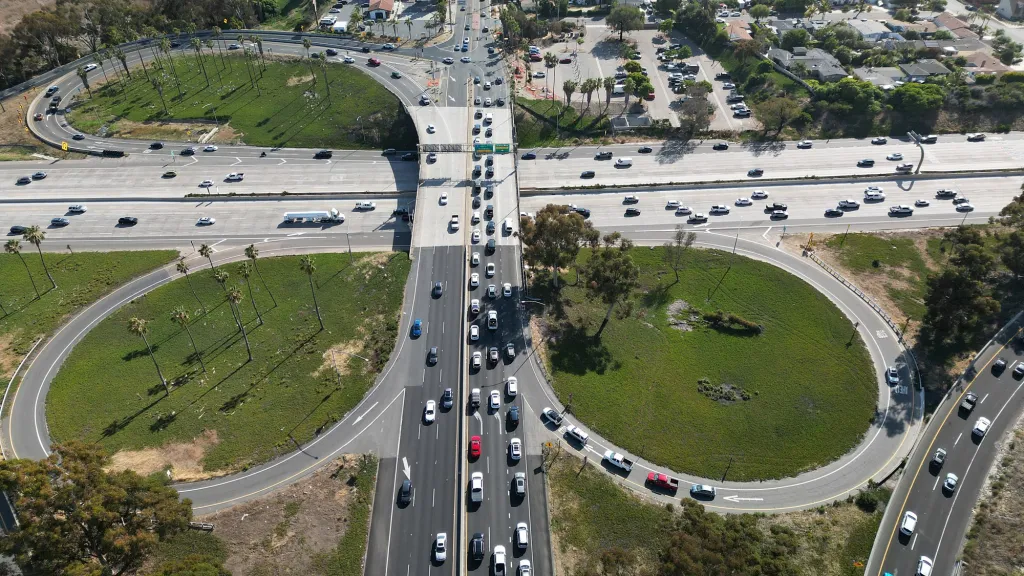
Perhaps the most annoying issue is that the three westbound lanes of traffic on Route 78 halt for signal lights at the onramp to southbound I-5. Two lanes turn left onto the ramp, which funnels into a single lane, slowing drivers and creating a long backup at peak hours. A third lane continues west onto what becomes Vista Way.
But the traffic signals are only part of the problem.
The offramp connecting southbound I-5 to eastbound Route 78 is short and tightly curved, a legacy of freeway construction in the 1960s when there were far fewer vehicles on the road. Drivers must merge with traffic entering I-5 from the nearby Cassidy Street onramp, steering quickly across congested lanes to reach the exit.
“They’re about 10 years late on building a flyover bridge for the 5 south to the 78 east,” said Leucadia resident James Robertson in a recent post on Nextdoor.
“The inland cities of Vista/Escondido have grown in population so much that a bottleneck occurs for everyone merging to the right two lanes for the 270 degree loop to go east on the 78…only to be met by a traffic light,” Robertson said, referring to southbound I-5 traffic in Oceanside exiting to get onto Route 78 headed toward the eastern cities.
“I’ve seen it cause a backup halfway to San Clemente,” said. “If you’re on the 76 trying to go 5 south in the afternoon/early evening it can take 15-20 mins just to get south of the 78 exit. Ridiculous.”
The proposed improvements have been in the slow lane for decades.
In a May 23, 2004, article in The San Diego Union Tribune, Mark Phelan, then the Route 78 project manager for the California Department of Transportation, or Caltrans, said a new, multilevel interchange was “a high priority,” and that it had support from Oceanside officials and Rep. Darrell Issa, R-Vista, who was the district’s congressman at the time.
Phelan said $500,000 had been approved for preliminary studies and that the project could be completed by 2012 if the $150 million needed for construction could be obtained. It was not.
Now, Caltrans and the San Diego Association of Governments have proposed three new possible solutions to improve the interchange.
People have until June 13 to submit comments on the three options or propose their own ideas. All comments and responses to them will be included the draft environmental documents to be prepared for project. They are expected to be released in early 2029.
The transition from westbound Route 78 to southbound I-5 is one of the few places in California where traffic from one freeway to another freeway stops for signal lights.
Adding to the complications is the location. The interchange is at the edge of the Buena Vista Lagoon, which increases environmental concerns.
Also, Vista Way west of I-5 takes drivers through a largely residential neighborhood. People there are averse to any increase in traffic that could result from the proposed changes.
A new effort to improve the interchange has been planned for more than a decade. It’s been slow going, but the project is on track for construction in 2034 through 2038, if sufficient funding becomes available.
Preliminary designs and the work needed for environmental documents have been fully funded for $12 million and could be finished in 2029, Caltrans officials said. However, so far there’s no money for construction.
All three of the proposed solutions would eliminate eastbound Vista Way’s access to I-5. That is certain to send more cars and trucks onto neighborhood streets to find another way to get onto I-5, the state’s longest if not its busiest freeway.
Alternative 1 would be the simplest and probably the least expensive solution. It calls for removing the traffic signals and ending Vista Way’s connections to both I-5 and Route 78.
Alternative 2 calls for building a single “flyover bridge” ramp with managed lanes connecting the northbound I-5 offramp with eastbound Route 78, and a westbound Route 78 offramp with southbound I-5. Managed lanes typically have controls such as tolls or HOV-only lanes. An existing general purpose offramp without controls would remain from northbound I-5 to eastbound Route 78.
Alternative 3 would provide a general purpose ramp without controls from westbound Route 78 to southbound I-5. The existing northbound I-5 to eastbound Route 78 connection would be redesigned to separate merging and exiting traffic.
All three alternatives include removing an existing onramp that takes traffic from eastbound Vista Way across the I-5 overcrossing to a 270-degree loop connecting to northbound I-5, which also can be a hazardous transition for drivers.
Longtime Oceanside resident Joan Bockman, a former city planning commissioner, was among more than 100 people who attended a community meeting to review the alternatives Wednesday at South Oceanside Elementary School.
She didn’t like any of the alternatives. Transit officials should do more to get people to walk, ride bicycles, take shuttles, join carpools and use public transit instead of driving, she said.
“Every (freeway) improvement results in more traffic,” Bockman said. “We need to switch our focus.”
Oceanside Mayor Esther Sanchez said city officials want to be sure that changes to the intersection don’t send more traffic onto Cassidy Street, where South Oceanside Elementary School is located.
Cassidy is two blocks north of Vista Way and has connections to and from southbound I-5, but not the northbound lanes. The nearest onramp to northbound I-5 is a few blocks farther north at California Street.
The California Environmental Quality Act requires Caltrans to consider what effects the proposed changes would have on local streets, such as Cassidy and California, along with other environmental effects, such as noise, air quality, stormwater runoff and more.
“It will be interesting to see what comes out of all of this,” Sanchez said. “The main thing is just access to I-5 … we want to find a solution that is going to address all the concerns. We all want that.”
Carlsbad officials also were well represented at the community meeting.
“We support the most cost-effective solution that meets the project objectives,” said Tom Frank, Carlsbad’s transportation director and city engineer.
Caltrans began preliminary studies for the current project in 2014, considering more than 20 options. The agency held a public meeting Jan. 29, 2015, at the Carlsbad Senior Center to get public feedback on the ideas. Again, the project has moved slowly.
“We couldn’t get the traction,” said Tracey D’Aoust Roberts, deputy district director of environmental for Caltrans, at Wednesday’s meeting. “We need the support of the community and local officials.”
Since then, Caltrans has narrowed the alternatives to three with an effort to reduce the effects on homes and the lagoon.
“We need feedback,” D’Aoust Roberts said. “I don’t think people realize how important their participation is.”
Caltrans officials did not provide an estimate of construction costs, but said the upcoming studies will help determine a number.
Construction depends heavily on state and federal grant funding, which normally can’t be lined up until a single preferred alternative is selected and final environmental documents are approved.
The interchange project is part of the North Coast Corridor Program, a $6 billion, multi-agency effort to improve transportation that began about 2016.
The program includes wider freeway bridges, new carpool lanes, double-tracked railroad bridges, miles of new bike paths, pedestrian walkways and crossings, and mitigation projects such as restoration of the San Elijo Lagoon completed in 2022.