








In 1991, San Diego city leaders celebrated the opening of the Neil Good Day Center, a place where homeless people can access daily necessities most people take for granted: laundry, mail, a safe place to relax.
Read more Díaz-Canel announces economic reforms to attract investment and involve Cubans abroad
The center was hailed then as a rare collaborative effort by local governments, business leaders and civic activists to help the city’s vulnerable.
“Truly, this shows a dream can become reality when people care,” then-Mayor Maureen O’Connor said at the center’s opening.
Almost 35 years later, today’s city leaders are shutting it down.
Mayor Todd Gloria and the City Council have agreed to eliminate funding for the day center at the intersection of 17th and K in East Village. The center will close at the end of this year.
Father Joe’s Villages, the nonprofit that has run the day center since 2015, vows to keep its services operating and plans to move the day center to its campus at 15th and Imperial — a move the city says it supports.
But Father Joe’s must raise hundreds of thousands of additional dollars to keep it running, and it may have to downsize services if it can’t raise enough funding.
Even if Father Joe’s did have the funding to backfill what the city cut, the city is not allowing the nonprofit to stay because it is ending its agreement to operate there, said Father Joe’s CEO Deacon Jim Vargas.
“We’re dealing here with humanity. We’re dealing here with basic dignity of individuals,” Vargas said of the city’s decision to close the center. “If we can’t take care of our most vulnerable, what does it say about us as a community?”
Mayor Gloria, who included the center’s closure in his initial budget, has said he instead wants to prioritize homelessness programs that move people off the streets into housing or shelter.
“Like every department and program, homelessness services were subject to difficult budget decisions this year,” city spokesperson Matt Hoffman wrote in an email. “The City must prioritize limited resources toward programs that maximize shelter capacity, connect people to housing, and deliver the greatest impact for those experiencing homelessness.”
Hoffman said the final budget will ultimately add about 200 shelter beds.
It will cut 50 shelter beds from 16th and Newton and all 37 beds at the Lighthouse interim shelter, but add 160 beds to the Rachel’s Promise Center for Women and Children, 60 beds for families to the Salvation Army’s Door of Hope program and 72 beds for single adults at a to-be-determined location, using opioid settlement funds, he said.
Hoffman noted separately that the city has for years gotten complaints from nearby businesses and residents about encampments, trash and open-air drug use around the day center.
It’s one of the areas that gets the most frequent encampment sweeps by city abatement crews, who clear people, tents and trash around there at least three times a week.
But homeless advocates have said that concentration of encampments is a result of people having nowhere else to go for basic services — there’s a persistent shortage of shelter beds and of spaces in the city’s secured tent camping sites.
When the day center opened in the early 1990s, its location was seen as an ideal place to move homeless services from Gaslamp District, which at the time was growing into a major tourist destination.
Read more EU agrees to launch membership talks with Ukraine next week even as war with Russia drags on
But since then, East Village has seen plenty of its own development, from bars and restaurants to gyms and luxury high-rises, along with a baseball stadium.
The day center was named after Neil Good, a city and county official and activist who advocated for homeless causes. Good died in 1989 from hepatitis.
Today, the center is open seven days a week and serves 7,000 people each year.
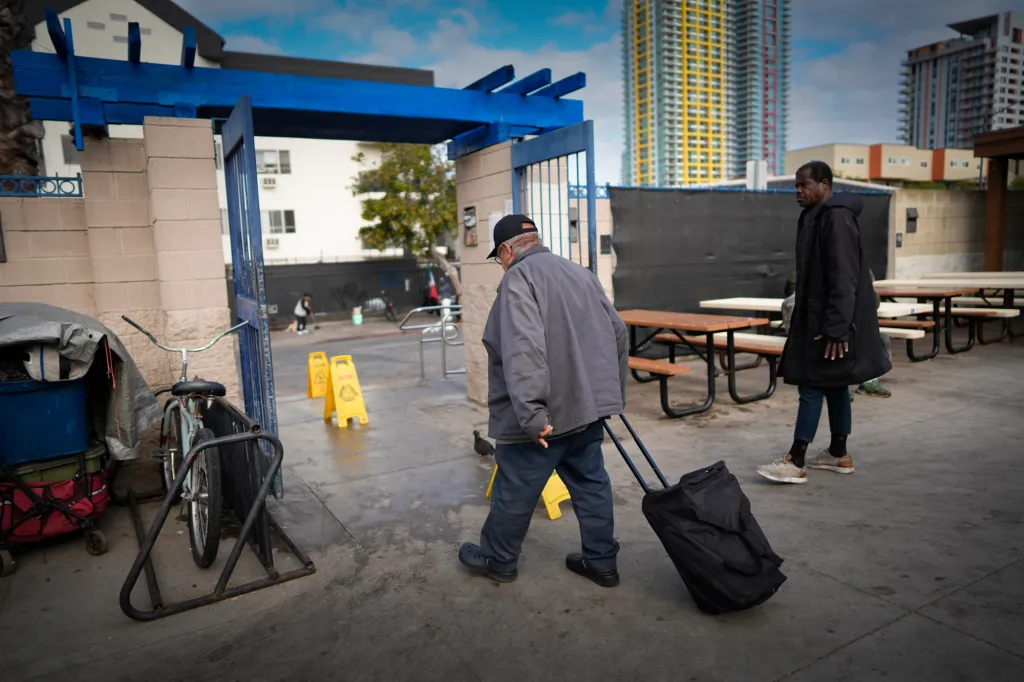
It is the main place in San Diego where homeless people who do not have a spot in the city’s limited shelter programs can get mail, laundry services, running water, flush toilets, personal storage and electrical outlets for phone charging. Hoffman noted that shelter programs provide such services to its enrollees.
Being able to have a mailing address is especially crucial for people who are looking for jobs and need an address to put on applications, and for people to receive benefits checks or important documents like state IDs.
It’s also a safe place for people to rest. People go there to simply sit at a picnic table or on a chair indoors; others come to sleep on a small hill of artificial grass after staying up through the night for their safety.
Father Joe’s has condemned the budget cuts to the day center, calling it a relatively low cost to the city that has an outsize impact on people’s lives.
In the last several weeks, Gloria and the City Council have reversed several other budget cuts and made other budget additions — including $10 million in arts funding, $1.5 million for the December Nights holiday festival, $900,000 for community events, $750,000 for a small business program and $200,000 for a position to promote and manage San Diego as a filming location.
Gloria initially proposed cutting $948,000 that the city says it provides Father Joe’s to run the day center. It costs Father Joe’s $1.7 million a year to operate it, and the nonprofit has been paying for the rest with its own fundraising.
Vargas estimates it will cost Father Joe’s $100,000 to $150,000 to outfit its 15th and Imperial Avenue campus to accommodate day center services such as laundry. The campus already provides free showers for people who aren’t enrolled in a shelter.
The nonprofit also anticipates having to raise another $200,000 to $250,000 to run the day center during the the latter half of this year, before it moves.
The city expects to provide Father Joe’s up to $237,000 for transition costs to get it through the end of this year, which is less than what the nonprofit has previously gotten from the city to fund six months of the day center’s operations.
Father Joe’s hopes to keep providing all of its day center services at the same capacity, but whether it can depends on how much it can fundraise. “We’re going to need this community’s support to make this happen,” Vargas said.
No current services at the Father Joe’s campus will be displaced due to the move, Vargas said.
It’s unclear what will happen next with the day center site. The parcel is owned by Caltrans, which leases the property to the city for $1 a month.
Read more Home where King planned Selma voting rights marches opens at Michigan museum