







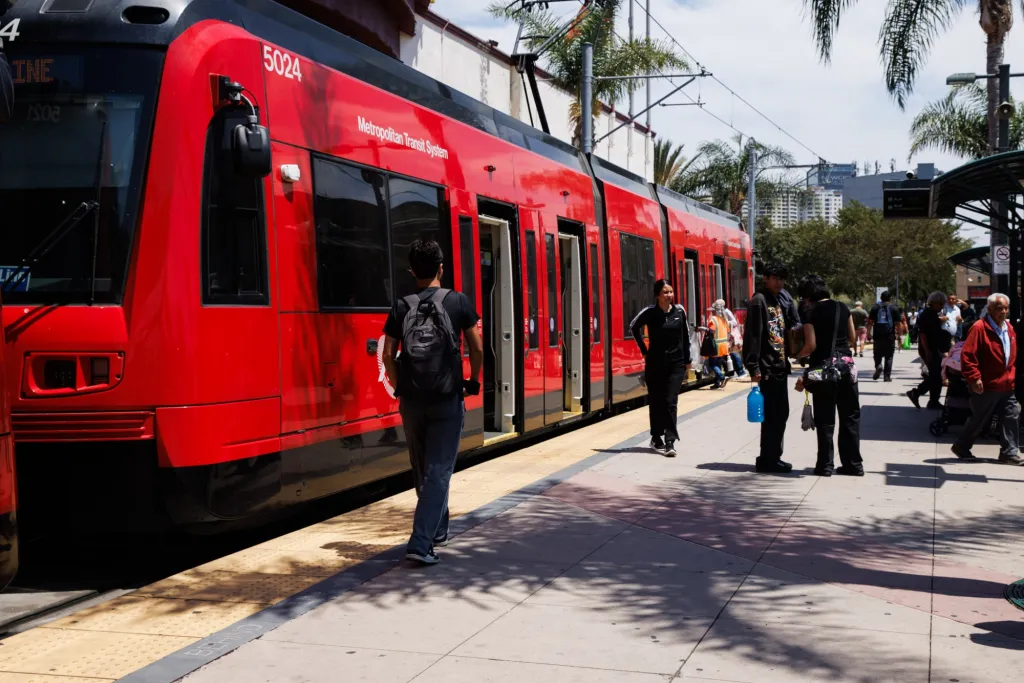
Concerns are starting to grow about the impact on low-income residents of proposed transit fare hikes as they near an approval vote scheduled for next month.
Residents from across the county criticized the proposed 30% hikes at two open houses last week and a Friday meeting of the panel slated to approve the hikes: the transportation committee of the San Diego Association of Governments.
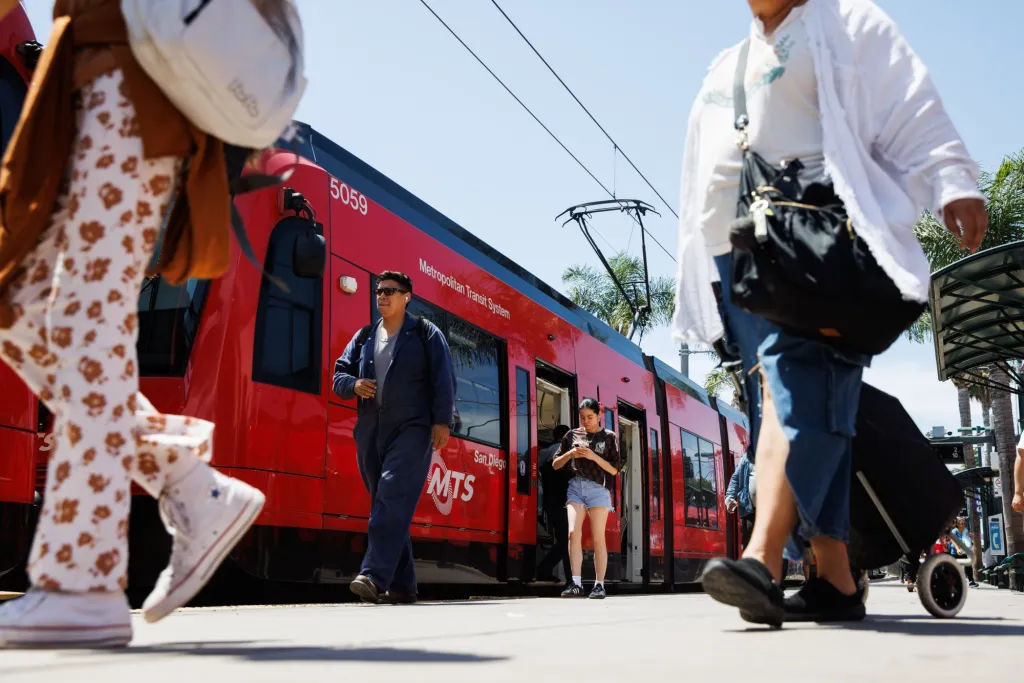
Concerns about the impact on low-income people are so strong at the Metropolitan Transit System that its board approved a fare freeze last week for anyone enrolled in CalFresh, CalWORKs or Medi-Cal.
And leaders of the North County Transit District said Friday that they’d like to protect low-income residents in similar fashion, but that they’ve struggled to find a way to do that before the hikes are expected to take effect in October.
Members of the SANDAG transportation committee expressed confusion Friday about whether fare discounts must be part of what they approve, or whether SANDAG can simply allow the transit agencies to handle them independently.
Committee members said they were also confused about why they get to decide on the hikes instead of the full SANDAG board, and why they held a public hearing on the hikes Friday but were prohibited from voting until July 17.
A major target of the backlash against the fare hikes is transit officials continually contending that residents who attended open houses and completed surveys said they’d prefer fare hikes over service cuts.
Many residents say the officials handling those workshops and surveys forced them into what they now call a false choice. If you need transit to get to work, you would obviously choose a fare hike over a service cut, they say.
“The survey didn’t give us an option,” Denisse Lopez said about the fare hikes SANDAG open house on June 9. “The wording was horrible. We voted for service because it seemed like they were kind of threatening us. It doesn’t represent the majority voice or what people came to advocate for.”
Jesse Ramirez, an official with the City Heights Community Development Corporation, told SANDAG officials Friday that the outreach events seemed designed to get feedback supporting a fare hike.
“There was a lack of meaningful engagement,” he said.
Maria Cortez told SANDAG officials that many residents can’t handle another cost increase with so many other fees going up.
“This is terrible,” she said. “You are going to have ridership decrease drastically.”
Cortez also called outreach efforts misleading.
“They voted for something they didn’t even understand,” she said.
Not everyone is opposed.
“The proposed increases are minimal and fairly assigned to both senior and disabled riders,” Judi Mitchell said. “If MTS feels this is necessary, we should support their needs and approve the fare increases being requested.”
Tania Ramirez, an official with transit advocacy group Circulate Planning and Policy, said fare hikes are far better than service cuts.
“After weighing the available options, we support the proposed fare amendments because maintaining service must remain the region’s top transit priority,” she said. “When transit service is cut, ridership declines, fare revenues drop and agencies can become trapped in a transit doom loop.”
Other advocates have pointed out that the fare hike would be the first in 17 years for monthly passes on local buses, the San Diego Trolley and the Sprinter.
Despite that, the MTS board voted 8-4 Thursday to freeze fares for anyone enrolled in CalFresh, CalWORKs or Medi-Cal as long as they aren’t already eligible for other MTS fare discounts.
NCTD has also discussed protecting low-income residents most vulnerable to a fare hike.
“At the NCTD board we all have this desire, but we also recognize it would take some heavy lifting to come up with what that program might look like,” said Solana Beach Councilmember Jewel Edson.
She said the goal was drawing a line between low-income and very low-income people so any program would target those who truly can’t pay the 75-cent fare hike.
Read more Díaz-Canel announces economic reforms to attract investment and involve Cubans abroad
Shawn Donaghy, NCTD’s chief executive, said the agency would like to help people with annual incomes between $15,000 and $25,000.
“We have to have a pretty comprehensive understanding of who’s impacted at what income levels, otherwise we will lose money with a fare increase,” he said.
Donaghy also argued that the fare hike made sense based on what other transit systems in big cities charge.
“This is one of the lowest fares in the nation for a metropolitan area our size,” he said.
The proposal would raise one-way fares from $2.50 to $3 this fall and then to $3.25 in fall 2027. That’s a 30% hike, far steeper than the last increase in 2019 from $2.25 to $2.50.
By comparison, a one-way fare on the Los Angeles metro is $1.75, and a one-way fare on the New York City subway is $3.
The cost of a monthly pass would jump from $72 to $85 this fall and then to $95 in fall 2027 — up nearly 31%.
Discounted fares for seniors, passengers with disabilities and people on Medicare would rise less sharply, from $1.25 to $1.50 for one-way fares and from $23 to $30 for monthly passes.
SANDAG officials said they completed a federally mandated analysis of the fare hikes on minorities and low-income residents and found no adverse impact.
There was significant confusion Friday about how the fare hike would receive final approval, and SANDAG officials struggled to clear that confusion up.
Oceanside Mayor Esther Sanchez, a member of SANDAG’s transportation committee, twice made a motion to approve the fare hikes Friday but was rebuffed both times.
The committee chair, Solana Beach Councilmember David Zito, said he empathized with Sanchez because he had also been confused.
“I had the same impression, but I got clarification at the beginning of the meeting,” Zito said.
Zito said the committee won’t vote until July 17. He did not explain why the agenda for Friday’s meeting said “approve” next to the fare hike agenda item.
When Sanchez questioned why the transportation committee got final say on the fare hike instead of the full SANDAG board, SANDAG general counsel Betsy Blake revealed several other details about the process.
“The fare ordinance is delegated to the transportation committee — however, the board ratifies the decisions that the transportation committee makes,” Blake said.
“To give some more color to that, the board — once it goes to them for ratification — can’t make changes,” Blake said. All they can do is give a thumbs-up or a thumbs-down. If they give a thumbs-down, we go back to square one.”
SANDAG officials said its policy allows the individual transit agencies to create fare discount programs or to freeze fares without approval from SANDAG.
Read more EU agrees to launch membership talks with Ukraine next week even as war with Russia drags on