



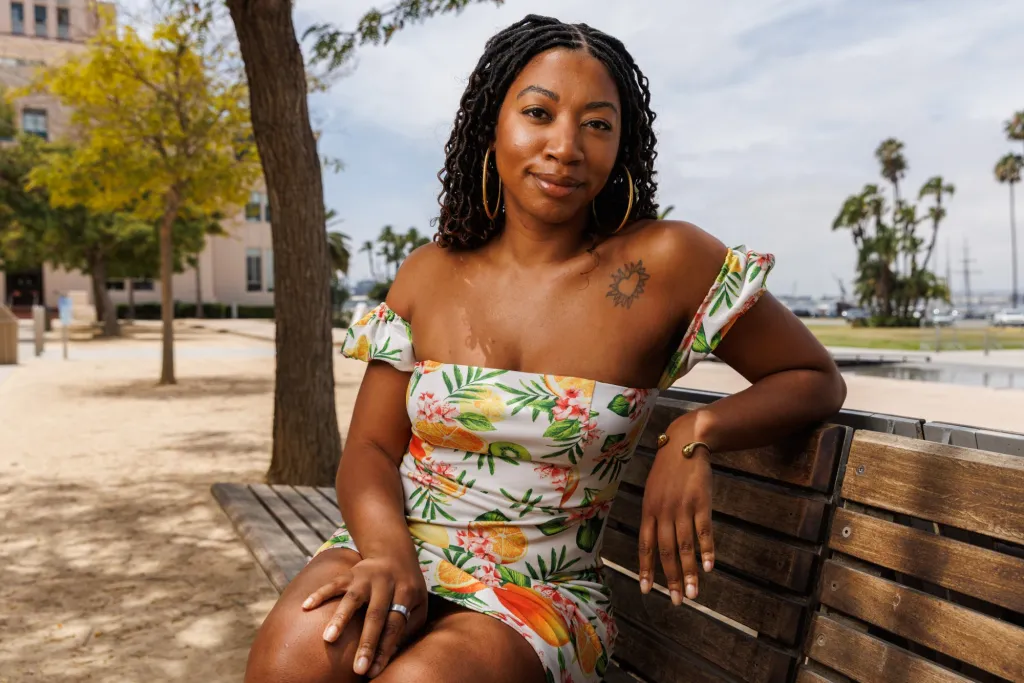
Loren Cobbs was lonely when she first got here. She had moved to the region as a foreign service officer with the U.S. State Department at the consulate in Tijuana in 2015, and was coming into San Diego and looking to connect with people, to make friends.
Read more San Diego transit commuters brace for pain with coming fare hikes
“When I tell you I was lonely and I had no friends? I did not know nobody and I was like, ‘I gotta meet people,’” she says. “So, I started producing these small dinner parties and food- and culture-focused experiences because those were just my passions already.”
With a background in diplomacy, marketing, and communications — and degrees in economics, communication, and policy from Purdue and Columbia universities — she went from those early days of organizing Meetup events for young, Black professionals, to founding SD Melanin in 2017, curating community-focused live events and family experiences. To date, she and her team have organized more than 300 events with more than 20,000 guests. One of those big family events is their annual Kinfolk Fest Juneteenth celebration, now in its ninth year. This year, there are multiple events, including a workshop for entrepreneurs on Wednesday, an R&B night on Friday, the main event from 1 to 9 p.m. on June 20 at Waterfront Park, and linking up for a Black artist exhibition on June 21. The big festival features a day of live music and DJs, a marketplace with Black vendors, food and drinks, games, and other activities (with tickets starting at $28).
It hasn’t been easy. She’s dealt with discrimination and disrespect she found surprising from a place with such a laid-back, breezy reputation — like the time a venue she had worked with for a black-tie gala called the police on her and her group. Despite the difficulties, she was encouraged by the joy and connections people were experiencing because of the spaces and opportunities she kept creating. Today, Cobbs, 36, splits her time between southeastern San Diego and Atlanta, and took some time to talk about her work, and being able to help other people feel a little less lonely.
Why was SD Melanin something you wanted to create?
I moved to the region as a diplomat with the State Department, and I moved to Tijuana. I’d gone to grad school in New York at Columbia, I’d done my training in Washington, D.C., and I’m originally from Ohio—all of those places have really large Black populations and a lot of dedicated spaces and curated spaces for Black folks and folks of color in general. So, I came to the region, not expecting it for Tijuana necessarily, but I did have preconceived notions of what I would find. Like, you hear a lot about California being this melting pot of sorts in this very liberal space. So, I got here and I found myself wildly lonely. I’m a huge extrovert and I still struggled. I was calling after people on the street, like, “Hey, girl! Um, where y’all be at?” And, a lot of people that I met would just be like, “I don’t know, I’m trying to find it, too.” There just weren’t a lot of spaces you could go to and felt welcome, safe, and catered to. For me, that was the big difference. Maybe I could find spaces where there were a few Black-owned restaurants, but beyond that I felt this missing opportunity of spaces that were curated for us, for folks like me, so that’s why I started it and why I continued it.
The feedback I got was just, “Man, this is needed.” It’s not just a space for people to turn up. Myself and my team, we’ve created a real community of folks who see themselves welcomed, who see themselves reflected in a very warm, open, safe environment. It’s not necessarily built around a specific place, a specific venue, but it’s built around being very intentional about who we work with, how we work with them. We vet the venues and the vendors to make sure that they’re also safe spaces for our community, and we hold ourselves to a standard of modeling the behavior and creating the experience that we want folks to feel and to also model to each other.
What I love about southeastern San Diego…
I think the first part is that a lot of our people live over here, so that’s dope. Understanding that Southeast has historically been a Black and Brown community, and when you think about gentrification and how San Diego is increasingly becoming unaffordable for a lot of working folks, it’s dope to see that some of us are still able to buy and stay in the community. I love that. I really, really bang with the MLK park over here, I think it’s an incredible resource. It’s super nice with all of the services they provide for the community. I love that there are a lot of really cute mom-and-pop spots, like from the little fruiteria spot that’s around the corner from where I am, to the taco trucks and little stands that you can just pull up on around here.
What does that look like when you say the modeling of behavior?
We don’t hide who we are. We are very clear about who we are, who our audience is, and what we’re trying to achieve with the staff and with the venues that we work with because the whole reason I started this company was because I saw a lack and mistreatment. I was in spaces where I was like, ‘Oh wait, the treatment is different based on what you look like.’ Since curating, I see it over and over again. I remember when we hosted our one-year anniversary, and it was a gala. I guess the on-site lead wasn’t around for all of the lead up we’d done with the venue manager, so she wasn’t primed on who we were, what our audience looked like. So, we show up and it’s this group of Black folks in ball gowns, and for whatever reason that offended her. At the end of the night, she ended up calling the cops on us, and it was just a reminder of why we do the things that we do, but also the challenges that come with this. Like, I’d paid in full for this venue for this night, we’re literally in floor-length gowns, and throughout the night, she treated us as if we didn’t deserve to be there. She weaponized the security that we paid for against us, and at the end of the night, called the cops, and the cops were like, “Well, I don’t know why we’re here.” So, on one end there are a lot of conversations and engagement we do with venues on the importance of how we show up, how the staff and security shows up, how they treat people. That’s a huge part of it.
The other part, in terms of how we model the behavior for our guests, is that when they walk in, we treat them like this is my homegirl or homeboy and we’re so happy that they’re here. We want them to be here. When you first walk into a place, especially if you’ve never been there before and you don’t know the folks who are throwing the event, you’re not sure what to expect. I think it’s a bit disarming because they see our smiling faces and it’s really warm. The second part is that we’re intentional about how we problem solve and de-escalate situations because, inevitably, things will come up, but we take a very human-focused approach to de-escalation. Like, ‘Look, we all want to have a good time, we all want to be up in here, and that requires us to respect and treat each other a certain way. If you can do that, then you can stay, but if you can’t do that, we gotta ask you to leave. And, we gotta ask your friends to leave because they’re accountable for you, too.’
For us, if we see folks coming in alone, or who are looking to connect, we try to do that on site. We’re like, “Hey, you just got here, you’re from out of town, let me connect you with this person over here.” I think it sounds really small, but you see the difference it makes when organizers are intentional about creating connection for their attendees.
Where did you grow up, and how did you and your family celebrate Juneteenth when you were coming up?
I grew up in Ohio, born in Cleveland and then, when I was a young girl, my immediate family migrated just a little bit south of Cincinnati. So, I grew up really centered around a very strong, Black experience and Black community. There was a Black family reunion every year, and there were smaller Juneteenth celebrations every year, but in my immediate family we didn’t grow up doing a ton of Juneteenth things until, I think, I was in high school and I started tapping into the larger, citywide Juneteenth experiences. By the time I got to my early 20s, Juneteenth was a celebration that I had been taking part in for some years, and it was an extension of larger, Black-focused experiences that we had been taking part in for a while. When I first came to the region here, it was just natural that we were going to do a Juneteenth celebration. So, we hosted our first one in 2018 and it was like a small block party, mini festival style experience. Over the years, that’s evolved and it’s grown.
The history of Juneteenth (June 19) is that it marks the day in 1865 when word of the Emancipation Proclamation finally reached enslaved Black people in Texas. What does this day mean to you? What comes to mind when you think about Juneteenth?
It’s an incredible sense of pride. I’m very proud to be a Black American, I’m very proud to be a descendant of folks who survived and thrived despite the horrors enacted upon them through slavery, Jim Crow, the failed Reconstruction, and everything else today. The resilience that comes from our ancestors is just unbelievable, and the resilience that flows through our blood, so I’m very proud of that.
What it means for me, and I don’t want to get super political, is when we look at what’s happening today, I was freaking out. Like, full-court-press freaking out. And, I talked to my therapist, who’s an older Black man, and a lot of older Black folks, and they were just unfazed. Annoyed, angry in some respects, but overwhelmingly not freaking out like I was. I remember my therapist saying that this isn’t the first time we’ve been here, probably won’t be the last time, and we have survived every single time. To me, that spoke to this acknowledgement of the reality of the circumstances. We acknowledge that throughout American history we have been persecuted, mistreated, whatever you want to say, and despite it all, we thrive, we find joy, we find love, we find celebration. So, Juneteenth, to me, is this perfect embodiment of how, from the moment that folks heard (the news about the Emancipation Proclamation), there was celebration, there was unity, there was community. It didn’t take anybody saying, “Let’s do this” and “We’ll give you this day.” No, we have always done for ourselves, and we continue to do so, and we continue to thrive. We continue to survive, and not just survive, but survive in community, thrive in love, thrive in joy. Throughout history, with all the things that have come our way, we’ve waded through it—like “Wade in the Water”—we’ve gone through it and come out on the other side. It honestly brings me so much joy to reflect on it because it’s just this incredible moment in our incredible legacy as a people in this country, on this continent, and it’s real beauty for me.
You’ve been organizing Kinfolk Fest for nine years now; what do you look forward to about it? What do you personally experience when you see folks at this event?
I always joke that I’m looking forward to the day after, but if I’m keeping it a buck, Kinfolk Fest is probably our most multi-generational SD Melanin event. Typically, for our experiences, we see folks between 25 and 45; a very specific age range. What I love seeing most at Kinfolk Fest is the aunties and grandmas and grandpas, the family units there. You’re there with your mom and your grandma. I love seeing that beauty because I think our elders have survived so much more than we have, they have so much more knowledge, so I love creating a space that someone’s grandma or auntie wants to go to. I feel like that’s a flex, so I love seeing the multigenerational crowd that Kinfolk Fest brings out.
I love seeing the different aspects of Black community at play. We have this whole gaming area with spades and dominoes, but people will also bring their chess boards and it inspires us. We’re like, ‘Oh, we need to provide that for the people next year, too.’ I love seeing folks lounging and relaxed on their blankets or in their chairs. I love to see Black folks at rest. We’re a capitalistic country, we’re a country where work is often your identity, is often how we judge and place value in ourselves and in each other by the work that we’re doing. That hustle culture. So, I love seeing the opposite of that. I love seeing folks at rest, I love seeing folks at peace, feeling safe, feeling that they’re within company that will let them exist. There’s no performative nature. I think, oftentimes, especially if you’re in mixed company, sometimes you can feel like you need to be on, you need to perform, you need to showcase that you’re safe. One of the best compliments I’ve ever received over the years was a young Black dude who walked up to me at an event, and he was like, “Man, I walked up in here and just really felt like I could just be, so thank you for hosting this event.” And that stuck with me for years. It’s not often that we’re in larger society and we can just be, so I love seeing that. I love seeing people dance with strangers, laugh with each other, and seeing us do that with the water within our gaze and the grass beneath our toes.
What brought you to San Diego and why have you stayed?
When my tour in Tijuana ended and I left the State Department in 2020, I thought that was going to be the end of SD Melanin. I thought it was going to be like, ‘OK, that was cool, but I have to go to wherever they’re sending me next.’ Then, I got a lot of feedback from people saying that this is really important, and then I just saw the change. I saw other companies pop up and I saw the impact. Maybe even just by existing, we were inspiring other people to just exist. We were creating friendships, marriages, people have met their partners; there is real community being cultivated, and there’s more that can be done.
I’m going to keep it a buck with you-my “why” has been Black women. Seeing how I was treated as a Black woman in this space, and understanding that I came from a place where I felt celebrated. In my household, in my family unit, in my community, I never, ever questioned my worth as a Black woman. I never questioned my access to things as a Black woman. I came here, and I never felt more unwanted, and I came from a place where I knew what the entirety of my existence had told me before I’d come here. Then, I got here, and I had to constantly have a mental conversation of ‘Wait a minute, I know what’s happening, but this is an anomaly. This isn’t your truth.’ Then, I started thinking about women who didn’t necessarily have the upbringing, or the community that I had. Or, women who had been in an environment in which they felt unwanted, undesirable, or they’d struggled for community because there were just so few of us. Or, the ways in which we could find each other were just so difficult. So, my “why” over and over again as a Black woman has been that it’s brought me great joy to see the spaces and the joy that other Black women get from finding their people, finding their tribe, and creating those spaces for us. We welcome everybody; everybody can come and have a good time, but I think about how important it is for me to show other Black women that they are worthy, that they are beautiful, that they are wanted, that they provide great value in our community.
What is the best advice you’ve ever received?
It’s been something that I’ve been actively trying to take to heart: “Assume good intentions.”
What is one thing people would be surprised to find out about you?
I think people would be surprised that I struggle with anxiety and depression. As a huge extrovert and someone who has a very fun, exciting business, and if you look at my resume, I think there are a lot of things that are very impressive, but I struggle sometimes to believe that. I think I’ve become a bit more honest about my anxiety and depression because I’m like, ‘How is it possible that I’m feeling this?’ Sometimes it’s just something that you have to be really cognizant of and careful with yourself about it. I’m trying to de-stigmatize it for myself, I guess.
Please describe your ideal San Diego weekend.
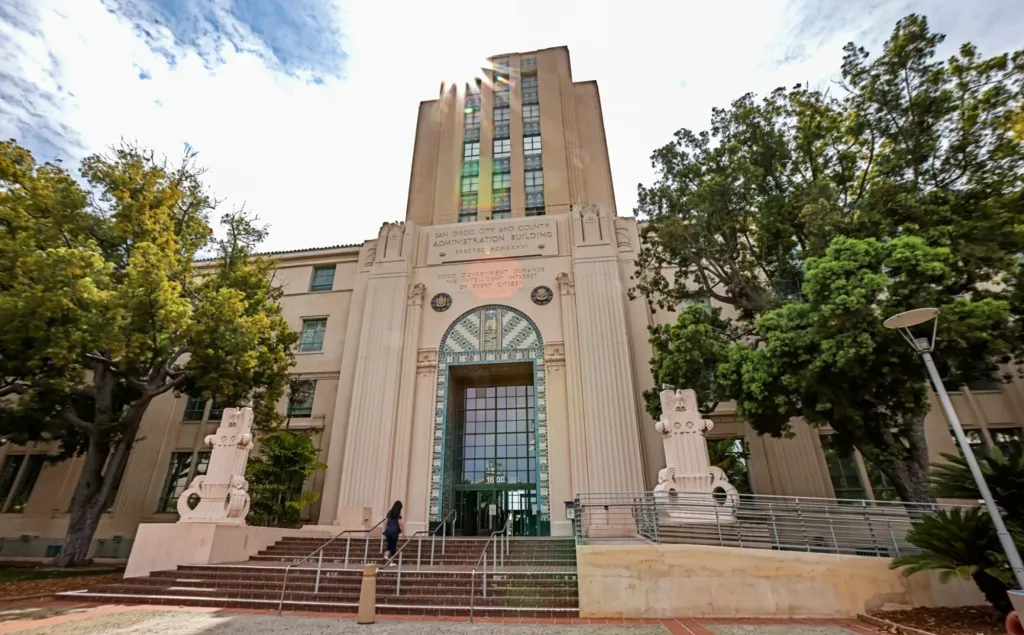
I’m trying to get some Filipino food, like at Tita’s Kitchenette. Depending on how I’m feeling, I might take it to the beach. There are some really dope curators in the city who are doing things, so maybe there’s a day party on a Saturday. The dope part about San Diego is that there is always something to do, so whether it’s a book fair in North Park, or a vegan festival, or a farmers’ market. There’s a really dope new farmers’ market every Saturday and Sunday on the waterfront that’s Black-owned, like south of the county administration building. I’m a big fan of Louisiana Purchase, and then Balboa Park is an incredible spot to just swing over to with all of the museums, or just walking around. On Sunday, I’m almost positive I’m going to a brunch spot. I would definitely do the Hillcrest little vibe, hop around to the bars over there, if I’m not throwing my own party.
Read more Díaz-Canel announces economic reforms to attract investment and involve Cubans abroad