





If anyone ever called you a “picky eater,” they were wrong and probably needed to increase their food literacy.
Read more She didn’t know anyone in San Diego at first, but now thousands of people know her work
The idea of food literacy is generally understood as knowing how the choices we make about the foods we eat affect our health, our environment, and the economy. In the upcoming Wunderland Food Literacy pop-up series at the Skyline Hills Library Monday through Thursday, the facilitators are making a bit of an adjustment to that point of view.
“We’re using ‘food culture literacy,’ so we think that food is culture. We are what we eat, and don’t eat. Our bowl is a mirror, it’s a reflection of us, so it’s not just about the ingredients or nutrition or recipes — we are really using food to tell stories about people,” says June Jo Lee. “We’ve lost literacy about what’s good to eat for ourselves. We’ve lost connection with our own senses, our bodies. There’s so much expert advice, and influencers, and people telling us what we should eat, that what we’re trying to build back is a body-trusting knowledge about our appetites, our modern hungers. For us, what’s underlining all of our food literacy programming, and what we are trying to encourage is very simple: love food, taste with your whole body, and find our food life rhythms.”
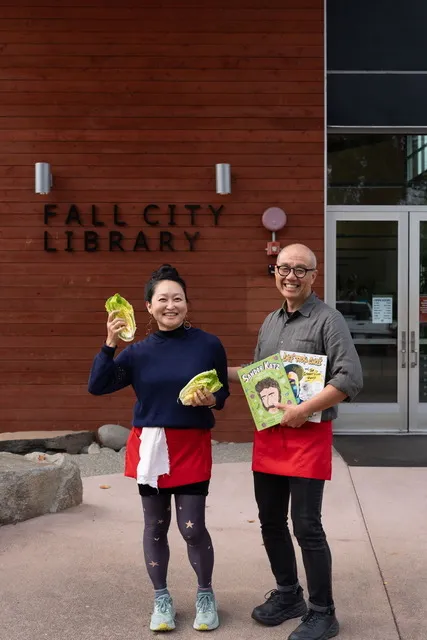
Lee is an author and food ethnographer who worked for Google and conducted research for companies, including Nestle, Whole Foods Market, Walmart, and Starbucks. Philip Lee is the co-founder of Readers to Eaters, an independent publisher focused on food literacy through books and community programming. Together, the couple created Wunderland Kitchen, offering food literacy education through pop-up programs at public libraries, schools, and community organizations. This free program starts at 2:30 p.m. each day in the community room at the Skyline library, for kids 8 to 14, and their families. The Lees have authored and published multiple articles, research papers, and children’s books on the topic, including the forthcoming “Kimchi Taco Time,” being released in October. They took some time to talk about getting kids, and adults, to learn to trust themselves and learn about others by exploring all kinds of foods. (This conversation has been edited for length and clarity. )
What does it mean to find our food life rhythms?
We’re all off rhythm in terms of what, how, why, and when we’re eating. There are so many people who come to us and tell us, “I don’t know what to eat. I don’t know how to cook. I don’t have time.” In a lot of ways, as a food ethnographer, I’ve seen how the industry has taken over food at home, food at work, food at school, food outside, celebration food, everyday food, snacking food. They’ve really become the way that we eat, and we’re trying to bring back that knowledge and those skills and power to people because I think it belongs inside culture, not inside corporations or industries or brands.
You’re bringing your Wunderland Food Literacy pop-up to the Skyline library. Have you done this work in San Diego before? How did this opportunity come together?
It’s the first time we’re bringing it to San Diego, and we’re very, very excited. Also, I think San Diego just acquired a Charlie Cart, so we’ll be kicking that off. (The Charlie Cart Project) is another food education program that creates a mobile kitchen that teaches kids how to cook. It’s literally a little cart that libraries buy from this (nonprofit) organization in Berkeley, and it has the cooking tools and equipment.
Partly, what connects us to San Diego Library, is the Lunch at the Library program. This, to me, is very exciting. The free summer meals are primarily focused on providing food for kids in the summer, but now they’re also including a literacy component to it. The library is the reading place, it’s a book place, yet they have a food program that’s not connected to books, so it’s exciting to be able to really come in and start to make that connection. Also, the California Library Association said that we should definitely check out San Diego, since they have a long running, and one of the biggest programs in the state.
It’s actually funded through Do Your Homework @ the Library (a free homework assistance program from the City of San Diego that also offers summer programming). It has this amazing literacy addition, so it helps make up for that summer gap in literacy.
Can you walk us through how these pop-ups generally work?
Generally, a library system will host us for about a week, and we show up to the library and bring everything; all we need is a kitchen sink and tables, and then we guide people through a three-act program. The first step is really about getting to know each other, and I use my ethnography background to ask some prompts, like, “What is the flavor of home?” We really want to hear the community start sharing what home tasted like growing up. For kids, that’s current; and for families and adults, they start sharing their home when they were growing up. I share from my point of view from my Korean-American heritage, and we start there, getting to know each other as people.
The second act is introducing taste and flavor. We have different kinds of pop-ups, and in San Diego we’re doing a kimchi and kraut-chi pop-up, so we’ll be making kraut-chi, which is a combination of kimchi and sauerkraut. We’re also going to make Awesome Sauce, and that’s just the everyday magic of turning gochujang and mayo into something that makes meals and veggies delicious.
Then, we’re going to do a Bibim-bap Remix, and on the last day we’re going to do sourdough. So, the second act is tasting, exploring ingredients, and prepping the ingredients to make something. The third act is a community class, so by then everyone is shopping, tasting, making, remixing beautiful, colorful vegetables and other ingredients. It’s really them creating the community experience together. A lot of our pop-ups use the theme of fermentation because fermentation is transformation you can taste. You take simple ingredients, like cabbage or flour, and you add a little thyme, and maybe a little something spicy, or tricky, or troublesome, and then you turn it into something more delicious and nourishing. So, how do we deal with complexity? How do we deal with change and uncertainty? How do we show up in our full essence, and how do we become more of who we are as whole people? That’s the underlying theory of change under the pop-ups, but it’s really through tasting, fermenting, and mixing, and then everyone gets to take something home.
As you can see, it’s not just a straightforward cooking class; it’s really having a real cultural component, in terms of family. We spend the first 15 to 20 minutes just talking about the family food culture. What we also find at these events is that it’s very intergenerational and intercultural. Often, we have three generations of participants coming in because food can do that, so that’s something that we’re really excited about. That’s the kind of community building that we’re really excited about.
And, I’m really excited to pilot a new pop-up in San Diego, it’s our sourdough pop-up. I’ve been working with a farmer who is growing ancient grains up in Washington, so we are going to use einkorn flour, the most ancient grain that was found in, I think, an iceman’s stomach, and they replanted it. We’re going to make sourdough starter and learn about grains, and everyone will, hopefully, want to take home some of the starter. We have a book called “Bread Lab!,” and we are using that book as background. Really, each of the pop-ups are inspired by a book that we published, and Wunderland pop-ups are a way that we try to bring that book to life, so that people can “eat” the book, in some ways.
We’re going to taste test the difference in sourdough einkorn that I would have baked that morning, versus Wonder Bread. It’s not that we’re judging, or saying one is better than the other; I want to get beyond a “good or bad” food binary. I just want to know what the kids are tasting for themselves in terms of texture, the flavor, the aroma. That’s the literacy we’re trying to build, for kids to trust their own bodies, to know what they want in their bowls. Ultimately, it is our food activism because we believe that it’s the small bowls where change starts from.
Read more San Diego transit commuters brace for pain with coming fare hikes
A 2024 article on food literacy from the Centers for Disease Control and Prevention mentions a 2015 study about a preschool program in Australia designed to increase children’s food literacy and encourage them to enjoy vegetables. After weekly session led by dieticians, preschool staff and volunteers, more than 70% of the kids in the study asked for and ate more vegetables and were more knowledgeable about vegetables. Can you talk about the impact of food literacy programming? Why it’s important and what kind of difference you’ve seen it make in your work?
The whole point of the pop-ups is for kids to be tasting vegetables the whole time. Basically, all of it is like one big salad, and the dips are to get them to eat more vegetables without being pedantic or didactic about it. It’s just to show the beauty and flavor and tastiness. Vegetables shouldn’t be a hardship, they should be what we love.
I’m certainly familiar with a lot of these kinds of studies, and certainly a goal is that we want kids to eat more vegetables, try different things, but a lot of our approach is just introducing them to the idea of flavor and texture. Know your body, know what you like. I want to make clear to a lot of parents that we don’t want to give labels and say that this makes kids “picky eaters.” We work with a lot of school gardens, having kids pick vegetables, and that‘s wonderful; but if you want them to eat a bowl of salad, it sure tastes better with dressing on it. June likes her salad dressing more acidic, so she likes more vinegar, and I like mine more sweet—this does not make either one of us picky, we just have a choice. It’s the same with kids. Sometimes, the education is for the kids knowing what they like, but also for the parents to know that kids have a choice, culture has a choice. Every culture has their preferred vegetables that are really ingrained into their history, so it’s just recognizing those foods and not necessarily saying certain food is healthy or unhealthy. It’s a balance.
What happens to a person who’s labeled a picky eater, their relationship to food, and their subsequent literacy around food?
This is a tricky question because I actually did research for the food industry for retailers around this. I used to interview both parents and kids together and separately, and something that I learned was that parents often label their own kids picky because who wants to fight over dinner? When I’m talking to the kids, they’re developing their own sense of food and what tastes good, or what textures they like or don’t like, and the stories they attach to it. Like, “Oh, I like these sandwiches because my dad made them,” and “Usually mom makes all the food, but this is something dad makes,” so they like the fish burger because of that. Food is so much more than just nutrients, it’s stories wrapped around our food, and it’s emotions wrapped around our food. It’s safety and warmth, so that’s one answer.
Another answer is I was talking to a sensory lab out in Philadelphia, the Monell Chemical Senses Center, and one of the researchers told me that people all have different levels of sensory abilities. Some are super sensors, and the thing that hurt her the most is that parents assume that the kids have the same sensory taste as them, but everybody has different sensory sensitivity, and that changes over time.
I was doing a project for Kraft Foods back in 2009 and we were interviewing consumer targets who just weren’t buying the Kraft brands, and I remember this one mom and dad saying, “You know, I was a picky eater growing up. I stayed pretty limited, I knew what I liked, but I don’t want my kids to grow up that way. I want them to have all the opportunities in the world, so I hide my own picky eating in front of my kids, so that they can have all the opportunities in the world.” Another mom who was Indian American said, “Traditionally, you’re supposed to only like mom’s food, growing up in India,” but that would limit her son. She wants her son to the whole world, so that his opportunities would be as big as the world. Picky eating is kind of tricky, and I think it often becomes a little bit of a power struggle within the house. We’re trying to show how to try something new, try something spicy.
In my experience working with the parents and kids, a lot of parents tend to make these sweeping categorical judgments on kids’ eating habits, like, “Oh, they don’t like spinach. They’re picky because they like broccoli and not spinach.” That’s OK, though. If they categorically don’t eat vegetables, that may be a problem, but if they like one vegetable and not the other, that’s the choice. Also, a lot of times texture plays a role. That’s why, in the workshops, we want to point out textures. Even for me, I don’t like bell peppers raw, but I love them roasted. Even with a tomato, we sprinkle a little salt on it and it tastes so much better. We want the kids to know they have the ability to make it more tasty, so that’s the conversation we have, rather than just saying something is good or bad.
How would you describe San Diego, and who we are, through your food ethnography lens?
I have never studied San Diego as an ethnographer, but what I know about San Diego is that it is a rapidly growing, diverse city with a strong military presence. So, if I were to start thinking about San Diego, I would start thinking about global cuisine because that’s what the military brings. I would start thinking about California-Mex, burritos, other things to try when we’re there.
Taking the advice from your TED Talk on how the rest of us can be food ethnographers, I want to ask each of you, what’s your flavor of home?
My flavor of home is kimchi. My mother used to make water kimchi wherever we moved, and we moved around a lot, just like a military family. I think I grew up moving every two or three years, and so the first thing she would make is water kimchi (kimchi made in a brine rather than a paste), which I just made the other day.
I have two answers for you. I grew up in Hong Kong, which is not something we made at home, but it’s like a barbecue pork bao. The char siu bao is like a roast pork in a bun, and it’s a perfect fit for a little kid because it’s warm and fits in your hand, and you can just have it all without sharing. It’s not something people would make at home, but it was so easy in Hong Kong to just buy a takeout bun somewhere. But really, a flavor of home is just rice. Coming home and just smelling good rice. They say you know a Chinese family always has a pot of rice going, and that is very comforting to me now.