







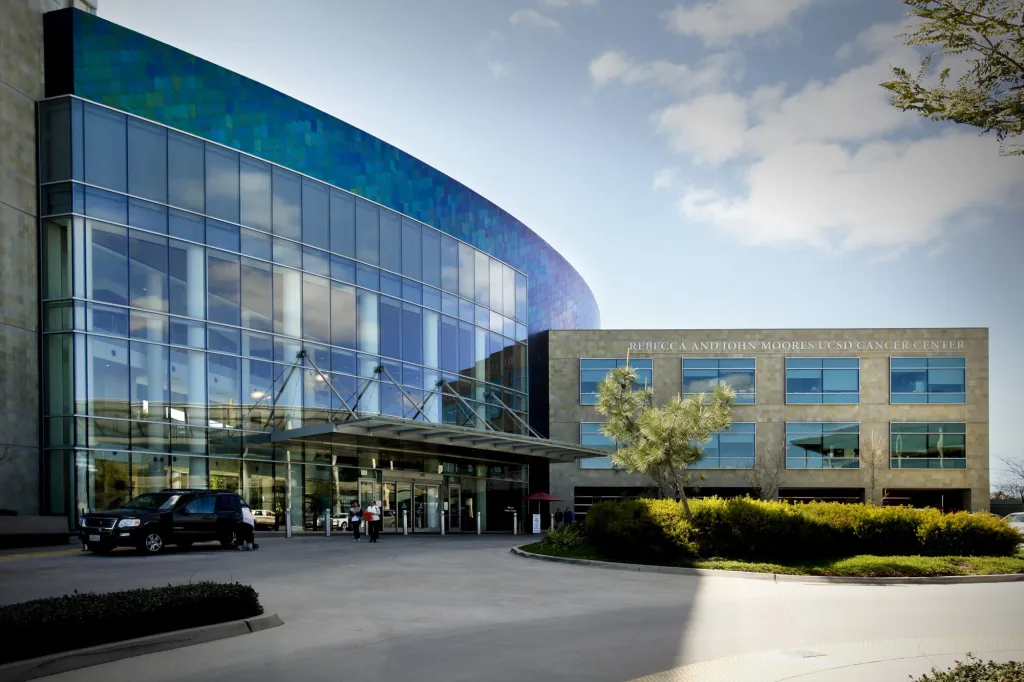
The National Cancer Institute has renewed a key source of financial support for UCSD Moores Cancer Center, laying to rest concerns that turmoil in the organization’s clinical trials office could lead to a loss of support for the region’s only federally designated comprehensive cancer center.
Read more Legislation overhauling college sports faces a major test in the Senate
Simmering friction behind the scenes surfaced in mid-2023 when an influential industry publication, citing anonymous sources, indicated that patient safety could be jeopardized, and grant funding lost, if equilibrium was not restored, especially with the departure of of Moores’ former chief executive officer.
UCSD recruited Dr. Diane Simeone, a pancreatic cancer surgeon and researcher, and previously an assistant director at Perlmutter Cancer Center in New York, to run Moores and oversee its grant renewal application.
It would appear that was the right move.
Simeone said this week that she is proud of the reductions achieved in the amount of time it takes to activate new clinical trials. According to Moores’ official Cancer Center Support Grant description, it took 224 days to activate a new trial in 2018 compared to 86.5 days as of April 2025.
This faster pace, the director said, has resulted in more trial enrollments.
“We have had about a 250% increase in accruals to interventional clinical trials, realizing that, for many patients, the best opportunity for a cure is going to be in a clinical trial.”
Renewal of Moores’ core cancer grant from the NCI brings $25 million in federal funding over the next five years. Loss of this support, which is said to cover 25% of the center’s operating costs, would have been devastating both financially and reputationally.
UCSD has received this source of funding continuously since it first became available in 1978. The organization’s status as one of the nation’s 58 federally designated comprehensive cancer centers would have been hard to sustain absent this core grant, which requires applicants to prove their cancer research and patient care qualifications and accomplishments every five years.
Simeone said that there has been a significant investment in helping local cancer researchers start their own clinical trials at Moores, with about 40% of offerings now based in San Diego.
“We’re starting to see patients coming in from other parts of the country because of the expanding clinical trial portfolio that we have,” Simeone said.
While the grant renewal process does examine a cancer center’s outreach efforts to the communities it serves, it is not, in and of itself, a gauge of ground-level patient satisfaction.
U.S. News and World Report, an online publication that rates health systems in many categories of specialty care, ranks Moores No. 41 in the nation among all cancer centers. Ratings for patient survival, nurse staffing adequacy, use of advanced technology, and available patient services are deemed “excellent,” while patient experience landed at “above average” in the most recent report.
Read more Vance, skeptical of foreign wars, becomes the face of Trump’s tentative deal to end war with Iran
But the U.S. News assessment also lists Moores’ “relative number of high-risk patients treated for cancer-related illness” as “very high,” with 2,121 such cases during the study period.
While there is no difficulty finding online comments from patients who praise Moores for saving their lives, a few have recently noted difficulties with timely appointment scheduling. One poster on the social commentary site Reddit described waiting for a month to see an oncologist after receiving a cancer diagnosis.
Another patient, who asked to remain anonymous, reported recent delays in imaging analysis and longer waits to see subspecialists related to breast cancer care.
In a statement, UCSD Health said that “strong local and national demand for specialty care” can “result in longer wait times in certain subspecialty areas, which can also be affected by the need for prior authorizations from health insurance companies.”
A patient experience team, the university health system said, is tasked with responding to patient concerns quickly.
“We always prioritize patients with urgent medical needs and clinical trial patients, so that their treatment plans are not impacted,” the statement said.
Efforts are underway to recruit more doctors and expand imaging and clinical capabilities. Seventeen new physicians are expected to join cancer care teams by the fall. Today, about 60% of new patients, the statement said, are able to be seen within seven days.
Intake efforts around breast cancer care are said to be more robust.
“93% of new patients diagnosed with breast cancer who are in need of medical oncology are seen within 7 days,” the statement said. “To support continued growth and demand, we are actively expanding our comprehensive Breast Health Team, including the addition of four new medical oncologists and four new advanced practice providers.”
The recent opening of UCSD’s McGrath Outpatient Pavilion in Hillcrest, which includes 20 new infusion chairs regularly used to deliver many different types of cancer treatment, is also expected to help meet demand.
Read more ‘Low public safety return’: Police oversight commission calls for limits on pretext traffic stops