







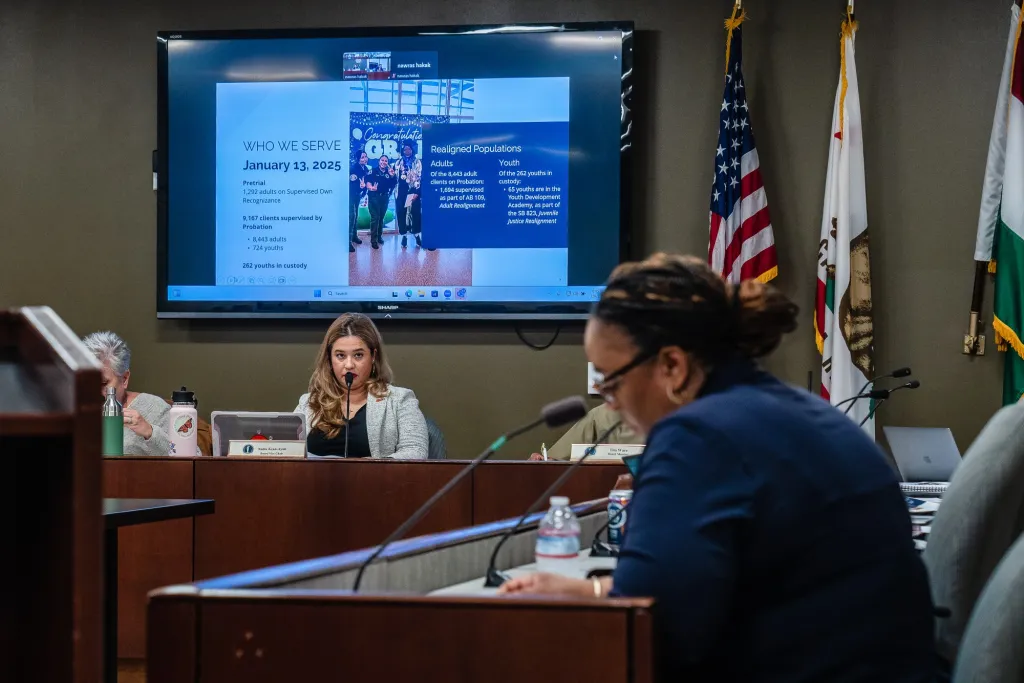
A protracted tug-of-war between the San Diego County Probation Department and its civilian oversight board is stalling the public’s business and posing potential new costs, with neither side able to agree on how to interpret a new state law.
Read more They once delivered meals. Now they’re on the front line of patient safety.
Probation officials are refusing to turn over records of officers under investigation by the county’s Citizens’ Law Enforcement Review Board, or CLERB.
According to the Probation Department, the oversight board must first notify anyone whose records are being sought and issue a subpoena for the information. Both the employee and department can then legally challenge the subpoena before any documents are released, county officials say.
But CLERB, which is charged with investigating complaints against the Probation Department and the Sheriff’s Office, says it has a legal right to the records under a 2025 law authored by Assemblymember LaShae Sharp-Collins, a San Diego Democrat.
Neither of the two San Diego County agencies appear close to budging — and the dispute may soon escalate.
Review board executive officer Brett Kalina told The San Diego Union-Tribune last week that he has received no response to a March demand for requested records, and may go to court to force the Probation Department to comply.
“CLERB is weighing various options, including litigation,” Kalina said.
At issue is Assembly Bill 847, legislation signed into law last fall that strengthened rules over the release of personnel records of law enforcement officers in cases of suspected misconduct.
AB 847 gives California’s law enforcement oversight boards access to police personnel files in misconduct investigations. Oversight boards would be allowed to review records only in closed session and would be barred from releasing certain details to the public.
While state law already grants oversight commissions subpoena power, requests for certain files have been routinely denied, Sharp-Collins said when she introduced the bill.
Probation officials say CLERB’s request for records exceeds its scope of authority. They also contend the department is not subject to the legislation because language in the bill does not specifically include “probation” in describing the affected law enforcement agencies.
“Nothing in AB 847 references Probation; rather, the bill repeatedly discusses sheriff oversight boards,” Probation division chief Kristine LeFebvre .
that the records were outside CLERB’s authority. He said the request was specifically tailored to officers under review and noted that no one claimed he was overstepping his jurisdiction during a previous meeting called to clear the air.
“That meet-and-confer was done in an open and honest discussion about the new state laws,” Kalina replied. “There was no disagreement about jurisdiction, nor confidentiality, nor process, nor scope.”
Probation spokesperson Chuck Westerheide said AB 847 does not authorize CLERB to have direct access to Probation records. He said the review board has other legal means to obtain records and ensure the rights of third parties like youth in juvenile detention.
“The county of San Diego Probation Department is an organization of highly skilled individuals with a shared mission to protect public safety by supporting their clients to restore their lives, families and communities,” he said by email. “Our team of more than 1,000 San Diegans provide services while balancing support and accountability.”
Westerheide said both agencies are acting in good faith to meet their legal obligations, but the two sides differ on what the law requires.
“When interpretations differ, agencies have the option of seeking court guidance,” he wrote. “Because this involves a legal matter — not a policy issue — Board of Supervisors’ intervention is not required.”
In a statement, Sharp-Collins said the two sides should figure out a way to meet the terms of her legislation.
Read more In a high-stakes race for Congress, Democrats vie to take on a well-known Republican in North County
“I encourage county legal personnel to help interpret the appropriate scope,” she said. “AB 847 is not intended to and does not address scope, but spells out which documents are subject to oversight and how they must be provided.”
Voters approved the creation of CLERB more than three decades ago. The idea was to establish a panel of independent volunteers, combined with a professional staff, to investigate complaints and to monitor the Sheriff’s Office and Probation Department.
The oversight agency has grown to a budget of more than $2 million and a staff of eight that investigates complaints, in-custody deaths and other incidents.
Any findings are publicly released each month, although the names of deputies and probation officers are withheld in most cases. If the panel approves, disciplinary and policy recommendations are sent to the sheriff and chief probation officer, although those are strictly advisory.
The Probation Department monitors thousands of adults and minors placed on supervised or unsupervised release by a judge. It also is responsible for the care and housing of roughly 250 youth at two county juvenile detention facilities.
A year ago, California Attorney General Rob Bonta announced an investigation into alleged civil-rights violations by the county Probation Department at the East Mesa Juvenile Detention Facility in Otay Mesa and the Youth Transition Campus in Kearny Mesa.
Elizabeth Uremovic, a former substitute teacher at the East Mesa Juvenile Detention Facility, told The San Diego Union-Tribune she contacted Bonta’s office after repeatedly witnessing excessive force by officers, including the use of pepper spray on children. CLERB has also fielded complaints from parents alleging misconduct in San Diego County juvenile detention.
Probation officials said they would cooperate with the state probe, which appears to be ongoing.
This isn’t the first time CLERB and the Probation Department have clashed over access to records.
Last year, probation officials began requiring CLERB to seek court approval before obtaining records in cases involving juveniles — a process former CLERB officials and advocates described as hindering meaningful oversight. That led to several cases being dismissed without an investigation.
And in 2024, CLERB was forced to close two investigations into probation officers when the department refused to turn over requested documents.
One complaint involved an officer who was accused of using racial slurs, swearing at boys under his supervision and showing sexually explicit movies to children.
The other dismissed case involved four boys who suffered possible overdoses. The review board sought details about how drugs may have gotten into the detention facilities.
“The complainant’s allegations are insufficient to support CLERB’s authority to review and investigate,” the Probation lawyer told the review board in that case.
The legal position appears to contradict the San Diego County code, which among other things requires departments and department heads to provide CLERB with their “complete and prompt cooperation.”
“The review board and other public officers, including the sheriff, the district attorney and the grand jury, shall coordinate their activities so that the other public officers and the review board can fully and properly perform their respective duties,” the administrative code says.