
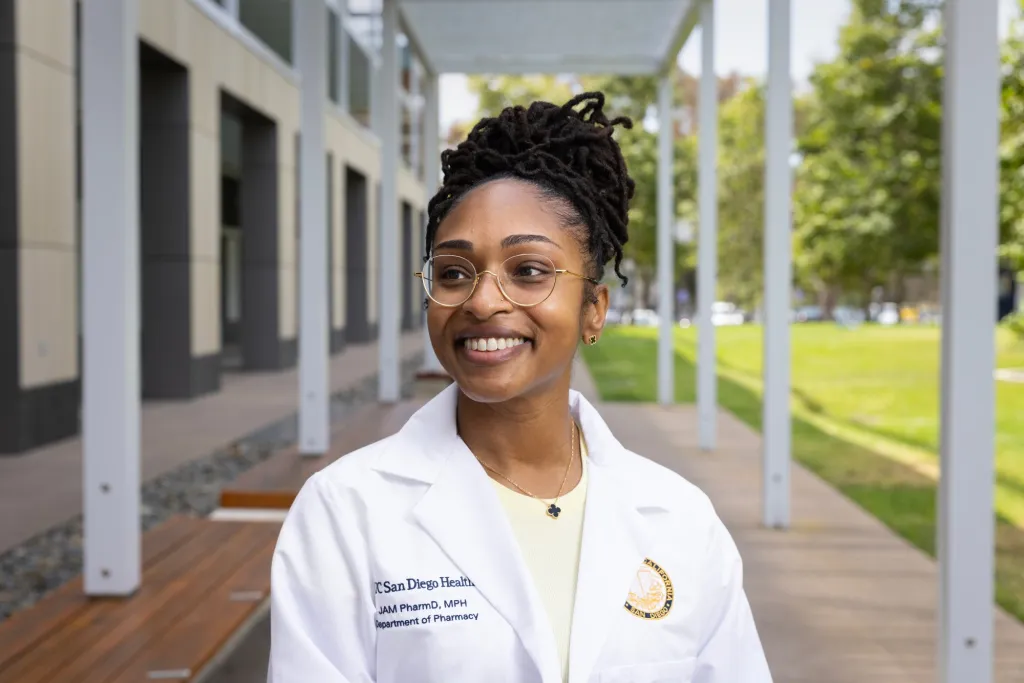
As a pharmacy student at Howard University, Jacinda Abdul-Mutakabbir had the chance to work at an independent pharmacy and saw firsthand what kind of difference her chosen profession could make.
Read more San Diego is wrapping up a uniquely tough budget season. What will it cut, and what will it save?
“It was my first time engaging with a trans person, and I realized that I didn’t necessarily have the language to navigate that experience, but what I did have was compassion,” she says, recalling that she could see that the person in front of her likely didn’t identify with the name she was looking at on their bottle of medication. “I could see them kind of come in with the weight of the world on their shoulders and, in that moment, it was like something said, ‘You need to show up well for this person,’ and I remember asking how they would like for me to refer to them. I don’t know where the language came from, but I literally saw that person transform.”
Abdul-Mutakabbir, who goes by JAM, says that experience showed her how one interaction can change the way someone might seek out care, and there was power in her position to do good, to make an experience better for others. Finding a way to do that, to have in-person contact with others to help them, literally compels her out of bed in the morning. It lights her up and shines with intensity in her work as an associate professor and antimicrobial researcher at UC San Diego in the School of Pharmacy and the Division of the Black Diaspora and African American studies; as director of education for the COPE (Congregations Organized for Prophetic Engagement) Health Equity Collaborative; and as clinic director of the UCSD Skaggs School of Pharmacy + County of San Diego HHSA Pharmacist-Led Community Health and Wellness Clinics, with three free pop-up visits per month that include screenings, education, and resources.
“And, I continue to be able to have so many experiences like that, being a pharmacist. It’s transforming how I exist as a person, so it’s been like the profession of my dreams. I couldn’t ask for anything better,” she says, taking some time to talk about her work and the kinds of conversations and improvements happening for her patients, her students, and the ways they approach providing care to communities. (This interview has been edited for length and clarity. )
You were recently recognized as a finalist for the 2026 Nancy Jamison Fund for Social Justice Award, highlighting your work in “pharmacist-led, community-based preventive health clinics.” Can you tell us what these clinics do?
This is something I adapted from my intervention in San Bernardino. I work in collaboration with a lot of community entities, and in this particular case, I work with San Diego County. They have LiveWell and they also have a pharmacy team and we collaborate with local libraries and other institutions. Right now, we have three clinics and we kind of pop our services up; I bring a slew of clinic materials, including blood pressure cuffs that I purchased on my own, blood glucose monitors. My students and I have developed informational tools to communicate the values that we get from the individuals, and we give them the information sheet to take with them that describes what we screened them for and they’re able to take that to their primary care provider if they have to follow up for medication. We also do medication counseling, so we go through every single medication with individuals when they bring it in. We tell them what the medication is for, we talk to them about how they’re taking it, and we give them opportunities. So, we say, “Is this a medication that should be taken in the morning?” and they’ve been taking it at night and it was not working for them. Or, if they should be taking it with food, we give them that advisement, and we created a tool for that. Then, the county brings vaccines and they vaccinate as needed, but we literally take the services that would typically be in a brick and mortar location, and we place them right in these areas.
When and where are these clinics located?
Every first Thursday from 10 a.m. to 1 p.m. at the Grossmont Health and Wellness Library, 9001 Wakarusa St., La Mesa; every second Friday from 2 to 5 p.m. at the Spring Valley Branch Library, 836 Kempton St., Spring Valley; and every first Monday from noon to 2:30 p.m. at the Lot O Care Fair, 1800 Welch Road, San Diego.
These are described specifically as “pharmacist-led” health clinics; does that designation make a difference?
I think so, and I guess I have a bias, but I think it does make a difference. First, I think pharmacists are the most community accessible providers and I really am dedicated to showcasing the variability of how we exist as a profession. A lot of times, when I tell people I’m a pharmacist, the immediate question is what drug store do I work for? I always like to tell people that pharmacists are so dynamic and we can do so many different things. In a time where we’re seeing health care insurance being repealed, and we’re seeing people lose access, because I began my clinical practice in the midst of the pandemic, I saw the importance of education. When you don’t have education, that can decrease your opportunity for agency and to make good, sustained decisions for yourself. For me, when I think about what profession is accessible and can do all of those moving parts, I think about pharmacists. I think about the fact that so many people might not be able to see a primary care provider, but you can walk into a pharmacy, or you can find us at the community clinics, and you can ask about how you can optimize the care that you receive, or what vaccine is optimal for you to get. When you have these one-on-one appointments, you have so little time to ask additional questions, or maybe to receive a recommendation, or to get to those more specific questions you may have about your health. I think, being able to have a pharmacist outside of the traditional environment allows for people to maybe ask those more specific questions, for us to spend more time with them, for us to hone in on drug therapy or preventative therapy. When I think about health care, a lot of times folks can think, ‘If I don’t have an acute illness, it doesn’t make sense for me to engage with the health care system.’ But, we can engage them in preventative care, whether that be screening to identify if you’re at risk or currently have an illness, or receiving a vaccine. So, I think that’s the difference being pharmacist-led because we are dedicated to preventive care, and we can show how that exists across the continuum.
Read more Michael Smolens: Jim Desmond’s challenge
Walk us through how these clinics function.
When they come in, we meet them with a smile. Students are allowed to volunteer in the clinics, so the first people that they see are the undergrads. So, I make the undergrads greet them with a smile, and they also greet them with a consent form. The pharmacy students perform the screenings when they’re present, but I like to afford them early opportunities to engage with the community. Hopefully, at some point, they develop these types of clinics where they live and they practice. So, they will perform a blood pressure screen and a blood glucose screen, depending on what the patient wants, and they will do that under my direction. After we receive the reading, then we then discuss if this is the normal reading that the patient has received. If not, there are things that they can do if they would like to moderate that reading. Maybe this is a conversation now for your primary care provider. We also tell them that this is a moment in time, this is not a diagnosis. With consistent readings you can kind of make an assessment of where your health is.
If they bring their medications with them, we go through the medications that they’re taking and we make sure they’re clear on the recommendations for the medications. If we see duplicates, we highlight it, so that they can take that back to their primary care provider. A lot of times, people will go to the emergency room and then they’re discharged with a medication, but they may not know that they had a similar medication at home. If the other provider didn’t know that they had something at home, that can sometimes cause a lot of confusion, so I like to make sure that we go through all of those things.
After that, we chat for a few, and then they’re free to go, or partake in the county services. The county also brings public health benefits, so if folks are not enrolled in Medi-Cal, they are able to enroll right there on site. A lot of times, people may not know the benefits that are offered to them through their public insurance and the county can provide that information. We also do CalFresh enrollment on site. I actually tell the students from the school of pharmacy the same thing if they need to enroll in public benefits for food. I think we don’t think about food insecurity amongst college children, so we do that enrollment on site. If there are college students reading this, I hope that they see that they can go right on site and we can enroll them.
The libraries themselves have tables there, so they tell people about the resources they have and things that they can do to be involved in the community. We also offer vaccines, COVID and flu, and we also have games and things for kids.
What kinds of gaps did you notice were being left by traditional health care systems? And, what kinds of needs did you identify in the communities you serve?
I think the biggest is that a lot of folks are unaware of their risk for a lot of vaccine-preventable illnesses. The more diseases that they have, the more aware I would expect them to be, but it kind of is the opposite. That could be because folks don’t have the opportunity to go to a primary care provider because of stigmatization, bias. Outside of not having access a lot of times, people just don’t want to go because they’re nervous about what that appointment will look like. But, the lack of knowledge of risk has always been very surprising to me.The lack of recommendation to receive a vaccine, too. I’ve had patients that have come to me, and they have felt betrayed in some ways by their health care providers. Like, I’ll do an education session, or I’ll tell them, ‘Hey, if you’re this age, or if you have this disease, this vaccine is recommended to you.’ I had a patient who was 75 years old tell me, “I’m a veteran. I go to my primary care provider multiple times a year, and at no point did they tell me that I should get the shingles vaccine. No one ever mentioned that to me.” It makes me think about how sometimes people will say, “I can’t believe that hasn’t been recommended,” or “I have a primary care provider that looks like me, and I thought I was covering everything,” From a provider standpoint, I think about our young clinicians being put into practice in this climate, and vaccine misinformation, disinformation, and politicized conversations. I cannot say that it would not be nerve-racking for me to engage in a conversation, so I can kind of see what that limitation is, but I can also see how those gaps are exacerbating because no matter what, now they’re in charge of somebody else’s care. If they aren’t taking that time, if they aren’t taught how to make those recommendations, or aren’t taught how to navigate a difficult conversation, we’re going to have all these folks that are lost in the ether for getting these recommendations.
I think that the biggest one that I’m also seeing is how we forget to tap back in with our aging population. For me, that’s been the most devastating to see because as people age, and I think about how much my seniors and my ancestors mean to me, it’s so hard to see them kind of lost in the health care system. So often, I have folks that will come to our clinics at 90 years old, and they’re still in great health. They’ll talk to me about how “My primary care provider won’t call me back,” or, “I didn’t get this,” or “I didn’t get that.” That’s been a hard thing, but I’m so happy to come and be able to support them. I have 85-year-olds ask me what they can do to advocate for themselves, and it’s important that they have that information, but how sad that they can’t trust that the providers that are paid to take care of them, would take care of them with their best interests. I see these clinics as an opportunity for us to do that.
Another thing that I’ve seen with these clinics that really blows my mind, and really changes how I think about care, is with our unhoused community. Oftentimes, their blood pressures will be kind of decent, not anything I raise my eyebrows at, but the blood sugar is extremely high, especially with young individuals. Or, there’s an unwillingness to have the blood sugar tested because I’ll get the insight of fast food is the only thing that’s keeping them afloat right now. That’s the only thing they can control in their life, and I have to take a back seat and say, ‘You know what? If I was in this circumstance, a burger might be the only thing keeping me afloat right now, too.’ So, we have conversations about what they can do. Or, with the medications, they’ll say, “I went to this clinic, they put me on this medication, but I know that a side effect of that medication is loose stools. So now I have to walk around until this drug is completed. This is a complete mess, and I can’t really navigate that,” and I have to say, “You know what? By all means, let’s talk about a natural way that we can mitigate this. Maybe you can do more screens so that you can just have an idea of where you are, and if you start to feel odd, this might be the reason why.” This made me think about the utility of the screens that we do in the clinic. When I was in training, it was kind of like you screen, then you treat with the medication therapy. For me, it’s become more so that you screen, and now that information becomes knowledge, and you meet the individual where they are in terms of what that care looks like. That doesn’t always look like the drug therapy at the end of that, no matter what that ailment may look like.
Read more UC San Diego betting big bucks new center for students and alumni will be a hit