





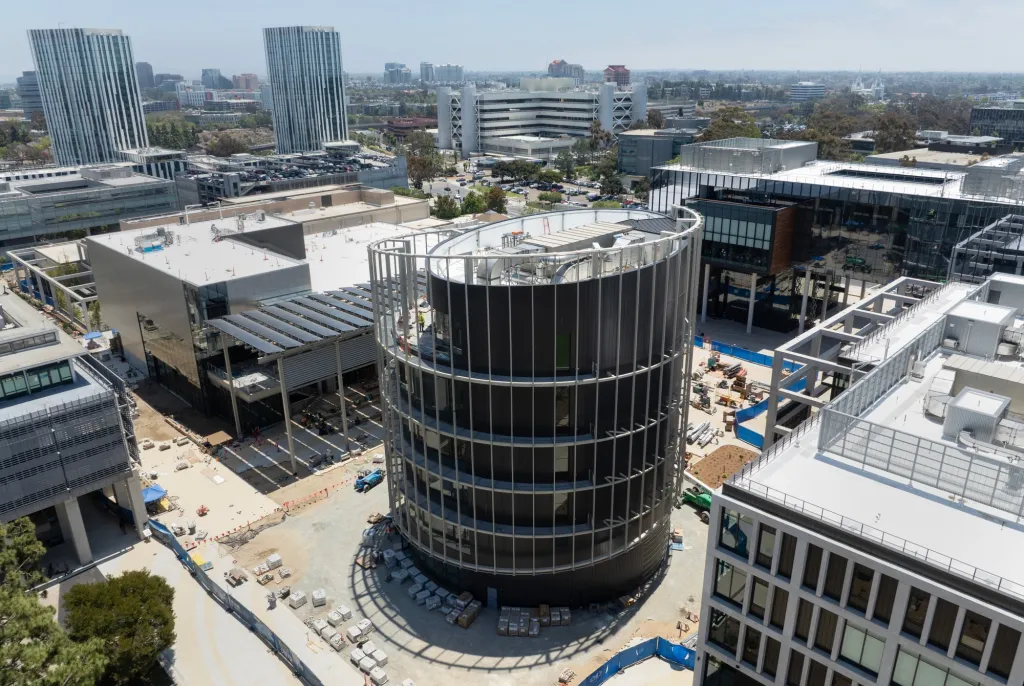
A glassy round tower has risen above the tree line at UC San Diego, drawing curious looks from passersby.
Read more Grossmont school district’s contracting, student services face new scrutiny
It’s the new alumni center, part of a pricey effort to make the school livelier, better known, more healthful, and easier to navigate for a student body that numbers 45,000 and growing.
There are three other buildings as well. All of them were blended into a student village that will serve as UCSD’s “front door,” much in the way that carefully placed bricks turned Harvard Yard into a grand gateway.
Collectively, the four new buildings are known as Triton Center, a $453 million project that’s beginning to open after three years of construction.
The public is getting its first look as the scaffolding falls away, revealing a hub for art, science, health and entertainment, including concerts and sporting events that will be broadcast in a large format on the exterior of the alumni center.
Chancellor Pradeep Khosla believes these amenities will attract not only students but the general public, saying, “You will see people on this campus who we have never seen before … (and) not just La Jolla people.”
UCSD also envisions the district’s courtyard — dubbed Triton Plaza — becoming the most popular social spot on campus, eventually gaining the sort of cachet enjoyed by UC Berkeley’s Sproul Plaza.
This wasn’t a solo undertaking.
Triton Center is part of one of the largest university expansions to occur nationally in the past decade or so.
Khosla has spent $7.1 billion to transform UCSD from a pastoral spot on the coast to a city dotted with dorms standing more than 20 stories tall.
He says he’ll spend at least another $4.5 billion over the next few years. Roughly $2.5 billion will underwrite high-rise dorms housing 6,000 students, with the rest going to building a new hospital in Hillcrest.
Building momentum
UCSD’s enrollment has surpassed 45,000, crowding its current student union and leading to the need for more space. Khosla wasn’t interested in a conventional student union that mainly served up food, books and clothing.
Instead, he wanted to address broader interests, and do so in a visually striking way.
Alumni Hall is likely to grab the most attention. It’s a cylindrical, six-story gathering place for UCSD graduates, who number nearly 270,000 worldwide. They’ll mix and mingle throughout the tower, including on an open-air rooftop terrace.
The alumni center is located near Triton Health and Wellness, an airy, four-story building that offers primary and urgent care, as well as mental health services, which are in demand by the school’s largely Gen Z students.
The facility will open on July 14, making UCSD one of the comparatively few universities in the U.S. that operate a large, diverse, free-standing health and wellness center on campus.
Another four-story building — The Forum — will feature Jacobs Celebration Hall, a 500-person venue for symposiums and conferences. It also will house the Strauss Family Meta Gallery, a showcase for art that’s tied to science, technology and the humanities.
The complex will also be home to Triton Administrative Services, a six-story teaching and learning hub with offices for campus executives.
Expanded health care
This new heart of the campus beats not just with culture but also with a focus on care.
The health and wellness building consolidates all campus student health services and, for the first time, adds a UCSD Medical Group office offering primary care services to faculty and staff. Though hospitals have long been part of the campus, it is the first time that the health system’s network of outpatient centers has an outpost near the places where so many work five days a week.
“It will be just like any of our other clinics,” said Lydia Ikeda, associate chief operating officer at UC San Diego Health System. “If you are, let’s say, a professor or on staff and you just need primary care, you will be able to pop in there.”
But most of the resources are for students. The ground floor has a significantly larger student urgent care center and nurses’ station than were available in the previous student health services complex on the west side of the campus’ Library Walk, according to Dr. Edward Junkins, executive director of student health and well-being.
“We will have regular treatment bays, private rooms, and high-ventilation rooms for possible outbreak treatment,” Junkins said.
For the first time, the student health center’s offerings will include physical therapy and rehabilitation services. Previously, these resources required leaving campus.
Read more US military shot down Iranian drones launched toward Strait of Hormuz
Student mental health services, currently in two different locations on campus, will occupy the new building’s fourth floor.
According to campus health services, students currently wait six to 11 days for primary care appointments at the existing health center, with no wait in urgent care.
The new center, Junkins said, should be able to maintain those thresholds with an anticipated increase in visits of between 20% and 30%.
A wellness lounge is among the ground-floor amenities facing Triton Plaza, with virtual reality and massage chairs filling a space for relaxation before or after classes.
Pharmacy space is also significantly expanded, with five pick-up windows compared to just one in the current space, as well as extra space for optometry visits.
The changemaker
Khosla, an engineer, became chancellor in 2012 and quickly began expanding the university’s student housing. He wanted to position UCSD to help absorb the huge increase in enrollment that the University of California system projected it would get in the coming years.
The La Jolla campus had lots of room to build dorms, few dissenting neighbors and a faculty that welcomed the opportunity to gain more potential graduate students to help with the university’s enormous research program.
What the school lacked was a buzzy, urban core that would serve as a unifying force in the way that Westwood Village infused life into UCLA decades ago.
Khosla met this challenge in a calculated way.
He helped convince the San Diego Association of Governments to add a Blue Line trolley station in a centrally located spot on campus — a stop that’s become among the busiest in San Diego’s Metropolitan Transit system.
He fixed the street that led from the station to the interior of the campus. Then he built a large open-air amphitheater on the north side of the street and a towering 1,300-bed housing project on the south side.
Those amenities flow into the new Triton Center, which is receiving some positive early reviews.
“I’m broadly optimistic that this is going to be a boon for the campus,” said Samuel Sharp, a freshman majoring in computer science. “I love all the buildings that are going up. Things are more exciting.”
William Simpson, president of Associated Students, which serves undergraduates, feels the same.
“I wondered where the center of campus was when I got here in 2023,” said Simpson, who majors in economics. “Triton Center will change that. It’s beautiful. It’ll be a hub that attracts students.”
The upbeat remarks come during what has been a difficult 18 months for UCSD and other major universities.
Early last year, the Trump administration deeply cut federal research funding nationwide, stopping or slowing countless science projects, including efforts by UCSD to develop a vaccine against HIV.
At the same time, the university was grappling with the possibility of losing $50 million in state funding. Khosla revealed in April that these dual problems could potentially cost UCSD $500 million.
The losses didn’t reach that level. But the school did lose $85 million in grants and had to cut more than 1,000 jobs.
“The mood was morose a year and a half ago because we had no idea what was coming,” Khosla told the Union-Tribune recently.
Things are more stable now. But faculty worry that things could turn dark again. There’s particular concern among some medical researchers that the work that began on a new research building last year won’t resume.
Khosla took a neutral position, saying, “The short answer is yes, it will be built,” Khosla said. “The more nuanced answer is, I’m not sure it is any time soon.”
Read more UN food agency says millions are being pushed into hunger by Iran war