




A long-awaited suicide barrier for the iconic San Diego-Coronado Bridge got a key approval Wednesday from the state Coastal Commission that could allow crews to break ground this fall on the $145 million project.
Read more Deputy Chief ‘Jess’ Specht selected as Oceanside’s next fire chief
The commission’s approval requires state Transportation Department officials to allow painted murals on four bridge columns near Chicano Park, replace fencing in Coronado and preserve some falcon nesting sites.
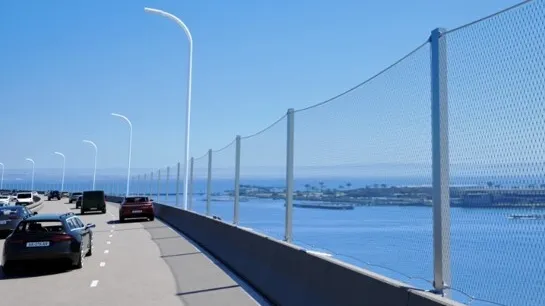
Commission staff praised the 8-foot-tall mesh-steel barrier, which would aim to prevent people from jumping off the bridge by requiring them to scale nearly 11 feet — the barrier plus the bridge’s existing 34-inch guard rails.
“This design preserves the bridge’s overall form and historic appearance,” staff said in a 25-page analysis recommending approval of the project. “Views of the bay and skyline would remain largely intact for travelers, with moderate localized changes to immediate views from the roadway.”
Views from the roadway would remain mostly unchanged, because the mesh barrier would be 87% transparent with one-inch openings, the report says.
While people viewing the 2.12-mile bridge from elsewhere may notice the barrier, it is not expected to make the 200-foot-tall bridge less attractive.
“The largely transparent barrier is not anticipated to significantly impact visual resources from the locations throughout the San Diego Bay that the bridge is visible,” the Coastal Commission report says.
The commission also said the project would boost coastal access by reducing bridge closures prompted by suicide attempts, which require drivers to take a 23-mile detour through Imperial Beach and the Silver Strand.
Neither Caltrans nor the Coastal Commission has provided any estimate of how often the bridge gets closed by suicide attempts or how long those closures typically last. An average of 83,000 drivers use the bridge per day.
Commission officials said they’re confident the design won’t prompt many birds to hit the mesh barrier, because 13% of it will be visible and not transparent.
The commission endorsed a Caltrans decision to opt for a vertical barrier instead of the type of horizontal anti-suicide barrier installed under the deck of the Golden Gate Bridge two years ago.
“An under-bridge horizontal design would result in highway closures for each suicide attempt for victim rescue operations, causing significant delays to and from the coast,” commission staff said. “Rescues carry substantial risk to first responders because of the difficulty involved in retrieving distressed individuals from great heights.”
The San Diego Fire Department agreed with this choice.
“We do not support the horizontal netting option, as it would pose a significant risk to personnel during the extrication process,” Deputy Fire Chief Dave Gerboth said in a 2022 letter to Caltrans.
The California Highway Patrol, San Diego Police Department and Harbor Police Department all agreed that a vertical barrier would be preferable to a horizontal one.
Read more Photos: November fire
The commission approval requires Caltrans to fund new murals on four bridge columns in San Diego that face east into Chicano Park, which is famous for its murals. Caltrans must also upgrade one of its maintenance buildings there.
Caltrans must also improve views from the Bayshore Bikeway under the bridge by replacing some tall fencing with new fencing no more than 4 feet tall.
San Diego City Councilmember Vivian Moreno, who serves on the commission, praised the project and the murals.
She explained that the bridge has a troubled history in Logan Heights, because its construction in the late 1960s disrupted and divided the community. “The Coronado Bridge has a very complicated history,” she said.
Commissioner Chris Lopez said it’s important to address mental health challenges.
“It’s hard to see items like this on an agenda, but at the same time we want to call it out and appreciate the investments being made to protect our friends and neighbors,” he said.
Estimates by state officials and suicide-prevention groups put the number of suicides on the San Diego-Coronado Bridge at somewhere between 400 and 550 since it opened in 1969.
Anyone contemplating suicide or struggling with their mental health should call 9-8-8, the state’s crisis center consortium.
Construction will take place at night, but at least one of the bridge’s five lanes will remain open in each direction throughout.
The project will include 20 new security cameras and under-the-bridge catwalks for maintenance. The catwalks are needed because the new barrier will reduce access to the bridge for maintenance and repair crews.
Installation would occur on the northbound side of the bridge for roughly one year, followed by roughly one year of installation on the southbound side.
Before construction can begin, the California Transportation Commission must finalize the project’s financing plan later this month.
Read more ‘We have a revenue problem.’ Firefighters raise alarm over El Cajon budget cuts