


A year ago, the startling headlines reverberated nationwide and triggered a fierce debate.
Read more Q&A: Meet Nichelle Henderson, candidate for California state superintendent of public instruction
An academic study predicted the price of a gallon of gasoline in California could top $8 by the end of 2026.
The end is near.
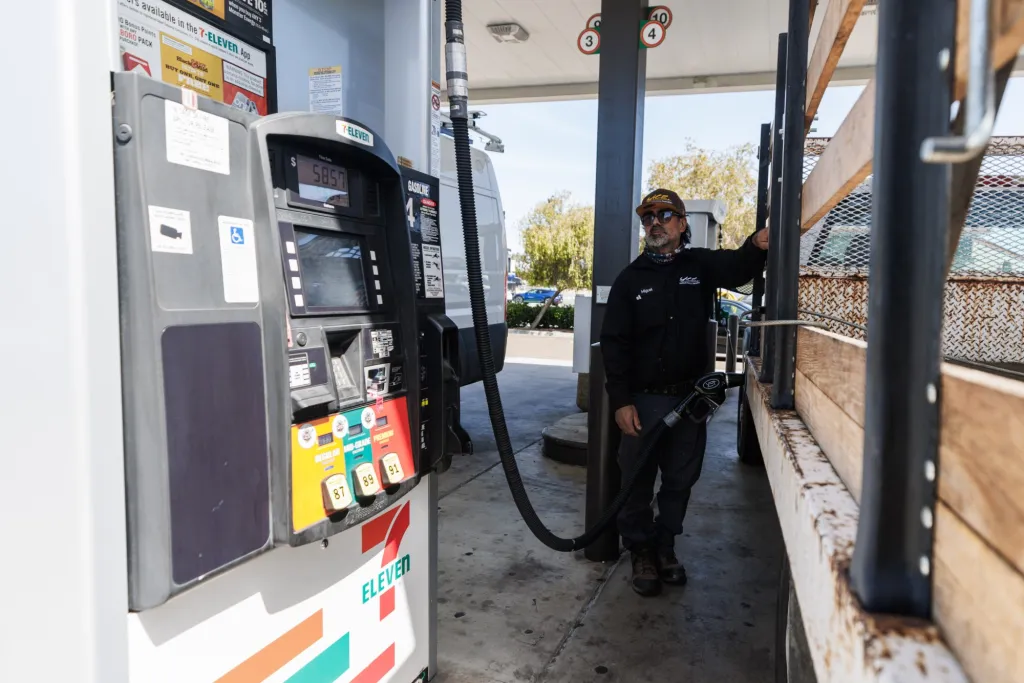
In the Bay Area, gas prices last week rose to just below that once-unthinkable threshold — $7.89 — and seemed destined to reach it at some stations very soon. In San Diego County, the average price of regular gasoline was $6.22 a gallon on Friday , according to AAA.
The reasons for skyrocketing prices are complex and many — more on that later — but in May of last year a simple political dynamic seemed set: Republicans would pin the ever-burdening price of filling up on Democrats.
They had tried doing that in the past. After all, California always has among the nation’s highest fuel prices, in large part because of air pollution controls and taxes unheard of in much of the country. And just about all of that has been at the doings of Democrats over the years.
Politically, the price of gas had been a handy but, it turns out, not very effective cudgel for Republicans in California. Democrats have only become more dominant in California over the years of higher gas prices.
But with the cost of living at the top of voters’ minds and the campaign buzzword “affordability” being bandied about, Republicans saw the price of gas as an even more potent issue in this election cycle, with the spooky $8 per gallon in the future.
“We’re going to make this a daily issue in California,” Senate Republican leader Brian Jones of Santee said last year.
When President Donald Trump launched the war against Iran, that seemingly surefire GOP advantage, at best, may have become greatly diminished. At worst, it may have vanished.
There are a lot more cost-of-living concerns than just pain at the pump. Groceries, utilities and housing, for the most part, are all getting more expensive.
But gasoline price increases are something people see daily by simply driving past gas stations, and experience regularly while filling up. In the two months since the U.S. and Israel launched attacks on Iran, the average price of gasoline nationwide has spiked more than 50 percent, AAA said last week.
Gov. Gavin Newsom and legislative Democrats have long been on the defensive over gas prices, often accusing oil companies of gouging and taking actions that never amounted to much. Now they have flipped the script, blaming Trump for the increase in prices due to a war with shifting goals, an uncertain timeline and an unclear endgame that polls show most Americans oppose.
This doesn’t mean California Democrats don’t bear responsibility for creating a system that guarantees higher gas prices — the tradeoff being reduced and cleaner emissions. Fuel supply and processing concerns before the war meant prices would likely go up, perhaps by a lot.
But for the time being, Democrats may be off the hook politically, possibly through the fall, which would further boost their current advantage in the midterm elections.
Attacking Democrats on the price of gas now would likely remind voters of the war, its economic impacts and Trump in general, who is miles away from the word “popular” in California, even in the best of times.
Experts say high prices will continue for some time even after hostilities abate and the Strait of Hormuz is open again to normal tanker traffic.
A trio of academics re-upped the specter of $8-plus per gallon gas in a recent commentary published by The San Diego Union-Tribune. One of them is Michael Mische, the University of Southern California professor who authored the study last year that caused such an uproar.
Read more Q&A: Meet Richard Barrera, candidate for California state superintendent of public instruction
Newsom immediately and repeatedly questioned it and attacked Mische. Not this time. The governor is training almost all of his fire on this subject on Trump and, by extension, congressional and legislative Republicans, who are largely silent about the war, but clearly concerned about its economic impact.
As an aside, one curious aspect of the price analysis is that Mische last year talked about $8-plus gas long before the war. He and the others still use that general figure even though the conflict — which is factored into the latest essay — has dramatically affected the U.S. and world economies.
Mische, UC Berkeley professor James Rector and Berkeley graduate assistant Joseph Silvi wrote that California faces “an acute gasoline supply shortfall driven by refinery closures, declining in-state crude production and escalating geopolitical disruption tied to the Iran war.”
They noted California is reliant on imported oil, and that the impact of reduced shipments of refined gasoline from Asia are just now hitting home because of the lag time in shipping. The same goes for crude from the Middle East.
“With shipping times ranging from 35 to 50 days, the absence of those barrels is only now being felt in California,” they wrote.
“. . . Based on current conditions, supply deficits are expected to increase going forward and extend for at least the next month. After a month of these deficits, gasoline inventory will only be a few days, and the system will lose operational integrity.”
That suggests potentially long lines and “No Gas” signs at gasoline stations, reminiscent of the Middle East oil embargo during the 1970s. We’ll see.
Prices and markets have been swinging up and down depending on the latest announcement or action regarding the war. Last week, stock markets rallied and the per-barrel price of oil dropped after China, the largest buyer of Iranian oil, called for a “comprehensive ceasefire” and a reopening of the Strait of Hormuz.
China, Trump’s nemesis, has been in high-level negotiations with Iran to de-escalate the conflict.
It might be a coincidence, but following that appeal from China, Trump suggested once again that peace is at hand.
It would seem a bit ironic if China were seen as a key factor in ending Trump’s war.
Regardless of how it ends, Trump will declare victory — he’s already been doing that for weeks, despite the nagging reality.
In any event, the notion of capitalizing on high gas prices is no longer a reality for GOP campaigns in California.
Dan Pfeiffer (@danpfeiffer), former senior adviser to President Barack Obama, regarding the Republican push for $1 billion in taxpayer funds for Trump’s ballroom.
“This is one of the most insane political decisions I have ever seen. It almost makes me think that the GOP leadership bet on the Dems winning the House and Senate on Polymarket.”
Read more Q&A: Meet Rick Shea, candidate for San Diego County Board of Education in District 5