





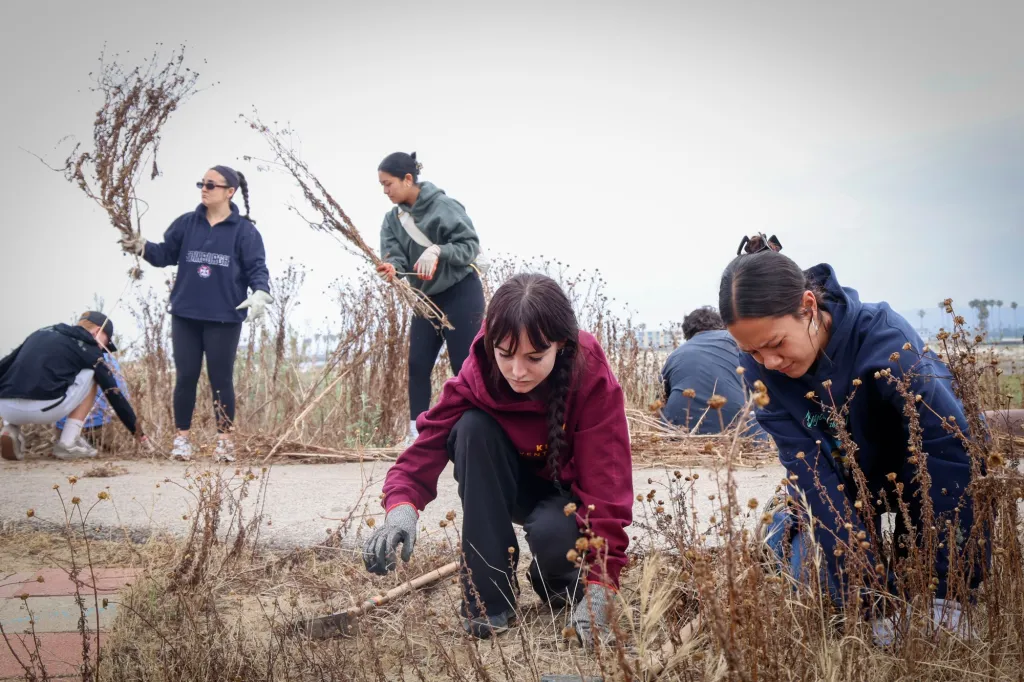
More than three dozen volunteers gathered Sunday morning in Ocean Beach to celebrate the end of the 23rd annual San Diego River Days by removing invasive plant species growing along the banks of the San Diego River mouth.
Read more Body of man found in overturned truck in ravine near Warner Springs
The goal of the gathering was to remove an ugly brown weed known as crown daisy so that native plants can grow in its place, allowing birds and other creatures to live in their natural environments. But it was also the culmination of a nine-day celebration of the vitally important, but often underappreciated, San Diego River.
“The San Diego River really is the lifeblood of San Diego,” said Natalie Borchardt, the senior manager of natural resources at the San Diego River Park Foundation. “It is the reason that we actually settled here. It is one of the most important features of our region.”
After about two hours of tedious weed pulling on an overcast and breezy morning, the roughly 40 volunteers had filled a 40-yard dumpster with crown daisy, according to Borchardt. They’d also vastly improved the aesthetics of a several-hundred-yard stretch of the walking and biking trail that runs along the estuary near Dog Beach.
San Diego River Days used to be just one day, according to Sarah Hutmacher, the chief operating officer at the San Diego River Park Foundation. But over the years it has grown into a much larger series of events held at points all along the 52-mile river, which begins near Julian.
This year, those events began May 9 with a 5K “Walk for Wildlife” and fun run at the Riverwalk Golf Club in Mission Valley. During two weekends, and throughout the week in between, the San Diego River Park Foundation and its partners put on more than 40 events. Several hikes and nature walks offered participants a chance to enjoy and learn about the river; other events involved cleanups, gardening and habitat restoration.
“It’s grown to thousands of volunteers and participants,” Hutmacher said. “It’s a very cool chance for us to get some work done, for sure, but I think more than that to just help raise awareness about the San Diego River.”
Hutmacher said that more than 500,000 people live in the river’s watershed, and their actions have a big impact. “The river will never be healthy if we don’t have people actively participating in its stewardship and avoiding things that cause harm,” she said.
Hutmacher said more than 1,000 volunteers gave more than 6,000 hours of their time during cleanup and restoration events during this year’s River Days.
“People can have a real transformational change on the river,” she said. “Humans are certainly the cause of some of the problems, but we can also be part of the solution.”
Read more Art, wine and Ferraris: Inside the luxury garage condos for South Florida’s richest collectors
Sunday’s habitat-restoration project was held in conjunction with the Surfrider Foundation’s San Diego chapter. Although the area where the volunteers worked was several hundred yards from the beach, the river estuary is interconnected with the ocean, said Zack Zeilman, the climate action program lead for the Surfrider Foundation’s San Diego chapter.
“This spot is really important because it provides a sort of nature-based solution to climate resilience for the community; having the sand dunes and the wetlands provide a good buffer from sea level rise and storm surges,” Zeilman said. “And then there’s all these co-benefits of natural habitat for the threatened and endangered birds and plant species.”
Among Sunday’s volunteers was 23-year-old Gwen Garcia, who grew up in Northern California but came south to attend San Diego State University. She graduated last year with a bachelor’s degree in microbiology, studying organisms much smaller than the invasive plants she spent her morning ripping from the ground.
“But I really like being out here, in the weeds, actually making a change in the environment that we live in on a daily basis,” said Garcia, who began volunteering with the foundation about three months ago.
In addition to its River Days events, the foundation provides volunteer opportunities all year. Every Tuesday, volunteers clear out invasive plant species and restore native habitats, with the site alternating between the river mouth in Ocean Beach and along areas further inland near Mission Valley. Garcia said volunteering just a few hours a week makes a big impact.
“Every week we come back and we can see a difference in the environment, and we can watch native plants growing back in the areas that we’ve cleared out in the weeks before,” she said.
Garcia, who is taking sustainable agriculture classes at City College to learn more about such work, said she wants the community to reconnect with the river, and the plant and animal species that live there.
“It feels good to be able to restore Ocean Beach and to enjoy it and be part of it, not just be a passive witness of the land around us, but to actually reintegrate ourselves into the ecosystem,” Garcia said. “And do our part to help right the wrongs that humans have done here over the last few hundred years.”
Read more New solutions studied for North County’s congested I-5-Route 78 interchange