








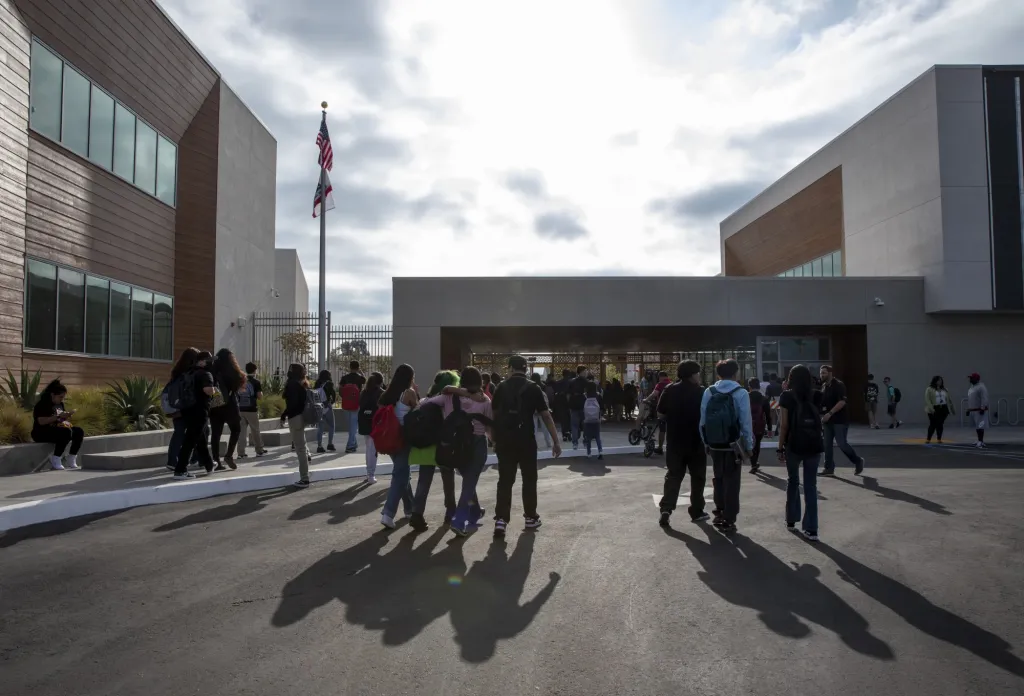
A new report released Thursday on the well-being of San Diego youth says that, on average, the kids are alright — but progress is needed to address disparities among youth of color, unhoused young people and LGBTQ+ students.
Read more Families of kids with disabilities warn Education Department changes could break a flawed system
The compiled data from 2005 to 2023 from across local, state and federal agencies to assess how young people are doing across a range of areas — education, economic stability, physical and mental health, victimization and risky behaviors such as drinking and vaping.
Among the key findings were rising graduation rates among San Diego high school students and stable preschool enrollment. But it also found rising rates of unhoused students and fewer young adults who are able to make a self-sufficient wage.
“In some places, they’re doing really well,” said the report’s lead researcher Alicia Jurek, from the Policy & Innovation Center. “And then there’s other places where there are some areas of concern.”
The research — supported by her center as well as the San Diego Foundation, Prebys Foundation and the city of San Diego’s Office of Child and Youth Success — compared the well-being of young people in the city and county of San Diego, statewide and nationwide.
The report calls on policymakers to deepen investment into the region’s youth, including through expanding the Youth Commission, supporting youth programs and funding future research.
But the report comes at a challenging time for youth services in San Diego.
In recent budget deliberations, the Office of Child and Youth Success was nearly cut from next fiscal year’s spending in an effort to confront the city’s projected $146 million deficit. While spared, the hours at several parks and libraries will be reduced, which youth advocates say could directly harm young people and the services they rely on.
In recent years, the Youth Commission, a city advisory body that aims to bridge the gap between young people in San Diego and the city’s leadership, has also struggled to maintain enough members to function.
And a measure San Diego voters passed four years ago to address the region’s shortage of child care by allowing it to be hosted in recreation centers has been stalled by funding uncertainty and bureaucratic delays.
Jurek wants this new report to help spur city officials into action.
“My hope is that my report will mean something,” Jurek said. “That the city will use this to say, ‘Here are some measurable priorities… and that we can continue to invest in research like this to track this over time.’”
Roughly 30% of San Diego County’s population — about 1 million people — are under the age of 25.
The report shows some positive developments. The percentage of adults in San Diego County who have graduated from high school has risen from 84% in 2005 to over 95% in 2023, the year with the most recent available data.
Read more Moores Cancer Center wins renewal of foundational federal grant
Frequent cigarette use had essentially stopped among San Diego Unified School District students, dropping from 4% in 2005 to 0.5% in 2021. Nearly all — at 97% — of youth in the county had health insurance coverage in 2023, up from 88% in 2008.
But the report also identified some shortcomings. There was an increase in drinking from 2021 to 2023 among San Diego Unified high school students, especially those 18 and older.
The share of students meeting or exceeding expectations on standardized tests in English and mathematics fell in the years after the COVID-19 pandemic began. Hispanic, Black and Native American students in the city and county were less likely to meet those standards than other groups.
The number of homeless students in the city and county also rose from 2021 to 2023 — to over 9,000 in the city and over 21,000 in the county.
Jurek also points to troubling disparities among LGBTQ+ students, who are more likely to report isolation, risky behaviors, poor mental health and suicidal ideation and skipping school because they feel unsafe.
Karlo Vazquez Melendez, a third-year student studying political science at San Diego State University, says he was most concerned about the declining number of young adults who are making a self-sufficient wage.
“The possibility of me continuing to live here in San Diego and seeing a future with me and my family is becoming more and more distant,” he said.
The report recommends that the city adopt a budgeting system to track its youth and child spending and better understand how the city is investing in young people.
It also asks the city to create a regional working group to coordinate efforts, update the youth well-being report periodically and expand the Youth Commission with a youth ambassador program.
The recommendations reflect the Office of Child and Youth Success’ “overarching concern” that the city must address the gaps in access and opportunity for children and youth.
“The policy recommendations outlined here are grounded in a commitment to equity and aim to create a more inclusive and supportive environment for all young people,” the report reads.
Read more Legislation overhauling college sports faces a major test in the Senate