






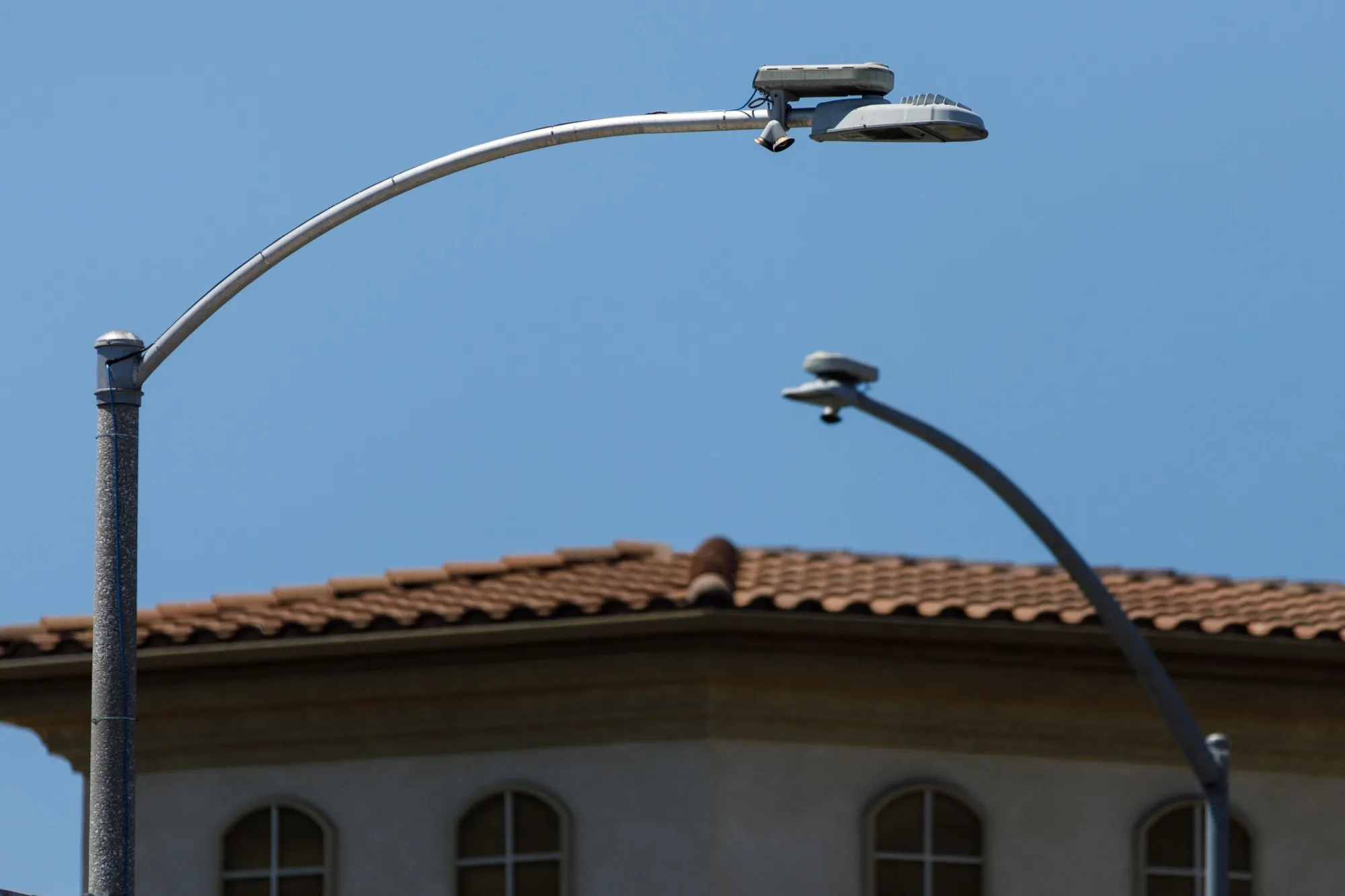
The battle over the use of streetlight cameras and automated license plate readers by San Diego police has ebbed and flowed for years.
Read more The millions spent by California billionaires against Prop. 40 is about 0.07% of their wealth
Now it’s approaching another high-water mark.
Opposition has picked up strength with increasing legal and political demands to shut down the system over myriad privacy concerns that have grown nationwide.
Just this month, the four San Diego City Council members who take that view picked up a likely fifth vote — and a majority on the nine-seat panel. A council committee last week voted unanimously to recommend the full council halt the city’s use of what’s often called ALPR technology.
A lot more has to play out for that to happen, however.
Mayor Todd Gloria, a staunch advocate of the crime-fighting value of ALPR along with Police Chief Scott Wahl, could veto council action. A sixth vote would be needed to override the veto, and it doesn’t appear to be there yet.
The November election could change that equation in either direction, with the election of candidates that could provide that supermajority or, conversely, upend the anti-Flock majority.
It’s unclear when the matter will go before the full council. Newly elected council members take office Dec. 10.
San Diego City Councilmember Stephen Whitburn once supported ALPR technology but recently made the pivotal announcement that he no longer does.
He said the ALPRs have “helped solve crimes, and I believe our police department uses them responsibly.”
But he said the potential for ALPR to be misused by the federal government to aid unjust immigration enforcement — despite the city and state prohibition on sharing the technology for that reason — isn’t worth the risk.
“Many people worry Flock cameras are being used in that crackdown,” Whitburn said.
Whitburn’s reversal follows a lawsuit to end ALPR use in the city of San Diego filed by the American Civil Liberties Union on behalf of Partners for the Advancement of New Americans.
Gloria has repeatedly weighed in to defend the technology and how it’s used.
“Taking this proven tool away from our officers would be a serious mistake and a step backward for public safety,” Gloria said in a statement after the Budget and Government Efficiency Committee vote on Wednesday.
According to the mayor’s office, the ALPR system has helped solve nearly 900 cases and recover more than $8 million in stolen property since it was launched in 2023.
In 2025, the technology assisted in the arrest of 269 suspects and the recovery of 12 firearms and 259 stolen vehicles. The mayor’s office also said the system contributed to homicide investigations and locating four missing persons.
Gloria said the city’s TRUST Ordinance has established guardrails and set “the gold standard for transparency and oversight of surveillance technology.”
The mayor maintains problems reported elsewhere across the country are in jurisdictions that haven’t developed San Diego-like restrictions, which critics nevertheless say aren’t as solid as Gloria maintains.
Much of the criticism has been specifically focused on Flock Safety, a company considered the market leader in ALPR and which is under contract to provide the technology in the city of San Diego.
Other firms offer similar systems, but Flock has been a lightning rod across the country. Use of the technology in the public and private sectors has exploded in recent years, but increasing numbers of jurisdictions are dropping Flock.
Earlier this month, before Whitman’s announcement, Gloria extolled ALPR in an interview as “a force multiplier” for San Diego’s perpetually understaffed police department.
But his high level of support for the technology didn’t extend to Flock.
“I do think there are issues with the provider, obviously,” the mayor said in an interview.
Read more Dozens of vote centers open for early in-person voting across San Diego County
“I am committed to improving as we learn and to do better going forward,” he added.
He said the city’s ALPR system is under continued review, and if misuse surfaces, “we’ll address it.”
On Thursday, the mayor’s office said Gloria “is preparing for a scenario where the City Council cancels the Flock contract. For the Mayor, this is less about any particular vendor and more about the technology, which is a proven crime-solving tool that can keep our communities safe”
Gloria would push to put the contract out to a competitive bid again, but “that should not be interpreted as a decision to replace Flock.”
Early in its use, San Diego’s ALPR system was accessed by the federal Homeland Security Investigations department and Customs and Border Protection 10 times, according to the Times of San Diego. The San Diego Police Department said none of those was related to immigration enforcement.
Meanwhile, in 2023, settings meant to bar outside agencies from accessing the system were temporarily misconfigured, allowing other California law enforcement agencies to search San Diego’s database, according to the Times. Such access has since been walled off, the city says.
The council dynamics could shift. Councilmember Henry Foster, who is in a tight re-election battle in District 4, is adamantly opposed to Flock and is stressing that in his campaign. He led the committee action on Wednesday.
His opponent, Martha Abraham, has expressed concerns, both regarding privacy and losing a crime-fighting tool. She has said an analysis of the data should drive the decision on ALPR use.
In the race for council District 2, Deputy City Attorney Nicole Crosby wants to boot Flock. Her opponent, former Coronado Mayor Richard Bailey, has suggested tighter restrictions on its use are needed, but has not stated he would vote to remove it.
San Diego’s rocky history with the technology began under Gloria’s predecessor, Mayor Kevin Faulconer, when the city installed Smart Streetlight cameras and the data was used by police, which the public didn’t know about initially. In response to the ensuing controversy, the city turned the cameras off.
Then, under Gloria, the city and advocates and critics of the technology embarked on a lengthy public process to create guidelines that were incorporated in the Trust Ordinance.
The growing dispute across the country has been super-charged by reported abuses, some of which are nothing short of outrageous.
The Washington Post in August revealed cases in which at least 69 police officials have been accused, charged with or convicted of misusing Flock’s system or other license-plate readers for unauthorized purposes. The abuses included stalking women and spying on wives, girlfriends and exes.
In May 2025, the 404 Media website reported Texas authorities conducted a nationwide ALPR search for a woman they said had a self-administered abortion.
Such news not only elevates concern about privacy in a world that increasingly has less of it, but personal safety regarding how the information might be used under the color of authority.
This comes amid broader fears about how artificial intelligence is being used now and in the future.
The issue has struck a bipartisan nerve in Congress. Democrats have introduced the Ban Flock Act, while Republicans are pushing the Stop Flock Abuse Act, which calls for audits and limits on its use.
In these politically polarized days, few things can bring Democrats and Republicans together.
Flock is one of them.
The Washington Post
“After the Trump administration dismissed scientists behind a key national climate report last year, some of them decided they’d keep working on it — but from outside the government.”
Read more Less than 2 weeks from Election Day, here’s how much is being spent in San Diego City Council races