






A San Diego City Council committee has voted to eliminate Flock automated license plate readers — technology that the city’s mayor and police chief strongly support — creating friction at City Hall and uncertainty about whether the technology will actually be removed.
Read more Prop. 45 seeks to rewrite state environmental law. Here’s why San Diegans should care
The full council would have to finalize last week’s unanimous vote by the council’s budget committee, a measure that will likely be taken up before the end of the year. At least five of the city’s nine current council members recently signaled their support for pulling the plug on ALPRs.
But the upcoming election, and the timing of such a vote, could complicate that by changing the council’s membership.
Two council members are being termed out, and two others are in re-election battles. Nearly all of the challengers and newcomers signaled willingness to cut or seriously reconsider use of ALPRs or replacing Flock as the provider.
In addition, any approval by the full council could be vetoed by the mayor, requiring an override vote by a six-member supermajority.
Surveillance technology has long stirred controversy in San Diego, but the debate intensified recently as ALPRs drew increased scrutiny nationally, particularly as the Trump administration has ramped up immigration enforcement. The pushback — much of it against Flock, the market’s biggest player — has led a growing number of cities to cancel or not renew their ALPR contracts.
As Flock continues to make national headlines, here’s the deal with the surveillance tech in San Diego
As the debate rages, police Chief Scott Wahl has been clear: He wants to keep the license plate readers. His office cites the hundreds of cases solved and noted their use in investigations of 10 solved homicides last year.
Critics argue the license plate readers create a mass surveillance network and infringe on civil rights, particularly in marginalized communities. They also cite reports from across the country of abuses of the network by law enforcement.
Last month, a civil rights advocacy group sued San Diego seeking to end use of ALPRs, alleging an invasion of privacy rights under the state constitution. The city is also facing a federal lawsuit from a man who alleges he was wrongfully jailed for a month after police using ALPRs targeted the wrong vehicle.
Opponents also question the financial cost. Less than five months ago, facing budget woes, the San Diego City Council considered scrapping ALPRs — the $2 million contract would have allowed a reversal of some cuts to hours at nine libraries and 24 recreation centers. The vote was 5-4. The readers stayed.
Last week, the city’s Budget and Government Efficiency Committee unanimously voted to end the ALPR program and take the matter to the full council for review.
Even without the budget committee’s move last week, the use of license plate readers will still land in front of the full City Council before the end of the year for an entirely separate reason. A 2023 ordinance requires the council to do an annual review, with an eye on civil liberties, of all the city’s surveillance technology, including drones and ALPRs.
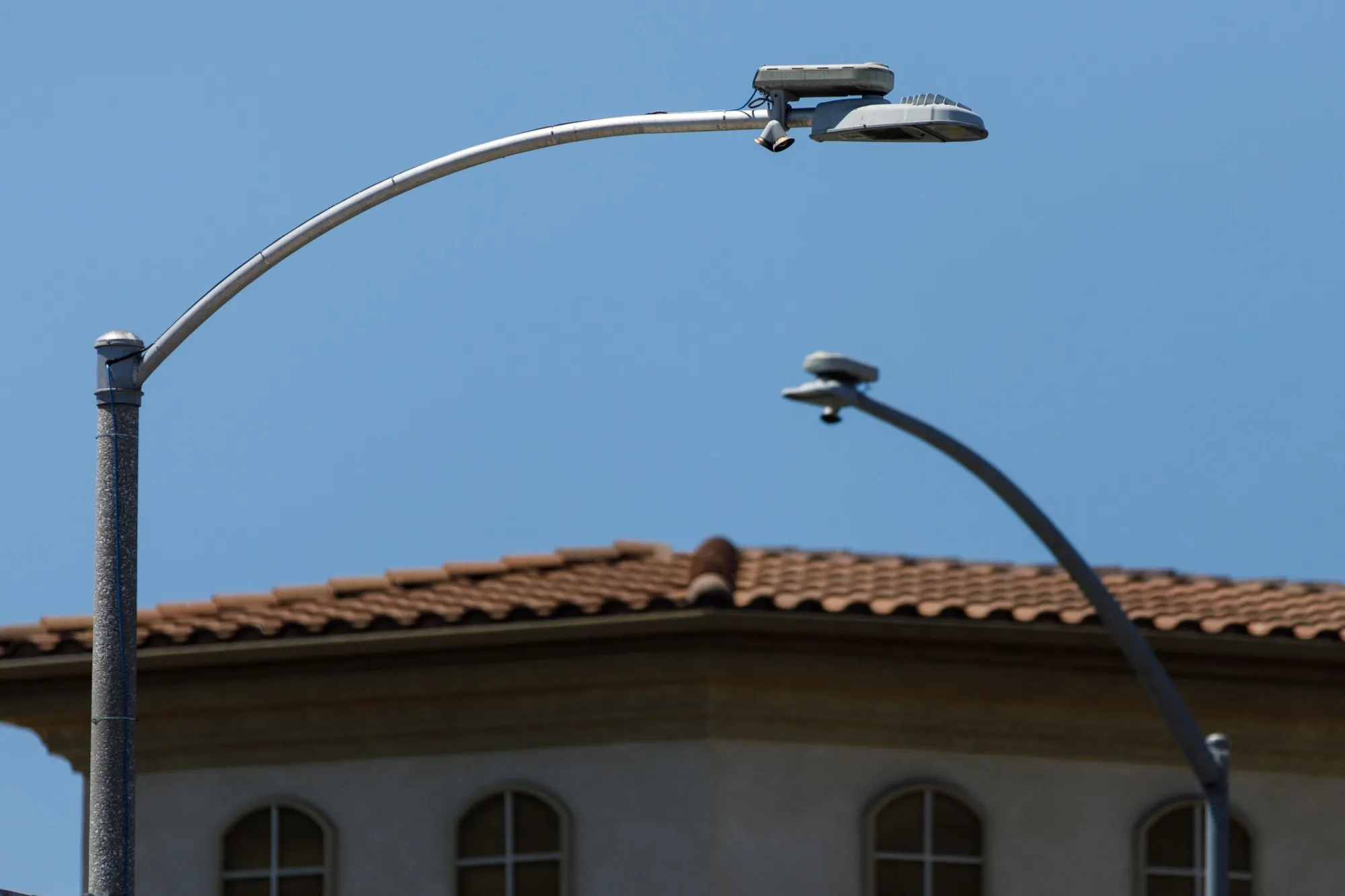
The city of San Diego has 500 surveillance cameras and license plate readers attached to streetlights citywide. The cameras record information — including plate number, make, model, color and markings such as bumper stickers — on all vehicles in their view, then store it in a searchable database. San Diego police hold the collected data for 30 days, but it is held longer if it is used in an investigation.
State law prohibits law enforcement from sharing the data with entities outside of California, although critics fear the federal government will muscle access. San Diego goes further: its sharing switch is toggled off so that no outside agencies can directly access its data. Last week, Flock spokesperson Trevor Chandler said San Diego has “implemented some of the most rigorous safeguards in the country.”
Candidate positions on ALPR use
When the full council scrutinized ALPRs during the annual review last December, five councilmembers voted to keep them. Those five included Stephen Whitburn, but he reversed course earlier this month and said he no longer supports using ALPRs.
The five also included Kent Lee. But he, too, changed his mind in recent months, and at last week’s budget meeting he voted to nix using ALPRs, citing cost in tight budget times and civil liberties. “The fact simply is that San Diegans remain more fearful than ever of the potential breaches and abuse of this technology,” Lee said.
Lee’s challenger in the November election for the District 6 seat is Mark Powell. On Thursday, Powell told the Union-Tribune he supports police use of technology for public safety but opposes the Flock program “as currently configured.” Noting the data is handled by a third-party vendor and a prior incident of unintended outside access, he called for pausing use of ALPRs until “strong, independently verified safeguards are in place, including strict limits on data sharing, especially with outside federal agencies, plus independent audits and clear accountability.”
Also up for re-election is Councilmember Henry Foster III, who cites mass surveillance concerns with ALPRs and wants them down. “I have opposed the use of this technology from its onset, and I want to make sure everyone understands that,” he said last week at the budget committee hearing. Foster, who chairs the committee, was the one who brought the matter to the committee for the vote.
Foster’s challenger for the District 4 seat is Martha Abraham. She did not respond last week to a request for comment, but her campaign manager said ALPRs are a public safety matter over which the budget committee doesn’t have jurisdiction and said discussing it there was “a publicity stunt.” At a candidate forum in September, she noted the growing concerns about how cameras are used, but said more analysis was needed to prove they are a bad idea. “Numbers don’t lie,” she said at the time. “We can present a case that it’s something that might not be needed in our community.”
Councilmember Jennifer Campbell has voted in support of the cameras, but she is termed out. The two people vying for her District 2 seat, Richard Bailey and Nicole Crosby, indicated support last week for the move to rescind ALPR approval.
“Yes, the city failed to implement adequate safeguards and communicate those safeguards to the public, which lost the public’s trust,” Bailey said when asked about the committee’s vote. “Unfortunately, both the city’s reputation and general safety will take a hit.”
Crosby said last week she applauds the budget committee “for taking the first step to end the Flock Contract. I am opposed to the City contracting with companies like Flock, which have been proven to not securely store sensitive information and to allow access without judicial oversight.”
Although Campbell is leaving the council, she will still be present through inauguration day in December and will have a chance to vote. Last week, her office said in an email that Campbell “recognizes the value these tools can provide to public safety, and she believes we must carefully evaluate their effectiveness alongside the safeguards necessary to prevent misuse.” Her office said she does not support the federal administration’s “immigration-enforcement agenda,” and she has “reservations” about Flock and is open to possibly exploring using another provider.
In District 8, Councilmember Vivian Moreno is also termed out come December. She has voted to stop using the readers. Both candidates to replace her, Antonio Martinez and Gerardo Ramirez, said they support the committee’s decision, and both appear to be OK either with ending or pausing ALPR use.
Martinez said that while the readers “are promoted as a tool for neighborhood safety, they collect data on everyday residents going about their lives, which is an invasion of privacy and leaves room for misuse.”
Ramirez said the city doesn’t control the data Flock collects, and that it could be shared through regional systems with agencies outside the city. “Until we can guarantee San Diegans their information is safe, it would be irresponsible to keep using these cameras,” he said.
The rest of the council
Councilmember Sean Elo-Rivera has been and remains vocal in his opposition to ALPRs, voting last week to remove them. Council President Joe LaCava and Councilmembers Raul Campillo and Marni von Wilpert have voted to keep the ALPRs. All three are in the middle of their second terms, but von Wilpert is running for Congress in the Nov. 3 election.
Asked last week for their positions on ALPRs, Campillo said public safety benefits are “real,” as are concerns about privacy and potential misuse. He said he has spoken with experts and continues to “closely examine” ALPR use in the city. “My goal remains the same: to protect the rights and privacy of San Diegans while giving our police officers the tools they need to prevent and solve serious crimes,” he said. “We should be able to do both.”
LaCava’s office said he will share his comments on the matter at upcoming hearings. Von Wilpert’s office did not respond Friday to a question regarding her position.
Read more Michael Smolens: Gloria strongly backs license plate readers. Flock’s? Not so much