






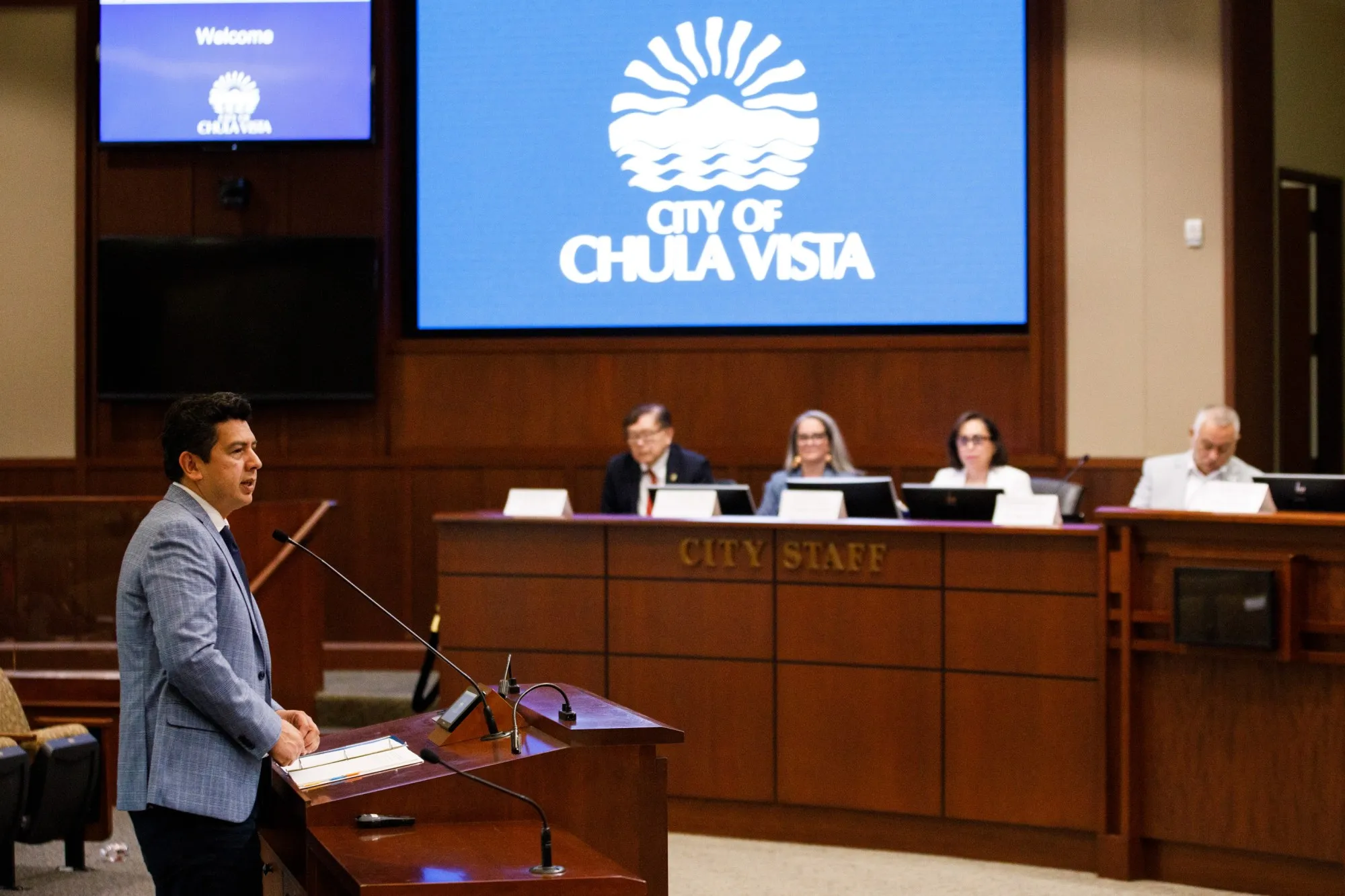
The South County Higher Education Planning Task Force on Friday made its first formal recommendation on a proposed four-year university district in Chula Vista, while holding off on decisions about how to finance the estimated $2.17 billion project until January.
Read more Black University of Mississippi students wrestle with forgiveness in wake of racist gestures
Members voted to recommend that state lawmakers keep working with Chula Vista to decide when and how to pursue legislation that would shield the project from challenges under the California Environmental Quality Act, the state’s main environmental review law. The motion, made by member Adrian Arancibia and seconded by member Valita Jones, passed with no opposition.
The task force, created under Assembly Bill 662 by Assemblymember David Alvarez, must submit governance, financing and land-use recommendations for the University District at Chula Vista to the Legislature by July 1. The campus is proposed for a roughly 383-acre, city-owned site in eastern Chula Vista.
Member David Malcolm, who was absent Friday, had raised the possibility of a CEQA exemption in August, citing concerns about challenges to the city’s 2018 environmental impact report.
Adriana Ochoa, the task force’s special legal counsel, said deadlines to challenge that report have passed and future exposure lies in later approvals, such as maps and permits. She cautioned that “there is no exemption that will end all litigation related to CEQA.”
Ochoa also presented a staff recommendation to amend the site’s exemption from the state Surplus Land Act, which requires at least 25% of housing units to be affordable. She said student, faculty and staff units — about half of the roughly 4,000 planned — cannot legally be designated affordable, effectively creating a 50% requirement on market-rate housing.
A 2025 bill to address the issue, Assembly Bill 76, was returned without the governor’s signature, with his veto message calling the change premature before the task force completed its evaluation. Ochoa said the proposed amendment “just resets the expectations to what was actually negotiated and makes the words of the statute match the deal.”
Member Gala Ledezma questioned whether the requirement truly blocks development.
“I’m just worried that we’re changing the terms of a public land arrangement to make private investment more attractive without demonstrating that this is a genuine barrier actually preventing development,” she said.
Nicole Salazar, a director with PFM Financial Advisors, said the firm had not consulted developers, but a team member’s quick calculation of the 50% threshold found no comparable examples.
“He kept coming back to a negative bottom where it would be hard for anybody to want to come out to do that,” she said.
Read more A West Point cadet drugged his girlfriend to force an unwanted abortion. Then he went to grad school
Salazar presented conceptual financing options, including a joint powers authority that could issue tax-exempt bonds. John Moore, dean of undergraduate education at UC San Diego, said that with many universities facing structural deficits, “it really seems to come down in the end to legislative appropriation in one way or another.”
Marlene Garcia, the task force’s lead facilitator, presented three staff-recommended next steps: forming a finance and governance entity with institutional partnership agreements, seeking a modest one-time state appropriation for startup costs and advancing pre-development planning.
Maria Anguiano, entrepreneur in residence at the College Futures Foundation, said the plan appears to assume a joint powers authority before the task force’s planned January governance discussion.
“It seems like we’re asking institutions to get married before they date,” she said.
Arancibia urged members to move forward.
“We’re just talking about getting this paper to the Legislature so that we can actually say we’d like some funding so we can begin the process of actually considering this,” he said.
Zaneta Encarnacion, chief of staff at Southwestern Community College District, said she was “not ready to make any decision” and asked for cost estimates ahead of the state budget cycle.
“And for anyone who’s done budget requests, they want to know exactly what, how much,” she said.
Chair Clarissa Reyes Falcon said the task force would likely return in January with a full package addressing governance, financing and the Surplus Land Act. The next meeting is Jan. 22 at a location to be determined.
Read more Once globally preeminent, US universities are sliding into decline