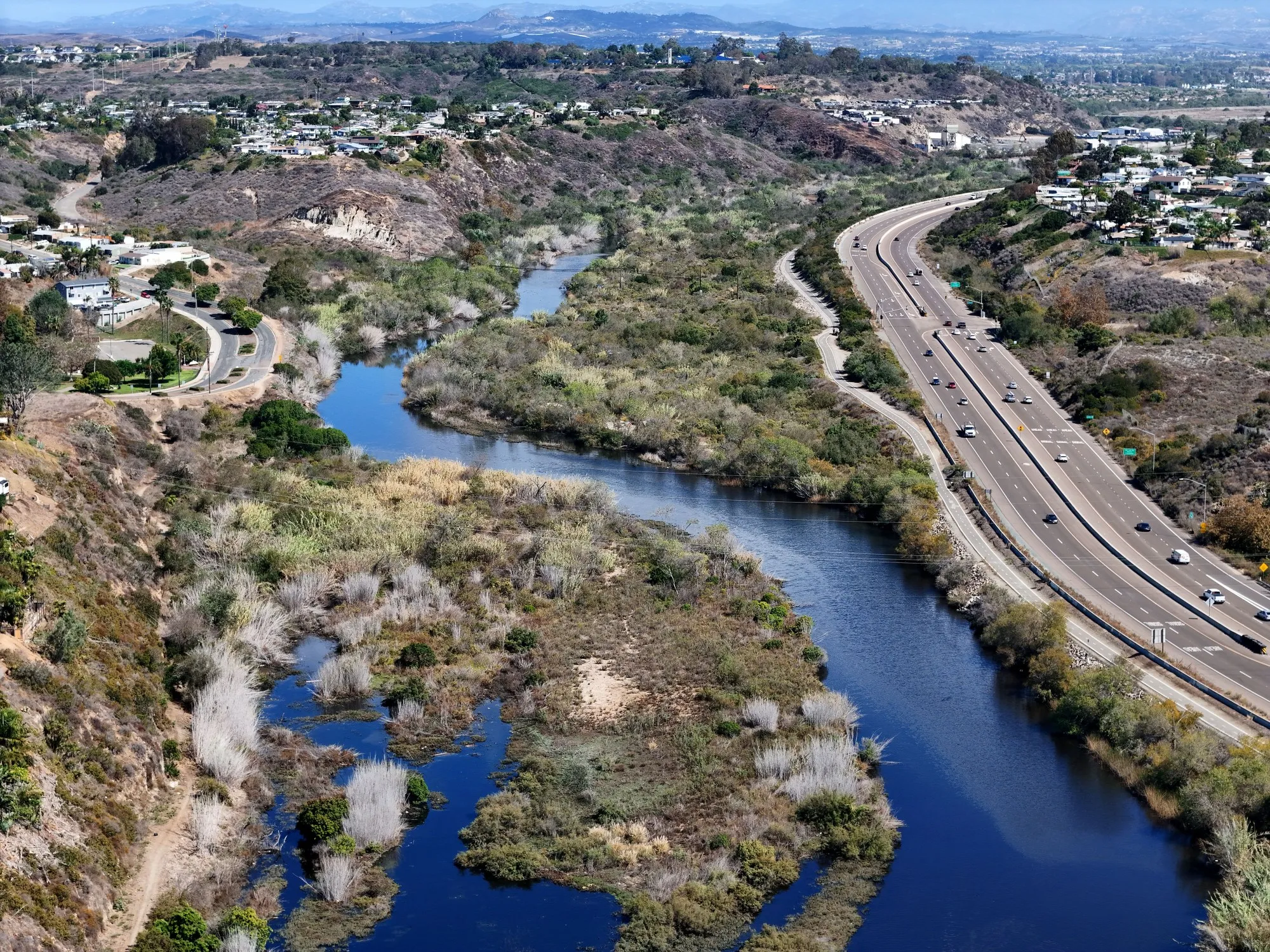






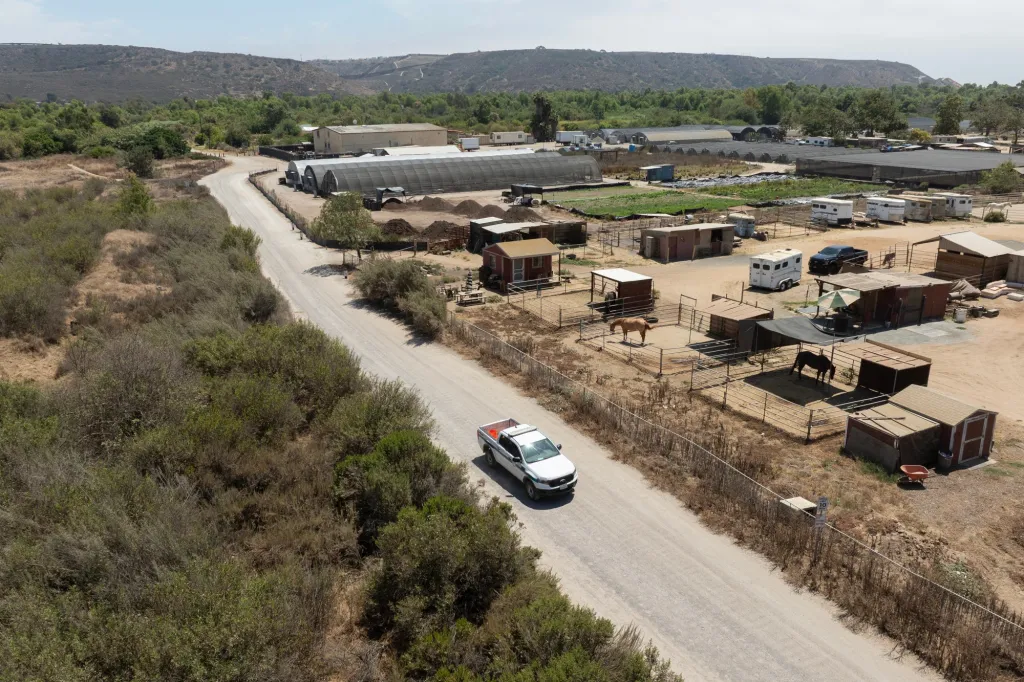
South Bay communities are one step closer to relief from a major air pollution hotspot after the California Coastal Commission approved a county-initiated project Wednesday to extend culvert pipes at the Saturn Boulevard crossing of the Tijuana River, where cascading sewage and industrial waste have blanketed nearby neighborhoods in toxic gases for years.
Read more Santee weighs long-term budget concerns, advances potential 1-cent sales tax measure
Separately, the federal agency tasked with trans-boundary flow and wastewater treatment at the U.S.-Mexico border, the U.S. International Boundary and Water Commission, told local officials at a San Diego Regional Water Quality Control Board meeting Wednesday they are trying to achieve near-zero dry-weather river flow by late 2027, as advocates and board members pushed back on the agency’s transparency and the slow pace of progress.
The Saturn Boulevard project, initiated by the County of San Diego, would extend two of five existing culvert pipes below the surface of the river during low flows, eliminating the turbulence created when water discharges approximately six feet above the channel onto rocks below. That turbulence has been identified as the primary driver of hydrogen sulfide off-gassing at the site, which sits within 1.5 miles of 11 schools.
Funding would be supplied in part from $46 million in Prop. 4 funding announced Thursday by Gov. Gavin Newsom’s office, which opened a competitive grant application period for projects targeting pollution in the Tijuana River Valley along the California-Mexico border.
San Diego County Public Health Officer Dr. Sayone Thihalolipavan told the commission the Tijuana River Valley sewage and pollution crisis remains “the only proclaimed emergency at the county of San Diego right now.”
He said Berry Elementary School, the monitoring location closest to the hotspot, is the only site in the region that has repeatedly exceeded the U.S. Environmental Protection Agency’s acute exposure guideline for hydrogen sulfide, regularly reaching in the hundreds of parts per billion. The California Office of Environmental Health Hazard Assessment sets a protective threshold of 30 parts per billion for sensitive groups, including children.
San Diego City Councilmember Vivian Moreno, a Coastal Commission alternate member who represents communities including San Ysidro, Egger Highlands and Nestor, made the motion to approve and noted the project’s limited but meaningful scope.
“This culvert does not address any of the sewage that goes through the plant,” Moreno said. “This culvert addresses the sewage that is coming down through the Tijuana River. While this doesn’t fix the issue, it does absolutely represent progress.”
Supervisor Paloma Aguirre, whose District 1 includes the most heavily affected communities, called the approval “a crucial step toward cleaning up the air we breathe at a major hotspot.”
She said the project is estimated to be completed by spring/summer 2027, though construction cannot begin until the county secures authorizations from multiple agencies including the U.S. Navy, which owns land adjacent to the site, the U.S. Army Corps of Engineers and the San Diego Regional Water Quality Control Board, among others.
At the Water Quality Control Board meeting, Gilbert Anaya, USIBWC’s chief of environmental management, said that if rehabilitation of key Mexican pump station PB1 — currently underway as a 21-month project — is completed on schedule in late 2027, and if repairs to the Parallel Gravity Line in Tijuana are finished by August as projected, conditions could exist to achieve near-zero dry-weather river flow.
Read more Carlsbad nixes sidewalks to preserve parking for beachfront Terramar neighborhood
“The goal is to get to about two million gallons per day during daytime hours on low flow,” Anaya said. “We would block the river, that flow would then be collected by Mexico … and we would have little to no flow crossing.”
The Tijuana River’s complex binational infrastructure system begins with the main Mexican pump station PBCILA, which collects river flow and sends it north to PB1, a lift station that pumps wastewater either to the South Bay International Wastewater Treatment Plant on the U.S. side or toward coastal discharge.
The infrastructure in Mexico is currently not fit to handle all of the Tijuana River’s flow, though major upgrades are underway as a result of agreements between the U.S. and Mexico, minutes 328 and 333. As a result, millions of gallons per day of raw sewage and industrial waste bypass treatment infrastructure and flow directly into the South Bay, polluting the air, estuary and ocean.
Furthermore, when any component of the current infrastructure chain fails — whether a collapsed pipeline, a power outage or an overwhelmed pump station — more untreated sewage bypasses the system, flowing into the Tijuana River.
Board members and public commenters also pressed USIBWC on transparency, noting the agency has not held a community forum in nearly a year.
Sarah Davidson of the Surfrider Foundation and Tijuana River Coalition said hydrogen sulfide levels reached over 900 parts per billion at Berry Elementary School just last week and exceeded 300 parts per billion the morning of the hearing.
“This is a decades-long public health crisis and it deserves to be met with the highest level of urgency,” Davidson said.
Patrick McDonough, senior attorney for San Diego Coastkeeper, pushed back on USIBWC officials’ assessment that industrial waste and heavy metals are not a major factor in the river’s flow, saying Coastkeeper’s team has detected significant levels of benzene, toluene, arsenic, acetone, chloroform, PFAS, cyanide, copper, lead and zinc, among others.
“There’s also a (San Diego State University) sediment study, a (Scripps Institute of Oceanography) study, et cetera, that are at odds with the IBWC’s own reporting today that most of the sediment quality sampling has shown low levels of pollutants or non-detects,” McDonough said.
USIBWC said a community roundtable is tentatively scheduled for mid-July, though the format and degree of public access have not yet been determined.