





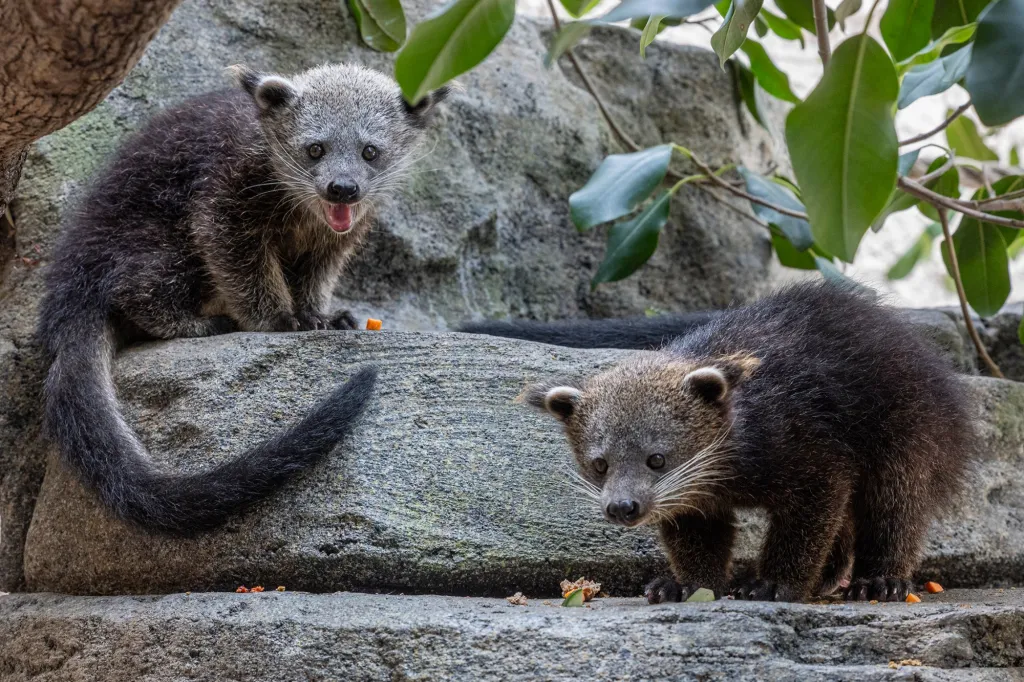
For the first time in more than 25 years, the San Diego Zoo has welcomed baby binturongs to the Balboa Park institution, twin males named Pulong and Tau.
Read more Supreme Court justices to testify before Congress on increasing security funding in rare appearance
Sometimes called “bearcats” because they have a face similar to a cat and a body that looks a bit like a bear, these animals are native to rainforests in South and Southeast Asia. When full grown, they are around the size of a dachshund.
The “bintlets” arrived in March, a birth that came about two years after the zoo first began trying to breed first-time mother Nettle. Officials initially paired her with Datu before experts managing the species suggested a different would-be dad, a male named Garrett who came from a different zoo.
That worked like a charm, said Nicki Boyd, the zoo’s general curator.
“They weren’t compatible, I guess. They never got the job done,” Boyd said of the Nettle-Datu matchup. Nettle, who just turned 7, is “compatible with Garrett,” and the pair could possibly become parents in a second round, once the twins are older.
Boyd said there are about 12 pairs of binturong in U.S. zoos, three of which recently became parents. The population is closely managed by experts under a Species Survival Plan that looks at genetics to determine which individuals should breed.
The San Diego Zoo currently has six in its collection, all of which represent a subspecies known as Bornean binturongs native to the island of Borneo. Boyd, who began her zoo career 34 years ago as a keeper, said the San Diego Zoo has cared for binturongs as long as she’s been there.
Zoo officials knew Nettle was expecting twins after doing ultrasounds; mothers can carry up to four babies. Zoo donors helped pick out names for the pair, which are named after a national park in Malaysia.
In the wild, the animals are considered “vulnerable” because of habitat destruction, poaching for traditional Asian medicines and the fur and pet trade.
The adults have shaggy black coats and tails that can grab or grasp objects. Their faces boast wiry whiskers and small, rounded ears.
They also have a distinctive scent. In the wild, binturongs are usually solitary animals. They mark their territory using a scent gland near their tails and spread a chemical compound in their urine with their tails and feet. That scent is how they communicate with other animals.
Read more Why Choose Milestone Relocation as Your North Carolina Movers?
Some people liken the odor to buttered popcorn — although to her nose, Boyd said it is more like Fritos chips or “dirty socks.”
For now, the twins and their mom are living in an off-exhibit area at the Wildlife Explorers Basecamp and can be seen on some behind-the-scenes tours.
Nettle is proving to be a good mother. “She’s raising them 100%,” Boyd said.
The parents and offspring are all being trained in the zoo’s animal ambassador program, which means they may eventually participate in activities such as taking walks through zoo grounds, working with staff in special presentations or participating in VIP experiences or summer camps.
The zoo has around 150 animal ambassadors, which are used to “help us connect people to wildlife,” Boyd said.
Binturongs are smart and curious, with distinct personalities.
“Pulong is a little more shy, but he’s a huge talker. He will eat anything, he’s not very picky, whereas Tau is more rambunctious and playful and he is a more selective eater,” she said.
Pulong has lighter fur, so it is easy for care staffers to distinguish between the two.
“We will showcase them as much as we can, whenever we can,” Boyd said. “The team is very excited to show them off, but it takes a little bit of time to get them trained and comfortable.”
The animals also need time to “just to be kids and hang around with mom and play.”
It is thought the twins will stay together for one to two years at the zoo, Boyd said. One probably will be transferred to another zoo with hopes of reproducing. The other likely will stay in San Diego in the ambassador program and possibly have a shot at becoming a father.
Read more Trump rolls out the White House welcome mat for new Iraqi Prime Minister Ali al-Zaidi