







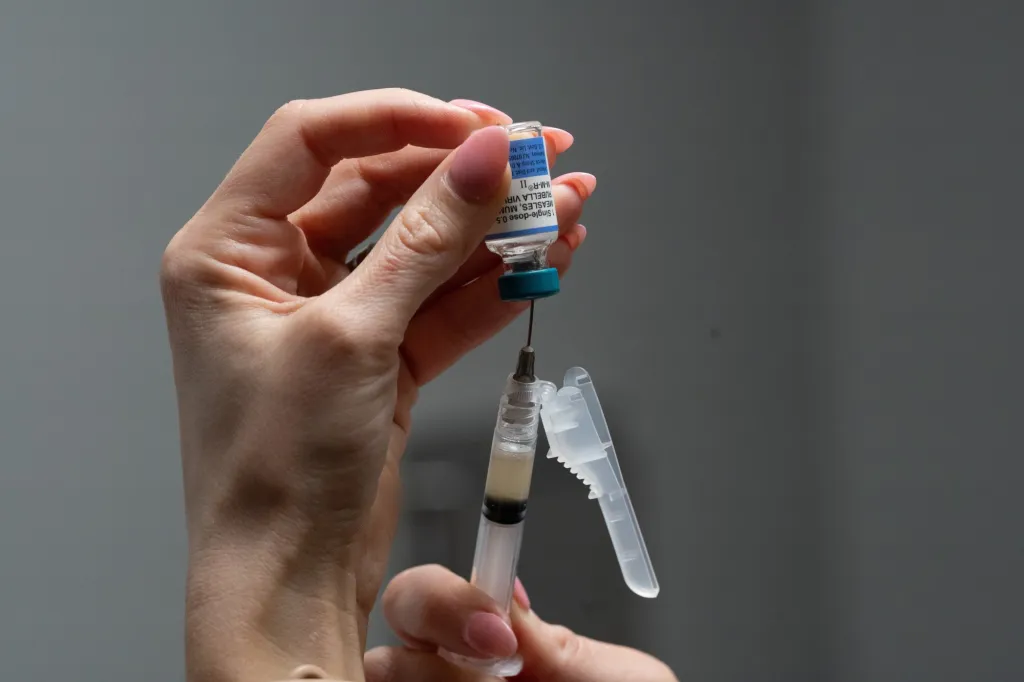
Measles is on track to infect more Americans this year than it did in 2025, increasing the likelihood of exposure to the highly contagious disease.
Read more US bombing of Iran expands as American troops killed and Tehran retaliates against the Gulf states
It is enough to make even those who are fully vaccinated begin to wonder about their level of personal protection. After all, most were immunized as children and have lived their lives in a world where measles was all but extinguished in America, meaning that their vaccine-induced immunity has never been tested.
While the vast majority of the 2,260 measles cases confirmed by the U.S. Centers for Disease Control and Prevention this year were among unvaccinated or only partially vaccinated Americans, 4% of those who tested positive had received both of their measles, mumps and rubella vaccine doses.
The latest results, updated through Thursday, July 16, show that this year’s total is just 29 confirmed cases shy of the 2,289 reported in 2025. With five months still to go before 2027 arrives, a year-over-year increase in measles cases seems certain.
Some might wonder: Will measles booster shots become a common practice as is already the case for the flu and COVID-19?
Neither the CDC nor the World Health Organization recommend routine measles booster shots. CDC guidance does not mention boosters, just two initial doses, the first given between 15 and 18 months of age and a second between a child’s fourth and sixth birthdays. Adults who don’t know if they were immunized are encouraged to have at least one dose, while those in certain situations, such as living in a college dorm, working in a health care job, traveling internationally or living with someone who has a compromised immune system, are urged to have two doses.
Given the observed uptick in measles cases, would it be beneficial for fully immunized adults to get boosters, especially if decades have passed since their two childhood doses?
Experts say measles boosters are probably not going to become broadly recommended health policy; in certain narrow circumstances, though, getting a booster might make sense.
Measles, explains structural biologist and immunologist Erica Ollmann Saphire, president and chief executive officer of La Jolla Institute for Immunology, simply does not mutate or reshuffle their genetic code in the same way that other threats do, making it less necessary to update a person’s immunity after initial vaccination.
The differences are both structural and natural.
“Flu, as an example, has natural reservoirs in animals, birds and pigs, lots of places where it can spread and amplify in the wild. Anytime it’s in a different host, it’s under different pressures to change, to mutate before it spills over into humans,” Saphire said. “Measles has its only natural host in humans, so it doesn’t have that opportunity to go and change in the wild.”
Bats and pangolins are the well-known natural animal reservoirs of coronaviruses. This opportunity to mix things up in other species, as well as the relative lack of human immunity to the new virus, resulted in the global SARS-CoV-2 pandemic, which saw that virus splinter into multiple significant genetic subtypes, each capable of evading existing immune system protections, in just a few years.
But, without animal crossover, and with genetic constraints, measles simply has less chance to change its genetic code.
“We’ve had measles as long as we’ve had human civilization, and it’s still only one genotype,” Saphire noted.
She adds that the coronavirus provides a good example of the structural reason why measles has mutated so little across so many decades.
“Measles needs to use two different proteins on its surface that it uses to enter human cells, whereas SARS-CoV-2 has just one spike protein that does the same job,” Saphire said.
It would take a large amount of mutation to change both of the measles proteins necessary for infection in ways that would help the virus evade immune system protections. But coronavirus, with just a single spike protein, has a higher probability of relatively small changes making enough of a difference to slip through existing defenses.
“Measles just can’t change and hasn’t changed in the ways that other viruses can and have, and that’s why the virus that we started using in the 1960s still more or less works well today,” she said.
That does not mean that protection does not wane over time, adds Dr. William Moss, a pediatrician and executive director of the International Vaccine Access Center at Johns Hopkins Bloomberg School of Public Health in Baltimore.
Moss was involved in a systematic review that examined how rapidly measles antibody levels circulating in the blood decrease. Antibodies, also called immunoglobulins, are tiny Y-shaped proteins produced by the immune system that lock onto viruses, marking them for destruction or blocking them from attaching to cells.
“Over a 20-year period, which was kind of the duration of the available data, measles antibodies did decrease, but they didn’t significantly go below the protective threshold,” Moss said.
Read more Filing period open for candidates running for Encinitas mayor, City Council
It remains a mystery, the expert added, why the immune system keeps making fresh supplies of some antibodies, like those against measles infection, while other types, such as those against influenza and coronavirus, wane quickly and need re-exposure through a booster shot to trigger a fresh batch of protection.
The medical community uses the term “titer” to measure the amount of protective antibodies in a person’s blood.
Public health departments routinely do titer tests of people possibly exposed to infectious diseases, and San Diego County investigators have collected such test results for the region’s three measles cases so far this year. San Diego County has not yet detected a locally acquired case; all three public exposure notices have been for people who traveled here for vacation or work from other communities.
About 88% of results compiled for 316 people who were potentially exposed, and who did not have evidence of full vaccination, showed protective titers, while 11% showed no such protection. About 85% of those exposed had proof of vaccination, with an additional 13% having been born before 1957, a year considered early enough before the measles vaccine became available to assume that a person would have gained immunity through natural infection.
Titers, though, are a bit of a red herring. Even if there are no protective antibodies currently circulating in a person’s blood, special immune memory cells should be capable of quickly producing more protection if live measles viruses arrive.
So, an otherwise healthy person with low titers would still likely be able to fight off an infection without serious medical consequences.
“We are not all going to need measles booster shots because, if you have been fully vaccinated, you have a high probability of being protected,” Moss said.
But what about that 4% of Americans who were fully vaccinated and still tested positive for measles infection this year? While those people may indeed have become infected — perhaps because a dose they received was not properly administered or their immune system did not recognize the vaccine and induce immune cell memory — they are the exception, not the rule.
That said, both Moss and Saphire note that some people are much more vulnerable in a nation that is seeing increased numbers of measles cases for two years running.
“Kids with cancer, people with compromised immune systems, babies under age 1, people who can’t be vaccinated or aren’t old enough to be vaccinated, they’re the ones who will suffer the most severe disease,” Saphire said.
People caring for those in these special categories should be more careful about their level of actual measles protection as the virus becomes more active in the United States, experts said. It is possible to take medical tests to confirm that a person does have protective measles antibodies in their blood, but Moss said that it’s often easier to just roll up one’s sleeve.
“Some people will ask me, ‘Should I get my measles antibodies tested?’” Moss said. “My response is that it’s probably easier and cheaper, if you are worried about this, just to get another vaccine. … It won’t hurt anything.”
Even though the CDC and WHO do not recommend measles booster shots as a broad public health policy, individuals are free to get one if they want. The rub is that without a recommendation from the public health establishment, individuals likely must pay out of pocket.
“It’s certainly not recommended, but it wouldn’t hurt if you did,” Moss said.
An online cost estimate for the MMR vaccine indicates that doses can be had for about $106 each.
What might hurt quite a bit is getting measles without being vaccinated. While it is true that the vast majority of cases resolve without causing significant medical problems, rare side effects can be life-threatening. There is also evidence, both Moss and Saphire note, that measles kills immune system memory cells when infecting someone without vaccine-induced or natural immunity.
This means that immunity against other threats such as the common cold, flu or coronavirus can disappear if a person contracts measles without any existing immunity.
“The paradox is that, after measles, you lose some of your immunity to other pathogens, but you do get really strong immunity to the measles virus,” Moss said.
An increasing number of children, including in San Diego County, are not vaccinated.
Routine childhood immunization against measles, mumps and rubella has recently slipped, hitting 93.7% in San Diego County last year, according to county data. That level is said to be below the 95% “herd immunity” threshold, a level that helps prevent long chains of person-to-person transmission.
Read more US military identifies 2 soldiers killed in Iranian attack on Jordan as from Texas and Hawaii