







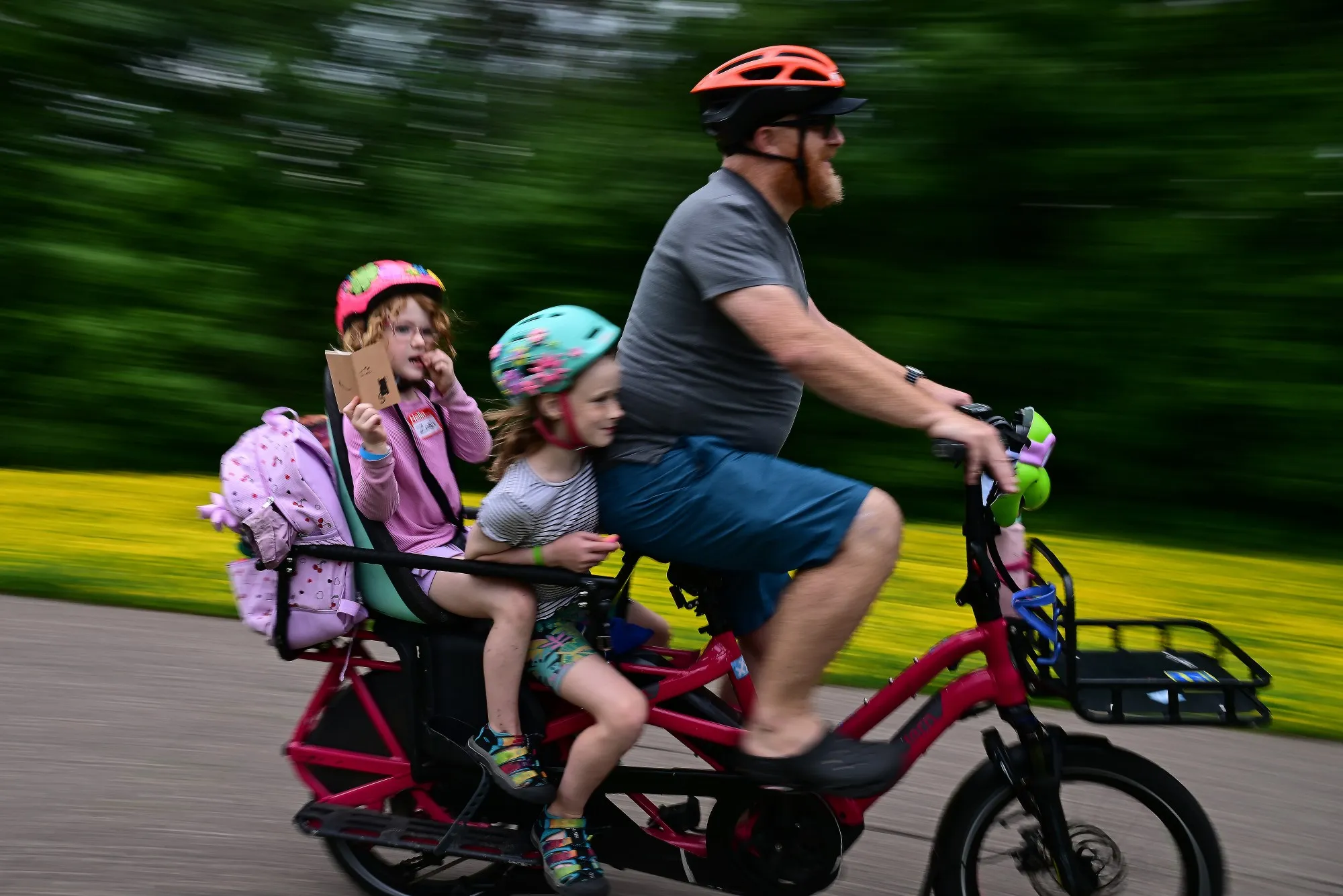
Patrick Stephenson is, like many parents, in a rush to pick up his kids at summer camp at day’s end. What’s a bit different from the norm: He isn’t driving.
Read more Burned in a bombing in Gaza, a Palestinian teen finds healing with Jewish surgeon
He puts Iskra, 8, and Zosia, 6, on the back of his Tern GSD, a specialized bicycle commonly known as a cargo bike. The kids are the cargo in this scenario, once they’ve donned their helmets and perched in familiar form on the bike’s back bench.
“So I load ’em up, unlock the bike and then we get on the road,” said Stephenson, of St. Paul, Minnesota.
People on such bikes are a common sight in the Twin Cities as residents increasingly embrace them for shopping and family outings — sometimes taking the extreme step of replacing a car with a cargo bike.
Local bike shops are scrambling to stock cargo bikes. A St. Paul store, the Cargo Bike Shop, has made the specialty bicycles central to its business. The owner, Tim Stanton, has a branch in Madison, Wisconsin, as well.
Minneapolis even has a budding network of cargo-bike lending libraries with a small fleet of bicycles available for weekly checkouts for free — kind of like checking out a hardcover. A St. Paul branch is in the works.
Cargo bikes range from “long tail” models like the one Stephenson uses to front-loading versions with the rider positioned behind a big, deep basket for kids or cargo. Such designs have been around for years.
“But I think cargo bikes really started to take off with the proliferation of e-cargo bikes” that have electric propulsion, Stanton said. “That’s when more and more people became knowledgeable about them and interested in them because they’re an easier ride for replacing those car trips.”
Demand for electric cargo bikes in the U.S. is projected to grow from $370 million in 2025 to about $1.54 billion by 2035, an increase of 318.5%, according to Fact.MR, a market research firm.
“Cargo bikes are now a legitimate transportation alternative in the United States,” said Suvrangsou Das, CEO & co-founder of EasyPR LLC, who has studied global currents in lifestyle and technologies as expressed through media and consumer behavior for the past seven years.
“Increasing gas prices, declining trip distances and the expense of multiple car ownership have increased the appeal of the cargo bike in recent years. A second car has an annual upkeep cost of $8,000, while a cargo bike can be purchased for $3,000 and offers a plethora of potential solutions for congestion and parking,” Das said.
Dads haul their daughters
Taylor Bruhschwein of Edina got into cargo biking when he became a dad. He invested in an Urban Arrow front loader when his older daughter, Frida, 3, was born three years ago, and he created an Instagram account a year and a half ago when his second daughter, Fiona, 2, was born.
He’s now equipped his cargo bike’s styrofoam-reinforced basket with a video camera to capture his girls’ candid moments while on rides. He publishes the videos on his mnbikedad feed.
“We live two miles from Lake Harriet and we didn’t want to deal with driving, but it’s too far for a stroller,” Bruhschwein said. “We wanted to figure out how to do that,” and cargo bikes were it.
“Oh, they love it,” he said of his girls. “They like seeing the sights when we’re headed to the park or the grocery store, and they’re finally old enough to talk to each other now.”
Stephenson has been using cargo bikes for about eight years — since the birth of his eldest daughter.
She was riding at 10 months. In photos, “she was just a bald baby on the bike, and I didn’t even put shoes on her for some reason,” he said.
In a more recent shot, taken around Easter, she is “angry with me because I had stopped biking for a second,” Stephenson said. “Yeah, like, once they’re going, they don’t want to stop.”
The crew was headed home last month, “and we pulled up to a stoplight,” he said. “The girls were waving at somebody in the car next to us.” And he had an epiphany that “you don’t wave at somebody from your car.”
Stephenson has owned a variety of cargo bikes — including a green Yuba long tail with a bright orange seat that was stolen during the summer of 2020.
“Our car also got stolen that summer,” he said. “I remember distinctly that I was way more sad about my bike getting stolen.”
Stephenson also owns a Burley, the brand name for a popular line of bicycle trailers. These are typically used by parents with non-cargo bicycles. But Stephenson has magnified his dad-cyclist prowess by hooking his Burley to his cargo bike and thereby gaining the ability to haul five or six children at once.
Cargo-bicycle retail stores
Cargo bike-friendly shops in the Twin Cities include the Cargo Bike Shop, Perennial Cycle, Watt Cycle Works and Angry Catfish. They have sometimes struggled, but the cargo-bike trend is giving them a lift.
Read more UN human rights chief wins second term despite opposition from US, Israel and Russia
Stanton, of Madison, opened the Cargo Bike Shop roughly when the pandemic started in 2020; he would not make his first significant sales until the following year. In another blow, burglars made off with a bunch of cargo bikes in February 2022, pretty much emptying out his showroom near Snelling and Selby avenues. He persevered.
He started his Madison business in his garage in the fall of 2014 and moved to a proper store in the fall of 2016.
That’s roughly when cargo bikes began to take off, he said. “It’s only increased every year since then. And I think the cargo bike market is going to continuously and steadily expand.”
He said “we hear lots of great adventures” from people who buy bikes, “People who go bike camping and so on. They call and ask whether I can carry this or that, from a parrot and a cat to grandma.”
Luke Breen has owned Perennial Cycle in Minneapolis for 33 years, and he has handled cargo bikes such as Urban Arrow front loaders and Yuba long tails for the past dozen years or so.
“In 2019, a year before the pandemic, we were picking up some real momentum with cargo bikes,” Breen said. “And then, when the pandemic hit, it went on steroids.
“People were trapped in their houses,” he said. “They wanted to be together and get out of the house … riding bikes more and driving cars less.”
Cargo-bike lending libraries
She started with three cargo bikes to lend out. Now Laura Mitchell is up to 15 serving a network of lending libraries — two that are up and running in Minneapolis, two more on the way — with a branch recently launched in Rochester.
“The idea is we have a variety of different electric cargo bikes that folks can borrow for free for a week, see what fits into their lives, use them for school drop-off, to get groceries, to visit friends,” said the founder.
The MN Cargo Bike Library program is a partnership among the Bicycle Alliance of Minnesota (an educational organization), the Lyndale Neighborhood Association and CycleHoop, a maker of secure bike storage. Borrowers attend a one-hour orientation with curriculum from BikeMN while CycleHoop shelters keep the fleet safe between bike loans.
“This is not the first bike library in the country; they’ve existed for many, many years,” Mitchell said. “But as far as I know, this is the first dedicated cargo bike library in the country.”
St. Paul will likely get a branch if a grant comes through, she said. She expects to hear about the funding by August, meaning the branch wouldn’t be up and running until next year. Duluth is also on the radar.
The Minneapolis fleet saw more than 4,100 miles and 675 trips last year, Mitchell said.
Last May alone, “we’ve already had 48 people borrow bikes from our program and they’re averaging about 10 trips (across their five-day loan periods),” she said.
Andrea Poole, a Minneapolis apartment-dweller, recently checked out a library bike when her mother and grandmother came for a visit. Grandma is 71 and not in the best of health.
“I knew that she probably wasn’t gonna be able to bicycle very far on her own,” Poole said.
She chose a Bunch front-loader, a model with two front wheels and a box large enough for an adult to sit in, so Grandma wouldn’t miss anything.
“We rode her around the parking garage a little, and she was like, ‘This is the bomb diggety.’”
For her part, regarding the lending system, Poole said, “I was very, very surprised that it is free.”
Elizabeth Makarewicz of Minneapolis is, like so many others, in the market for a cargo bike. So she used the lending library for research.
She borrowed the Bunch bike to try out with a friend who is an amputee.
And she tested an Aventon Abound, a long-tail model. “I rented it twice,” she said. “It’s really great for transporting kids, and there are also pannier bags for hauling stuff.
“I remember I took it across the river to St. Paul and all the way to downtown and around and back,” she said. “It’s quite a hike, but with an e-bike, it’s very doable.”
Read more Years after diabetic man’s jail death ruled a homicide, San Diego County must pay his widow $3M