






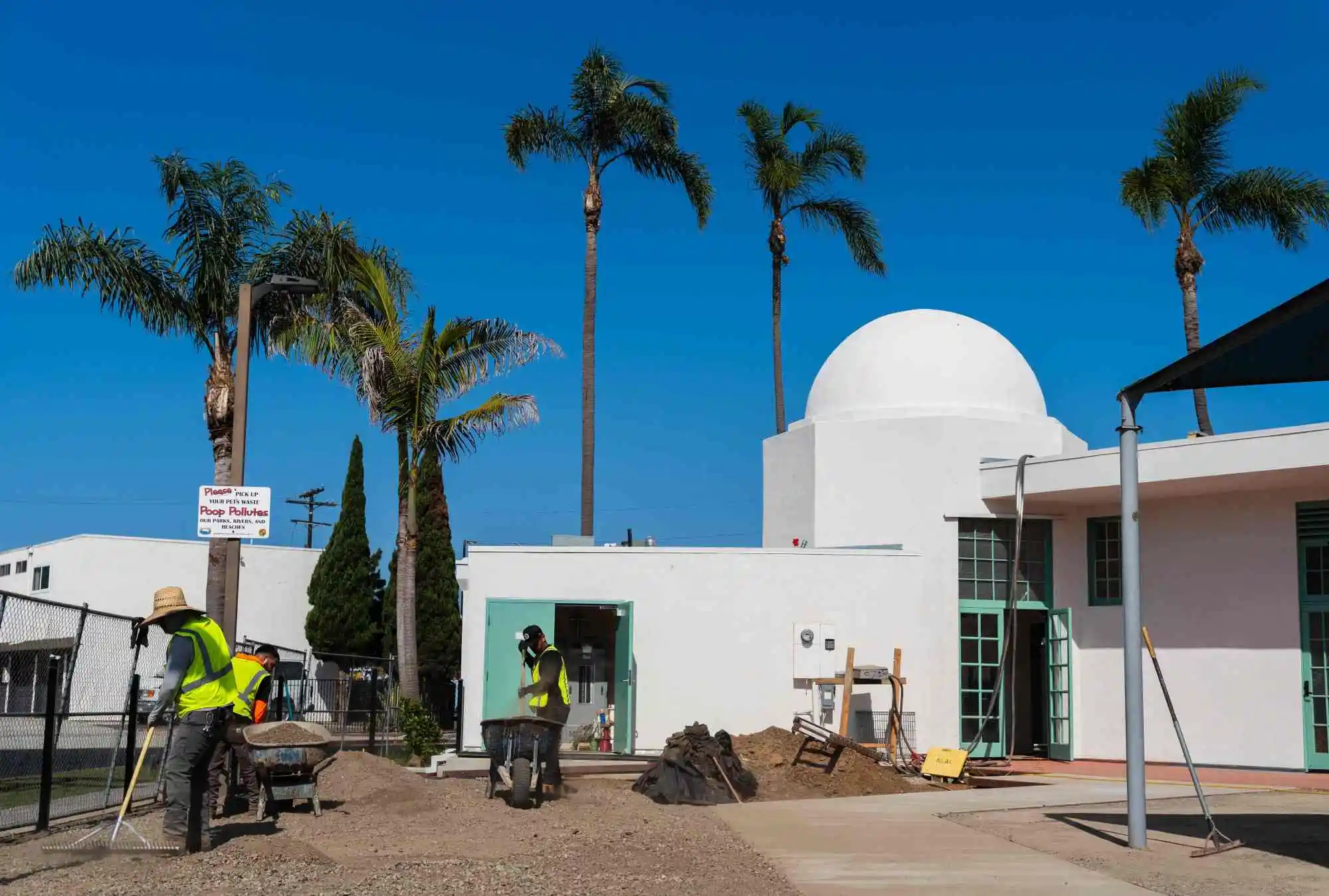
Oceanside is preparing to reopen its Crown Heights Community Resource Center after an extensive rehabilitation that began in February 2025 to the historic building designed by noted architect Irving Gill.
Read more As illegal crossings plummet, Border Patrol turns focus to bolstering checkpoints in San Diego
While the exterior looks much the same, only refreshed, the interior is all new with improved handicapped access, modern electronics and plumbing systems and — for the first time in the history of the 95-year-old building — air conditioning.
The job turned out to be bigger than anyone expected. Construction costs jumped from an initial estimate of $2.4 million to more than $5 million, largely because detailed inspections early in the process revealed the building would need a new foundation. The entire structure was temporarily lifted onto steel beams for support during the foundation’s replacement.
“It turned out well,” said Maria Jose “M.J.” Hernandez, the project manager, during a visit to the site Thursday. “I’m proud of it.”
Many of the contractors used were specialists in the renovation of historic buildings, she said. They installed a new roof, restored the stucco exterior and replaced the large rectangular, multi-paned windows.
Inside the building, workers repoured the original red concrete floors in the entrance rotunda and added a multi-gender restroom that meets the requirements of the Americans with Disabilities Act. They installed a small kitchen, new hardwood floors and suspended light fixtures in the spacious community rooms with cream-colored walls and green trim.
Some of the original architectural features, such as the concrete and the white Moorish dome on the roof over the entrance, are signatures of Gill’s style.
Gill also designed Oceanside’s first fire station and its companion City Hall building, which now house the Oceanside Museum of Art on Pier View Way. He had a long career and is known for other distinctive work in Oceanside, San Diego and Los Angeles.
“His approach was to be practical and inexpensive as much as he could,” Hernandez said. The windows were intended to illuminate rooms with natural light, and the building materials used were relatively inexpensive at the time.
The 37,000-square-foot building first was Oceanside’s Americanization School, built by the Oceanside School District as a place where Spanish-speaking residents were taught English and civics.
After the Americanization School closed in 1943, the building was used for a while as a school annex and then as a warehouse. Later, it was boarded up and became neglected and a target for vandalism.
Some students who attended the school later expressed resentment about the experience, saying they felt the segregation robbed them of their cultural heritage.
Read more San Diego court sought to intervene in independent oversight board, newly released records show
“This building’s story hasn’t always been an easy one, but for the past several decades it’s stood for something very different: a place where Crown Heights neighbors can find real support,” said Mayor Esther Sanchez in a recent city news release.
“This is one of the largest investments the city has made in Crown Heights, and it’s a reflection of how much this neighborhood matters,” she said. “We’re preserving a piece of architectural history while making sure the building continues serving neighbors every day.”
The city purchased the property from the school district in 1990.
“It was about to be sold to a developer to be demolished for a 7-Eleven,” said Victor Velasco, Oceanside’s principal civil engineer.
In 1994, the city completed a restoration for about $450,000 with the help of neighborhood volunteers.
The building was placed on the National Register of Historic Places in 1994 and has been used as a community resource center since 2001. It offers after-school programs and social services to residents of a diverse, low-income neighborhood just west of Interstate 5 and south of Mission Avenue, near the rear of Oceanside High School.
“There’s a lot of great success stories here,” Velasco said. Many Crown Heights residents credit the community center with helping them finish high school and go on to college and successful careers.
The building has mentored residents in the surrounding neighborhood for decades now, said Adrian Mendoza, the city’s community programs supervisor.
About five nonprofits provide services at the center, Mendoza said. Lifeline Community Services holds daily after-school and summer programs for students in kindergarten through 12th grade, offering a safe place for young people to do their homework, meet friends and plan their future.
The Vista Community Clinic and Feeding San Diego distribute food about three days a month. Medi-Cal, CalFresh, CalWORKS and the Legal Aid Society of San Diego provide services on specific days. Computers and Wi-Fi are available, along with assistance for those who may need it. It’s also a stop for the city library’s bookmobile.
“All of our services, all of our programs are free,” Mendoza said. “We focus on the needs of the community.”
The center also hosts occasional special events such as an annual Cinco de Mayo celebration in its outdoor courtyard. It is one of four community resource centers operated by the Oceanside Department of Housing and Neighborhood Services.
Read more In this art exhibition, the disruptions are where the truth resides
A ribbon-cutting open to the community will be held at noon Aug. 15.