





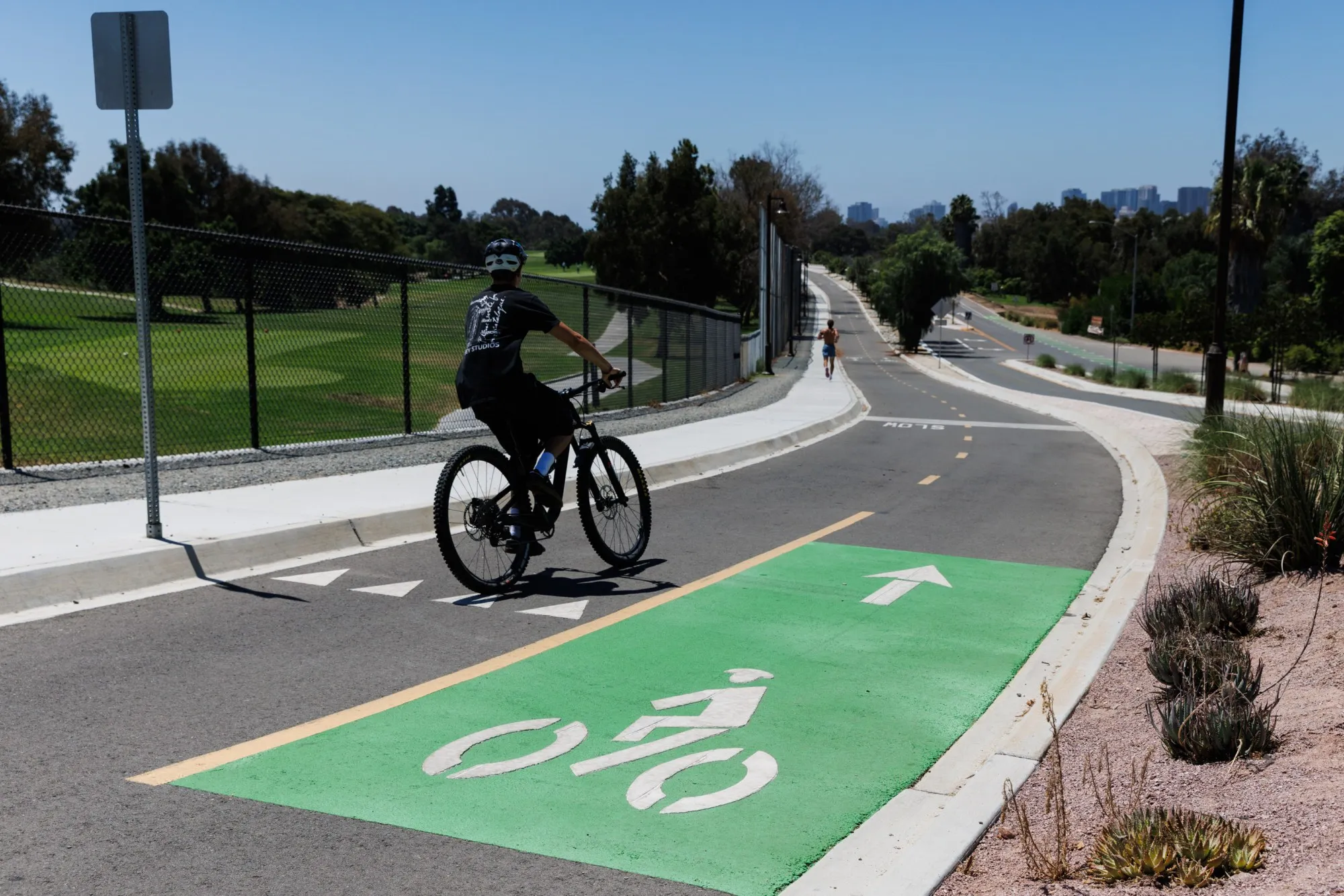
Environmentalists and cycling advocates are lobbying San Diego officials to revive and expand the city’s bicycle-sharing network seven years after it ceased operating.
Read more A quiet channel between ICE and Iran shaped deportation flights, newly released emails show
Advocates want the new network to expand beyond San Diego’s boundaries into other cities and neighborhoods across the county — especially places with strong mass transit — to create a comprehensive regional system.
They say a robust bike-sharing network would help get more commuters out of cars, solve the “last-mile” problem for many trips and boost mobility on college campuses and in neighborhoods where fewer people have cars.
Their proposed network is expected to cost around $34 million for a fleet of electric bikes, stations and other infrastructure and start operating as soon as late 2028 — but advocates concede 2030 is probably more likely.
Funding would potentially come from a title corporate sponsor, grants, advertising revenue, user fees, public subsidies and a sales-tax measure the Metropolitan Transit System might place on the November 2028 ballot.
Advocates stress that San Diego is the second-largest city in the nation without a bike-sharing network — Houston is the only larger city without one — and that 415 cities across North America already have such a network.
San Diego became one of the first cities in the nation to launch a bike-sharing network back in 2015, with a system of bikes stationed in docks around the city. But it was privately run with no subsidies, and the operators ran out of money before its second phase could be built.
That previous network, called DecoBike and then DiscoverBike before it ceased operating in 2019, faced strong competition shortly after it was launched from rival bike operators that didn’t use docks.
Dockless bike operators were harshly criticized for blocking sidewalks with their bikes, which were often vandalized or thrown into empty lots and other places that worsened blight in some areas. But many users opted for their bikes over the docked ones.
Dockless bike operators gradually switched most of their fleets from bikes to electric scooters, which dominated parts of San Diego for a few years before vanishing in late 2023 when new city operating rules prompted all the operators to leave.
Now, advocates for bike-sharing are lobbying for a docked system to avoid the problems created by dockless bikes and because they say that type of system has proven successful in many cities across the nation.
Advocates say San Diego is in a position to benefit from the city’s own mistakes and the challenges other cities have faced and overcome.
“We want to introduce a system that learns from the mistakes of the past,” said Ian Hembry, who’s helping lead the campaign as head of the San Diego County Bike Coalition.
Aria Grossman, policy manager for nonprofit Circulate Planning & Policy, said it may help San Diego to be adding a network so late.
“One of the benefits of being such a late mover on bike share is we have a lot of information from other cities around the country that have implemented it successfully,” Grossman said.
Hembry and Grossman last month secured an endorsement of their proposal from the San Diego Parks and Recreation Board.
Read more A federal policy is complicating how organizations battle the opioid crisis
“A properly designed docked system would be a clear improvement over the dockless systems previously tried in San Diego,” board chair Marcella Bothwell said. “Unlike those earlier programs, users cannot simply abandon bikes wherever they choose — the bikes must be returned to designated docking stations.”
But the board also requested the advocates explore supplying helmets at bike stations, create age restrictions, place stations in low-income areas and use geofencing to limit speeds and locations.
Hembrey said there would be geofencing. He also stressed that while all the bikes would be electric, they would be class 1 e-bikes that can’t travel faster than 20 mph — not motorcycle-style e-bikes.
Creating such a network is crucial to helping San Diego meet its goal of having at least 7% of commutes be made by bike by 2030 and at least 10% by 2035, said Anar Salayev, leader of BikeSD.
“If we really want to be serious about these goals, bike share is a clear mechanism,” Salayev said this week.
Advocates say the previous system failed primarily because of an incomplete network, competition from dockless bikes, a lack of stations on college campuses and poor connection to mass transit.
They say a new system would be able to avoid those problems and benefit from transportation improvements since 2019, including the extension of one trolley line, new rapid bus routes and many miles of new cycling infrastructure.
That infrastructure includes lanes on Pershing Drive, cycle tracks in Little Italy and downtown and new lanes on Park Boulevard that connect University Heights to downtown.
The new trolley line — the Blue Line extension from Old Town to University City — creates many new opportunities for commuters who live just far enough from stations on the new line to need a rented bike, advocates say.
Salayev said another key this time around will be better coordination with local transit agencies and placing stations in areas where fewer people drive, such as City Heights. He said DecoBike focused mostly on tourist areas to make money.
Grossman said advocates have already had robust discussions with MTS, the North County Transit District, the San Diego Association of Governments and possible title sponsors for the network. Elsewhere, New York’s network is sponsored by CitiBank and Portland’s by Nike.
San Diego State University also recently applied for a grant to fund part of the proposed network, Grossman said.
She said advocates will continue to focus on those efforts and securing support from key groups.
They already have endorsements from the city’s mobility board and climate advisory board, along with groups such as Climate Action Campaign, Discover Pacific Beach, Families for Safe Streets, RideSD and San Diego 350.
Read more Walmart strong again in second quarter, but its outlook is reserved