Andrea Chung majored in illustration in college, and she hated it. She never really felt like a painter, so graduate school gave her another avenue to express her creativity.
Read more Trump administration appeals latest ruling blocking his mail voting order from taking effect
“I just kind of started finding other ways of telling stories and really got into finding mundane materials that people don’t really consider, and making work based off that,” she says. “So, sugar is a huge part of my practice. I don’t think people think about the origins of sugar and how that has impacted the world—not just ecologically, but the things that it’s done in terms of slavery and indentured servitude, and how it has really shaped the world.”
Her interdisciplinary work includes cyanotypes, installations, sugar casting, and collage, among other forms. In her work for a show in Switzerland, she had a couple of pieces that involved a process using plant leaves and sunlight to create prints, that didn’t make it into the show. When she mentioned those prints to a long-time friend and curator, they asked Chung to be part of “The Giving Tree,” a new group exhibition opening Saturday at Art Produce Gallery in North Park.
Curated by Jill Dawsey, senior curator at the Museum of Contemporary Art San Diego, this latest exhibition is part of Space 4 Art’s year-long residency at Art Produce, funded by an Arts Ecosystem grant from the Prebys Foundation. “The Giving Tree” art show takes its title from the classic Shel Silverstein children’s book of the same name, but “the exhibition approaches the story as an anti-tribute, reconsidering its familiar narrative of selfless giving through the lens of humanity’s complicated relationship with the natural world,” according to a statement from organizers. Fourteen artists from San Diego and Tijuana are sharing work that celebrates trees and nature, and examines ideas around reciprocity and regeneration. (An opening reception is being held from 5 to 8 p.m. Saturday at the gallery, with readings by poet Fiona Martinez, and artist and writer Ruth Wallen. The exhibit will be on display through Sept. 26.)
Chung, 47, is a full-time visual artist who’s earned bachelor’s and master’s degrees from Parsons School of Design in New York City and from the Maryland Institute College of Art in Baltimore. Her work has been featured in multiple solo and group exhibitions, including at MCASD; is part of collections including Harvard University and the University of Texas in Austin; and has participated in numerous national and international residencies, and lectured at Princeton, the University of San Diego, San Diego State University, Southwestern College, and many other institutions. She lives in San Diego’s Mount Hope neighborhood with her husband and their child, and took some time to talk about how the themes in her work align with those in this exhibition, how motherhood has made her a better artist, and how kindness has carried her in her career.
How many pieces do you have in this show?
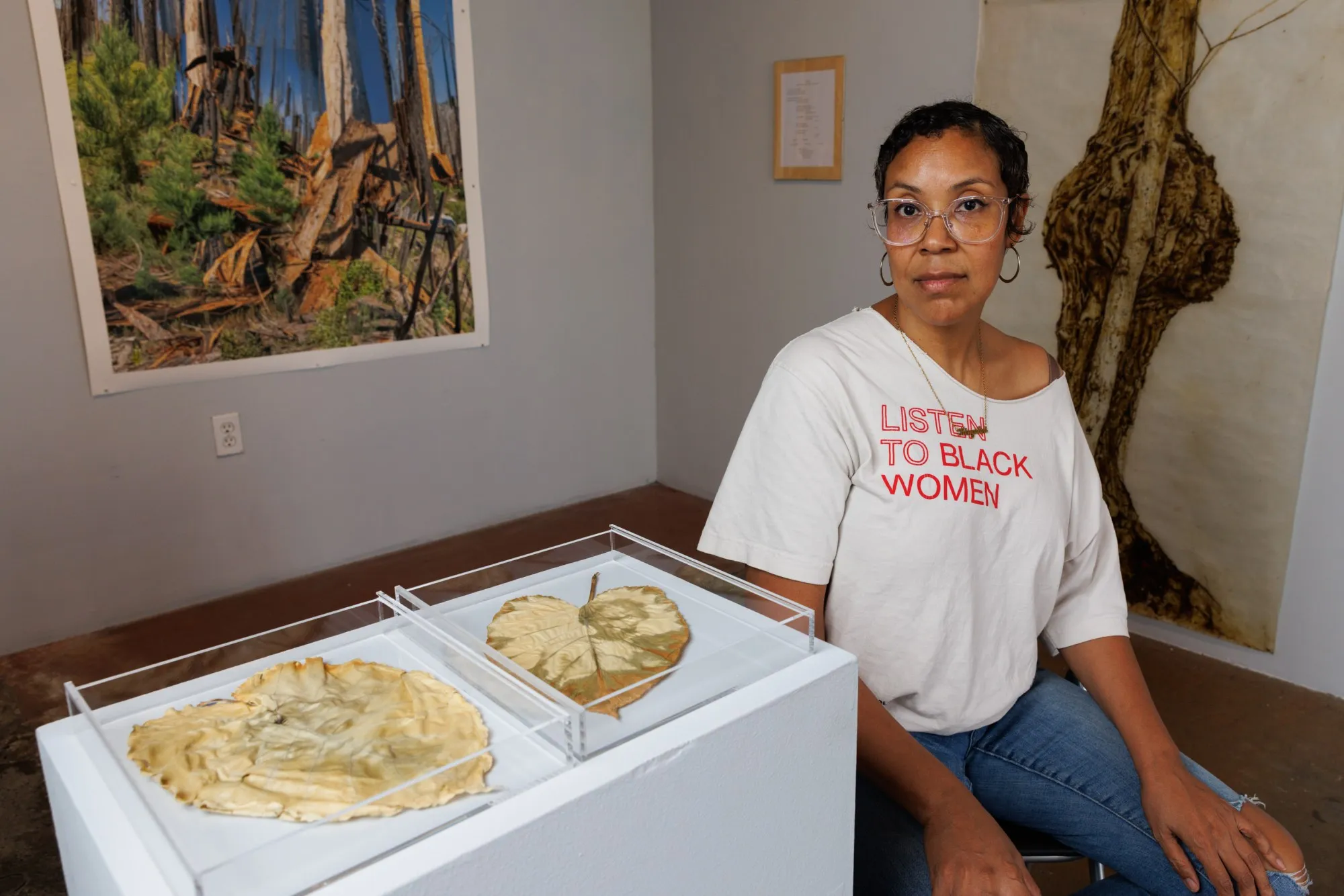
Just two. I didn’t make them for this show, but I made them this year. They were experiments for a show that I’m in in Zurich right now (“A Kind of Paradise: Colonial-Era Photography in Contemporary Art” at the Musem Rietberg). They’re called chlorophyll prints. I have a bunch of philodendrons in my house, and there’s a way that you can take a positive on film, and you put it over the leaf and expose it to the sun. The sun sort of bleaches out the chlorophyll in the plant, and your image transfers onto the plant. I had already been doing a project that required me to do that, and I was telling Jill about it, and this kind of naturally fit into the idea for the show.
The process of making them isn’t very isn’t very long; it depends on where you live and, luckily, San Diego’s sunny all the time, so I could print these in a day. You just expose it and leave it overnight to the next day. Depending on what the weather is like in your location, it can take a couple of days, it can take an afternoon, depending on how bright the sun is.Then, there’s the whole process of trying to preserve the image because it will eventually fade away. Ephemerality is a huge part of my work; I do like the idea of work not lasting forever. It’s kind of—I hate to say middle finger—but it’s my way of sort of challenging the notion of the art market and the commodification of artwork in certain ways. Especially because I do make work about formerly enslaved people, colonization, so I think it’s kind of strange to have some of those things in people’s homes. I certainly don’t think that I would want an image that I’m using to be above somebody’s couch or something like that. I think that that’s really perverse, in a way, so I only want my work to be purchased by an institution that’s willing to care for the life of the work, and that it can be used for educational purposes. I think that the way that this exhibition is discussing consumerism, I thought it was a good fit for the show.
What I love about Mount Hope…
I like the diversity in my neighborhood. While people would think it might be obnoxious, I love when I’m hearing somebody having a party in a house that’s behind me, and they’re blasting the salsa music really loud. I can hear them playing “Suave” a million times, and we’re in the house dancing. I like hearing a neighborhood alive, I like hearing my neighbors having a good time. And, there are several little libraries in our neighborhood. We put up one during COVID because we were trying to really care for our neighbors, putting out books for kids to read, or sometimes canned food. There are a lot of them in the neighborhood now, so I like that the neighborhood kind of looks out for each other in that way.
What is the show in Zurich that these pieces originated from?
I tend to work with a lot of archival material, and the museum in Zurich holds one of the largest collections of ethnographic photos of women on the continent and, a lot of times, those images were taken without their permission of knowing how those images were going to be distributed. A lot of them were used to show how primitive and savage we were, to shame us for our nudity, those types of things. So, I had been doing a previous series where I noticed that some of the women looked really angry in the photographs, and I always think about how would they feel if they knew how their images were going to be proliferated around the world? I made a whole series where I let the women take ownership of their own images, so they’re looking directly at the viewer and sort of challenging the viewer as to why they feel they have the permission to look at them and to put them on display. I kind of create these ornate collages. I’m not sure if you’re familiar with minkisis-they’re African fetishes where they’re power figures made out of sculpted wood, and then you drive a nail into them, and the more nails that the nkisi has, the more powerful it becomes. I use needles to do the same thing to these images, so for this iteration of me using their collection, I took the images and created these large cyanotype prints. Alongside them, I also printed some of the imagery on the leaves, and I encased them in a vitrine that had a salt generator, kind of like if you were to go to a spa and it had Himalayan pink salt walls-it’s supposed to be really healing. I have a generator that that spits out salinated water, like a mist. Over the duration of the exhibition, the leaves start to be impressed with salt, so it’s me sort of thinking about the idea of preservation. Should these things be preserved, should they not be preserved? Who gets to decide where they are located and preserved? Who gets to discuss the ownership of archival materials? These were two prints that I didn’t put in the show, that I had left over, and I was mentioning it to Jill, and she was just excited to have it.
Since you already had these prints that made sense for “The Giving Tree,” was there any kind of creative process for you for this show? Any material you were reading? Listening to?
A lot of my work is about looking at the impact of colonization, not just on the people, but also on the land, and the artificiality of ideas like idyllic paradises that are actually not-they’re all constructed. I’m including ecological things and things that comment on climate change, as well, which isn’t initially what I thought about my own work.As far as what I’m reading, I have been reading a lot by Saidiya Hartman. In particular, she has an essay that she wrote called “Venus in Two Acts” that deals a lot with the archive. She’s a great thinker; all of her books are pretty powerful, but this essay in particular was really examining the archive and sort of building out the lives of these people from the archive, and humanizing them in a lot of ways, so that really resonated with me. What else was I reading? I just finished this book called “Ours” that is really quite powerful. It’s a really long book and it’s by Philip B. Williams. Also, Marlon James has a sci-fi trilogy (The Dark Star Trilogy) that he’s been working on for some time. The third book hasn’t dropped yet, but I was reading that, as well. These are the kinds of things that get my brain turning when I need to make work and I’m stuck.
Read more Barred from speaking, Trump to skip 9/11 25th anniversary ceremony in NYC
What did it mean to you to take an “anti-tribute” point of view to this story for your contribution to this show? How do we see that “anti-tribute” framing expressed in your work?
That’s a really good question and a hard one to answer. I’m always one that likes to re-examine the stories of things that we grew up knowing and were maybe reading about as kids. Now that I’m an adult, I get to put you know a much larger lens to it. I think a lot of that is because I don’t want to repeat those same patterns with my own child. When they were younger, I was really particular about the kinds of books that I would incorporate in their little library, so I had a lot of books on feminism. They were born a boy, so it was really imperative to me that they not grow up to be a misogynistic jerk because we have enough of those running around. The thing that my husband and I have always said is, “You can be whatever you want when you grow up, but don’t be an a——. Just be a good person.” So, feminism was definitely something that I always made sure that the books that I bought supported. I think having a child really does make you change your perspective on a lot of things that you hadn’t really considered, so they are a big part of my lens and how I view the world, and also my own artwork. I think that they really inform me a lot. I do think that I’m a much better artist as a mother. Now that I’m a mother, they help me inform my ideas on how I want things to be read, with how to communicate. They’re freakishly smart for their age, so they do give me their own personal feedback, which is always really interesting, especially now that they’re 13. They’re the type of kid that’s like, “Why aren’t they teaching us Malcolm X in school?” They know what colonization is, we tell them the truth about slavery, and we’re very open about those kinds of things because we want them to understand the way the world works, and we also want them to know where they fit in this world. And, I think that a book like “The Giving Tree” is the wrong example to give your child, whether I had a boy or a girl. This idea that you have to just give up everything for this man that gives you nothing, you know, nobody should be used in that way. I think that when you come from marginalized communities, you are hyper aware of that and not wanting to be treated and used in that kind of way.
How would you describe your own relationship to trees and the environment? And, how would you like to see that relationship evolve?
I like to say that a big part of my culture comes from the ecosystem, like thinking about how my parents are from the Caribbean, so sugar is the reason why I’m alive. Honestly, having people move from one location to the next, against their will, that is kind of where my origin story sort of begins, so I think that there’s a lot to be learned from nature. We were just having this conversation with our child about how humans don’t think of insects and plants as being sentient, but they are. They have their own languages, they can speak to each other. Like mushrooms have a whole connected network; trees actually warn each other of predators and dangers. So, when you start to appreciate that they are sentient beings, then you start to respect their lives a little bit more. It needs to be a give-and-take—they provide you with fruit, and you need to take care of them, as well. Without them, we wouldn’t be able to survive. I don’t understand the climate change-nonbelievers because I think the summer is a huge wake-up call. Mother Nature is like, ‘You’re not gonna ignore me.’ All these fires that are happening everywhere, all these earthquakes, volcanoes are erupting—I just saw a terrible video on the border of Nepal and China with a huge mudslide that looked like an apocalyptic movie. That’s how horrible it is, so I think it’s a huge wake-up call to pay attention and start paying respect to the land that you have the privilege of living on. Unfortunately, it feels like the most ill-equipped person that is running our country, is so interested in destroying the planet, and I don’t think that people are really thinking about the consequences of that. It’s a major thing to destroy our ecosystem. I think that plants tell us a lot about ourselves. They tell us about history. Like, if you cut a tree down and you look at the rings, it can tell you so much about what’s happened in the past. For some cultures, like in Jamaica, a cottonwood tree is where spirits live, so they’re very sacred. There are trees from Nigeria that are the same, so I think we need to really start respecting the land a lot more than we’ve been doing. The baobab trees in Madagascar are so incredible and beautiful. They provide shade, shelter; when they’re hollowed out, I’ve seen where people have lived inside of them. It’s really incredible, and I just don’t understand why people just don’t appreciate those things.
What’s been challenging about your work?
On a local level, infrastructure. There’s no infrastructure for artists. There aren’t really places for studios, there aren’t grants. There’s just no support. People want San Diego to be this cultural city, but they don’t want to pay for it, so that’s a huge thing. Like, you see a lot of students that come out of UCSD that leave because there’s nothing keeping them here-there’s no support, the rent is too high, studios are impossible to find and if you do find one, the rent is crazy. They’re like New York prices. We’re down to one art supply store now. We have Blick and that’s it. Where’s the support? You want all of this stuff, you want these beautiful exhibitions and shows. The lack of support for Black artists is huge. I can count on, probably, one hand how many contemporary Black artists there are in San Diego., which is very sad, but it is what it is.
What’s been rewarding about this work?
I enjoy the process of making, it’s like therapy. I’ve met a lot of really great people doing this. One of my closest friends is someone I met at an artist residency when I was pregnant. My child thinks of her as their aunt, that’s how long she’s been in our life, and she’s basically family for us. That’s been really great, to make strong bonds with people. Travel has probably been one of my favorite aspects of being an artist. I’ve been able to go places that I never would have thought I’d ever be able to go, it’s kind of mind blowing. It never stops being amazing to me that I get to be in Norway one year, and I get to take my child and my husband, so that my child can experience the world and see that the way things are here are not the way that it has to be. It can be so much better, or worse, depending on where you are. Traveling is something that, I think, really informs me as a human being. It teaches me about myself and it’s one of the most rewarding things that I’ve gotten to do, being an artist.
What is the best advice you’ve ever received?
Well, I think when somebody asks me what advice I would give, it’s usually in terms of students, and I always tell them just to be kind because being kind has taken me a long way throughout my career. And, it doesn’t cost you anything to be kind. Being an artist is really a lot about relationships, and you can tell when someone’s being fake and trying to just network, but if you’re just kind to people, the opportunities will present themselves.
What is one thing people would be surprised to find out about you?
I’m an introvert. I’m very introverted, and I’m also actually shy, and people don’t believe it. I’m painfully shy when I have to be in public situations. I get really uncomfortable.
Please describe your ideal San Diego weekend.
See, normally I would say the beach, but I’m kind of a beach snob since I am Caribbean—we have crystal clear water, but I do like going on the coast to have dinner somewhere. I like feeling the breeze and just having a glass of wine with friends, or my family, and just talking. I really enjoy just being around good people and listening to them. I find that to be really relaxing. It doesn’t take much for me to be content. I think I’m at the age now where I’m just enjoying the smaller things.
Read more Kentucky woman indicted on charges she damaged the World War II Memorial in Washington