





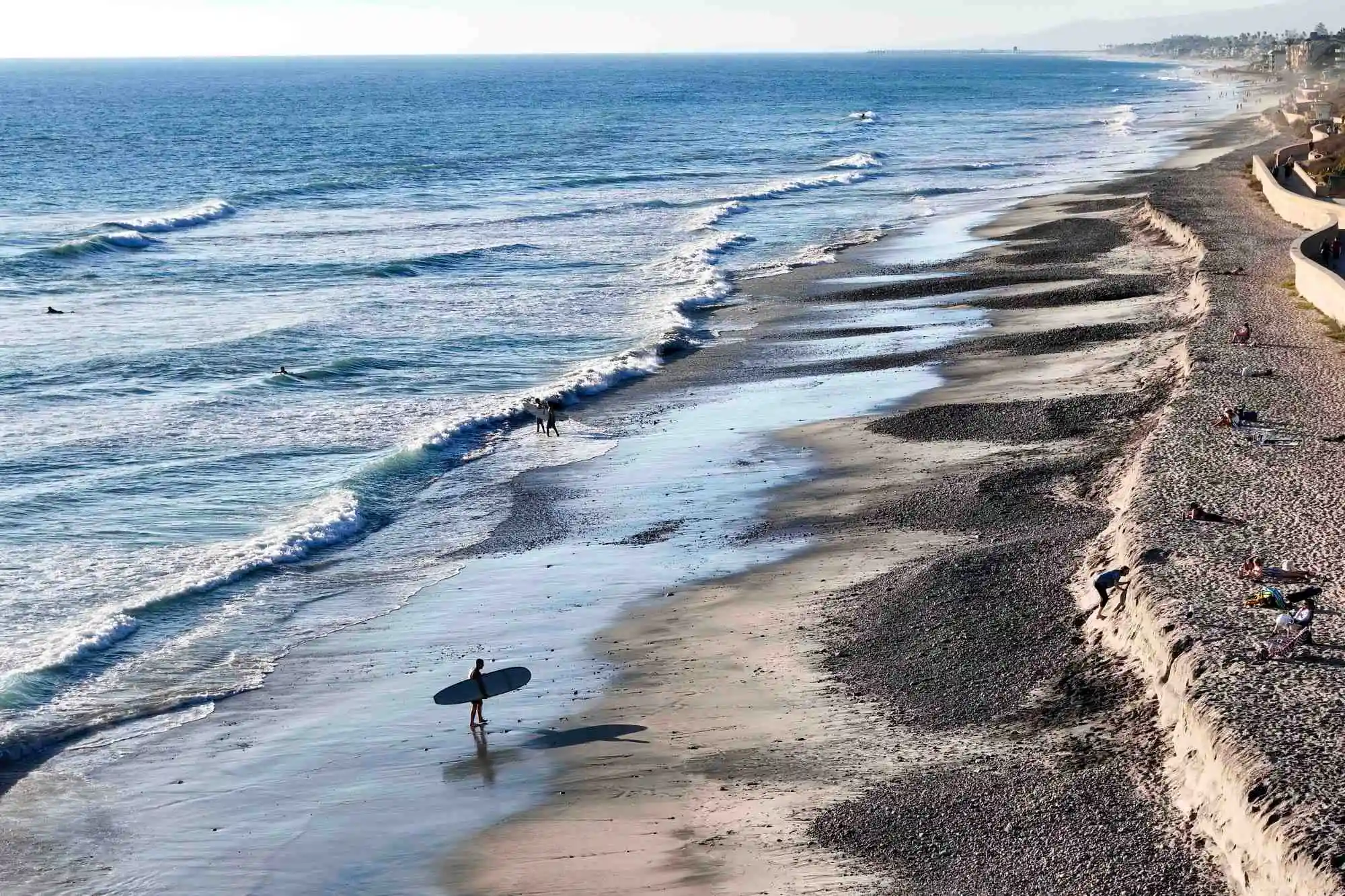
Erosion is nothing new on North County beaches, but the situation at Carlsbad’s Tamarack State Beach is being met with disbelief.
Read more Trump administration scrubs data on gender-based bullying from school civil rights survey
Marti Chalk, who said she lives within walking distance of the popular stretch of coast south of the Carlsbad Village district and north of Agua Hedionda Lagoon, said the severe damage that weeks of big waves have done to the sand supply has been surprising, especially the additional pounding last week that pushed the California Parks Department to close Tamarack’s parking lot on Friday, Aug. 28.
“I’ve lived here for four years, and I’ve never seen it like this,” Chalk said. “The surfers love it, but having the parking lot shut down, that’s just crazy.”
Waves driven by tropical disturbances in the South Pacific have kept larger-than-normal sets rolling in week after week, and that heavy action, while an absolute delight for surfers, has been hard on sea-level infrastructure.
What started with stripping the beach down to its cobblestones has gradually penetrated deeper. Bluffs in the area are protected by a thick concrete seawall, but the lot is shielded by riprap boulders, providing a shorter and more-permeable line of protection.
“The loss of sand, combined with tides and wave action, has caused the riprap to slough westward onto the beach,” the state parks department said in a statement.
With more high surf predicted for Labor Day weekend, it is not clear when the popular lot might return to service.
“State Parks is consulting with coastal engineers to evaluate potential solutions to reopen the parking lot to vehicles while minimizing further damage,” the parks statement said. “The department is also coordinating with the California Coastal Commission regarding engineering treatment options and permit requirements.
“There is no estimated timeline for reopening at this time.”
Carlsbad, noted City Manager Geoff Patnoe in an email Wednesday, is unable to take action on its own as Tamarack is part of Carlsbad State Beach.
“The City of Carlsbad does not have authority to lead the response or make repairs there,” Patnoe said. “As we monitor this natural phenomenon, we’re staying in close contact with State Parks regarding the conditions of their property.
“The State has not yet indicated to us (that) they view this as an emergency situation; however, we are ready to collaborate with the State should they request our assistance.”
Read more Watchdog report: Ex-Labor Secretary Chavez-DeRemer oversaw hostile work environment, misused funds
It is clear, as a partially torn paper sign glued to the Tamarack seawall attests, that not everyone considers the erosion damage a crisis.
“Locals that have lived and surfed here every day for 40, 50, 60 years are so glad to see Tamarack Surfing Beach return to its natural cobblestone state,” the sign reads.
Noting that there remains plenty of sand south of the jetties that protect Agua Hedionda’s inlet, the message’s unsigned authors point out that sea walls have known environmental consequences and that “Mother Nature always wins.”
Adam Young, a coastal process and erosion researcher at UC San Diego’s Scripps Institution of Oceanography, said that wave action from the south appears to have pumped up the usual process of “longshore” sand transport, which gradually pushes grains in the opposite direction.
A survey of the beach mid-August, Young said in an email, showed that swells appear to have pushed sand to beaches in north Carlsbad and south Oceanside.
“The pattern observed recently with summer erosion at Tamarack and accretion at the north end of Carlsbad has also occurred in previous summers, but the signal is much stronger this summer, probably because of the higher-than-normal seasonal south swell energy,” Young said.
Why Tamarack and not other nearby beaches? Nearby jetties are known to affect sand transport along the coast, and the specific underwater shape and makeup of individual beaches — called bathymetry — is also known to play a major role in which areas lose sand and which are better at retaining their grains. Young said more study is necessary to better explain Tamarack’s summer bareness.
Another sand-migration pattern called “cross-shore transport” is also known to suck sand more directly out to sea when big waves, with more energy, arrive. Does Tamarack’s current field of cobbles indicate that a significant amount of tonnage got Hoovered right out past the surf zone?
“While we think a lot of sand moved north from Tamarack, it is possible some moved offshore too,” Young said. “But we don’t have any offshore data to confirm it.”
More data is in the offing. Young said that Scripps intends to conduct a fresh survey at Tamarack next week.
Read more US issues sanctions on Turkish bank that it calls a ‘critical financial lifeline’ for Iran