



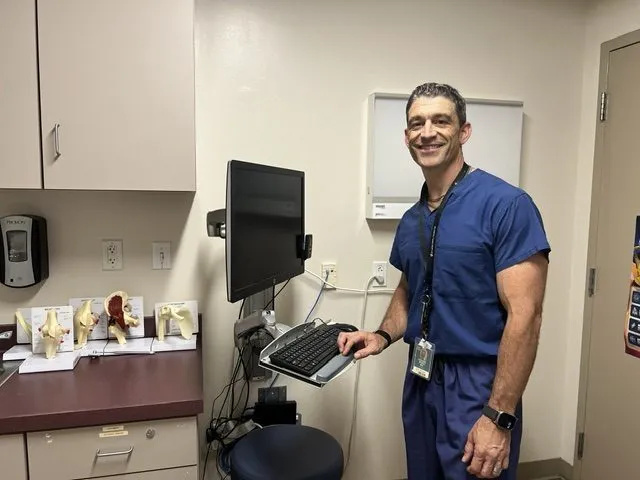
Encinitas resident Dr. Greg Mundis, an orthopedic surgeon with Scripps Clinic, is never too busy to help others. Recently, he won a national humanitarian award for his extraordinary volunteer work.
Read more San Diego judge sentences central figure in NAVWAR bribery scheme
Given his background, this is not surprising.
Born in 1977, Mundis was raised in Austria, along with his sister. Their father was a missionary for the Assemblies of God church, and their mother taught English. As a missionary family, they represented the church overseas.
“My parents lived their lives focused on just serving others,” Mundis said. “I was always challenged to pursue God’s will more than pursue the next shiny thing.”
He grew up wanting to become an architect because he loved drawing, painting and creating.
However, that changed in 1993 when the family traveled to a poverty-stricken area of India for missionary work and visited a charity hospital.
“There are moments in life when you see things that are imprinted into you and this was one of them,” Mundis said. “A sea of people living in boxes, many children, people staying warm with burning tires, a wretched smell.
“At the hospital, we volunteered to help with the feeding program. I don’t know how many thousands of people were in line, but that was their only meal that day. The despair. The children. It affected me. I was a 16-year-old boy scooping rice in tears.”
He left the experience wanting to get into the medical field to help people.
After graduating high school in Vienna, he attended college in Missouri and worked full time at a hospital hoping to learn about the medical field. His goal was to find a way to work in the emergency room.
He began as an aide transporting patients to radiology. Then he advanced to drawing blood. Finally, he became a technician assigned to the emergency room where he first saw “bone doctors.”
“Every time bone doctors showed up, I knew it was going to be exciting,” he recalled. “Taking bones and setting them. They had the craziest injuries they had to manage.”
Read more Judge orders return of deported Oceanside resident and father of former U.S. Marine
He decided he wanted to become one.
After graduating college, medical school and completing a residency program, Mundis came to San Diego in 2009 as a “bone doctor,” an orthopedic surgeon specializing in complex spine reconstruction. And, in 2014 he began working at Scripps Clinic.
Throughout his career Mundis never forgot his original motivation.
While in college, he traveled to Nicaragua to assist a volunteer medical team. While in his residency program, he traveled to a rural area of China with a medical team. As an orthopedic surgeon, he led volunteer medical teams to multiple locations in Mexico, Columbia, Brazil, Ethiopia, Nepal, Kenya, Uzbekistan and Ghana.
During his trips, he performed hundreds of complex surgeries like one involving a 14-year-old girl living in Monterrey, Mexico.
“With a deformity in her back, she was bent over,” Mundis recalled. “She needed a big operation to remove two vertebrae from her back. Very risky around the spinal cord. And then we had to put it all back together. The surgery was successful. She was so grateful. I teared up as I have done on every trip.”
For his volunteer work abroad and in San Diego volunteering in pediatric surgery, Mundis was awarded the American Academy of Orthopedic Surgeons 2026 Humanitarian Award, stating “Dr. Mundis is a living example of what it means to be a true humanitarian.”
In addition to some 300 surgeries a year, Mundis teaches new surgeons at Scripps’ residency program and is part of Scripps Clinic’s research team, which typically has 50 active projects at any one time. The team publishes over 35 papers annually and has had breakthroughs in areas vital to surgery planning.
“I am so privileged to be a surgeon,” he said. “Patients consent for us to open their bodies to fix problems. That is something I don’t take lightly. A lot of planning and design goes into surgery.
“In fact, being a surgeon is very much like being an architect,” he added, referring to his childhood dream. “I call myself a human architect.”
About this series
Goldsmith is a Union-Tribune contributing columnist.
We welcome reader suggestions of people who have done something extraordinary or otherwise educational, inspiring or interesting and who have not received much previous media. Please send suggestions to Jan Goldsmith at [email protected]
Read more Trump pushes 2030 census to exclude immigrants, not ask about race