








San Diego’s pension board has narrowly rejected a proposed policy change that would have helped the cash-strapped city avoid budget cuts by shrinking its annual pension payment by more than $30 million.
Read more Supreme Court to decide whether to hear Maine lobsterman’s challenge to GPS boat tracker requirement
The proposal, which the pension system’s actuary called reasonable and financially sound, would have increased the system’s unusually conservative estimates of how fast its investments will grow in the future.
Those estimates are key to determining the annual pension payment, because a crucial part of the city’s long-term plan for paying billions in pension benefits is that its investments will significantly grow in value.
The pension board considered increasing the annual growth estimate for its investments from 6.5%, which is among the lowest in California and the nation, up to 6.75%.
The move would have shrunk the city’s pension debt by roughly $375 million, from $3.46 billion to less than $3.1 billion. The city’s annual pension payment due next July, now estimated at $573 million, would have become about $542 million.
But the impact would have gone beyond one year. The new policy would have created $30 million in savings year after year, reducing the annual payment more than $300 million cumulatively over the next decade.
The proposal comes during a bull market on Wall Street that has seen stocks surge in recent months and years.
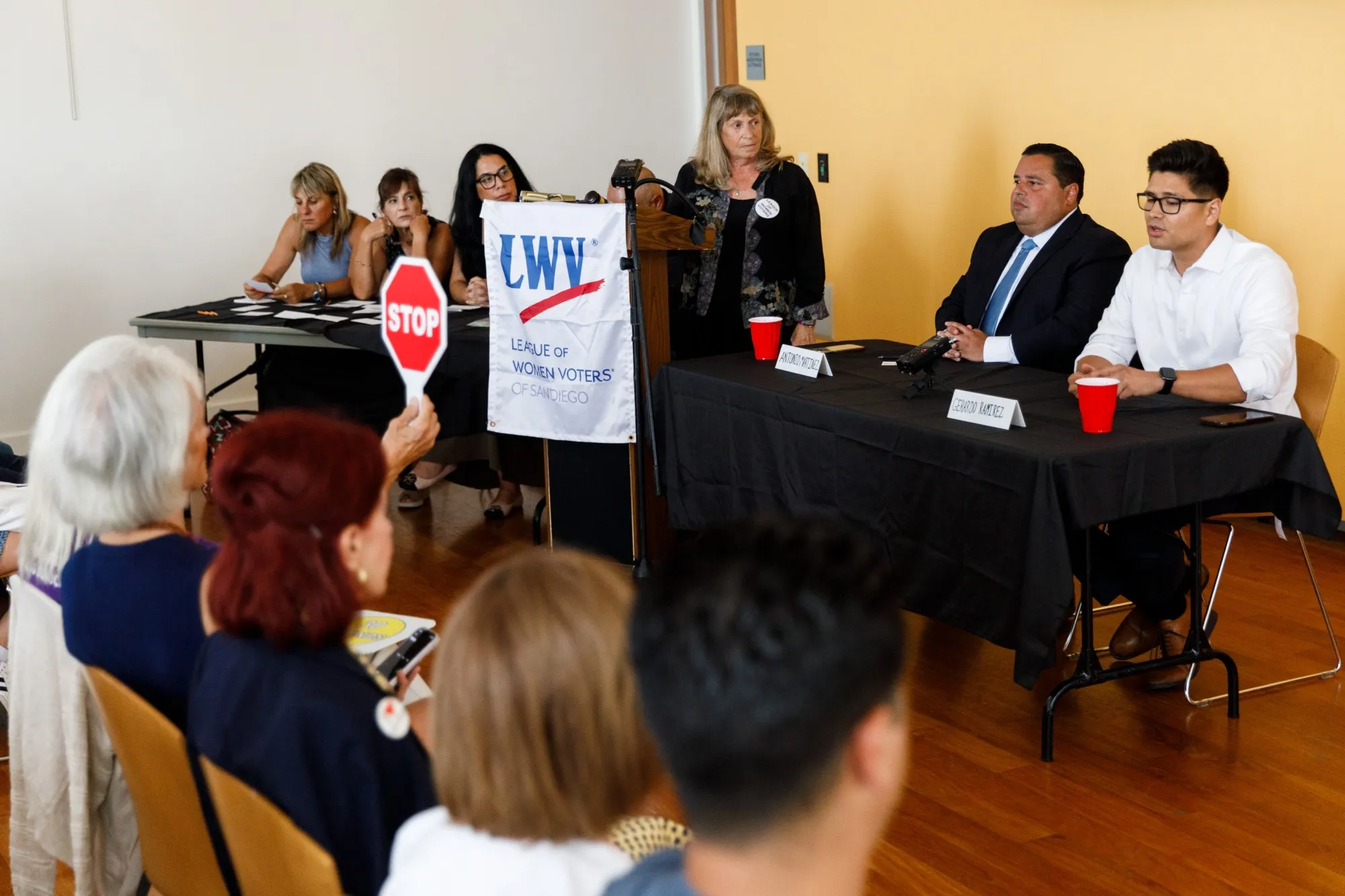
The board actually voted 6-4 in favor of the policy change on Friday, but it fell just short of approval because seven “yes” votes were required.
Trustees in favor called the proposal sound and reasonable, while those opposed stressed the value of a conservative approach and the uncertainty of the future.
San Diego got nicknamed “Enron by the Sea” two decades ago for a pension underfunding scheme, a scenario the pension board has vowed to never repeat.
Trustee Chris Brewster praised the policy change, stressing that the pension system’s investments have grown at a rate of 7.4% in recent years and are projected by investment consultants to grow by 7.5% in the future.
Brewster also contends the existing policy is unfair to current taxpayers, forcing them to overpay and allowing future taxpayers to benefit when investment returns end up outperforming the city’s 6.5% estimate.
“They should pay what they owe, but we should try to ensure they don’t pay more than they need to,” Brewster said. “I think it’s time to recognize we went a bit too far going down to 6.5%.”
He’s referring to the city incrementally shrinking its investment estimate – formally called a “discount rate” – from 8% to 7.75% in 2009, to 7.5% in 2012, to 7.25% in 2014, to 7% in 2017 and to 6.5% in 2019.
That 6.5% rate is in the bottom quarter of pension systems nationally and near the bottom in California. Of 39 pension systems in the state, 32 use a higher rate, two use a lower rate, and four others also use 6.5%.
Read more Protect College Sports Act gets renewed push and fresh opposition as college football returns
The pension system’s actuary, Gene Kalwarski, told the board that any investment rate between 6.25% and 7% would be “reasonable” and financially sound.
“There are sound reasons to consider raising the discount rate, and there are sound reasons to maintain it,” Kalwarski said.
He also agreed with Brewster that an artificially low rate can create injustice that he called intergenerational inequity.
“You don’t want one generation of pension system members and taxpayers subsidizing a subsequent generation, or vice versa,” Kalwarski said.
But four members of the board voted against the proposal.
“There have been years when this board has made some very significant decisions that did not turn out well,” said Trustee Roberta Spoon, almost certainly referring to the Enron-by-the-Sea scandal. “I am a strong advocate for leaving it right where it is.”
Trustee Paul Kaufmann said the growing national debt, uncertainty about the future of artificial intelligence, and other factors made him skeptical.
“Macroeconomics and the political situation are certainly unsteady at best,” he said.
Board President Lisa Marie Harris stressed that the future is uncertain.
“It’s not about being right or wrong, it’s about being reasonable,” she said. “And that’s what we need to be focused on, because there is no crystal ball.”
The debate about the pension system’s investment estimates came up during discussion of a comprehensive, once-every-three-years analysis of the system’s assumptions and policies.
That analysis covers everything from investment estimates to future salary hikes for workers with pensions to how long employees will live after retirement.
In some good news for the system, the analysis determined that the system has been slightly overestimating how long people will live and how quickly workers will retire after becoming eligible.
Those findings and some others will lower the pension debt by $122 million, shrinking the city’s annual pension payment by $11 million next July.
Even without those changes, the city’s annual payment next July is expected to be less than the $573 million estimated last March. That’s because the stock market has done better than expected since then, requiring a smaller city contribution.
Read more States, cities sue over Trump rule seeking to deny green cards to immigrants using public benefits
The new payment will be announced in January.