








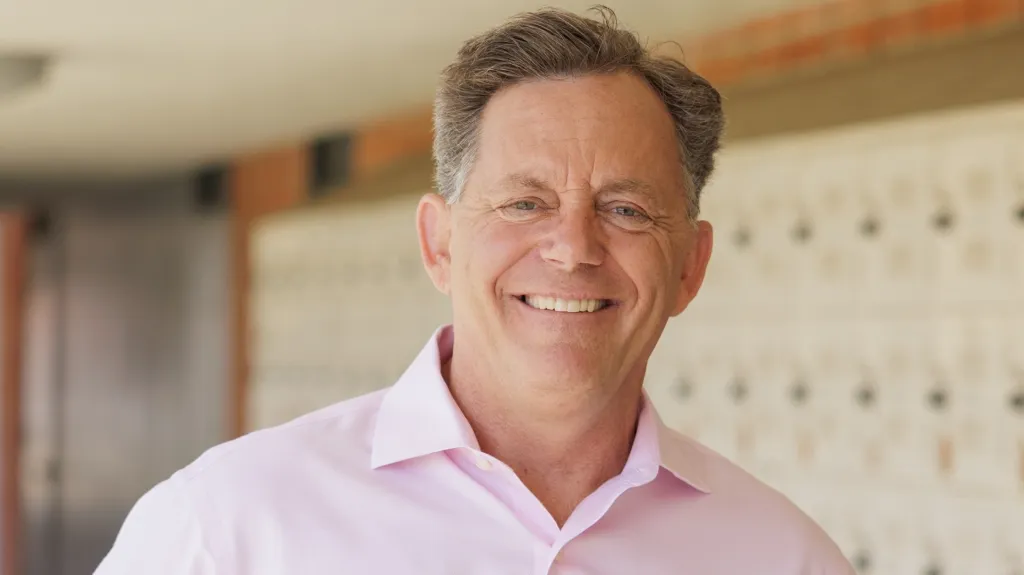
Josh Newman, 61, a former Democratic state senator, is running for California state superintendent of public instruction.
Read more Q&A: Meet Sonja Shaw, candidate for California state superintendent of public instruction
Originally from Poughkeepsie, New York, Newman lives in Fullerton and is a senior fellow at the UC Irvine School of Social Ecology. The job he’s running for is considered nonpartisan.
The San Diego Union-Tribune emailed a series of questions to Newman and other candidates to help inform voters about their positions, priorities and plans if elected.
Newman said he used AI tools to edit and proofread his responses to the Union-Tribune’s questions.
1.) Why are you running, and what makes you the best candidate? (150 words max)
I’m running for state superintendent of public instruction because too many California kids are being let down by a system that should be working for them. I know why, and I know what needs to be done.
As chair of the state Senate Education Committee, I spent years learning this system from the inside: where the money goes, where state mandates conflict, where accountability breaks down and where innovation is sorely needed. I advanced legislation and secured major investments but came to realize that the reforms California’s students need aren’t going to happen in a committee room. They’ll require someone in the superintendent’s office willing to take on the hard work of aligning a massive, decentralized and underperforming system around honest priorities and rigorous goals.
That kind of leadership has been missing from the office. I intend to change that, by bringing focus, urgency and accountability to deliver real results for students and families.
2.) What are the top 3 issues facing schools and students in San Diego County? (150 words max)
San Diego County’s schools and students are facing three urgent challenges:
First, academic achievement, especially in early literacy and math proficiency, are far too low. Fewer than half of students are meeting grade-level standards, with even wider gaps for Black and Latino students. We need evidence-based reading instruction, universal early screening and a stronger teacher pipeline in math, science and literacy.
Second, chronic absenteeism is harming learning. Nearly one in four students is missing substantial classroom time, often because school schedules don’t match the realities of working families. Expanding before- and after-school programs, improving transportation and strengthening mental health supports are essential to getting students back in class.
Third, too many students are leaving school without a clear path to college or careers. Students need stronger career pathways: more dual-enrollment opportunities, deeper partnerships with community colleges and apprenticeship programs and expanded career and technical education in high-demand fields.
3.) What are the first 3 things you would do in office if elected? (150 words max)
First, I would set three statewide priorities — literacy, attendance and career readiness — and align the Department of Education, county offices and districts around them. That would entail clear goals, transparent data and real accountability measures. California’s schools won’t improve outcomes without shared priorities and honest measurements of progress, along with energetic, focused leadership willing to hold the system accountable.
Second, I would launch an early literacy initiative focused on evidence-based instruction, universal screening and stronger preparation, along with expanded support for teachers in reading, math and science. That includes pushing for high-quality curriculum adoption and expanding coaching and residency programs to build the teacher pipeline we need.
Third, I would develop a statewide strategy to reduce chronic absenteeism and improve student engagement by expanding before- and after-school programs, improving transportation, strengthening mental health supports and working with districts to better align school schedules with the pressing realities of working families.
4.) What experience do you have in the classroom and in other education roles, and how have your professional experiences prepared you for this role? (150 words max)
I’ve worked in education both inside classrooms and at the systems level.
As a young Army officer, much of my work involved instruction and training oversight: designing lessons, coaching soldiers and ensuring mastery of essential skills, experiences that shaped my approach to teaching, leadership and accountability.
Early in my post-service career, I taught in San Francisco as a substitute teacher and civics instructor, gaining firsthand experience with curriculum, classroom management and the daily realities teachers face. More recently, I’ve taught an undergraduate course on state politics at UC Irvine, giving me valuable insight into what students truly need for college, careers and civic life.
My most extensive education experience came as chair of the state Senate Education Committee, where I worked with educators, visited schools across the state, helped shape major legislation and came to understand both the promise of our classrooms and the urgent need for system-level reforms.
5.) What input do you believe the state superintendent and department should have into classroom instruction in California schools? (150 words max)
Families shouldn’t be left to wonder whether their child is getting a quality curriculum and strong instruction. The state superintendent shouldn’t dictate every lesson, but the office should set clear, practical standards for what high-quality curriculum and teaching look like in every California classroom. Right now, quality from district to district varies far too widely, and that inconsistency is harming students and achievement overall.
The superintendent and the California Department of Education should ensure all schools use materials and instructional practices backed by evidence, especially in reading and math, and require universal early screening so that parents know early if a child needs additional supports. Districts would still choose their own curricula, but within guardrails that guarantee a solid foundation for every student. The state’s role should be to give teachers the tools and training they need, reduce confusion and make sure every child in every district gets strong, reliable instruction. Students deserve nothing less.
6.) How will you ensure access both to career and technical education and to higher education, including ensuring students who pursue career-oriented education now can attend college later in life? How will you ensure equitable opportunities for rural, suburban and urban students? (150 words max)
Every California student should graduate with a real plan — for college, career or both — and access to a system that keeps those doors open throughout their lives. Dual enrollment programs that allow students to earn college credit and certifications while in high school (something I worked on while in the state Senate) should be expanded further. I would also deepen partnerships between school districts, community colleges and high-quality union apprenticeship programs to create clear, affordable pathways into high-demand fields.
To support lifelong learning, we need flexible “earn-while-you-learn” models and better-connected credit and certification systems that allow career-oriented students to pursue new career pathways later without starting from scratch. A student’s ZIP code should never determine their opportunity. Schools and training should be meeting communities where they are: Rural districts need funding adjustments, broadband and regional collaboration, while suburban and urban districts need stronger facilities, transportation and expanded learning supports.
Read more Q&A: Meet Rick Shea, candidate for San Diego County Board of Education in District 5
7.) In light of federal immigration crackdowns, funding cuts and rollbacks to civil rights protections and oversight, how can California better serve vulnerable student populations, including those who are immigrants, are LGBTQ+ and have disabilities? (150 words max)
Every family deserves assurance that their children will be safe, supported and respected at school. In this moment of federal crackdowns and civil-rights rollbacks, California must step up for its most vulnerable students.
First, schools must remain safe places for immigrant families. That means clear, consistent enforcement of California’s protections: limits on immigration enforcement on school campuses, confidentiality on student information, and rapid response systems for when federal actions create fear. No child should fear coming to school.
Second, we must strengthen services for students with disabilities. Families deserve timely evaluations, high-quality IEPs (individualized education programs) and accountability when districts fall short. The state should provide stronger oversight, more training for educators and better support for small and under-resourced districts.
Finally, LGBTQ+ students deserve schools where they’re safe, seen and respected. The state must enforce existing protections, ensure inclusive school climates and make clear that harassment and discrimination have no place in classrooms.
8.) What role should technology play in the classroom? Where do you stand on screens in school, cell phone bans and the use of generative AI? Please be specific. (150 words max)
New technologies should support learning, not replace it. In many schools, the pendulum has swung too far toward constant screen use, which can undermine attention, deep thinking and social development. A more balanced approach is needed which prioritizes strong instruction, reading and hands-on learning, with technology used intentionally rather than as a “silver bullet.”
I support banning cell phones during the school day. The research is clear: Smartphones are a major distraction, fuel social-media harms and make it harder for students to focus and feel safe. Schools that have implemented bans report better focus and improved student wellbeing.
With generative AI, the question isn’t whether students will use AI, it’s about preparing them to use it well. AI should be integrated thoughtfully to enhance learning, support teachers and build skills students will need in a world where AI will be everywhere, while maintaining strong safeguards for privacy, accuracy and equity.
9.) School districts across San Diego County are struggling to improve attendance and reverse declines in enrollment. What should the state superintendent and department do to help? (150 words max)
Improving attendance and stabilizing enrollment requires meeting families where they are and making school a place students want and are able to be every day. Continued expansion of Expanded Learning Opportunity Programs offers real promise for addressing this critical issue. Well designed and well-run before- and after-school programs have been shown to improve attendance, strengthen academics and give students a sense of belonging.
Expanding ELO-P should be part of a larger statewide priority to help districts better align the school day with the workday across the entire year. Too many families are forced to patch together childcare, and students pay the price in missed days and learning loss. As superintendent, I will spearhead a statewide effort to modernize schedules and expand enrichment. Also needed are better transportation, mental-health supports and early outreach to families. When barriers are removed and students feel safe, supported and engaged, both attendance and achievement improve.
10.) Independent reports have raised concerns about confusion and conflicts over who is ultimately accountable for education in California. In part to remedy this, Gov. Gavin Newsom has proposed reducing the power of the state superintendent by moving control of the Department of Education to within the governor’s office. Do you support this effort? Why or why not? How else can accountability at the state level be improved? (150 words max)
I oppose the pending proposal to shift authority over the Department of Education from the state superintendent of public instruction to a gubernatorial appointee. Consolidating control in the governor’s office might improve alignment on paper, but it’s highly unlikely to deliver it in practice, while sacrificing what California’s public education system needs most: independent, dynamic leadership capable of convening districts, educators and communities around shared goals.
The accountability problem in California education is real. But the answer to it isn’t fewer voices at the table, it’s better leadership and clearer priorities. A strong, independent superintendent could work with the Legislature and the next governor to cut through fragmentation, set a coherent agenda and align the system in ways a department buried inside the governor’s office won’t. Real accountability comes from transparent goals, honest data and a superintendent willing to name what isn’t working, and not from simply rearranging the boxes on an org chart.
11.) If the state superintendent role were changed before you took office, how would the changes affect your approach to the job? How would you continue to advocate for students? (150 words max)
If the role were diminished before I took office, I wouldn’t treat that as an excuse to lead small. The superintendent’s platform, relationships and public voice don’t disappear with a reorganization — and I would continue to use every tool available to advocate for students and push for real reform.
That would mean using the “bully pulpit” to set an agenda, holding the system publicly accountable and working directly with districts, educators, families and community organizations to drive change from the ground up. It would also mean being a relentless advocate with the Legislature and the governor for the resources and reforms students need.
Ultimately, the students and families of California need a champion in that office regardless of its formal authority. I’d show up every day and fight for them, leveraging my legislative experience, my deep relationships in Sacramento and across the state and every other tool at my disposal.
12.) What should the California Department of Education’s and the state superintendent’s role be in conducting oversight of districts and charter schools’ compliance with state laws? Do you think anything should change about the way the state conducts oversight?
The state has a responsibility to ensure that every school district and charter school follows the law and uses public dollars responsibly. Too often, oversight has been slow, fragmented and reactive, allowing financial crises and scandals like A3 in San Diego County to develop long before the state intervened.
The superintendent and the California Department of Education must play a stronger, more proactive role: earlier monitoring of district finances, clearer expectations for long-term budgeting and faster intervention when warning signs appear. For charter schools, authorizers need better training, stronger accountability and clear consequences when they fail to act.
Stronger oversight will ultimately require legislative action. Last year’s efforts, SB 414 and AB 84, fell short, but the need hasn’t gone away. As superintendent, I would be the key convener and driving force behind a renewed legislative push to give the state the tools it needs to protect students and taxpayers before problems become crises.
Read more Q&A: Meet Gus Mattammal, candidate for California state superintendent of public instruction