






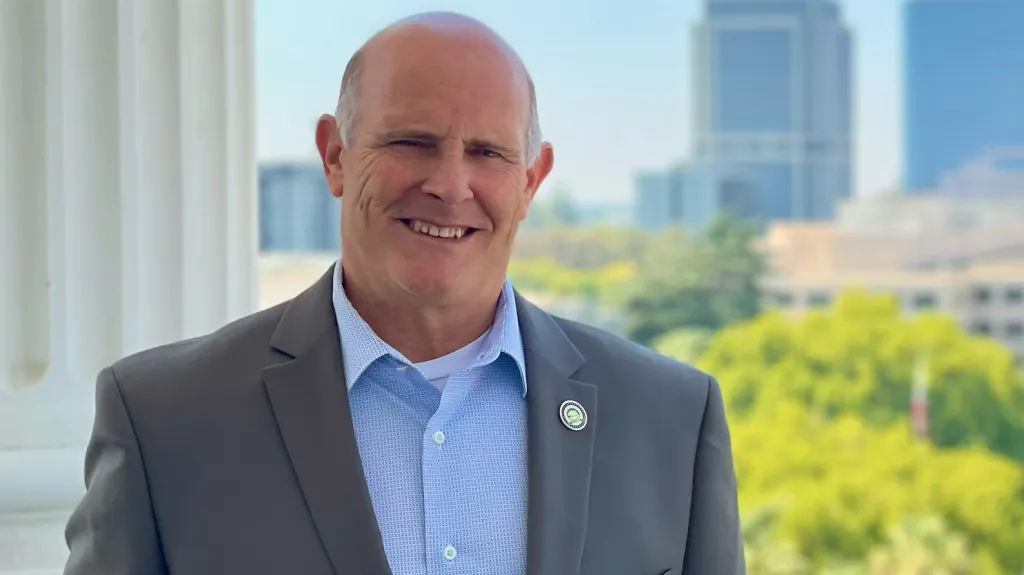
Kelly Seyarto, 66, a Republican and incumbent state senator, is running for re-election to represent the San Diego County backcountry and portions of the Inland Empire in District 32.
Read more Q&A: Meet Dr. Tiffanie Tate, candidate for California State Senate District 32
Originally from the San Gabriel Valley in Los Angeles County, Seyarto is a longtime resident of Murrieta.
The San Diego Union-Tribune emailed a series of questions to Seyarto and other candidates to help inform voters about their positions, priorities and plans if elected.
Seyarto said he did not use any AI tools in responding to the Union-Tribune’s questions.
1) Why are you running, and what makes you the best candidate? (150 words max)
I am running because our region needs an advocate who is experienced and knowledgeable in addressing the issues unique to this district. I bring a combination of professional and life experience that is much needed in today’s Legislature. My 35 years in the fire service have made me well informed in public safety matters, while my 13 years as an elected official in local government provide a deep understanding of the myriad challenges facing our communities and the interactions between local, state and federal governments. In addition, my education — including a masters in public administration — has given me a strong foundation in government programs, processes and budgeting. Combined with my knowledge of the district, statewide issues and intergovernmental responsibilities, I am well prepared to effectively serve and advocate for our communities.
2) What are the top 3 issues facing this district? (150 words max)
Cost of living/affordability, healthcare and infrastructure are the top three issues facing this district.
The cost of living in California has been rising to levels that people simply cannot afford to absorb. Over-regulation, unrealistic mandates and costly policies have driven up housing, insurance, food, fuel, energy and waste removal, placing a heavy burden on families.
Healthcare is also on the brink of collapse. Access to care, especially emergency services, has become increasingly difficult. In rural areas, access is already extremely limited, and across the region, population growth continues to outpace available providers and facilities, making timely care harder to obtain.
Our infrastructure is not keeping up with the growth being forced into our region by the state. This is reflected in worsening traffic congestion, flooding in some areas and growing concerns over water supply and long-term reliability, while local agencies receive little support to meet these demands.
3) What are the first 3 things you would do in office if elected? (150 words max)
First, I would continue to work with my staff to develop a thoughtful and effective bill agenda for the coming legislative session based on the needs of our district. This includes identifying priorities, drafting legislation and ensuring we are prepared to advocate for meaningful solutions.
Second, I would engage with stakeholders across the district to better understand their needs and challenges. By maintaining open communication with community members, businesses and organizations, we can ensure our office is responsive and ready to act when opportunities arise.
Third, I would meet regularly with local government agencies to understand their goals and identify where the state can be a helpful partner. Building strong relationships with local leaders allows us to better coordinate efforts and support our communities effectively.
4) What should California do to solve its shortage of affordable housing and curb homelessness? Which existing efforts do you believe are working, and which aren’t? (150 words max)
California must address housing affordability by focusing on supply and demand while reducing regulatory barriers that continue to drive up costs. We need to stop creating new regulations that make housing more expensive, fix the insurance crisis and work with local governments to streamline approval processes. Much of the delay in housing development is driven by state requirements, and meaningful CEQA reform, not piecemeal changes, is necessary to remove outdated barriers.
At the same time, the state’s approach has placed too much emphasis on high-density housing, often limiting local input and failing to account for infrastructure impacts. A more balanced approach that reflects community demand is needed.
On homelessness, after spending over $24 billion while homelessness continues to increase, it is clear current efforts are not working. We must address mental illness more directly and ensure individuals receive treatment while improving accountability for how resources are used.
5) This district and its neighbors are vulnerable to climate change impacts like wildfires, rising seas and extreme heat, and to the health effects of climate-warming emissions. What should California do to improve climate resilience and reduce emissions and fire risk? (150 words max)
California should focus on mitigation measures that help people better cope with changing weather patterns. We need abundant and reliable energy supplies and more attention to where community growth is encroaching into high-hazard brush areas. Our public safety departments must have the resources they need to respond to emergencies, and our utilities must be produced and distributed in a way that ensures access at a manageable cost.
In the 32nd District, the impacts related to our climate are most often heat- and wildfire-related. Extreme policies and regulations have proven to be ineffective and cost prohibitive. We need reliable energy sources, and I prefer a more reasonable approach that favors a variety of energy sources. With the wildfire issue, which is my area of expertise, we need to ramp up prevention, response and recovery efforts and fix the insurance issue throughout California.
6) Laws enshrined in California’s Constitution that protect residents from tax increases have also painted local governments into a corner as they seek to fund basic services and have led to chronic underfunding of schools. What would you do about this? For instance, would you support changes to Proposition 13 to remove its protections for commercial properties? (150 words)
K-12 schools in California are not underfunded. With the coming year’s Proposition 98 allocation estimated at $138 billion, it is hard to believe we are not investing enough in education. That amount exceeds nearly every other state’s budget, yet we spend more per pupil while ranking near the bottom in performance. Something is wrong, and it is not revenue-related.
When teachers are forced to buy their own classroom supplies while school budgets continue to rise every year, something is clearly not working. Pouring more money into a system without identifying the problem will not fix it.
Read more Q&A: Meet Tasha Boerner, candidate for California State Assembly District 77
The same issue exists across our public agencies. We are paying more taxes than any other population in the nation, yet it’s never enough. We have a spending and priorities problem, not a revenue problem. I do not support weakening Proposition 13 or raising taxes. Taxing citizens even more is not the answer.
7) In light of those constraints, along with federal funding cuts, how should California balance its budget and fund basic services? Where would you seek new revenues or savings? (150 words)
To balance our budget, we need to do what every responsible person, business and agency does: stop spending more than the amount taxpayers provide. We do not have a revenue problem; we have a priorities and spending problem. When faced with a deficit, you don’t add costly programs beyond the capacity of your budget, yet that is exactly what the state has done.
That means we cannot continue creating programs or offering services we cannot afford.
Medi-Cal spending alone is expected to reach $223 billion this year, and the federal share has increased. At the same time, California must address the growing issue of fraud, which is likely diverting billions from their intended purpose.
This is not to say we should stop investing in worthwhile programs, but we must have more oversight and accountability. When billions are spent and outcomes do not improve, that is a problem we must fix.
8) Speaking of spending, Californians consistently rank the cost of living as a big concern. Recent jumps in the costs of fuel, food and other goods — combined with federal cuts to safety-net programs, new limits on certain federal loans and more — are further squeezing residents who were already struggling. What relief would you seek to offer, and how? (150 words max)
Residents are being squeezed by California government. Unrealistic climate goals, energy transition mandates, and other economically damaging regulations are driving up the cost of fuel, food, and everyday goods. Many younger residents are choosing to leave the state to raise their families elsewhere.
To address affordability, we need to be honest about what state government has done over the past 20 years. That means repealing costly legislation tied to energy transition goals and replacing it with a more realistic plan that puts affordability first. We have too many state agencies creating mandates that are wreaking havoc on our citizens’ lives.
Draconian mandates and regulations forced on us by unelected and unaccountable activists appointed to our state regulatory agencies need to be reeled in, and the economic effect of solutions generated by these agencies must have more consideration. We need to pause and re-evaluate our approach to better serve our citizens.
9) President Trump has made cracking down on immigration a cornerstone of his administration, ordering widespread arrests and detentions of immigrants nationwide and directing military resources to a new military zone along the U.S.-Mexico border. What impact have these actions had on this district? What are your goals on immigrants, immigration and the border, and how would you pursue them in the Legislature? What is your message to constituents who are immigrants? (150 words max)
The framing of this question highlights the problem regarding this topic. My goals on immigrants are the same goals I hold for everyone else: I want them to be successful. People understand the important role that immigrants have had in shaping America and generally have a great deal of compassion for people who want to come to the United States to seek a better life. Lawful immigration is not controversial. Unlawful immigration is.
It is the federal government’s job to enforce our immigration laws. California’s obstructionist approach makes it difficult and dangerous for unlawful immigrants committing serious crimes to be detained and deported. A clear, safe and legal process must be established so that those who want to come to this country do so the right way, not by bypassing the law. California should work with the federal government to help in that process.
10) Health care costs for many Californians are rising — some because of new federal eligibility requirements, some because of Gov. Gavin Newsom’s moves to limit Medi-Cal coverage for some immigrants. How would you rein in costs? Would you vote to reverse the governor’s cuts to immigrant health care coverage? (100 words max)
The healthcare issue is complex, but costs must be addressed through accountability and sustainability. California regulations that drive hospital and medical center costs should be evaluated, and the industry must improve internal efficiencies to reduce prices. On the insurance side, reimbursements must reflect actual costs without driving unaffordable premiums.
Medi-Cal for All has proven to be unsustainable, contributing to a fiscal crisis that must be addressed. We should never have put ourselves in this position in the first place. The governor’s actions to curb costs reflect that reality. I would not reverse these changes without a clear, sustainable funding source.
11) Among the many ballot measures being pursued by lawmakers and citizens for the November ballot are a handful that have drawn much attention and money. Should each of the below measures qualify for the November ballot, would you personally vote for measures that would do the following? (50 words max per measure)
— make ride-hail companies like Uber and Lyft liable for sexual assaults committed in cars?
No. This is another attack on Uber and Lyft. Individuals who commit sexual assault must be held accountable for their actions, not the companies that provide rides.
— require voters to provide a government-issued ID each time they vote?
Yes. Voter ID is a simple and necessary part of ensuring election integrity.
— levy a one-time 5% wealth tax on people with over $1 billion in assets?
No. Wealth taxes are a bad idea. Read the fine print. They risk driving away taxpayers who already contribute significantly and open the door to broader taxation beyond the ultra-wealthy. Using one-time revenue to fund ongoing programs is not sustainable and creates bigger problems in the following years.
— pass $10 billion in bonds to fund affordable housing development?
I am generally opposed to bonds because they add debt and are oftentimes misused for programs instead of infrastructure. I am currently reviewing the current measure to better understand the long term outcomes and evaluating alternative ways of accomplishing the goals outlined in the bond.
Read more Q&A: Meet Antonio Salguero, candidate for California State Assembly District 78