







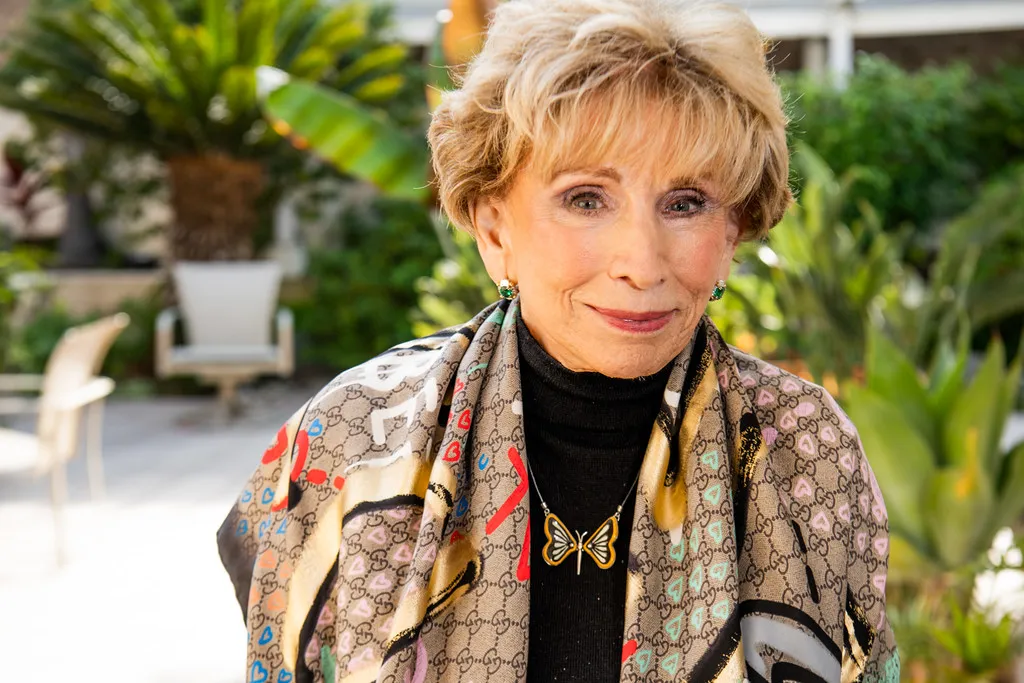
Like many a grandmother, Edith Eger loved to bestow kisses on her grandchildren, who knew to lean in with the top of their head. Rather than a peck on the cheek or forehead, “my mother always kisses the (children) on the head,” said Marianne Engle, Eger’s daughter. “This is what she always did. She kisses them and rubs their heads.”
Read more Two bodies found in Otay Valley Regional Park, but deaths appear unrelated
Engle went on to describe how at a Passover seder with her family in San Diego earlier this year, her mother finally revealed the meaning behind the gesture. “She said, ‘I want to tell you why I kiss your heads.’ Everybody stops. ‘The last Passover at my house, my father came and kissed our heads. And that night, at 4 in the morning, they came and took us away.’ ” It was 1944, and 16-year-old Edie, her parents, and a sister were taken from their home in Hungary by Nazis and put in a cattle car train to Auschwitz.
“You should have seen the looks on (the grandsons’) faces,” Engle said. “Talk about sitting with history, and what it must have felt like to her. It was an amazing moment. She must have known she was dying because she wanted them to know. Before, it had always been this sweet thing, ‘kiss your head, kiss your head.’ Suddenly, it had meaning. I just felt like it was the biggest gift she gave them.”
Eger — clinical psychologist, bestselling author, and Holocaust survivor — died April 27 at her home in La Jolla. She was 98.
Eger was well-respected in her field for her ability to help patients suffering from post-traumatic stress disorder, including working with the U.S. Army and Navy to treat combat veterans. Her path to healing others, as well as herself, did not come quickly or easily. Eger kept her traumatic experiences in Nazi death camps hidden for more than 20 years. Her own children did not know their parents survived the Holocaust. “She wanted to protect us, and she did,” Engle said.
Edith “Edie” Eva Elefánt was born Sept. 29, 1927, to Ilona and Lajos Elefànt in Košice, a town that was then in Czechoslovakia, and raised in Hungary along with her two sisters, Magda and Klara. At Auschwitz, Edie and Magda were separated from their parents, who were killed in the gas chambers almost immediately; Klara was hidden by her music teacher during the war.
Eger was a talented ballerina and gymnast, and while in Auschwitz she was ordered to perform for Josef Mengele, the notorious German officer known as the “Angel of Death.” Eger and Magda survived several camps, and were rescued by U.S. forces in May 1945 at Gunskirchen in Austria. Soon after the three sisters reunited in Hungary, Edie met Béla Eger while recovering at a tuberculosis hospital, and the two were married in November 1946.
Béla Eger faced pressure to join the Communist leadership, and so the young family planned their escape, ultimately choosing to give up all of their belongings to emigrate to the United States with their infant daughter in 1949. They spent time in Baltimore before heading west to El Paso, Texas, where they settled, raised a family, and Eger took life-altering steps to confront her past and forge her future.
In her 40s, she enrolled in the University of Texas, El Paso, earning a degree in psychology, followed by a Ph.D. from Saybrook University in Oakland. During her time at UTEP she started dealing with her trauma when a fellow student lent her a copy of “Man’s Search for Meaning” by Viktor Frankl, a psychiatrist and Holocaust survivor. “She always said that it was a pivotal moment,” said Katie Anderson, her longtime assistant.
While serving as a doctoral intern at William Beaumont Army Medical Center at Fort Bliss, Texas, Eger grew confident in the need to face her own trauma. “She said to herself, ‘I can’t take these soldiers any further than I’ve been and I need to confront this, too,’” Marianne Engle said.
Read more Motorcyclist killed in City Heights crash
Eger would return to Auschwitz. “She had to revisit the places she had been, relive the experience, and revise (her) life,” said Jordan Engle, Eger’s grandson and executive director of The Edith Eger Foundation. “That was the sort of therapeutic journey she would take people on. She said, ‘I had to go back. I had to go back to the lion’s den, look it in the face, and see that it no longer had a hold on me.’ ”
Along the way to becoming a bestselling author — Eger published her first book, “The Choice: Embrace the Possible,” in 2017, a few weeks shy of her 90th birthday — she taught high school in Texas and moved to San Diego in the late 1980s, setting up a clinical practice, holding a faculty appointment at UC San Diego, and embarking on countless speaking engagements around the world. She went on to write two more books, “The Gift: 12 Lessons to Save Your Life” and “The Ballerina of Auschwitz,” and continued seeing patients up until a couple of years ago, Jordan Engle said. All three books were bestsellers and award-winners. In addition, a documentary called “The Choice,” which is focused on Eger’s work with a mother whose son was killed by friendly fire in a case of mistaken identity, is scheduled to premiere May 30 at the Berkshire International Film Festival.
Beyond her expertise in helping people to confront and heal from trauma, Eger was known equally for her commitment to family and resilience, her ability to break out in a balletic high kick, her consistently elegant attire, her fondness for good food, and her affection for San Diego.
“She loved being a part of this town,” said Jordan Engle, adding that the foundation is based here and will continue to preserve her legacy. “Her love language was (someone) showing up with a plate of El Pescador sashimi and a cup of clam chowder for her.”
Whether she was moving gracefully through her home or speaking to a book group, Eger was eager to show off her dancer flexibility with a kick that brought her toes to her forehead. “She was doing kicks up until three months ago,” Marianne Engle said. “Even as she was in bed quietly fading away she would lift up her legs!”
Marianne Engle also shared that her mother made a lasting impression with everyone she met — including the queen of Sweden. In 2003, Engle’s husband, Robert, was awarded the Nobel Prize in Economic Sciences. The Engles, their children, and their mothers traveled to Stockholm for the ceremony. Security was tight, and the photo op with the Swedish monarchy and Nobel laureates was limited to immediate family — Robert, Marianne, their son and daughter. “All of a sudden I see my mother and my husband’s mother hand in hand, coming down (an aisle) … there were three levels of security and only my mother could talk her way past that,” Marianne Engle said. “And so there we were with the king and queen asking, ‘Do you want to meet our mothers,’ and they posed with the king and queen. We went again (to Stockholm) a few years later when a friend won a Nobel Prize, and the queen walks up to me and says, ‘How’s your mother?’ Only my mother could make that kind of impression.”
Eger is survived by her three children, Marianne Engle, Audrey Thompson, and John Eger; five grandchildren; and 10 great-grandchildren. She was preceded in death by her husband, Béla; sisters Magda and Klara; and her second husband, Mort Winski.
Memorial donations may be made to the nonprofit Edith Eger Foundation based in San Diego, which helps trauma patients.
Read more State DOJ reports overcrowding at Otay Mesa immigration detention center