





Two incumbents are defending their seats on the Chula Vista City Council in the Nov. 3 general election, with the winners of the District 1 and 2 seats set to serve four-year terms leading San Diego County’s second-largest city.
Read more Inmate dies in apparent suicide in Otay Mesa jail cell, sheriff’s officials say
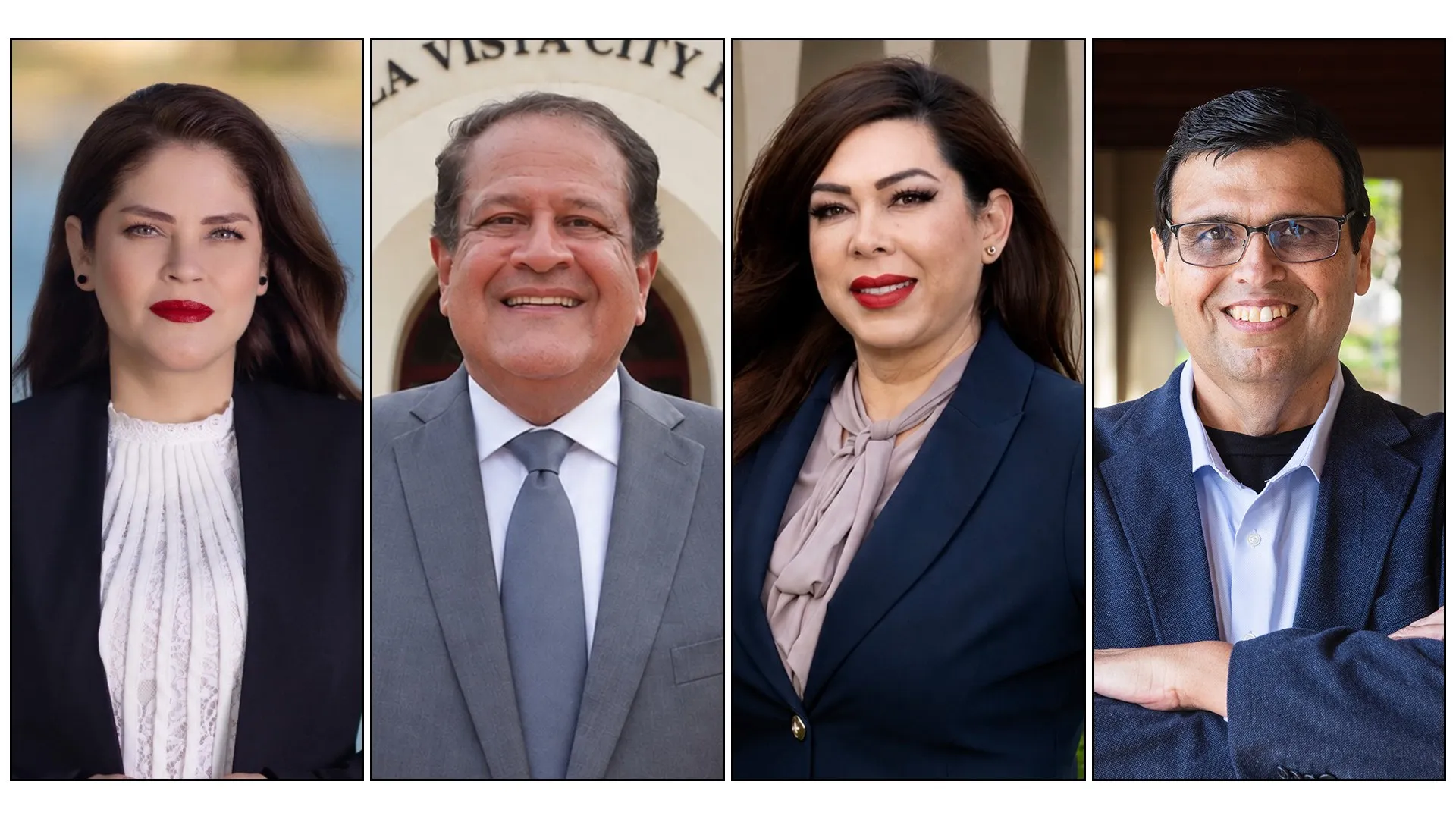
In District 1, Councilmember Carolina Chavez faces political newcomer Greg Martinez, a certified public accountant and small business owner. In District 2, Councilmember Jose Preciado faces Angelica Martinez, a substitute teacher and political newcomer.
City Council races are officially nonpartisan, but political leanings have played an unmistakable role on the council. Chavez and Preciado are part of its four-seat Democratic majority. The council also includes Mayor John McCann, a Republican, Deputy Mayor Cesar Fernandez of District 4 and Councilmember Michael Inzunza of District 3, both Democrats. McCann is also on the November ballot, facing school board trustee Francisco Tamayo.
District 1 covers the northeastern region of the city east of Interstate 805. It includes the neighborhoods of Del Rey, Bonita Long Canyon, Eastlake, San Miguel Ranch and Bella Lago, among others. District 2 lies in western Chula Vista and includes the Windsor Heights neighborhood, where Preciado has lived since 2006.
Council members are limited to two terms. Under the city’s charter, a council member who has served two consecutive terms must wait at least one year after the second term ends before running for the same office again. The annual council salary is $64,607, according to the city — a figure that typically rises each year under the city’s charter.
In the interest of consistency, each candidate was asked the same questions. They covered a package of 13 proposed charter amendments brought forward by LIUNA, a labor union, as well as the role of outside interests at City Hall, the rising cost of living for residents, and how residents will benefit from development on the bayfront and in the University District.
Each candidate was also given the opportunity to raise an additional issue of their choosing.
District 1
Carolina Chavez
Chavez, the incumbent District 1 council member, is seeking a second term in the seat she has held since 2022.
Chavez, 43, holds a bachelor’s degree and currently serves as a director at Unicare Systems Inc. She cites more than 22 years of regional leadership spanning development, business, public policy and binational affairs.
Chavez’s response on outside influence did not directly reference the charter package. She pointed instead to accessibility, citing neighborhood workshops, one-on-one conversations and materials in multiple languages.
“My responsibility is first and foremost to the residents of Chula Vista,” she wrote. “Decisions at City Hall should be guided by what is in the best interest of our community, not any one organization or outside interest.”
She said she has brought the same approach to her role representing Chula Vista at the San Diego Association of Governments, a regional planning agency. There, she said, she has pushed for greater transparency around state Route 125 and decisions affecting South Bay residents.
“Ultimately, trust is earned by listening, being transparent, and delivering on the commitments we make,” she wrote.
On the cost of living, Chavez said the city should look for practical ways to help residents keep more money in their pockets. She noted that she authored the city’s resolution opposing federal tariffs because of their potential to raise costs for families and local businesses.
She also said she has supported expanding the city’s free shuttle service and advocated for child care space in new developments. At the Metropolitan Transit System, she said, she voted against fare increases while supporting investments to make transit safer for riders.
On development, Chavez said “residents should feel the benefits of that growth in their own lives and in their neighborhoods.” She noted Chula Vista is the only city of its size in California without a four-year university. She said she voted to bring San Diego State University’s nursing program to the Millenia Library.
Chavez chairs the city’s Economic Development and Binational Affairs Committee. In that role, she said, she worked on recommendations now in the city’s Economic Strategic Plan. They include ways to turn economic activity generated by the Gaylord Pacific resort into opportunities for local businesses and workers.
“I want the families who have built their lives here to be part of Chula Vista’s future,” she wrote.
Chavez’s additional issue was the city’s role in the binational region. She said nearly $60 billion in trade moved through the Otay Mesa Port of Entry in 2025. More than 15 million vehicles and nearly 8 million pedestrians crossed northbound through San Ysidro that year, she said.
“These aren’t just statistics,” she wrote, adding that they represent people going to work and school, visiting family and supporting businesses.
Greg Martinez
Martinez, a certified public accountant and small business owner, is running on independence, transparency and reducing costs for residents.
Martinez holds a bachelor’s degree in accounting from the University of Southern California. He has served as vice chair of the Chula Vista Measure P Citizens’ Oversight Committee and ran for the Otay Water District Board of Directors in 2024. He has also served multiple terms on the board of the Rolling Hills Ranch Community Association, including as treasurer and president.
“My responsibility as a council member would be to the residents of Chula Vista — not political parties, unions, developers, special-interest groups, or large campaign contributors,” he wrote.
He said the charter amendment controversy “demonstrates why major changes affecting city government need to be handled openly and transparently.” He said he would support stronger disclosure requirements so residents can see who is lobbying city officials. He would also oppose last-minute proposals that have not received adequate public or commission review, he said.
“Most importantly, I would remain independent,” he wrote. “As a CPA, independence is one of our core principles in certain areas of practice. I understand independence and the appearance of independence.”
On the cost of living, Martinez said, “City government cannot control all of those costs, but it should not unnecessarily add to the burden.” He said he would examine city fees, regulations and permitting. He cited the city’s Housing Element, which recognizes that fees can be reflected in rents and home prices.
He called for streamlined permitting and predictable approval timelines, along with housing for young families, seniors and first-time buyers. He also said the city should avoid disrupting existing single-family neighborhoods with high-density housing and should provide adequate parking for multi-unit projects.
He said he would oppose the mileage tax, citing recordkeeping costs and privacy concerns. He proposed taxing electric vehicles instead through electricity at charging stations. He also proposed a Business Development Commission to attract employers.
On development, Martinez wrote, “I support growth when that growth improves the quality of life of the people who already live here.” He said residents should see tangible benefits, “not simply see impressive renderings and hear promises about what may happen decades from now.”
Read more San Diego man sentenced for involvement in smuggling ring that disappeared 2 immigrants
He said growth should pay for the infrastructure it requires. He also said he would pursue good-paying jobs so Chula Vista becomes “more than a bedroom community.”
For major projects receiving city assistance, he said, residents should be able to see what was promised, what has been completed, how much has been spent and how many jobs have been created.
“Growth should not be an end in itself,” he wrote.
Martinez did not raise an additional issue.
District 2
Jose Preciado
Preciado, the incumbent District 2 council member and a California Coastal Commission board member, is seeking re-election.
Preciado, 55, holds a bachelor’s degree and a master’s degree from San Diego State University. He has worked at the university for 28 years and serves as its director of undergraduate studies. He previously served on the boards of the Sweetwater Authority and the San Diego County Water Authority.
On the charter package, Preciado wrote, “I’m proud to stand with working families and the labor organizations that represent them. But I voted no on the LIUNA measure for a variety of reasons, mainly because it was rushed.”
He said that on July 21, he joined the council majority in referring the package to the Charter Review Commission. He said the proposal bundled pay raises and longer terms with ethics reforms. It was pushed toward the ballot weeks before the deadline, he said, even though the city’s Board of Ethics unanimously opposed fast-tracking it.
“That was wrong. It’s the kind of backroom maneuvering that runs counter to everything our city prides itself on,” he wrote.
“No one gets a shortcut, including groups I’ve worked with,” he wrote.
On the cost of living, Preciado wrote, “Let’s be honest about what a city can and can’t do.” He said the city does not set gas or grocery prices, but “City Hall does have real levers.”
He said the city should push back on electricity rate increases before the California Public Utilities Commission and through its role in San Diego Community Power.
On housing, Preciado said he would continue working to speed up permitting. He said he helped create a pathway for 249 affordable housing units. He also said he would push to expand the city’s Shallow Rental Subsidy program for low-income residents 55 and older at risk of losing their homes. The program is filled to capacity with a waitlist, he said.
On development, Preciado wrote, “The very fact that these projects are here is a benefit to residents.” He said the bayfront will bring jobs, visitors and public space, and will continue to be “an economic engine and a resource for Chula Vista.”
He said the University District will give South Bay residents the chance to study and advance their careers close to home, “just as their counterparts in North County do.” He noted that San Diego State, UC San Diego and Cal State San Marcos are partnering to bring bachelor’s programs to the city.
Preciado’s additional issue was making sure economic growth reaches every neighborhood, especially western Chula Vista. He said that in 2025, he and Fernandez led the city’s Western Chula Vista Economic Development Subcommittee. The council approved its recommendations unanimously, he said.
He said that work led to a Community Benefit District ordinance. He said it is also built into the city’s first-ever Economic Development Strategic Plan, which includes revitalizing Broadway, Main Street and Third Avenue.
“A plan is only as good as its implementation, and that’s where I’ll keep pushing,” he wrote.
Angelica Martinez
Martinez, a substitute teacher with the Chula Vista Elementary School District, is running on transparency, affordability and neighborhood quality of life.
Martinez, 48, holds a bachelor’s degree in liberal studies from Point Loma Nazarene University and has lived in Chula Vista since 1991. In 2024, she ran unsuccessfully for the Sweetwater Union High School District board.
She said she spoke out against the charter amendment package because residents deserved adequate notice and clear explanations. She said they also deserved a genuine opportunity to understand how each proposal could affect their city government.
“The community must always come before special-interest groups,” she wrote.
As a council member, she said, she would insist that major proposals be made public with enough time for residents to review them. She said she would also support greater disclosure, accessible public records and community meetings within District 2.
“Political support should never purchase access, influence, or a councilmember’s vote,” she wrote.
On the cost of living, Martinez, who is raising three children in Chula Vista, wrote, “The rising cost of living is not an abstract issue to me — it affects my family too.”
She said the council “cannot control every price, but it can avoid making the problem worse.” She said she would oppose unnecessary tax increases and carefully examine proposed fees, utility rate increases and sewer rate pass-throughs.
“Residents need a council member who recognizes that every new tax, fee, and rate increase affects a real household budget,” she wrote.
On development, she said the bayfront and University District could bring jobs, education, tourism and revenue, but “residents deserve more than promises.” She said she would advocate for transparent agreements with measurable community benefits, including opportunities for local workers and small businesses.
Martinez’s additional issue was public safety, homelessness and neighborhood quality of life. She said District 2, particularly northwest Chula Vista, has experienced some of the city’s highest crime rates in several categories. She said she supports “more boots on the ground” and stronger community-based policing.
She also called for addressing homelessness “with both compassion and accountability.” She also called for regular public updates on park closures, citing Hilltop Park and Eucalyptus Park.
“I am from the community, for the community — and the community will always come first,” she wrote.
Read more Escondido City Council won’t hear update on ICE shooting range contract