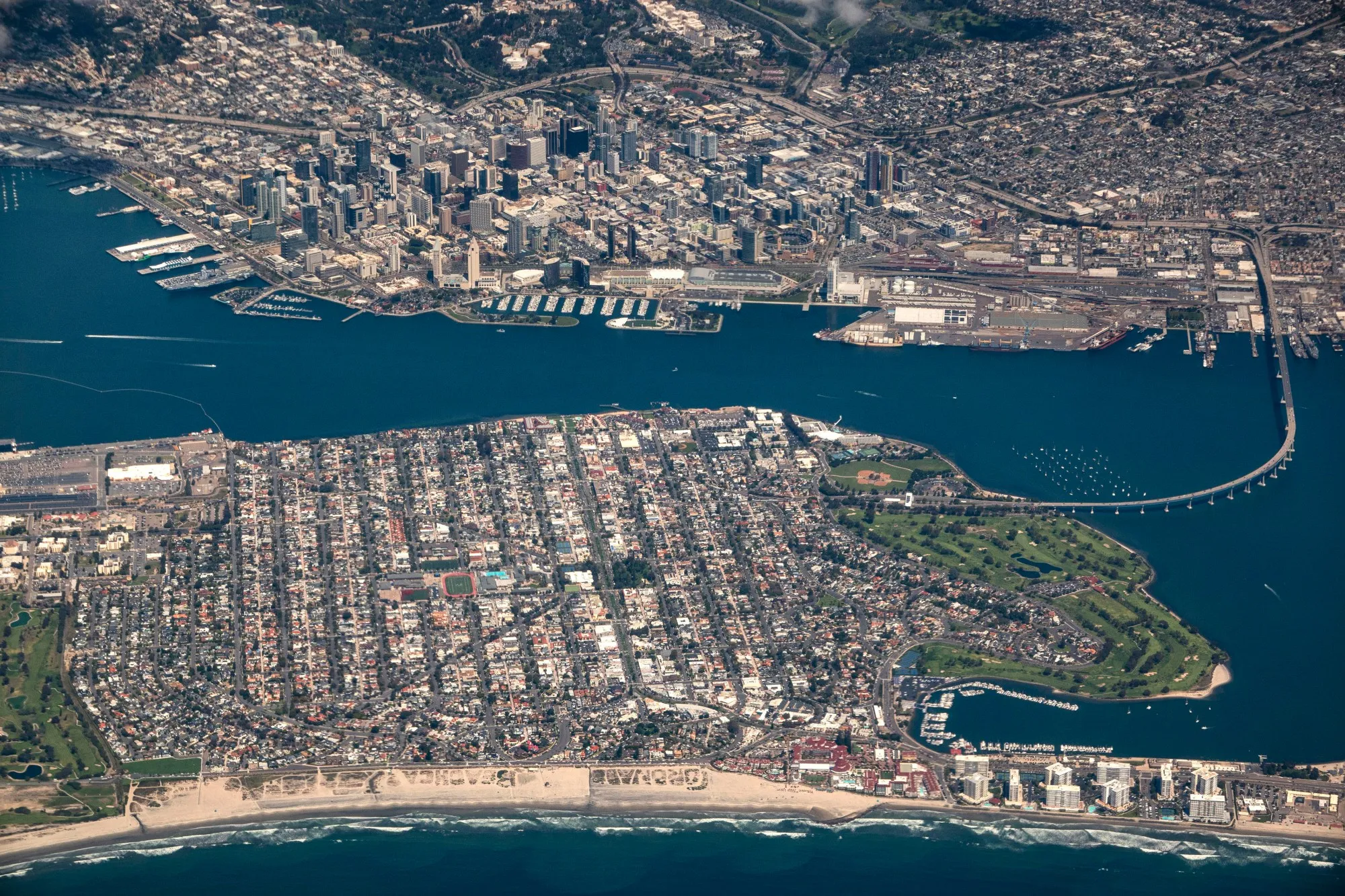






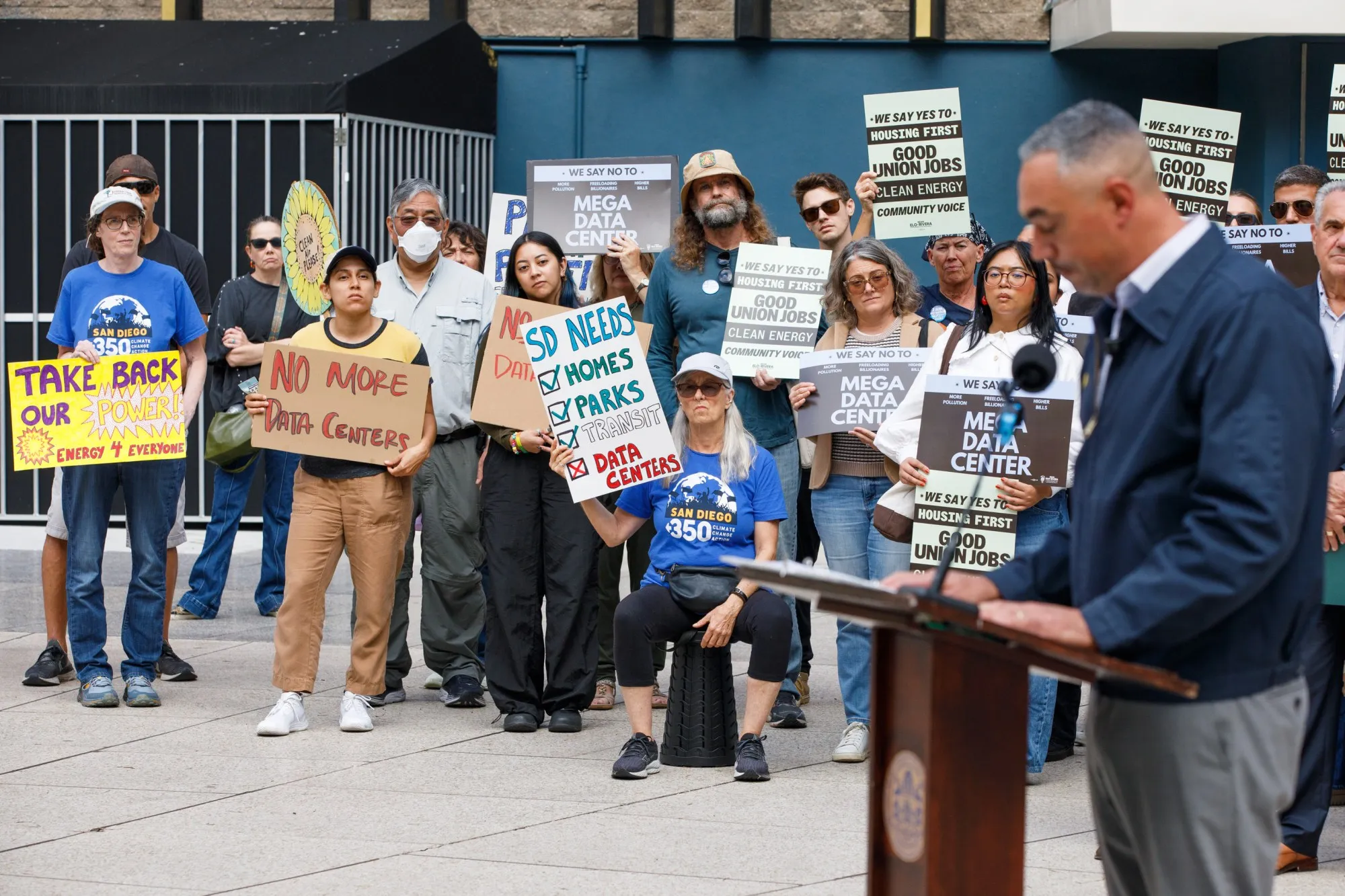
A combination of San Diego politicians, labor groups and housing advocates gathered in front of City Hall on Thursday to voice opposition to a potential data center a local developer is considering as part of a 70-acre redevelopment project at Naval Base Point Loma Old Town Campus.
Read more University of San Diego president to retire after greatly improving the school’s fortunes
“I’ve seen many projects in my time,” San Diego City Council President Joe LaCava said. “What we don’t need is a resource-guzzling data center in the middle of our city.”
Executives at the Manchester Financial Group have emphasized that a possible data center is simply one of a range of options the company has on the table to reshape about 60 acres of the property on the site straddling Pacific Highway, home to Naval Information Warfare Systems Command (NAVWAR).
“We’re committed to getting the project done for the Navy, and I would be neglecting them if I didn’t look at every single idea that comes up,” company president Ted Eldredge told the Union-Tribune on Wednesday. “That’s why we’re looking at all these different alternatives, and the data center was one that came up.”
But data centers have become a red-hot political issue across the country and the mere suggestion of the potential construction of a facility in an urban area of San Diego has sparked pushback.
San Diego Mayor Todd Gloria Thursday to direct city staff to advance a temporary moratorium on new data center development within the city limits.
“San Diego is a city of innovation, and I want us to continue leading in the technologies and jobs of the future,” Gloria said in a statement that was released at about the same time the rally was held. “But we cannot allow a rapidly expanding industry to get ahead of the rules needed to protect our residents.”
The proposal will be placed on on the City Council docket Monday. The order establishes a working group of up to 15 stakeholders to develop recommendations for water and electricity demand and potential impacts on utility bills, housing and neighborhoods.
Another provision directs the mayor’s government affairs team to develop or support legislation from the impacts of data centers — including those located on state or federal property outside the city’s land-use authority.
“Here’s the hard truth about NAVWAR,” Councilmember Sean Elo-Rivera told the crowd of a few dozen. “NAVWAR is federal land. The city can’t stop this project on its own.”
He and others want San Diego’s federal delegation to take action.
“First, immediately urge the Navy in writing to rule out a data center,” Elo-Rivera said. “And second, and most importantly, introduce legislation when the new Congress convenes in January holding leased military land to the same standards that we’re putting forward in San Diego today.”
Gov. Gavin Newsom recently signed into law multiple bills passed by the state Legislature to address data center concerns. The new legislation intends to make sure large electricity users are responsible for meeting the costs associated with their energy demand, while protecting existing customers from sudden cost shifts.
Average residential electricity rates in California have grown faster than inflation, and according to the Public Advocates Office, San Diego Gas & Electric’s rates have jumped 97% in the past 10 years. Southern California Edison’s average residential rate has climbed 101% and Pacific Gas & Electric’s has risen 69% during the same time frame.
Among the new laws is Senate Bill 886, authored by Sen. Padilla, D-San Diego, that directs the California Public Utilities Commission to establish tariffs or rules governing interconnection of data centers to the electric grid.
Read more MAHA’s Calley Means resigns as a top RFK Jr. health adviser days before the midterm elections
But Assemblymember Chris Ward, D-San Diego, said bills passed in Sacramento have not gone far enough.
“I think that we are realizing how fast this is coming at us,” Ward said after speaking at the rally, “and we have to get ahead of stricter regulations that are going to guarantee that communities will not lose out.”
The Manchester group has floated the idea of a 400-megawatt data center developed by a prospective tenant on the site. But Eldredge told the Union-Tribune, “We’re not married to that megawattage,” adding that any possible facility is dependent on market conditions and the project’s feasibility.
“I don’t have all the answers yet,” he said. “There is the potential that it doesn’t work.”
For perspective, a data center proposed to be built in Imperial County is designed for 330 megawatts of capacity. Expected to cover about 1 million square feet, the Imperial Valley Data Center would be the largest data center in California.
But the project is currently on hold after a Superior Court judge brought up environmental concerns.
Others worry that housing development will end up getting short shrift at the NAVWAR project.
“NAVWAR is a transit-oriented site,” said Council President Pro Tem Kent Lee, chair of the city’s Land Use and Housing Committee. “It’s adjacent both to the Old Town Amtrak station and the Old Town Transit Center. It must be utilized for mixed-use development with homes not only for San Diegans, but especially to support our many military and veteran families.”
A spokesperson for Manchester Financial declined to comment about Thursday’s news conference.
Data centers have come under scrutiny following the recent surge in artificial intelligence. The facilities house the massive racks of computer systems required to train generative AI models and chatbots emanating from the cutting-edge technology.
Proponents say AI and its accompanied infrastructure create new jobs and will eventually transform almost every segment of the economy — and society at large. But critics, among other concerns, worry that electricity- and water-hungry data centers will strain resources.
Within San Diego County, the Poway City Council earlier this month approved an ordinance that bans large, third-party data centers used for artificial intelligence applications throughout the city. And the city of Escondido extended a moratorium on any potential development of data centers within its boundaries through August 2027.
Energy journalist and author Robert Bryce keeps track of communities that have rejected data centers. According to his most recent count, the number in the U.S. has reached at least 370.
Read more West Virginia investigates environmental groups over ‘deceptive’ climate change advocacy