


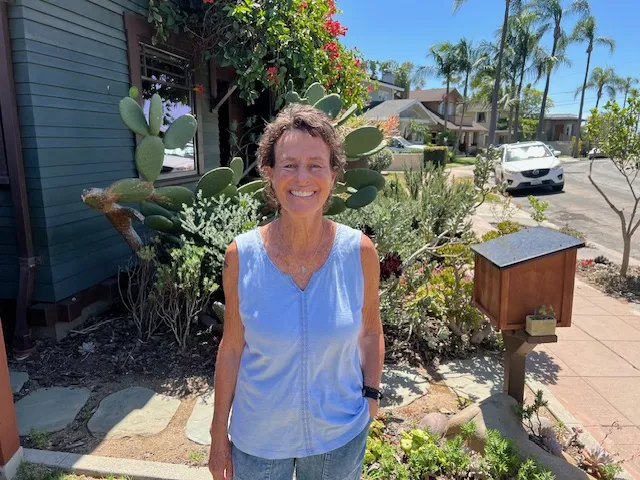
On March 6, 2026, Dana Harwood was on the operating table at UC San Diego Transplant Center. Most people would be nervous, but not Harwood.
Read more His paintings are a chance to connect with others, and be kinder to himself
“I’m happy to donate my kidney,” she recalls telling the medical team.
“This is how it’s supposed to work. I have two and only need one. Why wouldn’t I share a kidney?”
Born in 1965 and raised in San Diego, Harwood said she had an “amazing childhood” and as a pay it forward has always been motivated to help others not as fortunate.
“There was no trauma in my childhood,” she said. “My parents gave me unconditional love and support.”
While attending San Diego State University in the mid-1980s, Harwood was influenced by teachings about social justice.
“Rather than just talking about social justice, I decided to do something about it by helping people who did not have the opportunities I had,” she explained.
In 1987, she graduated college with a bachelor’s in health education and went directly into the Peace Corp, spending two years teaching in Honduras.
After returning to San Diego, she earned a master’s in education and teaching credentials. She taught health education at community clinics and Juvenile Hall and went on to teach various subjects for 15 years at San Diego’s Monarch School to children of homeless families. She retired in 2020 and volunteered at several food distribution programs.
In 2024, when her cousin needed a kidney transplant, Harwood was medically tested but was not a match. The seeds were planted, however, for her to nevertheless donate to someone else in need.
“Once I found out about living kidney donations,” she said, “there was never a doubt that I was going to donate.”
She learned that, according to the National Kidney Foundation, there are over 90,000 people on the national waiting list for a kidney transplant at any one time, but just 27,000 transplants annually.
The average wait is three to five years. More than 4,000 people die every year waiting for a kidney.
Read more In legal dispute over ‘The View,’ ABC argues Trump administration is trying to chill free speech
By far, most transplants come from deceased donors. Of the approximately 6,000 per-year living donors, virtually all are directed donations from relatives or friends to a known recipient. They will get transplants quicker than those who rely upon the waiting list for a donation from a stranger.
Only about 300 transplants a year come from living donors directed to strangers. Harwood became one of those 300.
She chose a donor program (dovetransplant.org) that arranges donations to military veterans. According to studies, veterans tend to have higher rates of kidney disease due to toxin exposure and other factors.
Harwood selected someone from the waiting list after reviewing and comparing background information. She made a directed donation to that person.
However, it turned out that Harwood’s kidney was not a match for that person. Under the program, her kidney went to someone else from the list who was a match, and Harwood’s selected recipient also received a transplant.
“It was a two for one,” she said. “I lost one kidney and two people benefitted. My kidney was taken from me in the evening and flown by red eye to New Haven. Then, my directed recipient received hers from someone else who was a match.”
Before the operation, Harwood said she received extensive medical testing. Afterward, she remained in the hospital for two nights. “I was sore, but nothing hurt unless I sneezed or coughed,” she said.
A week later, she did a 3-mile beach walk and, two weeks later, a hike in Julian.
Although the program paid all medical costs, she received no compensation.
“What I got was 150% more valuable than monetary compensation. I was able to impact the lives of two people,” she said, adding she would be happy to meet both recipients.
Harwood, who lives in Mission Hills with her wife, Alicia, plans to spread the word about kidney transplants. “I almost went my whole life without knowing about it,” she said. “I don’t want others to miss out. With every donation, there is one less kidney needed to save a life.”
About this series
Goldsmith is a Union-Tribune contributing columnist.
We welcome reader suggestions of people who have done something extraordinary or otherwise educational, inspiring or interesting and who have not received much previous media. Please send suggestions to Jan Goldsmith at [email protected]
Read more White House ballroom security upgrades become Democratic target