







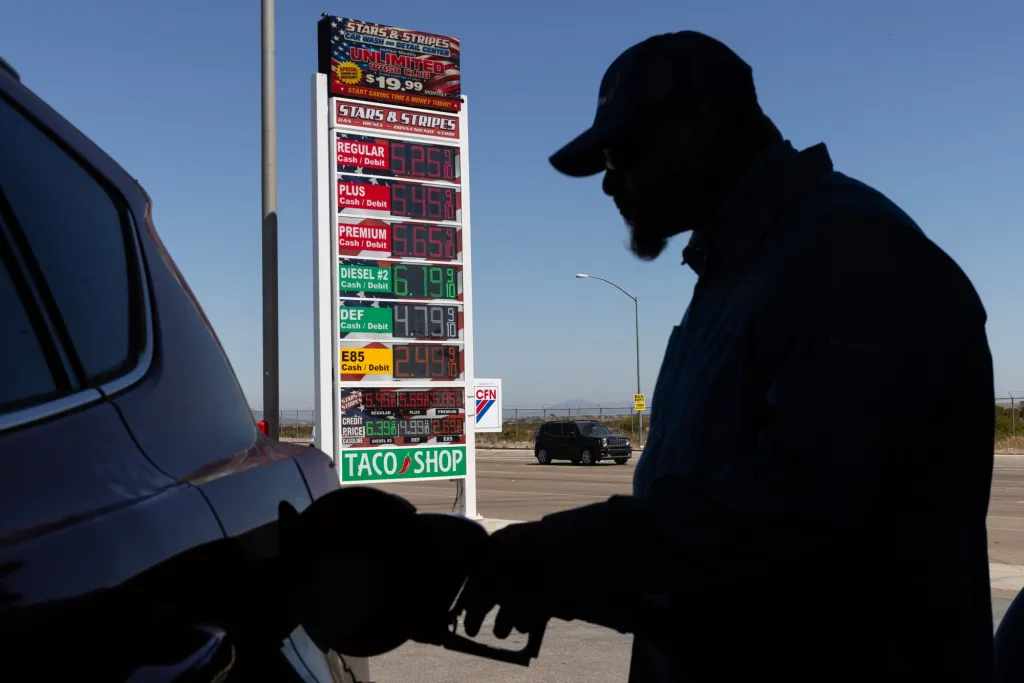
It’s not exactly cause to pop Champagne corks, but drivers in the San Diego area are seeing lower gasoline prices as the Fourth of July weekend approaches.
Read more San Diego is shrinking late-night hours at 35 coastal parking lots to reduce crime
Even before the Trump administration and the regime in Iran agreed to a recent deal that has at least partially unclogged crude oil transit through the Strait of Hormuz, gas prices were trending lower, following a steep spike in oil prices at the start of the war in Iran.
The average price of a gallon regular in San Diego stood at $5.539 on Friday, according to AAA. That’s a drop of 11 cents in the past week, and 59 cents lower than one month ago.
Over the course of the conflict that spilled across borders in the Middle East, the highest price in the San Diego area reached $6.213 a gallon on May 6.
Fuel analysts expect prices to keep dropping, although they are quick to add that things can change quickly.
“We’ve seen six weeks of falling prices and it’s largely because the anticipation that a deal, which is now at least holding together by a few threads, would happen,” said Patrick DeHaan, head of petroleum analysis at GasBuddy. “Unless there’s some sort of curveball, prices could keep going down through July 4 and potentially beyond that.”
California’s sky-high diesel prices have also retreated. Back on April 8, the average price for diesel in San Diego reached $7.724; on Friday, it came to $6.587.
While most drivers focus on gasoline prices, David Hackett, president of Stillwater Associates, a transportation energy consulting company in Irvine, said the cost of diesel fuel has an outsized impact on the economy at large.
“In the case of manufacturers, their parts are delivered by a truck (running on diesel) and for retailers, their supplies are delivered by truck,” Hackett said. “A lot of that comes back to them through the cost of production. So if you reduce those production costs, reduce those expenses in diesel fuel, that will make prices for everything go down.”
But even if the things in the Persian Gulf settle down, Hackett said drivers should not expect gas or diesel prices to return to pre-war levels anytime soon.
First, world oil inventories are extremely low and need to get restocked. Second, the big oil-producing countries in the area shut down operations during the war, Hackett said, “because they didn’t have a place to put the crude oil … it can take some time for the production to ramp back up.”
Before hostilities began on Feb. 28, about 20% of global oil exports passed through the Strait of Hormuz on a daily basis. While traffic has accelerated, ship movements this week were estimated to be about half of pre-war levels.
An incident Thursday exemplified the fragility of the current 60-day deal.
Iran’s Islamic Republic Revolutionary Guard Corps attacked a Singapore-flagged cargo ship in the strait, according to reporting by the Wall Street Journal. The assault, which did not result in any casualties, came after the Iranian corps warned vessels not to use passage routes the regime has not sanctioned.
Despite the dip in gas prices, San Diego drivers are paying more at the pump than they were at this time last year.
On June 26, 2025, the average price for a gallon of regular came to $4.658. That’s 88 cents less than the average price on Friday.
Notwithstanding the situation in the Middle East, DeHaan said California’s fuel outlook remains volatile because of a pair of recent refinery closures in the state.
The Phillips 66 twin facility in the Los Angeles area shut down late last year and two months ago the Valero refinery in the Northern California town of Benicia ceased operations at its 145,000 barrels-per-day site.
The Valero and Phillips 66 facilities combined to account for about 18% of California’s total refining capacity to process gasoline, diesel, aviation and other transportation fuels.
Imports from foreign countries can help pick up the slack, but the closures may leave the state more vulnerable to price spikes. According to the California Energy Commission, 61.1% of the oil supplied to refineries in the state last year came from foreign sources — and that figure is expected to grow.
“California still has the same problems it was facing six months ago, like reduction in refining capacity,” DeHaan said. “So if any of this turns around, which is certainly a possibility, you could see prices go up really quickly again.”
California’s gas prices are the second-highest in the country.
According to AAA, the average price in the Golden State came to $5.486 on Friday. That’s $1.59 higher than the U.S. average of $3.901.
Hawaii’s average price of $5.507 is the highest of any one state.
Another bit of a bummer for the summer?
Wednesday marks the start of the fiscal year and that means California’s gasoline excise tax increases from 61.2 cents per gallon to 63.4 cents.
As per Senate Bill 1, which the Legislature in Sacramento passed and then-Gov. Jerry Brown signed into law in 2017, the excise tax on motor vehicle fuels gets adjusted for inflation each fiscal year.
Formally called the Road Repair and Accountability Act, SB 1’s gas tax expects to raise $52.4 billion over 10 years. More than $3.2 billion per year will go to the Road Maintenance and Rehabilitation Program that includes $400 million for bridges and culverts, $200 million for local entities and $100 million for bicycle and pedestrian projects.
Since 2017, the gasoline excise tax has gone up 33.7 cents.
California has the highest excise tax on gasoline in the country. Pennsylvania comes in second, charging 57.6 cents per gallon.
Nonetheless, the Auto Club of Southern California expects drivers to hit the road in the coming days at a slightly higher rate than last year, and will keep on motoring throughout the summer.
AAA estimates that 5.48 million Southern Californians will travel at least 50 miles from home between June 27 and July 5, for Independence Day trips.
“Even with high gas prices, if you’re talking about a family of three or four people going away, driving is going to be cheaper” than flying, said Marie Montgomery, spokesperson for the Automobile Club of Southern California, “especially if you’re just hanging around the Southern California area or going to, say, Arizona.”
Read more Michael Smolens: Questions about county raised as crucial fall sales tax vote looms