





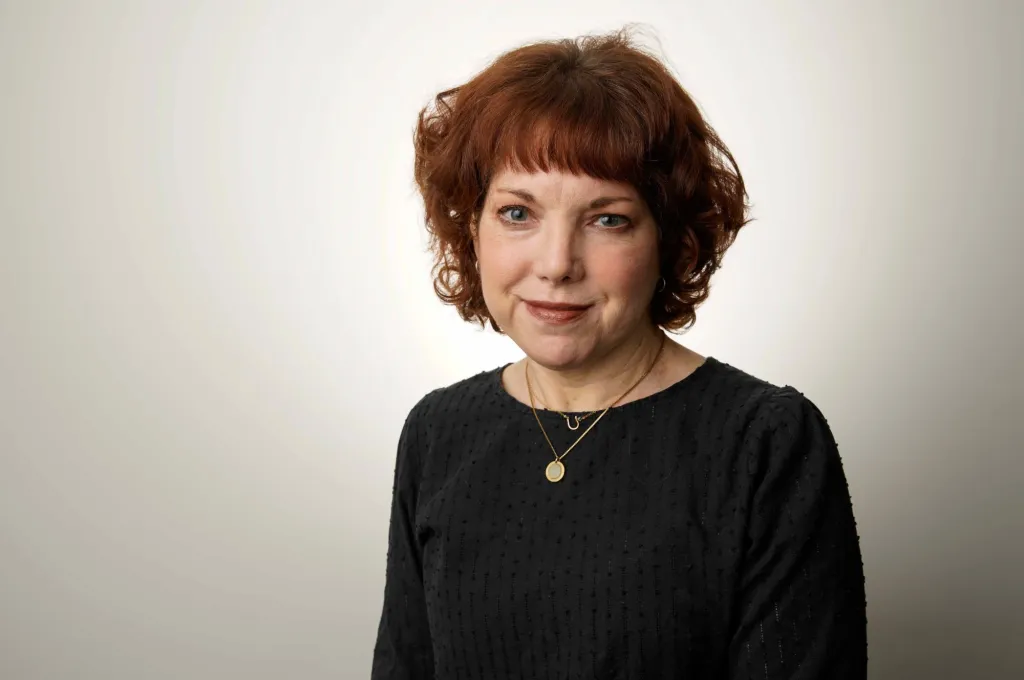
Wherever Kelly Davis looked injustice in the eye, or inequity or the misuse of authority, outrage surely followed.
Read more Democratic congressman asks the CFPB to investigate ‘rent now, pay later’ companies
The native daughter of Southern California parlayed her core belief in righteousness into an award-winning career in journalism, where she delighted in exposing policies and practices that hurt the less advantaged and pressed officials of all stripes to explain themselves — and to do better.
The sense of fairness that drove Davis as a writer and artist pushed her to explore stories of the desperate, the disaffected, the marginalized and the needy.
With a dedication that persisted over decades and drew the ire — and respect — of elected officials across the region and state, her work appeared in The San Diego Union-Tribune, the Voice of San Diego, the now-defunct San Diego CityBeat and many other publications.
Davis, who beat back cancer for nearly a dozen years while producing policy-changing dispatches before a tumor reappeared this spring, died at the East Campus Medical Center at UC San Diego Health early Wednesday. She was 53.
Her death leaves a hole in the San Diego County journalism community, which has struggled to keep up with reporting on waste and misconduct across local governments as news outlets adjust to shifting economic models.
Davis almost single-handedly forced the perennially high mortality rate in Sheriff’s Office jails onto the front burner of the public agenda, authoring a series of exposés first in the pages of CityBeat and later in the Union-Tribune.
Her reports on jail deaths, which began more than a decade ago and continued into this year, helped spur a 2022 state audit that sharply questioned San Diego County Sheriff’s Department practices.
They also prompted Gov. Gavin Newsom to sign a pair of reform bills sponsored by San Diego lawmakers following a slew of eye-popping stories on the deaths, their impact on families and the tens of millions of dollars they cost taxpayers in legal settlements.
“The terrible problem of too many in-custody deaths would not have received front-page attention if it weren’t for Kelly’s compassion, investigative prowess and storytelling,” said MaryAnne Pintar, chair of the San Diego County Citizens’ Law Enforcement Review Board.
“Her reporting gave these tragedies the visibility needed to make even those not involved in the criminal justice system care and understand how all of us are hurt by it,” she said.
Davis, who worked as a freelancer following the demise of CityBeat until joining the staff of the Union-Tribune early last year, also focused her reporting on broader social and criminal-justice issues.
Just three weeks ago, Davis profiled the challenges San Diego city and police officials have confronted trying to implement the Commission on Police Practices approved by voters six years ago.
Davis was known for her policy chops and a deep understanding of complicated subjects gleaned by arcane research. She studied government policy manuals and took classes to broaden her base of knowledge so she could write more authoritatively.
But her strongest assets were her human instincts, her news judgment, her skilled interviewing techniques and shoe-leather reporting.
She visited homeless people inside their tents to see how they lived first-hand, she toured shelters and quizzed providers about their operating practices. She consistently pressed city, county and state officials to do more to strengthen the social safety net.
Davis was named journalist of the year by the San Diego chapter of the Society of Professional Journalists in 2023. More than a dozen family members of people who had died in custody attended the banquet to celebrate her work.
“Kelly had a singular drive to do justice to a person’s story about a lost loved one,” said Julia Yoo, a San Diego attorney who has represented many relatives of people who died in jail — and won millions of dollars in legal settlements.
“Her stories captured not just the facts and the full context of the story, but people’s feelings of anguish and tragedy, of longing and profound loneliness,” Yoo said.
Davis was known for much more than her journalism.
She loved cats, and left three at her home in Fletcher Hills. She was known for her thoughtful gift-giving, often finding just the right item for friends and family. She was famous for the Harvey Wallbanger cakes she made for friends every Christmas.
Davis also played rhythm guitar and sang backing vocals for an indie band called Super Thirty-One through much of the 1990s, recording multiple extended-play records. In its heyday, Super Thirty-One was a staple of the underground scene and shared stages with bands like Radiohead and Belly.
Brian Espinosa remembers the very moment he first bumped into Davis, then still a teenager. Not surprisingly, it was at a concert in Los Angeles.
“I met Kelly on Nov. 21, 1992, at the Hollywood Palladium at a Jesus and Mary Chain/Spiritualized gig,” he said. “One month later, I was in her band. Four years later, the band exploded and we got married.”
Read more Trump administration sues California, Virginia over new gun laws
After Super Thirty-One broke up, Espinosa and Davis joined another band called Aberdeen, releasing several albums and videos. Davis drifted away from professional musicianship, in part to focus on her education, but the couple continued playing commercially with The Luxembourg Signal for many years.
Davis earned a bachelor’s degree in literature from Chapman University and later a master’s degree from Boston College.
She briefly taught classes at UC Santa Barbara but never committed to academia. She started hunting for jobs in journalism and soon caught the eye of David Rolland, who was then the editor of the Ventura County Reporter weekly newspaper.
When the Reporter owners tapped Rolland to steer the launch of a new paper in San Diego in 2002, Rolland insisted Davis join him and named her associate editor. She jumped at the opportunity and set about raising a ruckus among the San Diego establishment.
“At CityBeat, I set the tone and the vision, but she was its heart and its humanity,” said Rolland, who now counts himself a friend of 25-plus years. “I’ve never met anyone more empathetic.”
By the early 2010s, Davis and her then-colleague Dave Maass began examining local jail deaths. Their “60 Dead Inmates” series showed San Diego County had the highest mortality rate among California’s largest jails and pushed the issue onto the public agenda.
Davis kept covering criminal-justice issues after CityBeat reformatted in 2015 and then closed, freelancing for national and local publications, including the Union-Tribune. After Davis wrote about one particular jail suicide, county lawyers subpoenaed her notes and other unpublished material.
The action was roundly criticized, and a team of free-press advocates from the San Diego office of the Sheppard Mullin law firm stepped in to defend her at no charge. The county lost its claims but Davis noted in an interview later that the ordeal affected her reporting.
Her lawyers “put so much time into this case, it really blew me away,” she told the Union-Tribune in 2018. “But because I didn’t want to make things more difficult for them, I shelved a couple of stories I was working on about jail deaths. So the subpoena definitely had a chilling effect.”
Davis also made national news in 2016 when she wrote movingly about the death of her sister, artist Betsy Davis, an ALS patient who was among the first people in California to exercise their rights under a then-newly signed right-to-die law.
“I watched her increasingly struggle to eat and speak and do the simple things the rest of us take for granted, like scratch an itch or brush a stray hair from her eyes,” she wrote. “No longer able to walk, she spent most of the day in bed.”
Dozens of friends and loved ones turned out at Betsy’s home in Ojai for a weekend goodbye celebration, Davis wrote.
“We ate pizza and tamales. There was music, booze and lots of photos,” she wrote. “I’d put sticky notes next to items around the house, explaining their significance. She invited everyone to ‘take a Betsy souvenir’ to remember her.”
Mary Elizabeth “Betsy” Davis ingested a lethal combination of medication under her caregivers’ guidance and died under a canopy in a makeshift bed after watching her last sunset.
In 2019, Davis co-authored “Dying Behind Bars,” a multi-day series in the Union-Tribune that culminated a six-month investigation into San Diego County jail deaths. The series won multiple awards and prompted a state audit of the troubled jail system that led to new state legislation.
By 2023, in search of more career stability — and health benefits — Davis took a job as press secretary for Rep. Scott Peters.
Davis knew the longtime member of Congress from his days serving on the San Diego City Council and the Port of San Diego board. She also knew Pintar — Peters’ chief of staff — through the Citizens’ Law Enforcement Review Board.
“Kelly was a talented and tenacious writer who cared a lot about accuracy and doing the right thing,” Peters said. “She gave voice to those who needed their stories heard, and she did it with tremendous heart. I was honored that she wanted to work for me.”
But Davis was far more comfortable asking rather than answering questions. She left Peters’ office in late 2024 and was quickly offered a job at the Union-Tribune.
Sam Schulz, the government and watchdog team editor who brought Davis aboard full-time in January 2025, said she was grateful to nab Davis and witness her contributions to the U-T staff.
“She challenged herself, and all of us, to be better journalists, better people, to question our assumptions, to investigate human suffering and relentlessly seek accountability and ultimately relief,” Schulz said. “And she did this even when — especially when — those details and questions might seem most difficult, or most easily avoided.”
Kelly Lynn Davis was born on St. Patrick’s Day in 1973 and raised in Irvine. She was preceded in death by her sister, Betsy Davis; and her mother, Judy Childress Davis. Davis is survived by her husband, Brian Espinosa; her father, Jay Emerson Davis of Tustin; and numerous aunts, uncles and cousins.
Read more Encinitas council member completes court diversion, ending criminal case against him
Memorial services are still being organized.